
Ah, the stories they tell!
 On a recent short-term mission trip to Malawi for my church, I had the opportunity to teach Writing classes to two groups of home schooled MKs (Missionary Kids). These were children from American, Canadian and South African families. There were nine in the 3rd-4th grade group and seven in the 5th grade and up group.
Two years ago I taught most of these kids “How to Write A Short Story.” Their creations were marvelous, and in fact, I posted some of the stories on my blog, Here’s How It Happened. (See the mystery, “The Tay Diamond”, the action-packed, “The Adventures of Timmy, the Squirrel”, and the creepy, Twilight Zone-esque “The Mirror”)
 After reviewing the stories and talking to the other home school teachers, we all agreed that the kids needed help in character development. The action was amazing; the worlds they created were vivid, but the heroes, helpers, and villains were flat and hard to imagine.
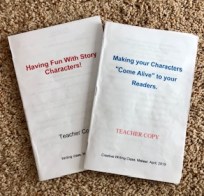
This would be my topic then. I prepared workbooks for each of the classes. We did some work in them in class, but there were “homework” assignments for them to do at home as well.
 Before I arrived I asked that the kids (both classes) bring the first several paragraphs of a story they had written to class. In class, I had them each read their paragraphs aloud. There were Captain Jack, Commander of a Starship, twin girls named Peace and Harmony, and a 20-year old girl named Ella who wanted to become a princess (and a dozen others).
I asked the listening students how they “pictured” each of these characters. There was either confused silence or vague and differing descriptions. I then asked the authors to describe how their characters looked in their own mind’s eye. They came up with a lot of colorful descriptions that were not in their stories. Suddenly they “got the picture,” and from there I showed them ways and examples of taking the images of their characters from their minds and putting them on paper for their readers.
 For the younger class, I had them draw in their workbooks a circle for a face, then slowly add features (eyes, nose, mouth, ears, hair) and write a description of each as they went. Next they drew bodies with any kinds of clothes and shoes (or not) they wished. I had them write why these “characters” were smiling, wearing… glasses, a soccer jersey, a swim suit, a long dress, a tutu, and had on sandals or swim fins. They began to see how to show what their story characters looked like by writing descriptions, and in the process developed more interesting information about them. (I could see “light” dawning in their eyes!)
We talked about what a boy’s face and posture would look like if he were angry, sad, or excited, and how to describe that in words. Then I had volunteers come to the front and walk like someone angry, sad, sick, old, or excited. The class called out descriptions of the body movements (facial features, arms swinging, shoulders slumped, stumbling, skipping, marching etc.) that portrayed the emotion. Suddenly they began to see how they could “show” these actions in their stories instead of simply “telling” the reader that the character was sad or happy.
We talked briefly about similes (and metaphors for the older group). Wow, did they come up with some doozers! At this point I had to remind them not to overload the story with these, but to sprinkle in descriptions as the story progressed in action or conversations.
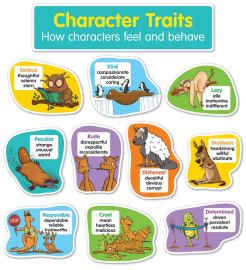 Next, we had fun with thirty-six Character Trait cards (ten seen at left) that I purchased from Amazon. I had them each choose a positive trait and a negative trait and to explain their choices. I asked them to describe the animals in the picture illustrating the trait. We talked about how they could write about the kind of person (animal) their character was by using these traits (such as, mischievous, responsible, persistent, mean, honest, loyal, etc.)
As an exercise I had them use these two opposite traits and write a short paragraph in their workbooks, describing how that character trait would look in actions. “Harmony was dishonest because she….. or Timothy was peculiar because he….”
For another exercise, I had them draw a large “T” diagram on one page, labeling the left side “What a character looks like” and the right side” How a character behaves.” They made a few comparisons from their own story characters. At home, they would make more of these diagrams and fill them in for other characters, or ones from books they liked.
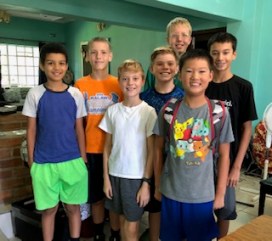 For the older class (all boys, and most writing sci-fi or fantasy) we delved a bit deeper into making their characters memorable by using various ways to describe physical as well as personality traits. They practiced describing a character in an action scene (showing fear or bravery without actually using those words) and played around with using an occasional quirk, flaw, or unconscious mannerism to reveal hidden traits.
We talked about body language and how personal beliefs and moral standards could affect their characters actions and words in certain situations. These t’weens and teens also enjoyed acting out emotions and physical limitations while the rest of the class called out descriptions. It’s a great exercise in noticing small things and putting them into words. Their favorite was imagining a large magnet across the room, and a piece of iron stuck on various parts of their body (forehead, stomach, etc). They were to show being pulled by that force and trying to resist. (Some were hilarious!)

 These boys also wanted to read from their stories, using some of the descriptions they’d learned inserted here and there.
I think they got it! By George, they got it!
(I can’t wait to read the complete exciting, imaginative tales!)
At the end of the two-hour sessions, I sent both groups home with assignments to sharpen their skills. Hopefully they will follow through and I will have a new pack of stories to post on my blog, with characters you can clearly imagine, love, or love to hate.
I love these kids, and I really had fun…. as you can see!

Post Script: I used several limericks in the classes, to illustrate teaching points, add humor, and keep the class attentive. One of the kids in the older group took one of these limericks, combined it with a vocabulary assignment from his home school writing class and came up with a HILARIOUS story – The Virtuous Walking Fish. Check it out too, and leave a comment for Jacob K.


 How many blogs besides this one do YOU read regularly (daily, weekly, monthly)? Yes, you can confess. We don’t mind. Reading them will help you become a better writer.

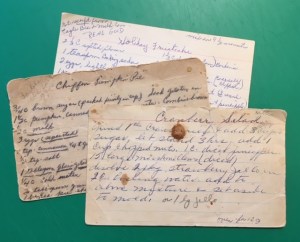 Now, the week before Thanksgiving I thumb through the 3×5 cards in Mom’s old plastic recipe box, looking for the Cranberry Salad, the Holiday Mincemeat Cake, and the Chiffon Pumpkin Pie recipes. The writing is faint and blurred; the cards are stained. And my heart gives a twist as I picture Mom taking each one out and assembling the ingredients on the counter. (This “treasured” box came to me 20 months ago when, at 94, she died.)
 Daily for a year or so in 1999, Dad sat at their kitchen table and drew stick figure sketches of Mom in various situations, from housecleaning and cooking, to relaxing with a morning coffee on the patio, working a jigsaw puzzle, gardening, and packing/traveling to Solvang on their anniversary. Each filmy paper illustration has her comment in a balloon above her head. I can hear her saying them all! I admit, I cried as I looked at each one in the stack.



 Years ago I bought a novel written by a well-known author because it took place in Seattle, a city where I’d lived, went to school, and worked for many years. A few chapters in, I was dismayed that the descriptions of setting were so generic that the story could have taken place anywhere. It was almost as if that the author had never set foot in the city.


 by Jackie Houchin
 Just kidding! You won’t get rich from these sales, but you will get “writing clips.” And when magazine editors discover your timely, well-written articles/stories etc., they will approach YOU with their needs.

 “A boost up”….when someone holds their clasped hands together next to a horse, and you put your foot in like a stirrup, and they propel you upward into the saddle.
 After writing my first three published short stories, something happened: Readers responded favorably to one of my characters. They liked this guy’s personality.


 And to add one more thing to this blog, Johnny Casino isn’t the only short story character to be in a book of his own. Chance McCoy arrived this year. His first book is called Second Chance. There are more stories to come. And there is a second short story anthology called Only in Hollywood coming out next year. The book consists of various stand-alone stories, but one features a guy named Charles Miro, a former TV actor turned private eye. He works for a younger woman who owns the detective firm. There are several stories about these two coming up. You see, even a short story can magically turn itself into a book if you try.

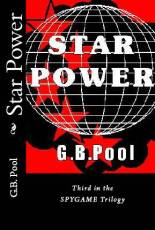
 A former private detective and once a reporter for a small weekly newspaper, Gayle Bartos-Pool (G.B. Pool) writes the Johnny Casino Casebook Series and the Gin Caulfield P.I. Mysteries. She also wrote the SPYGAME Trilogy: The Odd Man, Dry Bones, and Star Power; Caverns, Eddie Buick’s Last Case, The Santa Claus Singer, Bearnard’s Christmas and The Santa Claus Machine. She teaches writing classes: “The Anatomy of a Short Story” (which is also in workbook form), “How to Write Convincing Dialogue” and “How to Write a Killer Opening.” Website:
 “Johnny worked for me several years until he had enough P.I. hours under his belt to go out on his own. I hated to see him go, but I knew he worked better alone. Most of the time I do my work solo like the case at the racetrack in Hedge Bet. I should amend that statement because I got my husband, Fred, to do some work for me. His trip to Mexico to bring back a witness led to a few choice words from him, mostly unprintable. But the guy’s a natural P.I.

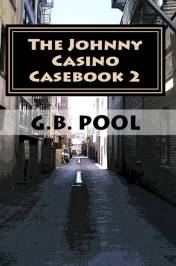 or at least I thought it was his real name, until another story in the Johnny Casino Casebook series uncovered something that even Johnny didn’t know. It changed everything for him. It’s in The Johnny Casino Casebook 2 – Looking for Johnny Nobody. That’s when I started seeing a pattern.”


You must be logged in to post a comment.