Redundancies and Series: How to Make Both Work.

by Jackie Houchin

A couple of weeks ago, Gayle shared with us about repeats and redundancies in our writing and how to avoid them. This is only one of the points she’s taught to keep our writing enticing and enjoyable for our readers. She used the TV show, Murder, She Wrote, to illustrate both the allowed and the frowned-upon redundancies.

“TV series like book series need formulas to stay consistent,” one person commented. “It’s why we keep going back.”

On the same note, I love books in a series.  When I find a well-written and fun series, I will begin with the first installment, read right through to the last, and then hope there will be more to come. They have the same main characters (which I’ve grown to love) and the plots, although varied, follow a basic plan each time. The settings can be here and there, I don’t care.

(Oops!  Yes, I know that for some readers, the PLACE where the series happens is the ‘sweet spot,’ as in outer space, a certain beloved city, or on a cruise ship. It’s why they keep returning for book after book. Sorry!)

Anyway, in a series, I know what to expect, even though I don’t know what to expect, if you get my meaning.

One series I enjoy is Canadian author Iona Whishaw’s Lane Winslow Mysteries. They are set in British Columbia (with a few side excursions) shortly after WWII. Lane was a British spy during the war, and she uses her “secret” skills to help the local police inspector solve crimes.

The author has written 13 installments, so far, with a little prequel thrown in.  I’ve read all but the last, and have just purchased it. It’s a series that can keep going with the same characters and slightly altered plots.

I have also enjoyed Gabrielle Meyer’s Timeless series, which combines mystery, light romance, and history across a dozen settings and eras. She uses a “time-crosser” or two in each book. These gals (and sometimes guys) are in one of two settings every other day until they turn 25. At that point, they must choose the one they wish to remain in.

While the plot is essentially the same (a choice between two lives, weighing the costs and benefits of each), the era and places, along with the wonderfully researched history, make each book different. They do not follow one another chronologically, like the Lane Winslow Mysteries.  It’s a series that can continue as long as the author wants, but each story stands alone. They repeat only in form.

The other series that hooked me was Ashley Weaver’s Electra McDonnell Mysteries. In these, Electra is a skilled safecracker from a family of thieves who is coerced into working for British Intelligence to avoid prison. Of course, a handsome Major is her handler. Sparks happen, but she is SO “not fitting” for a high-born Brit. Very exciting, suspenseful, and FUN. 

The books in this series follow a close chronological order and have a natural ending in book five.  If I want to read more in this series, I will have to re-read from book one.

Where was I? I guess I segued from redundancies, repeats, and formulas to book series. But these examples show that YOU can write a short or long series that grabs and holds your readers without resorting to boring repetition or copycats.

(And for my faux pas about setting, there IS a series I love set on the cruise ship, Siren of the Seas.  It’s Hope Callighan’s Millie’s Cruise Ship Mysteries.  Set aboard a luxury cruise ship, now as familiar as my own house, or at a port o’ call, the books feature recurring characters and similar plots. The story advances chronologically with each book, and there are multiple dozens of books in the series.)

I’d love your comments on the book series you love (and why you love them – characters, settings, plots?).  I have hundreds more I couldn’t list.  Let’s compare!!

Cats in Mysteries

by Maggie King

Want to make a good mystery even better? Add a cat.

Seriously.

Many mystery series feature feline companions. The most famous one is The Cat Who … series, created by the late Lilian Jackson Braun. The stories feature reporter Jim Qwilleran and his Siamese cats, Kao K’o-Kung (Koko for short) and Yum Yum. Koko has a “sixth sense” that gives him stellar powers of detection.

Shirley Rousseau Murphy also anthropomorphizes her feline detective, Joe Grey, P.I. I was on an Alaskan cruise a few years back and borrowed Cat Pay the Devil from the ship’s library. I had to return the book when the cruise ended but purchased a copy as soon as I got home. It’s a truly charming series.
Midnight Louie is the late Carole Nelson Douglas’s feline super sleuth. Rita Mae Brown’s Mrs. Murphy even speaks. I loved Jennifer J. Chow’s Sassy Cat Mystery Series, and was sad when she didn’t continue it.

Some cats leave the detecting to their human companions. Lydia Adamson, Susan Wittig Albert, Linda Palmer, Gillian Roberts, and Rosemary Stevens are just a few of the authors who feature cats as “window dressing.” Often literally, as cats like to perch on window ledges, watching the world go by.

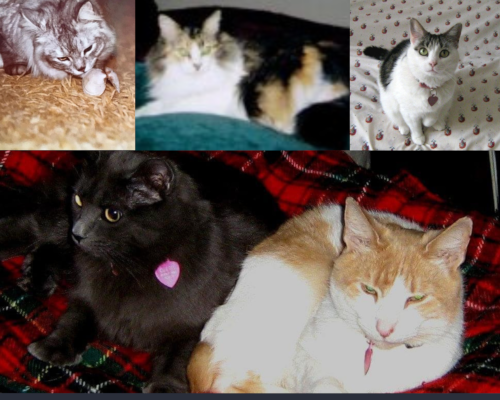
Just as my Olive stole my heart, she also stole the heart of Hazel Rose, the title sleuth in my Hazel Rose Book Group series. Shammy, Daisy, and Morris, now enjoying eternity together across the rainbow bridge, live on in my series. They don’t detect (Olive hunts down mice and voles, but shies away from killers).

I haven’t forgotten our canine friends–Linda wouldn’t forgive me if i did! The Robbins Library in Arlington, Massachusetts features an impressive list of mysteries with pets, cats AND dogs.

The cats of my life. Top: Marie, Shammy, Daisy; Bottom: Olive, Morris

Originally published in 2018 on the now defunct Pets, Paws, and Claws blog.

PART 3 – Always Ask Yourself

                                Does it advance the story?

                                Does it enhance the story?

                                Is it redundant?

Writers find ways to advance their story by dropping new bits of information or enhancing the story by giving a terrific description of a person, place or thing, but do they ever check to see if they visited the same place too many times or discussed the same bit of business in their story with way too many other characters?  When that happens too often it starts feeling like the writer ran out of material and is just filling up a few blank pages.

In the old Murder She Wrote episodes, good ol’ Jessica Fletcher would drop a clue early on during any given episode only to remember that incident later and realize it was, indeed, a clue to the killer. Now you might call that procedure “redundant” since it happened in every episode, but if you were a fan and watched a lot of the re-runs you would probably be looking for those hints at the beginning of the show and see if you can catch the clue before Jessica does.

I’ve been watching the old episodes and actually watch for those subtle hints so I can beat Jessica to the killer.  They do a good job having all the actors in any given episode give subtle looks that might indicate they are the bad guy, but since all of the actors do it, you have to pay closer attention to what each person says both before and after the killing. But they seldom trudge over the same clue or drag in the same person more than once. Therefore, there is no redundancy as such.

As for what a writer should do, unless you’re writing a TV series where every episode is a carbon copy of the previous one, don’t keep throwing out the same bits of information. Figure a way to move the story along with something innovative like a new character or take the main characters in a different direction even if it’s a dead end. That’s a better use of those words you’re putting on paper.

Even redundancies as simple as having all the conversations happen around the same dinner table or office desk or even the neighborhood bar or restaurant gets old. Maybe try taking your characters for a walk in the woods or for a drive in the country. The fresh air or different scenery will be a nice background for new revelations.

Even if the characters are trapped in a cabin in the woods during a snowstorm, let the people find a quiet corner, or the sofa in front of the fireplace, or maybe have your characters climb a ladder up to the attic for some quiet conversation. Just don’t have them constantly returning to the same place. As they say: “Been there. Done that.”

Your goal isn’t to say the same thing in half a dozen different ways. It’s to say new stuff. See new things. Meet new characters. Say new stuff…See new things…Meet new characters…Say new stuff…See new things…Meet new characters…

Remember the point of this post: Don’t repeat yourself.  Write On!