
by Miko Johnston
Last year I began the BACK TO BASICS series with BEGINNINGS and then presented MIDDLES, so as this is my first post of 2021, I’m beginning by ending the series with ENDINGS.
*
Congratulations. You’ve grabbed the reader’s attention with your opening and kept them rapt through your middle chapters. Don’t spoil things now with a disappointing or frustrating finale – the pages that comprise the lead-up to the climax through the final sentence.
An off-putting beginning may discourage a reader, and when asked she’ll say, “I couldn’t get into it, but you might like it”. A problematic middle will dampen her interest, but she’ll likely continue, hoping for redemption. However, a bad ending will exasperate her. She’ll fume over wasting her money buying the book and wasting her time reading through to the end, and she’ll badmouth the book to everyone she’s ever met.
Am I right?
Once you’ve convinced a reader to buy your book, you don’t want to ruin all the time they’ll invest in reading it with an ending that falls flat, doesn’t make sense, or comes out of nowhere.
A good ending must appeal to our emotions as well as our logic; move us, make us think, but also make sense. The best ending, simply put, satisfies the reader. This is not synonymous with a happy ending, which too often can be trite. It means the story finishes in a way the reader feels is plausible, based on what happened throughout the pages. She may be pleasantly surprised it didn’t turn out as expected, but as it ought to have concluded. Or she may be left wanting the story to go further and view the end as merely a good stopping point, which it should if you’re writing a series. Genres often dictate the type of ending needed – the detective solves the murder, the cop catches the criminal, the lovers beat all odds and wind up together.
To conclude your novel successfully, first consider what doesn’t make a good ending:
1 – A lack of any closure. The point of the story must be resolved. You don’t have to spell everything out, but too many story threads left hanging will frustrate the reader.
2 – Too ambiguous. You can leave some details to the reader’s imagination, but not the entire plot.
3 – Too neat. The opposite problem; tying up too much or having everything work out perfectly defies credulity.
4 – Too rushed. You want to build tension as you approach your final pages. A fast pace can produce excitement, but slow it down enough to generate that tension.
5 – Too drawn out. If you slow the pace too much you won’t generate tension and worse, you’ll lose the reader’s attention.
6 – Too contrived. Also known as deux ex machina or “the Martians landed”, this ending comes out of thin air with no foreshadowing in the story.
7 – Too predictable. Even if we know how the story will probably end, we still want something satisfying before we close the book.
8 – No ending. The story just stops.
If you’re wondering what satisfies readers you have only to look at book review sites like Amazon and Goodreads, which offer (usually) genuine critique. Your own experience as a reader will inform you as well. Classic endings include:
1 – Resolved: Effective in stand-alone stories where the protagonist has a goal and achieves it. The detective solves the murder. The lovers reunite. The operation is successful. This works best if it involves some plot twist, surprise or emotional satisfaction.
2 – Unresolved: Commonly used in literary fiction, where the point is to give the reader something to consider, or evoke an emotion. It’s often seen in series, where some plot elements are left for the next book, but trickier to pull off in a stand-alone. There’s a fine line between unresolved and ambiguous, so even when done well, many readers don’t find this type of conclusion satisfying.
3 – Open-ended: This is an implied ending, which like the unresolved ending, can frustrate readers who want to know, not contemplate, what happens. It differs from the unresolved ending in that the reader gets a sense of how the story turns out through foreshadowing in earlier chapters, or it might leave the plot open to interpretation, but complete the protagonist’s arc.
4 – The twist: Also known as a surprise ending. It differs from the contrived ending because it’s been adequately set up throughout the plot by lacing the story with subtle clues. Twist endings delight readers of mysteries, but it also works in other genres.
5 – Book-ended: I mentioned this in Part I of Writer’s Boot Camp. If you begin your story with the lead-up to the climax, complete the circle by returning to that moment at the end. Or, instead of pairing an action, create a symbolic book-end by repeating the theme of your opening, very effective in stories about never-ending battles like fighting crime, spies or terrorists.
6 – Statement or summation: This can complement or a contrast a statement or explanation beginning, and like it, tends to be cerebral. A successful version will be metaphorical rather than concrete, leaving the reader with something to think about, or picturing what happened and imagining what will happen next.
*******
The one element all good ending have in common is that they’re successful only when properly set up throughout the pages.
Still struggling? If your finale lacks closure or is muddled, it might be because you didn’t resolve enough story threads. Fix that with addition and subtraction – add enough details to flesh out critical plot point and edit out non-critical bits like multiple red herrings and extraneous characters or storylines.
If the pacing is off, decide whether you’ve rushed or dragged out the climax. If it’s the former, intensify the ending by delaying the payoff enough to create tension. Emotional reactions, thoughts, reasoning out, or physical actions like running, arguing or physically fighting can slow down a rushed pace with added conflict. Trimming might be enough to fix a plodding climax. Shortening sentences to an almost staccato rhythm speeds up the pace as well.
Does your protagonist feature prominently in the resolution of the story? There’s a reason a common synonym for protagonist is hero – we want our characters to be pro-active in bringing about the conclusion of the story. Make them active participants in their quest and its success or failure.
If pacing and character aren’t the problem, then consider the tone. Have you maintained continuity throughout? Can you justify your protagonist’s arc? I’ve read books that changed genres or mood along the way. In some cases the end bears little resemblance to the beginning. Find the scene where you lost your way and let it guide you to what and how much needs revising.
What if you don’t know the ending, or aren’t sure of how to bring it about?
I introduced the idea of writing different beginnings in Part I. It also works in reverse. If you’re unsure of how the story should end, consider the different possibilities and write out a few. See which works best with what you have. For example, if you can’t think of a good twist ending to your mystery, attempt a book-ended or a resolved ending. It may yield an idea for your story’s climax. Or, if you can’t decide between several endings, consider making it open-ended by inserting clues from the potential conclusions into the plot. Then the reader can decide for herself.
If you can’t seem to get to the ending you’ve planned, try the bridge technique outlined in Part II. Link up the ending with the last chapters you’ve completed by working backwards for a while, then move the story forward to that point.
I hope the techniques I’ve outlined in this series have been helpful. Perhaps you have other methods you employ to open, continue or close your stories. We’d love to hear them.

Photo by Kyle Glenn on Unsplash
Miko Johnston, a founding member of The Writers In Residence, is the author of three novels in the historical saga A Petal In The Wind, as well as several short stories in anthologies including LAst Exit to Murder. She is currently completing the fourth book in the Petal series. Miko lives on Whidbey Island in Washington (the big one). Contact her at mikojohnstonauthor@gmail.com


 Of course, the correct common usage idioms are “stubbed my toe, a drop in the bucket, beat around the bush, and a dime a dozen.” The last two are alliterative, yes, but why, I wonder, are toes the only part of our anatomy ever stubbed? And why drops only drip into a bucket instead of any other container? My favorite, though, is “a short/long week – or year, or hour.” What do they actually mean? Six days instead of seven? 11 months instead of 12? Sure, it’s easy to explain that an hour can drag on seemingly forever and a short week can mean time flies by, so why don’t we write that?
 I have a book, “The Describer’s Dictionary” that contains oodles of such hackneyed idioms but they do inspire me to create my own if possible. The book is tremendously helpful when trying to find a way to describe, for example, low-elevation clouds. One description offered is “a cloud mass like a formless gray horizontal sheet.” Would you honestly use that? However, I have found the book invaluable for character physiques, architecture, locales, settings, and surfaces and textures. There is an entire chapter on Necks. Granted, it’s only half a page but it encourages the mind to explore other possibilities.
 Jill Amadio is from Cornwall, UK, but unlike her amateur sleuth, Tosca Trevant, she is far less grumpy. Jill began her career as a reporter in London (UK), then Madrid (Spain), Bogota (Colombia), Bangkok (Thailand), Hong Kong, and New York. She is the ghostwriter of 14 memoirs, and wrote the Rudy Valle biography, “My Vagabond Lover,” with his wife, Ellie. Jill writes a column for a British mystery magazine, and is an audio book narrator. She is the author of the award-winning mystery, “Digging Too Deep.” The second book in the series, “Digging Up the Dead,” was released this year. The books are based in Newport


 I frequent a bookshop in a neighboring town that sells books for and about writers, along with writing-related merchandise (if you’ve been to Port Townsend Washington you know which store I mean). They carry postcards and T-shirts with writing slogans like “Avoid Clichés like the Plague”. Cute. Unfortunately, it denigrates clichés. The meaning of the word has been ‘adjusted’, and unfairly so, IMHO.
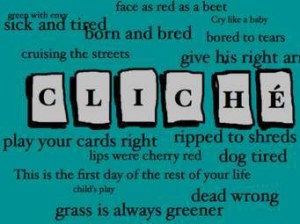 When selectively used, a good cliché expresses wisdom through metaphor. A stitch in time figuratively saves nine. Actions often do speak louder than words. Sometimes it is a dark and stormy night, but since that opening line shows up more in humorous writing nowadays, we expect it to be funny, not dark. Like cliché, the expression’s meaning has been ‘adjusted’.
 Na-
Na- “Traditionally, NaNoWriMo works best when you start a brand-new project. It may be an arbitrary distinction, but we’ve seen that novelists do better (and have more fun) when they’re free from the constraints of existing manuscripts. Give yourself the gift of a clean slate!
 I’m a writer.
 Now I’m working on the fourth of those books. I’m first doing a synopsis and three chapters to turn in, then finishing the rest of the manuscript. I have a few months, so I should be fine. But right now I’m looking at all the weekend events, panels and more, that I’ve agreed to in the near future. Then there will be a visit from some dear family members that will probably use up a week. And an annual trip that has been extended to see those family members at their home. So… well, I’m worried about meeting that deadline.
 Yes, deadlines are a part of life.
 Linda O. Johnston, a former lawyer who is now a full-time writer, currently writes

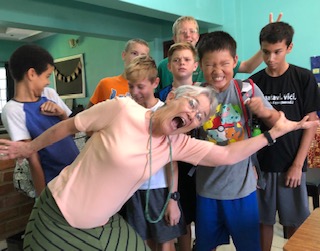
 On a recent short-term mission trip to Malawi for my church, I had the opportunity to teach Writing classes to two groups of home schooled MKs (Missionary Kids). These were children from American, Canadian and South African families. There were nine in the 3rd-4th grade group and seven in the 5th grade and up group.
 After reviewing the stories and talking to the other home school teachers, we all agreed that the kids needed help in character development. The action was amazing; the worlds they created were vivid, but the heroes, helpers, and villains were flat and hard to imagine.
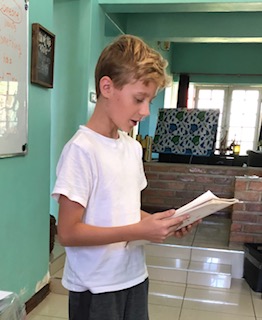
 Before I arrived I asked that the kids (both classes) bring the first several paragraphs of a story they had written to class. In class, I had them each read their paragraphs aloud. There were Captain Jack, Commander of a Starship, twin girls named Peace and Harmony, and a 20-year old girl named Ella who wanted to become a princess (and a dozen others).
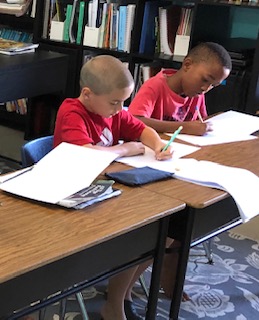 For the younger class, I had them draw in their workbooks a circle for a face, then slowly add features (eyes, nose, mouth, ears, hair) and write a description of each as they went. Next they drew bodies with any kinds of clothes and shoes (or not) they wished. I had them write why these “characters” were smiling, wearing… glasses, a soccer jersey, a swim suit, a long dress, a tutu, and had on sandals or swim fins. They began to see how to show what their story characters looked like by writing descriptions, and in the process developed more interesting information about them. (I could see “light” dawning in their eyes!)
 Next, we had fun with thirty-six
 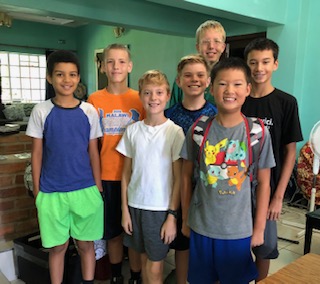 For the older class (all boys, and most writing sci-fi or fantasy) we delved a bit deeper into making their characters memorable by using various ways to describe physical as well as personality traits. They practiced describing a character in an action scene (showing fear or bravery without actually using those words) and played around with using an occasional quirk, flaw, or unconscious mannerism to reveal hidden traits.

 Jackie Houchin is a Christian writer, book reviewer, and retired photojournalist. She writes articles and reviews on a variety of topics, and occasionally edits manuscripts. She also dabbles in short fiction. “I’m a wife (52 years in Feb/2016), a mom, and a grandma (of adults, sigh!). I enjoy creating Bible craft projects for kids; growing fruits, flowers, and veggies; and traveling to other countries. I also adore cats and kittens and mysteries.” Follow Jackie on
  This kind of free writing invigorates your thought process, sparks ideas that catch fire and burn down forests of paper!! (Sorry, I got a little carried away.)
 The other type of free writing that most wordsmiths don’t like to consider, is writing FOR FREE; not charging a fee, gratis, a lot of work for no pay. Some do it for the experience and to get a name and byline which they can later barter. They think of it as a rite of passage, paying their dues, a necessary evil. (Hey, I love clichés.)
 How about volunteering to critique or edit a friend’s manuscript? (I edit papers by seminary students in Africa and it is very gratifying.) Or mentoring a newbie writer? (I’m doing that for a friend who’s attempting her first memoir.) How about writing a note of encouragement to an author who’s just lost her editor or publisher, or gotten a stinky review?
 The Writers in Residence
You must be logged in to post a comment.