
by Jill Amadio
How many of us buy site ads to promote our books?
Grinding my teeth at low sales in August I was able to ask a couple of successful authors how they manage to keep their titles before the public. Brenda Novak, who writes the Dr. Evelyn Talbot thrillers, said that one of the publicity tools she uses are book marketing sites. Although her wallet is somewhat fatter than those of many of us with four million copies of her books sold, Brenda still sends some of her personal advertising dollars to these sites.

Among her tactics: Organize your own book group on Facebook. It’s free. Offer inexpensive swag such as commemorative pins in exchange for downloading only your book titles from her web site – not the books themselves.
Add a shopping page to your own website to sell T-shirts, mini-totes, Christmas ornaments, etc. Brenda said that it cost her $2,000 initially to set up her online shop and now it is hugely successful.
Another tactic she uses is to create a Foodie Friday recipe which she cooks and posts on her Facebook and Instagram accounts, including a video.
Book trailers are one of her favorite ways to attract attention although she cautions that changing it regularly is key. To keep costs low (still expensive!!), the video company she contracts with uses stock video for much of the content.
Another tip: offer giveaways – one of her most popular was on Facebook Live in which she read from her books.
Find a company that sells “scrap” advertising which are spots in major magazines discounted at the last minute. But don’t let the “scrap” description fool you. Brenda says that even discounted, it can cost a bundle. Nevertheless, one she found available was in People magazine, and she is always on the lookout for deadline deals with women’s magazines.
“Not all marketing endeavors achieve the same goal. Some are more about brand building,” she told me. “I look at marketing my books like a farmer might his fields – it’s what I put into the soil before planting that makes the biggest difference in the end.”
*
Away from Brenda’s heady, enterprising and pricey ads are the less expensive and free methods used by some of us Writers in Residence and by our colleague, psychological thriller writer Sheila Lowe. Like Brenda, Sheila subscribes to www.BookBub.com, a web site that sends out daily emails advertising books to millions of readers, although costs can be high.
Here’s how it works: you set a maximum price you’ll pay for the exposure, say $100. When someone clicks on your book cover you get charged a certain amount of money for the impression. After your stated maximum budget, the $100, is reached, BookBub takes down your ad. You can choose which readers and audiences you want to target by genre, interests, retailers, and location, and you can monitor your campaign on the site’s dashboard. Extremely popular, the site has a waiting list of authors eager to sign up.
While Sheila takes advantage of the benefits Facebook offers including its Authors Page, she likes affordable subscription sites such as www.BargainBooksy.com and www.RobinReads.com. The latter is a free author promotion service affiliated with Amazon and you don’t have to be part of Amazon’s Prime/Kindle Unlimited yourself to use it. The site focuses on promoting eBooks which are now enjoying a massive surge. RobinReads buyers pay for discounted books if they choose to buy them only on Amazon. However, the deals are swift, lasting only 24 hours before they are retired for fresh offers.

At BargainBooksy with around 3,000 subscribers, advertising for eBooks is also king along with print books. After a buyer clicks on a link to a specific book they are taken to Amazon’s web site, where the book can cost 0.99 cents or less, while pricing is based on your genre. This, of course, affects your royalties, so unless you are only targeting publicity you might want to reconsider. However, the site also links to your books at Kobo, Apple, and Nook, and to your own web site.
To splurge, you can buy a $50 BargainBooksy Deal of the Day promotion on FreeBooksy, a specialized-genre readers’ site designed to boost your click-through rates and purchases with free books that are not available on the main site.
So, there you have it. A few costly as well as reasonably-priced ideas. Raid your piggy bank!

 Jill Amadio is from Cornwall, UK, but unlike her amateur sleuth, Tosca Trevant, she is far less grumpy. Jill began her career as a reporter in London (UK), then Madrid (Spain), Bogota (Colombia), Bangkok (Thailand), Hong Kong, and New York. She is the ghostwriter of 14 memoirs, and wrote the Rudy Valle biography, “My Vagabond Lover,” with his wife, Ellie. Jill writes a column for a British mystery magazine, and is an audio book narrator. She is the author of the award-winning mystery, “Digging Too Deep.” The second book in the series, “Digging Up the Dead,” was released this year. The books are based in Newport http://www.jillamadio.com
Books: Digging Too Deep, Digging Up the Dead
Non-Fiction: My Vagabond Lover: An Intimate Biography of Rudy Vallee; Gunther Rall: A Memoire, Luftwaffe Ace and NATO General
***
This article was posted for Jill Amadio by Jackie Houchin

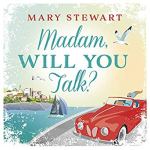 I’d asked a wise librarian in Burbank if there was something beyond Nancy Drew, but kind of like her, that I could read. She looked at this budding, though still gangling young teen, and recommended Mary Stewart’s first book, Madam, Will You Talk? (1955)
 This Rough Magic (1964), my opiate. ***
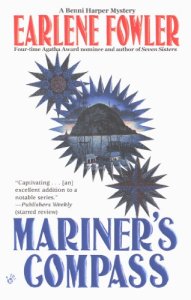 Mariner’s Compass (1999) is Earlene Fowler‘s sixth Benny Harper mystery, set along California’s central coast. Each of her books is named for a quilting pattern although Benny is not a quilter herself. She is a rancher and married to a cop, but she helps maintain a historical museum in town that features old quilts.
 Old Bones (1987) *** by Aaron Elkins is another favorite on my list. His protagonist Gideon Oliver is a forensic anthropologist, but his moniker in the series is “bone doctor.” It is absolutely amazing what you (he) can discover from a set of fresh or ancient bones. Who they were, yes, but more importantly in the book, how, where, when, and why a person becomes bones.
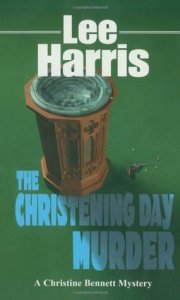 A freaky location again is the reason for my listing The Christening Day Murder (1993) by Lee Harris as a memorable favorite. (All Lee Harris’ Christine Bennett – a former nun – mysteries have a special “day” as their title.) I can’t even remember the mystery, but I remember where a good portion of it takes place.
 And lastly, the wonderfully warm and well-written family saga by the gifted Rosamunde Pilcher… The Shell Seekers (1987) **** (all 582 pages ) This is not a mystery, but a lovely women’s novel featuring Penelope Keeling, a 64 year old woman whose days are limited, and whose family does not understand her. A woman whose past is calling her, but whose present threatens to fence her in.
 For one thing, both follow a very specific set of rules. Crosswords must be square, they contain a specific number of squares and answers, they must be symmetrical, and they can’t duplicate clues in the grid. Clues and answers must match grammatically. Puzzles must have a theme. Now we’re getting closer to something writers can relate to: themes and grammar. For crossword creators, that means their answers must support the theme. Writers, on the other hand, must develop a theme that carries readers logically from beginning to end. Do I even need to mention that writing should be grammatically correct?
 But solving a crossword puzzle is far removed from the experience of reading an article. The solver of the former is looking for entertainment and a challenge. The reader of the latter wants to be informed, inspired, or educated. Or, at times, to be entertained.
 Semi-retired college English and Spanish instructor. Self-publisher, editor, and entrepreneur. Jeanette has been writing, teaching, editing, mentoring, and publishing for the past four decades. Now she is available online to help writers around the world with their writing ventures. When she’s not writing, she enjoys enjoys traveling to visit family and friends, especially her two grown daughters and her two young grandchildren.
 I attended the Romance Writers of America National Conference last week in New York City. Am I glad I did? Yes, mostly because of the wonderful people I saw, meeting up with those I knew professionally and as friends–or both. I’ve been attending RWA conferences for many years and for different reasons, but that’s the most important.
 Linda O. Johnston, a former lawyer who is now a full-time writer, currently writes two mystery series for


 Slogging away as we do on our mysteries, enjoying making sure we’ve planted subtle and not-so-subtle clues and fascinating red herrings, it’s a marvelous feeling to write The End and look forward to working on the second draft.
 When returning home from a recent trip in April and touching down in Washington D.C., the South African pilot announced, “Ladies and Gentlemen, welcome to the United States of America.” I have to admit, I got a lump in my throat and tears welled in my eyes. So often I take the privilege of living in “the States” for granted. So many in the world would change places with me in a heartbeat!
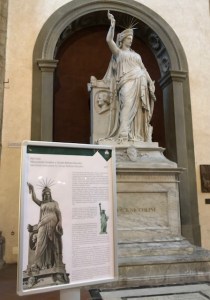 In a church in Florence, Italy, I discovered (along with the burial place of Michelangelo and Marconi) a statue that very well could have been the inspiration for the French gift of the Statue of Liberty. Softer, more feminine, but amazingly similar!

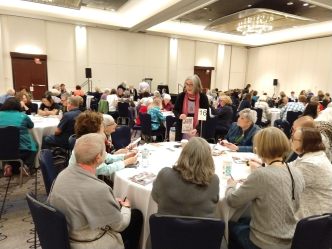 Let me explain what Author Speed Dating is first. In two hours, two authors pitch their works to approximately 144 readers at 18 tables seating 8 people. Each author has 2 minutes to pitch their book/project and then the next author pitches their book for 2 minutes. I partnered with
  After that point I ceded my time to Ann who spoke about her protagonist Inez Stanner traveling from Leadville to San Francisco in the 19th century and then a quick pitch for her friend

 On a recent short-term mission trip to Malawi for my church, I had the opportunity to teach Writing classes to two groups of home schooled MKs (Missionary Kids). These were children from American, Canadian and South African families. There were nine in the 3rd-4th grade group and seven in the 5th grade and up group.
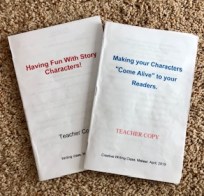 After reviewing the stories and talking to the other home school teachers, we all agreed that the kids needed help in character development. The action was amazing; the worlds they created were vivid, but the heroes, helpers, and villains were flat and hard to imagine.
 Before I arrived I asked that the kids (both classes) bring the first several paragraphs of a story they had written to class. In class, I had them each read their paragraphs aloud. There were Captain Jack, Commander of a Starship, twin girls named Peace and Harmony, and a 20-year old girl named Ella who wanted to become a princess (and a dozen others).
 For the younger class, I had them draw in their workbooks a circle for a face, then slowly add features (eyes, nose, mouth, ears, hair) and write a description of each as they went. Next they drew bodies with any kinds of clothes and shoes (or not) they wished. I had them write why these “characters” were smiling, wearing… glasses, a soccer jersey, a swim suit, a long dress, a tutu, and had on sandals or swim fins. They began to see how to show what their story characters looked like by writing descriptions, and in the process developed more interesting information about them. (I could see “light” dawning in their eyes!)
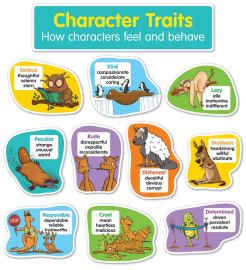 Next, we had fun with thirty-six
 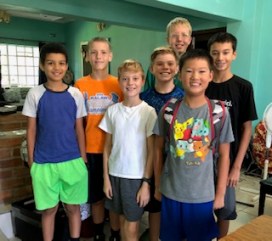 For the older class (all boys, and most writing sci-fi or fantasy) we delved a bit deeper into making their characters memorable by using various ways to describe physical as well as personality traits. They practiced describing a character in an action scene (showing fear or bravery without actually using those words) and played around with using an occasional quirk, flaw, or unconscious mannerism to reveal hidden traits.


You must be logged in to post a comment.