
by Elise M. Stone
When I was a little girl, I dreamed of being a writer. I put that dream on hold for decades while I got married, had a family, and built a career. It was one of the many things on my “someday” list. Then 9/11 happened, and I realized that “someday” might never happen. If I wanted to write a novel, I’d better get started.
I’ve written nine cozy mysteries in two different series over the past few years. Cozies generally have a romantic subplot, and mine are no different. While writing the last book, I realized I was enjoying writing the romance more than the mystery. What if my next book was a romance novel instead of a mystery? An intriguing question, which I decided to answer.
I began 2019 by starting on a sweet historical western romance series for a change of pace. This has been coming for a long time. Years, in fact, although I didn’t realize it myself at the time.
I have trouble sleeping. In the quiet, my brain is like a hamster on one of those spinning wheels. It thinks of all kinds of things it should not be worrying about at midnight. I have to distract it in order to fall asleep.
 One of the things that helps is listening to a podcast of Old Time Radio Westerns. Before most of the classic western series of the 1950s and 1960s were on television, they were on radio. I grew up with those TV series, so the stories, while different, are very familiar. Now I fall asleep to the Lone Ranger or Gunsmoke or the less-familiar Frontier Gentleman.
I’ve been absorbing these stories in my dreams for at least two years.
I find the time between the Civil War and the beginning of the twentieth century, when cowboys and outlaws and marshals were in their heyday, fascinating. The legends in themselves are romantic.
But I’d forgotten how hard it is to start a new series in a new genre. There are new characters in a new place in a new time. The people are like cartoon outlines with indistinguishable features. They’re not even wearing any clothes. They’re white blobs like the Pillsbury Doughboy. This is quite a change from going back to my senior citizens in the fictional town of Rainbow Ranch, Arizona, characters I love who live in places I’ve visualized dozens of times.
Another stumbling block is the historical aspect of this series. I often find myself stopped with questions like when did the railroad arrive in Tucson? (1880, which means I can’t use it because my story takes place in 1872.) Or did Philadelphia have mass transit in 1872? (It did: a horse-drawn streetcar.) Or handling issues of diversity for today’s sensitive audience.
The biggest threat to the settling of southern Arizona was Apache raiders. The attitude of most back then was that the only way to solve the problem was to exterminate the Apache. This was the opinion of not only whites, but Mexicans and the Papago, an Indian tribe now known as the Tohono O’odham. In fact, these three groups banded together and massacred a group of over ninety Apaches, mostly women and children, in a peaceful settlement outside Camp Grant in 1871. But not all Apaches were peaceful, and they were a serious problem for the ranchers and miners and homesteaders in the late nineteenth century.
And then there’s the romance plot itself. I bought several books on how to write a romance novel because—ahem—I’d only read one or two of them prior to this year. Unlike cozy mysteries, where I’d read hundreds over the years before I tried to write one, I had no gut feel about how a romance needs to work. A lot of times, I feel like I’m stumbling in the dark.
I know, eventually, the whole story will start playing itself out in my head faster than I can type. I’m looking forward to that stage because that’s when the magic happens. In fact, it happened for a time his past week as I was writing a scene and the characters started interacting in a way I’d never thought they would. I love when that happens. So I’ll keep pushing forward, stumbles and all, because I’m addicted to that magic.
And I love a happily ever after.
 Brief Bio:
Elise M. Stone was born and raised in New York, went to college in Michigan, and lived in the Boston area for eight years. Ten years ago she moved to sunny Tucson, Arizona, where she doesn’t have to shovel snow. With a fondness for cowboys and westerns, Arizona is the perfect place for her to live.
Like the sleuth in her African Violet Club mysteries, she raises African violets, although not with as much success as Lilliana, who has been known to win the occasional prize ribbon. Elise likes a bit of romance with her mysteries. And mystery with her romance. Agatha and Spenser, her two cats, keep her company while she writes.


 How many blogs besides this one do YOU read regularly (daily, weekly, monthly)? Yes, you can confess. We don’t mind. Reading them will help you become a better writer.

 I’ve been intrigued with this idea since I read Walter Mosley’s This Year You Write Your Novel. Yes, that Walter Mosley, creator of the bestselling historical crime series featuring Easy Rawlins. Mr. Mosley considers poetry the basis of all writing and suggests that reading, writing, and studying poetry gives fiction writers a deeper appreciation of the nuances of language.
 Maggie King is the author of the Hazel Rose Book Group mysteries, including Murder at the Book Group and Murder at the Moonshine Inn. She has contributed stories to the Virginia is for Mysteries anthologies and the 50 Shades of Cabernet anthology.


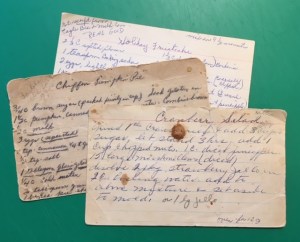 Now, the week before Thanksgiving I thumb through the 3×5 cards in Mom’s old plastic recipe box, looking for the Cranberry Salad, the Holiday Mincemeat Cake, and the Chiffon Pumpkin Pie recipes. The writing is faint and blurred; the cards are stained. And my heart gives a twist as I picture Mom taking each one out and assembling the ingredients on the counter. (This “treasured” box came to me 20 months ago when, at 94, she died.)
 Daily for a year or so in 1999, Dad sat at their kitchen table and drew stick figure sketches of Mom in various situations, from housecleaning and cooking, to relaxing with a morning coffee on the patio, working a jigsaw puzzle, gardening, and packing/traveling to Solvang on their anniversary. Each filmy paper illustration has her comment in a balloon above her head. I can hear her saying them all! I admit, I cried as I looked at each one in the stack.


 Years ago I bought a novel written by a well-known author because it took place in Seattle, a city where I’d lived, went to school, and worked for many years. A few chapters in, I was dismayed that the descriptions of setting were so generic that the story could have taken place anywhere. It was almost as if that the author had never set foot in the city.


 A few days later I threw out some stale bread crusts that I’d cut into tiny squares. (I’d hesitated only briefly as the thought of making croutons crossed my mind.) Too much trouble, and besides, maybe my new feathered friends would come again.
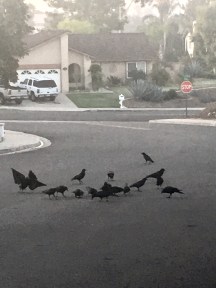 Now I have twenty-four black birds each morning. And they are beginning to make a lot of noise if I’m late. A man down the street came out with hands on hips and frowned at me. Dog walkers give my house that “look” as their dogs pull on their leashes towards the kibble mix.

 I TASTED the cool creamy sweetness of real Italian Gelato, bit into crusty (salt-free) Tuscan bread piled high with fresh-made tomato Bruschetta and drizzled with first-press virgin olive oil from an orchard that covered the nearby rolling hills. I sipped a frosty pale green menta (mint) icy that tingled my taste buds and sent shivers of coolness through my mouth and throat…on a baking-hot humid day.
 I sampled a vast array of Italian cheeses (said to outshine France’s), from wedges of soft, creamy whites, protected by powdery rinds, to the mellow, medium-soft, large-holed varieties (not Swiss), that were delicious in a salty-sweet way with a dollop of apricot jam on top, to the hard, net-wrapped aged cheeses that take a good strong knife to slice, and a hunk of soft Italian bread to eat it with to even out the sharpness.
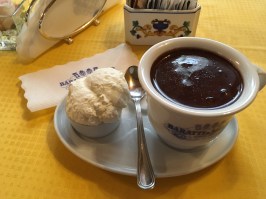 What about a decadent hot chocolate so thick and rich that it looks like Hershey’s Chocolate Topping, but more delicious, served with a scoop of freshly whipped cream so thick you could eat it with a fork.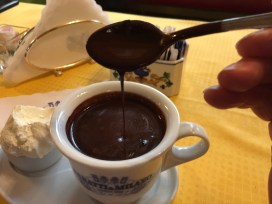
 Move through wet heat that causes limp hair, sticky skin, and clothes that cling. And then come upon an arched metal fountain in a park or piazza in the shape of a bull’s head (honoring “Torino”) that flows with cool sweet entirely drinkable water from its mouth. Hold out an empty water bottle, or cup your hands to catch the coolness, or even bend your head and drink freely.
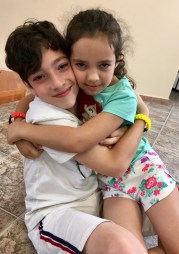 Kids walk down the streets holding hands and they hug their siblings freely, unembarrassed.


 Why do I use a time machine when I write? For Sandy Fairfax, I had no choice. I wanted to write about a ‘70s teen idol because of the culture of that time when teen idols were promoted through TV shows. I like the melodic songs from the era, the cheesy clothes, and the drama that often took place behind the idols’ innocent façades. \
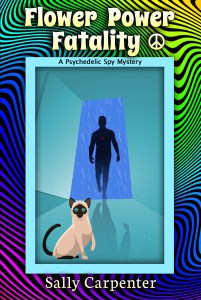 In “Flower Power Fatality,” Noelle McNabb is an actress at a Christmas-theme park in Yuletide, Indiana. Her drab routine is interrupted when a stranger shows up on her porch with a bullet in his chest. Then, a super-secret spy agency recruits Noelle to find missing microdots along with veteran agent Destiny King. As Noelle goes undercover, she finds herself dancing in sleazy nightclubs and chasing bad guys at night while wondering who is going to feed her pet cat.


 Sally Carpenter was born and raised in southwest Indiana but now lives in Moorpark California, leaving the land of rain and snow for wildfires and earthquakes. She has a master’s degree in theater from Indian State University. She also has a master’s degree in theology and a black belt in tae kwon do. She’s also “mom” to two black cats.


 Hanna Rhys Barnes is one of those people with an evenly balanced right and left brain. She has a BA in English but retired as a high school math teacher.
 A member of RWA’s national organization and of several local chapters, she currently lives and works on Whidbey Island in the beautiful Pacific Northwest. Hanna’s historical romances, Widow’s Peak and A Knight’s Kiss are currently available from the Wild Rose Press.


You must be logged in to post a comment.