
by Gail Kittleson
Decades ago, some friends invited us to go rafting on a local stream. I thought our son, three years old at the time, would be excited, but he said,
“I’m scared of those rabbits, Mommy.”
“Rabbits?”
“Yeah. Evelyn said we’re going to come to some rabbits…”
Those rapids would’ve scared me, too, if I thought they might hop into our raft. After a bit of explanation about the mild rapids, our son loved rafting.
**
Misunderstandings often ground our fears, and this proves true with writing. Being afraid to express our anxieties in black and white originates in false assumptions:
- What we write may be used against us.
- There’s a ‘right’ way to write, and we haven’t learned how.
- Once we write something down, we’re bound to the perspective we embraced at the time.
- Once written, our words will be “golden,” and therefore, we can’t destroy them.
First of all, what we write may be used against us. But this is no reason to forego all the benefits of the process. Writing in a safe place that no one ever sees has done wonders for many people experiencing trials.
The feeling that we have no control over who might see what we write can keep us bound by the tide of emotions swirling inside us. Launching out to safely journal our thoughts, tied irrevocably to those emotions, may seem beyond our power.
In order to take this tentative step, we must unlearn the second misconception, that there’s a ‘right’ way to write. Nothing could be farther from the truth. No perfect method for expressing what we feel exists.
In fact, the ‘perfect way’ will be the way our words come out. Each person’s story contains unique content, since it comes from our one-of-a-kind inner being. Each of us perceives even the identical situation with variations.
A family outsider, my sister, or my brother will see what I remember differently than I do. But my first feeble step—even if that amounts to writing one short paragraph about what’s transpiring inside me—unleashes immense healing power.
Now to the third misnomer: we are not bound by our viewpoint at any given time. A glance around us reveals that everything changes constantly. The only constant is change, as they say.
If I still looked at what I experienced fifteen years ago with the same eyes, I would be in big trouble. But the thing is, I would never have arrived at my present perspective if I hadn’t started writing down my thoughts and feelings.
At the time, my journal pages seemed somehow sacred, and they were. But as the years have passed, I’ve grown, and at certain points, I let go of certain writings from the pasts. Burned them, because they no longer seemed ‘golden.’ Some of them, I kept and edited. And re-edited, and re-re-edited into a memoir. That’s not the route for everyone, but proved to be an important part of my journey.
The point is, your writings are your writings. You have the right to choose what to do with them, including chucking them down a sinkhole never to be seen again.
And the broader point is that in the darkness of an emotional avalanche, we cannot even know what we think. By allowing words to flow from us, we invite clarity, and through this process, discover truths we would never have imagined.
Words equal an enormous gift—penned quietly in secret places, they blossom like hidden desert plants that bloom in darkness, where no one observes. But their flowers bear perfume, attracting the necessary insects for pollination. It may be that we will rework and launch our writings into a published memoir, but either way, this practice can become a powerful experience.

When Gail’s not steeped in World War II historical research, writing, or editing, you’ll find her reading for fun, gardening, or enjoying her grandchildren in Northern Iowa. She delights in interacting with readers who fall in love with her characters.
Gail Kittleson taught college expository writing and ESL before writing women’s historical fiction. From northern Iowa, she facilitates writing workshops and women’s retreats, and enjoys the Arizona Ponderosa forest in winter.

Catching Up With Daylight; a Journey to Wholeness, is Gail’s own memoir. She and her husband began renovating an old house after he returned from a deployment in Iraq. The book is “a gorgeous tapestry of non-fictional thoughts. This very gifted author knows how to weave her thoughts, memories, and the history of the old house she is refurbishing into a journey of emotional and spiritual wholeness.”
Women of the Heartland, Gail’s World War II series, highlights women of The Greatest Generation: In Times Like These, April 2016, With Each New Dawn, February, 2017 A True Purpose (Lighthouse Publishing of the Carolinas, and Word Crafts Press, December, 2017.)


 How many blogs besides this one do YOU read regularly (daily, weekly, monthly)? Yes, you can confess. We don’t mind. Reading them will help you become a better writer.

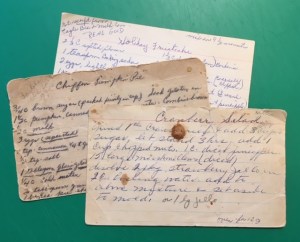 Now, the week before Thanksgiving I thumb through the 3×5 cards in Mom’s old plastic recipe box, looking for the Cranberry Salad, the Holiday Mincemeat Cake, and the Chiffon Pumpkin Pie recipes. The writing is faint and blurred; the cards are stained. And my heart gives a twist as I picture Mom taking each one out and assembling the ingredients on the counter. (This “treasured” box came to me 20 months ago when, at 94, she died.)
 Daily for a year or so in 1999, Dad sat at their kitchen table and drew stick figure sketches of Mom in various situations, from housecleaning and cooking, to relaxing with a morning coffee on the patio, working a jigsaw puzzle, gardening, and packing/traveling to Solvang on their anniversary. Each filmy paper illustration has her comment in a balloon above her head. I can hear her saying them all! I admit, I cried as I looked at each one in the stack.


 Years ago I bought a novel written by a well-known author because it took place in Seattle, a city where I’d lived, went to school, and worked for many years. A few chapters in, I was dismayed that the descriptions of setting were so generic that the story could have taken place anywhere. It was almost as if that the author had never set foot in the city.


 by Jackie Houchin
 Just kidding! You won’t get rich from these sales, but you will get “writing clips.” And when magazine editors discover your timely, well-written articles/stories etc., they will approach YOU with their needs.

 “A boost up”….when someone holds their clasped hands together next to a horse, and you put your foot in like a stirrup, and they propel you upward into the saddle.
 After writing my first three published short stories, something happened: Readers responded favorably to one of my characters. They liked this guy’s personality.


 And to add one more thing to this blog, Johnny Casino isn’t the only short story character to be in a book of his own. Chance McCoy arrived this year. His first book is called Second Chance. There are more stories to come. And there is a second short story anthology called Only in Hollywood coming out next year. The book consists of various stand-alone stories, but one features a guy named Charles Miro, a former TV actor turned private eye. He works for a younger woman who owns the detective firm. There are several stories about these two coming up. You see, even a short story can magically turn itself into a book if you try.

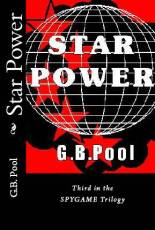
 A former private detective and once a reporter for a small weekly newspaper, Gayle Bartos-Pool (G.B. Pool) writes the Johnny Casino Casebook Series and the Gin Caulfield P.I. Mysteries. She also wrote the SPYGAME Trilogy: The Odd Man, Dry Bones, and Star Power; Caverns, Eddie Buick’s Last Case, The Santa Claus Singer, Bearnard’s Christmas and The Santa Claus Machine. She teaches writing classes: “The Anatomy of a Short Story” (which is also in workbook form), “How to Write Convincing Dialogue” and “How to Write a Killer Opening.” Website:
 “Johnny worked for me several years until he had enough P.I. hours under his belt to go out on his own. I hated to see him go, but I knew he worked better alone. Most of the time I do my work solo like the case at the racetrack in Hedge Bet. I should amend that statement because I got my husband, Fred, to do some work for me. His trip to Mexico to bring back a witness led to a few choice words from him, mostly unprintable. But the guy’s a natural P.I.

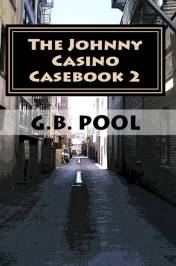 or at least I thought it was his real name, until another story in the Johnny Casino Casebook series uncovered something that even Johnny didn’t know. It changed everything for him. It’s in The Johnny Casino Casebook 2 – Looking for Johnny Nobody. That’s when I started seeing a pattern.”


 The Writers in Residence
You must be logged in to post a comment.