
by Jill Amadio
Many of my writer friends are “gung-ho enthusiasts” of Artificial Intelligence, or AI. They run their projects through, often chapter by chapter, to test their writing skills.
When the results come through, there is great interest in what the non-human synthetic experts have to say. While AI is a huge help, I suppose, if we need to be assured that our style and other fundamentals of our writing are up to par, does AI also diminish our confidence in our creativity?
Why do we trust an automatic machine to judge our writing rather than a person with a brain, a soul, and emotions, muddled as they may be? Why do writers believe that feelings expressed by AI have more depth and provide more compelling characters than those from human intelligence?
Certainly, we often feel a need for support when we aren’t sure we are on the right path with our plots and settings, but research can frequently send us on fascinating journeys when we use that old-fashioned tool.
Then, too, a friend might shoot down our joy by criticizing work we’ve spent weeks creating, but at least we can open a debate with said friend to challenge their viewpoint.
I read online that writers should not wait until a first draft is completed before checking it through AI. One should pass our writing chapter by chapter or paragraph by paragraph if we want our books to sell well.
However, brainstorming with AI can be a revolving door if we rely solely on it to give us feedback with which we disagree. We already have Spell Check in our Word program, and there are also grammar sites if we are unsure. Yet, do we want that advice?
I recently edited a book for a client from Liverpool, U.K., who writes in the way he speaks, a style that is occasionally ungrammatical but beautifully reflects his upbringing in a poverty-stricken family. He writes honestly and in detail about his criminal activities before reforming and brings the reader into his world in a personal, delightfully unself-conscious and un-generated-by-AI manner. His style takes us into heartfelt statements about his culture, his bitterness growing up, and how he turned his life around.
His book doesn’t flow strategically or logically. Instead, it takes us on a journey most of us could not imagine but feel compelled to follow to its happy ending. Would AI have come up with anything as mind-blowing as this man’s true story? Granted, AI is consulted mostly for its judgment of our writing, even its relevance to a central theme, but it seems to create doubt rather than determination to follow our own path.
All of which leads to the question of who is actually writing AI’s advice and training AI, and who is instructing us with strategic decisions we are told to make. Perhaps the AI originators are best-selling authors. Maybe they are paid a royalty for each bit of AI advice activated.
I read that AI can be biased and can misrepresent your writing style. It can tell you to make changes with which you disagree, but you can’t help believing that AI knows best.
Seems to me that human creativity is one of the most perfect parts of our mind, albeit for good or evil, and that if AI flags it, then we follow patterns and look twice at what we are thinking.
It also appears that AI can figure out if you are falling into the trap of writing patterns that annoy readers or structures that don’t make sense. All of which leads us to wonder if we could be accused of plagiarism if two or three writers receive the same rewriting from AI. Maybe we need to become our own amateur detectives to discover such an activity, and instead of fact-checkers, we need to become text-checkers for artificial intelligence.
I admit that AI is an excellent tool for writers who dither and are unsure of their characters, plots, and settings. It is normal to want an outside opinion, but there can be a nagging worry that AI cannot truly understand where our plot is going, or how characters can change as we write. Taking the guesswork out of our plots, sub-pots, and themes can lose us readers for future books in our series, and perhaps even prompt an admission that we used AI as an assistant to write the book in a Disclaimer or Introduction.
In conclusion, I am honestly pleased that some of my writer friends enjoy a foray into AI. I just ask them to be transparent and honest about it.

 Ghostwriting popped up in my life when I least expected, and it was certainly not sought. In fact, I was barely aware of someone writing someone else’s life story for them. It seemed the height of hubris both from the viewpoint of the writer and that of the subject. I believe I thought, when I first heard of ghostwriting, that if you couldn’t write your own story, then forget it.


 by Jackie Houchin

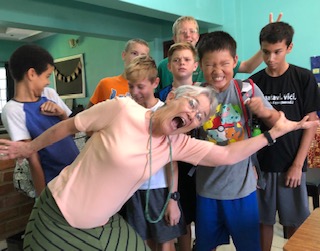
 On a recent short-term mission trip to Malawi for my church, I had the opportunity to teach Writing classes to two groups of home schooled MKs (Missionary Kids). These were children from American, Canadian and South African families. There were nine in the 3rd-4th grade group and seven in the 5th grade and up group.
 After reviewing the stories and talking to the other home school teachers, we all agreed that the kids needed help in character development. The action was amazing; the worlds they created were vivid, but the heroes, helpers, and villains were flat and hard to imagine.
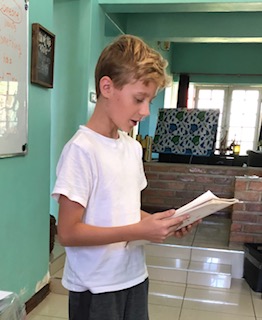
 Before I arrived I asked that the kids (both classes) bring the first several paragraphs of a story they had written to class. In class, I had them each read their paragraphs aloud. There were Captain Jack, Commander of a Starship, twin girls named Peace and Harmony, and a 20-year old girl named Ella who wanted to become a princess (and a dozen others).
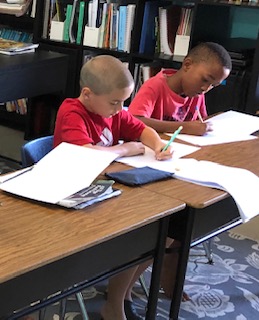 For the younger class, I had them draw in their workbooks a circle for a face, then slowly add features (eyes, nose, mouth, ears, hair) and write a description of each as they went. Next they drew bodies with any kinds of clothes and shoes (or not) they wished. I had them write why these “characters” were smiling, wearing… glasses, a soccer jersey, a swim suit, a long dress, a tutu, and had on sandals or swim fins. They began to see how to show what their story characters looked like by writing descriptions, and in the process developed more interesting information about them. (I could see “light” dawning in their eyes!)
 Next, we had fun with thirty-six
 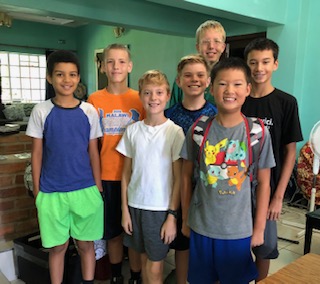 For the older class (all boys, and most writing sci-fi or fantasy) we delved a bit deeper into making their characters memorable by using various ways to describe physical as well as personality traits. They practiced describing a character in an action scene (showing fear or bravery without actually using those words) and played around with using an occasional quirk, flaw, or unconscious mannerism to reveal hidden traits.




 One of the things that helps is listening to a podcast of Old Time Radio Westerns. Before most of the classic western series of the 1950s and 1960s were on television, they were on radio. I grew up with those TV series, so the stories, while different, are very familiar. Now I fall asleep to the Lone Ranger or Gunsmoke or the less-familiar Frontier Gentleman.
 Brief Bio:

 How many blogs besides this one do YOU read regularly (daily, weekly, monthly)? Yes, you can confess. We don’t mind. Reading them will help you become a better writer.

 Now, the week before Thanksgiving I thumb through the 3×5 cards in Mom’s old plastic recipe box, looking for the Cranberry Salad, the Holiday Mincemeat Cake, and the Chiffon Pumpkin Pie recipes. The writing is faint and blurred; the cards are stained. And my heart gives a twist as I picture Mom taking each one out and assembling the ingredients on the counter. (This “treasured” box came to me 20 months ago when, at 94, she died.)
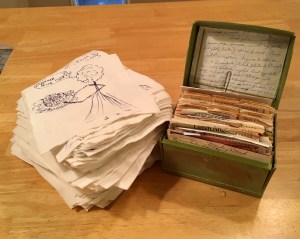 Daily for a year or so in 1999, Dad sat at their kitchen table and drew stick figure sketches of Mom in various situations, from housecleaning and cooking, to relaxing with a morning coffee on the patio, working a jigsaw puzzle, gardening, and packing/traveling to Solvang on their anniversary. Each filmy paper illustration has her comment in a balloon above her head. I can hear her saying them all! I admit, I cried as I looked at each one in the stack.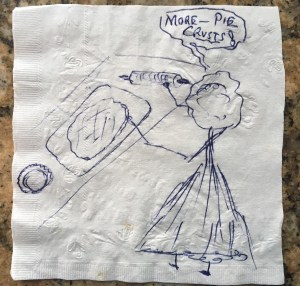


 The Writers in Residence
You must be logged in to post a comment.