
by Jill Amadio
As a Brit I put up with a lot of ribbing in America. Some friends take me to task for pronunciation. Well, I can’t help it if I have a very slight West Country accent as I am from Cornwall. As a writer, though, the ribbing can give me indigestion.
The main problem is spelling. I am warned by colleagues that editors at U.S. publishing houses come down hard if you keep inserting a “u” into words like behaviour, colour, and honour, or substitute a ”z’ for an “s”. Other minefields include using “ae” rather than “e,” as in “aeon” and “eon”. Maybe it’s a matter of simplicity. Americans pare as many ells and u’s as possible while Brits love double ells, such as “levelling” versus “leveling.”
My books are published here first but habits die hard and I usually claim that Brits use the correct spellings. They only got chopped when they arrived in America where unnecessary (to whom?) letters are summarily killed off. Flautists are called flutists, and gaol is jail. Obviously what it comes down to is pronunciation. Americans spell words as they are spoken although it escapes me why tyre is spelled tire.
It’s a huge temptation to some authors who have leapt across the pond to use British spelling, perhaps as a sly signal to agents and publishers they are querying that the writer is a Brit – a sort of literary snobbism one occasionally encounters at conferences.
Then there’s the grammar. Collective nouns in particular give me pause. Is a group, say a government, singular or plural? I have a page from the Associated Press Stylebook permanently stuck to my printer to remind me which to use.
Figuring out past particles is always fun. For instance, Brits say “pleaded” Yanks say “pled”. Oh, and the very, very worst word I hate to see changed is “hanged”. To my mind it should refer only to someone at the loop end of a rope, giving the action a far heftier meaning than the word “hung” as used here. People are not paintings.
Punctuation. I don’t worry about it although when I send in my column to the UK magazine I write for I make sure I place the comma and full stop after the quotes, not before. What else? “Have” and “take” always flummox me. Am I going to take a bath? Or, am I going to have a bath? I read somewhere that this is an example of a delexical verb, which I’m not even going to touch.
While writing my first mystery my beta readers caught another mistake. I wrote, “He drove her to hospital.” Wrong. I was told there should be a “the” in front of “hospital.” I’m sure there’s some kind of diabolical rule about this but I think it’s fine to give an in-house editor something to mark up to justify his/her salary. As for tenses, the past participle in the U.S. for “got” is “gotten,” an ugly word that makes me shudder enough to want to write a thriller entitled “The Dangling Participle and the Dark, Dark Pluperfect”.
While writing the first in my crime series based in Newport Beach, California, whose amateur sleuth is a disgraced Cornishwoman exiled by the palace for discovering a scandal (what, again?), I had to learn the police rankings and figure out who was a sheriff and who was a police officer. Having worked with a reporter at the good old rag, the Sunday Dispatch, I decided to have my sleuth simplify her confusion (and mine) and re-affirm her “foreignness” by using British titles. When caught speeding she addresses a California Highway Patrol (CHiP) officer as “Chief Superintendent,” and calls the Chief of Police, “ Constable.” I am, however, very pleased that sheriffs and policemen can be lumped into a group collectively referred to as “cops”.
When I mention a British pastime such as a pasty-throwing contest, blank stares are common. I talked about nighthawking the other day and no one had a clue as to its meaning. I’m giving the nasty habit to a character in my WIP although I know the explanation could be tedious unless you’re a nighthawker yourself. Both of these words are giving my Spellcheck nightmares.
Even the four seasons can be a challenge. Seeking representation for my first mystery I scoured the agent lists and was rejected by 65 of them. I knew small presses can be approached directly and I found one with whose name I fell totally in love: Mainly Murder Press. However, the website declared, NO SUBMISSIONS UNTIL LATE SPRING!
Ha. I immediately sent in my query along with a note: “Dear MMP, I live in Southern California and although it is only January according to the calendar, and snowing where you are, it is already late spring here. You should see the roses!”
I received an email back within three hours, asking me to send chapters. Which I did. Obviously the publisher was not off in Tahiti but still on the East Coast. Then came a request for the manuscript. By the end of a week I had signed a contract for three books. MMP publishes only 12-14 books a year, but who could resist the name? Sadly, MMP went belly-up before I could finish my third mystery.
So my advice is to go ahead and break the rules, lay it on thick, and change the climate. Worked for me.




 What is it like to sell 10 million copies of your books? I found it mind-boggling until I recently watched the Jackie Collins documentary. She sold 500 million copies of her 32 novels. But, hold on, Barbara Cartland wrote 723 romances and sold over a billion of them.
 Mystery writers are often asked how they decided to choose not only the genre but the plot itself. My revelation for my debut novel came about when I moved to the United States. I’d been a reporter and figured on continuing in that profession forever. I loved it. However, life has a way of setting one down a different path than planned.
 Books, books, books.
  Many writers I know run out of bookshelf space and begin piling books on the floor or finding nooks and crannies to fill. One client for whom I ghostwrote a biography kept a small shelf of paperbacks in her bathroom as many people do. I spotted another who had a penchant for refusing to return library books and not even bothering to removing their old category tags.
 Perhaps paying a visit to your own bookshelves will reveal a treasure you had forgotten. I wish I had bought a book I found at an airport gift shop in Jakarta. It was bound in beautiful red leather and titled “Sukarno.” I opened it up and every page was blank. I guess the publisher wanted to titillate buyers before the Indonesian leader passed away and there would be no repercussions about his controversial reign while he still lived.
 While her methods eventually result in catching the criminals, her way of operating tends to irritate her bosses and, once again, she is shipped off to another state. Montana, long known as home to private militias and survivalists, also has more than its share of grizzly bears. But why are they being killed along with several Native Americans? A KILLING SEASON provides a dazzling backdrop to the puzzle.
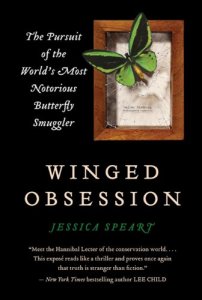 “It deals with an actual case that is so crazy no one would believe it if I wrote it as fiction,” she said. “A Japanese national began prowling around America’s national parks. One butterfly he chased was the Apache Fritillary, catching 500 of them and shipping them back to Japan to sell.”
 After BLUE TWILIGHT went on sale a small group of butterfly collectors felt she had attacked them, and, in turn, began attacking her.
 A leggy wildflower of a girl, teenage Sofia runs away from rural Oregon to big city Portland where she meets and marries a charismatic Saudi Arabian later known as 9/11 hijacker #13. While a slumbering America embraces feng sui and pizza she is present when terrorist sleeper cells are organized in her home, maps of landmark buildings, airports, and bridges are studied, and teams of recruits take flying lessons.


You must be logged in to post a comment.