A Writer Writes

by Rosemary Lord

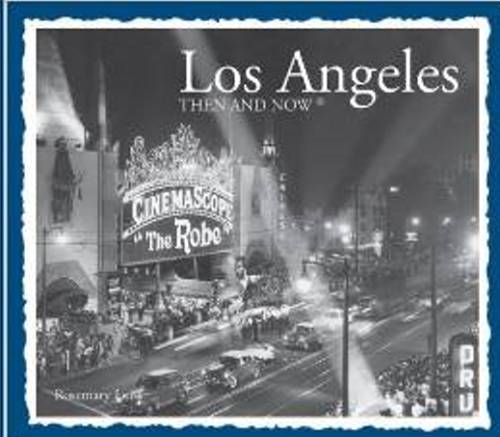
I’ve had a hectic few weeks writing my new Los Angeles Then and Now book, as I realized the June deadline was looming. Why do we think we always have more time than is really available?

I’d been in England and Greece with my family – which was lovely. But even when I was there, I was mentally figuring when and where I could grab a couple of hours to research and write. Even half an hour would help. But I’m not one of those writers that can sit down – plonk! – and start writing. I’ve come to realize that I need to come down from my everyday life. Then time to mentally flatten things out, before I can switch into writer mode.

I think this is because I am not currently writing fiction – where I find I can, if I need, plonk myself down on the corner of a table and scribble inspired lines, and even paragraphs.  That doesn’t mean that I don’t have to eventually sit down for many hours at a time, day after day, to actually write the novel I promised. But I can also write it in bits and spurts.

But writing this particular, nonfiction, book requires a lot of research. The physical – driving all over in heavy Los Angeles traffic, checking if a building is still standing and in what sort of condition, who the neighbors are and how the neighborhood is looking.  But I also do research about any construction or new plans for the building in question and the surrounding area. Thank goodness for the internet – but I still have to find physical documents from in-person library and record-office visits as well. That is after I have investigated the entire history and Government records.

I’m still begging our local offices for more information on the upcoming Olympic Games to be played in Los Angeles in 2028 – just after my book comes out. No one seems to know where any of it is really happening. They tell me they ‘hope’ but are still not sure. So I have to get very creative to sound as if I have actual facts, locations and dates! Which I don’t! And I have to write in a timeless way so that the book, which is to be published in late 2027, is not out of date and does not sound as if I wrote it in 2026. It needs to be readable for years to come and not sound dated. If that makes any sense. 

That writing project has to be my main focus currently, as I have a publisher and a deadline.

But I’m also still fighting to save the Woman’s Club of Hollywood and have spent a lot of the past 3 years appearing in court, fighting off greedy people that suddenly decide that they should own the historic landmark property! I was even sued by one of them for trying to stop them claiming they own the property now. I have learned far more about the law than I ever wanted to. But I’ve also learned a lot of legal lingo and how attorneys and court officials write and speak. And how to make them listen and believe me. I just wish I could get inspired to write some legal drama – as a lot of writing has been involved. I have written copious ‘statements’ and ‘declarations,’ addressing dishonest or bizarre claims, cleaning up witness ramblings and creating documents that swiftly and cleanly explain the current situation, precluding any wiggle room for misinterpretation. Just the facts, ma’am!  It is a specialized form of writing.  But not enjoyable, other than the knowledge that I am fighting for justice for an historic landmark.

But I do snatch time for my fun writing, as I clear my head of the other ‘stuff.’ My fun writing rambles, but sometimes results in an unfinished short story, another chapter in my second Lottie Topaz book – as yet, unfinished. Writing is therapeutic. Sometimes I just write 3 or 4 pages of what may be an essay on something. Whenever I have the time, I shall go through these scribblings and decide if I think they’re worth publishing. I have a lot of unpublished writings!

It was good to escape to Greece again, as I always manage to clear my head while I am there, and decide what in my life and my writing is worth keeping and what needs to be discarded. I get surprising clarity.

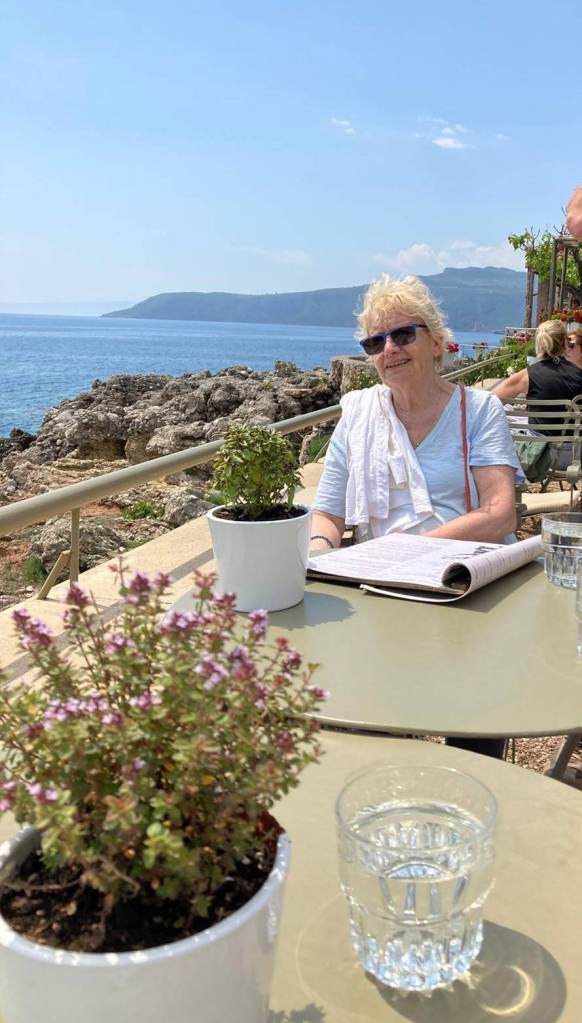
It could be the sound of the ocean just yards away from where we stay. Or the serenity of the old house we rent, where every room has many windows, all with amazing views of treetops and the ocean, or mountains on the other side, or terracotta roofs amidst the endless olive trees, and that characteristic yellow brick of the local houses. Every room has a view. There are verandas that scream for writing time, and a small, tranquil garden. What’s not to like? The challenge is, when one does sit down to write there, is to not be lulled to sleep by the sound of the waves. Especially when this follows some wonderful Greek meal. So, the struggle is enormous.  And I noticed on so many occasions there, that when the house was quiet, my siblings were all reading – before they were lulled to sleep. Everyone got through several books while we were there. We always do.

So now it’s back to reality – and writing deadlines. But I’m grateful to have a deadline and a writing deal – after so many years of chasing publishers and literary agents. That agent bit never came to fruition. But my book writing did. And so, I write on. And as long as I can write – even if it just for my eyes – I am a happy camper.

My Paper Trail

                  By ROSEMARY LORD

D’you ever forget what you’ve ordered online? I ordered a ream pack of copy paper. I was surprised because about 2 hours later a ream of 500 sheets of white paper was delivered. “That was quick” I thought. Even for Amazon Overnight. Except it wasn’t.  I’d ordered that paper two days ago – and promptly forgot. Oh well, so now I had two reams of copy paper. A writer can never have enough paper, I told myself.

As a writer, there is nothing better than to hold a fat wad of copy paper in one’s hands and know that, like magic, it is suddenly going to be covered in your very own words.

But I think I’m becoming a bit of a “clutterholic” where stationary is concerned. It was when I thought I was running out of paper – then discovered that I wasn’t – that I realized it was high time to de-clutter my stationary stash. Where does one start? Hmmm.

With great enthusiasm, I began to pull items off the shelves onto the floor. The idea was that I could sort through it all and put back only that which I really needed.

There was a lot of it. Knee deep in assorted packets of Easy Address labels, a box of hanging files, another stuffed with manila folders, a slew of tabbed sheet protectors, ‘Avery Clean Edge Business Cards’, and so on. I had many brightly colored folders – with the plan to color code and use specific colors for certain subjects.  But I hadn’t got that far yet, so there they sat. I found five packets of photographic paper – never used.

A large stack of manuscript sized envelopes – no longer needed because we send manuscripts by email nowadays. But I had liked the satisfaction of putting my sacred, written pages in an envelope with a carefully worded cover letter, beautifully addressed and stamped and the satisfaction of taking it to the post office and sending it off with a silent prayer and crossed fingers. Most satisfying.  It is still not quite the same as eventually pushing ‘send.’ There’s no tactile interaction there. Sorry, manuscript-sized envelopes: out you go.

I filled a large box with dozens of superfluous folders, hanging files, the afore-mentioned envelopes, see-through plastic folders. And what was with the multicolored copy paper?    A ream of lime green, another of yellow. Aha! I had a plan! I remember thinking I would print my Lottie Topaz novel on lime-green paper, which would catch the eye of the editors who could not resist pulling my green-colored manuscript out from the ever-growing slush pile of submitted manuscripts.  Of course, this never worked. And I still had a lot of colored paper left over. Into the charity box it goes.

The eleven spiral notebooks I could comfortably justify. I start my writing projects scribbling in such a notebook and fill it with the outline, a plot line, then many pages of character developments, colorful backgrounds, relevant plot through-lines and dénouement thoughts.  But these were all empty. So, eleven times I bought the notebook and had not used them, so that they ended up on the shelf next to the others.  Although, in my defense, on another shelf I discovered a whole stack of well-filled such notebooks, from cover to cover crammed with handwritten ideas, characters, names to use. I did something right.  Except, why were they sitting on a shelf in the cupboard, instead of on my desk, ready to be used in my next book? But eleven abandoned, empty notebooks? Not good.

As a writer of historical books and novels, I do a great deal of research. I was smugly satisfied with the idea that I had organized my research and kept copious copies of articles on historic figures, historic buildings, historic happenings. Problem was that I had obviously found these subjects so interesting that I just had to print them out, save them and file them.  Now I was faced with two boxes of such printouts. On closer examination, many of them were duplicated. Besides, with today’s technology, I can find a lot of what I want on the internet. I saved only a few of these – in the bin with the rest of them. I said a quick “sorry” to all the trees who had given their lives to support my paper clutter addiction.

I found a whole stack of papers marked “for filing.” Glancing through them, they were clearly not interesting enough to have been filed, and I could not see why I kept them. So, they were gone, too.

And then I looked into the box-files, where I had stored many years of handwritten notes, hastily scribbled on old envelopes, paper scraps, on the reverse side of something else I’d written. What was I thinking?!  That investigation into my stationary cupboard was quite overwhelming and I knew I had to get a grip on it.

I have a new friend at the Woman’s Club who is the ultimate in techie-nerdiness. He persuaded me to get a scan-copy machine and showed me how much easier and quicker it is to scan things I need to keep, or interesting articles I want to read when I have time. Now I can access those papers, research articles, my copious writing notes and half-finished books wherever I am – on my laptop or even on my phone. And they only take up a quarter-of-an-inch-square on my desktop. Who knew? And, because I am still a bit leery of all this techno-wizardry, I still copy everything onto flash drives, just for safe measure.

I hate to admit it, but my endless trail of paper collecting has forced me into the scary world of technology, if only to save the trees.   But I still cannot resist a lovely clean notebook or legal pad, with pencil poised, so I can unleash my imagination and create a whole new world for myself and my readers. And this is where the paper trail continues.

Stop and Go

By Linda O. Johnston

No, I’m not talking about traffic. I’m talking about writing. And I think all writers experience stop-and-go in their writing at various times. Maybe all the time.

The “go” is the best part. We figure out what we’re writing about, plan it, plot it, and do it. Go for it. With me, that’s most of my writing life. I’m always writing something, or planning in my mind what’s coming next. Telling the computer what’s on my mind, via my typing fingers, always helps too.

But then there’s the “stop.” That’s when you at least slow down, have other things in your life that get in the way, maybe (shudder!) even have some writing issues that slow you, then maybe let you grind to a halt—hopefully only for a short while. But the interruption can definitely matter.

I’ve recently been having more slowdowns and stops than I’m happy with. Breaking my arm, which slowed my ability to type, is certainly among them. So is receiving extensive edits and questions about a manuscript I recently submitted. That’s what I primarily need to focus on now. Is it stopping the rest of my writing? No, but it’s not allowing it to go as fast as I’d like. But I do concentrate on figuring it out so I can get back to what I was already working on, and more.

How about you other writers? Do you always get to focus on what you want to write, move forward, and enjoy it? Or have you also had some issues that slow you down, maybe stop you for a while?

But the great thing about being a writer is that we’ll deal with it and go forward with our writing. Right? Write!

Listen to Any Lyrics Lately?

by Jill Amadio

Listened to any lyrics lately? I seem to be spending far more time in my car than usual and, of course, I have my CDs at the ready.

I have to admit, shamefully, that I never truly considered songwriters to be real writers. Yet, they record their daily lives, romances, disappointments, failures, joys, and happiness with succinct and clever poetry and core messages that perfectly fit the moment.

My favorite is Leonard Cohen’s “Hallelujah” and then all of his other works. I enjoy singing along with him until he slides into recalling some of his private, sexy moments for all the world to share. I quickly fast-forward.

His writing is pretty explicit even when he writes about religion, and I am sure his childhood and into adulthood included prayer and participation in services.

Which brings me back to lyricists and their skill at fitting words that we often fling about so wildly, are perfect for the composer’s work. Only Frank Sinatra did it ‘his way’ and sometimes scrambled words together and stretched them out, to my mind. I have never attempted to write a lyric, although I was forced to dabble in some corny poetry in school. It never occurred to me that songwriters, both those who write the words and those who compose the music, were so gifted and creative. Interestedly, they manage to make simple sentences sound beautiful when sung. I urge my memoir writing class students to read their prose aloud and none have ever broken into song. Maybe that’s a good thing. But I am sure that lyricists practice their sons aloud as a way to judge their effect.

It amazes me how songwriters like ABBA and “The Mommas and Poppas” manage to squeeze a lifetime of hurt and happiness into a 3-minute song. It is understandable, of course, when they are singing about one specific moment, but even that requires a skill that many regular writers lack. I wonder if they trim and edit, as we fiction and non-fiction writers do?

I have never met a lyricist, although I have several poet friends, and I watch time and again movies about composers, although the films rarely ask, to my mind, the crucial questions, such as must the lyrics rhyme? Whence comes the inspiration?  Like many famous writers who are the subject of other writers’ biographies, the nitty-gritty of lyric writing and composing are often lost in the labyrinth of their concert performances.

I have read that lyricists and composers work together, but which comes first? Are the words arranged to fit the music, or vice versa? Does erasing carefully-conceived words annoy the lyricist as our editors annoy us? I remember reading that Ernest Hemingway had huge fights with his editor, Max Perkins at Scribner’s, who invariably won the battle and improved the books so magnificently into bestsellers.

I don’t recall any such fights between songwriters, but I am sure there were plenty. Perhaps they were short – like their songs, although I can’t imagine the writers of the lyrics criticizing the music unless they are composers themselves.

.

Perhaps we mystery writers should try to create a murder that can be described in just a few words, a one-page short story, although some songs have several stanzas. It seems that more contemporary songs are brief and to the point, except for country-western, which are often depressing and mostly seem to be about lost love.

Of course, once we’ve murdered the victim in our books and solved a sub-plot or two, finding the killer could take up an entire music album. Perhaps ancient people wrote songs although archaeologists only appear to discover crockery and texts. What would their songs sounds like?

These literary musings are a rather fun way to procrastinate although I am actually seated at my desk and using my laptop. And, I am writing!

A WORLD OF BOOKS…

by Rosemary Lord

Books. That’s what most of us aspire to write. And most of us writers read – a lot!

As Cicero said: “A room without books is like a body without a soul.”  I wholeheartedly agree!

Baudelaire wrote: “A book is a garden, an orchard, a storehouse, a party, a company by the way, a counselor, a multitude of counselors.”

And J.K. Rowling believes that “something magical happens when you read a book.”

While Honore de Balzac wrote, “Reading brings us unknown friends.” How true.

And I think that the books people have in their homes says a lot about themselves.

I remember visiting Rudyard Kipling’s house, Bateman, in Sussex, England. The 17th-century, wood-paneled house is filled with souvenirs from his travels to India and beyond, his dark, imposing library has floor-to-ceiling shelves crammed with encyclopedias, travel books, biographies and local-culture tomes from his exotic wanderings.

A much brighter house further west in England is Agatha Christie’s beloved Greenway House, situated in a rambling woodland garden on the River Dart in Devon, England. Like the rest of the sprawling house, Christie’s library is bright and sunny. The cream-colored shelves are filled with an array of crime-writer’s reference books of deadly poisons, murder weapons, infamous murderers, biographies as well as her travel pursuits. There are many books on archeology, Egypt, Syria and the Middle East. Christie accompanied her archeologist second- husband, Max Mallowen on his trips to the Middle East. She would catalogue the finds, methodically taking notes which would often later be used in her novels, such as ‘Death On The Nile.’  But in that sunny library, the most admired books are the shelves brimming with copies of all her own novels in their original or amended titles in English and a host of other languages.

Whilst most of us don’t have room in our homes for our very own designated ‘library,’ we do have bookshelves, or places to store or display books.

On the other end of the spectrum from Agatha Christie’s spacious, airy and very comfortable library, my own ‘library’ in my small Hollywood apartment is simply five bookcases in my living room crammed with my life readings.

The shelves are filled with books on the Golden Era of Hollywood and the history of Los Angeles. I have all of Agatha Christie’s novels, various mystery writers both past and present and a vast selection of ‘cozies.’ I have a lot of books written by fellow author friends. Of course, there are the mystery-writers’ required reading: ‘How to commit a murder’ books, forensics, poisons and other reference books.  On my bedroom shelves are my escapist novels by Rosamunde Pilcher, Victoria Hislop, Santa Montefiore and Paul Gallico.

Most of my writer friends have fascinating collections of murder/mystery/crime books, romance-novel or science-fiction ‘How-to’ publications, as well as assorted guides to publishers, literary agents, self-publishing and more. I have a friend who has wall-to-wall shelves filled with books about every musical ever produced, books of lyrics, sheet-music and musical biographies. Guess what his interest is?! Others have an array of nutrition, cook-books, photography or – like my late-husband – motor-racing or herpetology: the study of snakes.

The contents of people’s bookshelves reveal their focus in life: be it travel, biographies, photography, bird-watching, theatre or needlework.

I recall a brief visit to a young wanna-be Hollywood actress’s apartment. It was sleek, cool and very trendy, her wardrobe similarly up-to-the-minute. But there was not one book – or even a magazine – in the place. “Books?” she shrugged dismissively, “I’m not interested.”

 I still reel with shock at that image! (She only booked a couple of small non-speaking acting jobs then disappeared!)

Conversely, when my family and I stayed in an old house in Portugal, my room had bookshelves crammed with books on Mussolini, Stalin, Hitler, ‘Mass Murderers of the World,’ Nazis, World Wars, battles, ‘Mr. Nice: the international drug smuggler,’ Napoleon, Fidel Castro, ‘The Bin Ladens,’ ‘The Mind of a Murderer,’ and some Lee Childs’ Jack Reacher novels for light reading. All in Portuguese. There was a large, framed poster of a hand-drawn man’s face with several stab-marks, red slashes and undecipherable scrawled slogans. I quickly removed this and hid it behind an armchair. But the bed was very comfy and, surprisingly, I slept better there than I had in a long time.

One of the other bedrooms had a brighter selection of Hitler and Nazi books, mixed in with Winston Churchill and world political leaders. All in Portuguese. Another room had some travel books. How did that person fit in?

The general décor of this 1887-built house was grand but somber. The walls in the rather grim, marble-floored entrance lobby, and the walls of the sweeping staircase were filled with neat rows of gilt-framed, black-and-white etchings of various battles, warriors, death, solemn religious figures and crucifixions. So were the walls of the formal front parlor and the even-more formal dining room.  The walls in each of the bedrooms and the long corridor leading to one of the spacious, marble floored bathrooms were similarly adorned.  All the drawers throughout the house were locked. Even the Canaletto print over the fireplace was mournful and colorless. And so the selection of the books in this rambling old house was not surprising.

I remember my dad’s bookshelves were full of mysteries and police stories. His father had been a detective in the Bristol Constabulary. Dad had his Agatha Christie selection, of course. But his favorites were Arthur Conan Doyle, G.K. Chesterton, P.G. Wodehouse and George Simenon – which he read in English and the original French.

Mum, on the other hand, had favorite authors that included H.E. Bates, Laurie Lee, F. Tennyson Jesse (A Pin to See the Peep Show), Paul Gallico, John Steinbeck and W. Somerset Maugham, with whom she became regular ‘pen pals.’

I’m very blessed that I grew up in a book-loving family. For as long as I can remember, so many family conversations have turned to books old and new. Our mum wrote magazine articles, and all of my siblings have always been involved in the book or writing world in some way.

So, I guess they’re in my blood. Books, that is.

So, what books would we find on your bookshelves and what does it reveal about you?


………………………………………


IT WAS THE DEAD BODY IN THE LADIES’ ROOM…

by Rosemary Lord

She was enjoying such a lovely holiday exploring the English Devon Coast, the charming fishing village and the cream-teas that were to die for. But it was the dead body she found in the Ladies’ Room of the church hall that made her pause. It was most inconvenient…

How come my mind goes to those bizarre ideas – and gruesome murders – or at least a simple dead body… I mean, it’s not like I am a mass-murderer – or that I even killed just one person – not that I recall….

Maybe I should have continued that opening as a sweet and charming Cozy. I do write Cozies, too. I’m not always weird.

Perhaps, I should be writing some ladylike Regency, Jane Austen style romance, or a simple bodice-ripper. Or a sci-fi marvel. Or a very clever spy thriller or possibly a police procedural. Or perhaps not.

But my writer’s mind just goes there. My sister thought it was because our grandpa was a police detective. Could be…  So, it’s probably a good thing grandpa wasn’t an insurance salesman. I mean, even a door-to-door salesman would have more interesting tales to inspire a writer.  

But where would we be without our writing, without our amazing world of imagination to escape in to. I often think how lucky we writers are. When life gets really tough, when things around us are going haywire, (like today!) when we’ve had more than just a ‘bad-hair-day,’ when we think that Life has given up on us – we have our writing to retreat to.

Make a nice mug of coffee or tea, settle down in our comfy office chair, a blank page in front of us and away we go. Whether it’s with pencil and pad or the familiar clacking of the computer keys – we are transported to another world. Our Writer’s World.

Tough to explain to anyone who doesn’t write. But suddenly we’re galloping across the Sahara Desert or sneaking through the back streets of Charles Dickens’ London or stretching out lazily aboard a luxurious yacht.  How about enjoying a gourmet meal in a super-posh Paris restaurant, swimming in the Mediterranean – or walking across Regent’s Park, hearing the elephants at London Zoo in the background. Or climbing Mount Everest – if that’s where your mind goes…

You see how endless a writer’s imagination can be? And what a wonderful diversion from the tough times in the Life-of-Hard-Knocks, a distraction from everyday humdrum, or just a brief diversion from today’s offering.

Mark Twain said, “write what you know.” Which is sometimes very useful. But I find it much more fun to write about a world that I never inhabited. Besides, I absolutely love researching. I devour all the books, articles, newspaper clipping to do with whatever I am writing about. I especially love reading the 1910 or 1918 Sears & Roebuck Catalogues. Just like the adverts in old magazines, one can tell so much about life in those times when you see what they wore, household items they used and the hobbies they had. There are endless opportunities for stories in those pages. Even looking at the world around us today. The Farmers’ Almanac in Kentucky will have advertisements that spark an idea, or a fishing magazine in Finland, a local paper in New Zealand or the Scottish Highland Times – all sources of tidbits of ideas that, like Topsy, will grow. I find the Obituaries in these far-off places fascinating – apart from providing me with a cornucopia of character names to use.

What other profession gives one the opportunity to snoop, eavesdrop and blatantly plagiarize another’s life? The snooping is most fun!

And we get to add historical figures into our mix. Where else could one throw in a vision of the evil sinner Sisyphus, condemned to an eternity of pushing a boulder up a mountain, only to be thwarted once he got to the top, when the weight of the boulder forced it to start rolling downhill. So, he had to start again. And again. Or how about our use of oft-quoted characters from Shakespeare? You see – we get to use it all if we want.

So, after an extremely busy, stressful day at work, I retreat into my world of writing – this Blog being way overdue. And somewhere in my brain I am now thinking of taking that opening paragraph and running with it. Murder and mayhem in Devon anyone?

            Whatever odd twists and turns my writer’s brain takes, I always feel so relaxed and satisfied when I can print out a new page or three. So maybe it’s a good thing to have that weird streak? I just know how lucky we writers are to have that Writers’ Place to go to.

MAKING THINGS FIT….     

By Rosemary Lord

Whether it’s time or words – it’s an ongoing challenge for me.

Not having the luxury of a 30-hour day, I’m always trying to squeeze things in, so that, apart from ‘work’, I can have some sort of personal life, family time and of course writing time. As I struggle to transfer my workload at the Woman’s Club of Hollywood to a new dedicated crew, it’s taking a lot longer than I anticipated – and about 6 new people to do the work I’ve been doing on my own for so long!

But – I will make it all fit.

I designated Sunday as MY day, when I will not deal with any Woman’s Club work and only speak with family, friends, potter, catch up on housework and fit in some writing time, too. My ‘work phone’ is switched off. This is the only way I’ve been able to catch up on my personal life, finding serenity, make things fit – and even make time to paint my nails – a pale blue this week! I cherish my Sundays.

I envy some of my friends who retired early and travel all the time. I just can’t fit that in now!

 And then there’s making things fit in my writing. I have three major writing assignments at the moment.  A non-fiction, 144-page coffee-table history book, an historical novel and a memoir. So far, I’ve not had the time – or the mental focus – to sit for hour after hour, day after day, as I used to, to complete one of them. I tend to fit in the odd hour or two and peck away at one of my projects. Although my mind is always working overtime thinking about them.

First, in fiction, especially in mysteries, I have to get the right name for my characters.  I have to make the name fit.

I mean, you can’t really have an exotic, sultry siren called Mary or Jane, could you? Sophia or Camille, maybe. Or a tall, hunky, sun-bronzed hero called Arthur or Reginald, doesn’t really work, does it? The names have to fit the character, the story, the era, the background, in order to be believable.

Although one of my pet peeves as a reader is to have the characters all having a similar sounding name, especially in the same scene: Fin, Tim, Dick, Nick, Rick – or Jim, Jon, Jan, Jen, Janey, Jed and so on. I make a point of making sure the names differ in sound and length. You’re not going to get confused when characters names are specific for the storyline and sound different. Such as a Jim, Stephen, Montgomery, Drew and Samuel. Or Roberta, Annie, Pamela, Sue, Gwendoline and Florence. Different lengths and starting with different consonants. Easier for the reader (and me, the writer) to keep track of.

I always feel challenged with the word-counts we’re given. Tough to fit all I want to say within their limits. Should my work be a short-story, a novella, a novel – or a War and Peace tome? My storyline has to fit into the right category.

Then I (hopefully) unobtrusively, fit in the clues and red herrings. Remembering the villain needs to be seen, fleetingly, very early on in the story. Almost hidden, with no big flashing neon signs. So that at the end, when all is uncovered, I haven’t cheated my readers by suddenly announcing: “By the way, the Butler, whom you’ve never seen before, did it.” As a reader I like to think I know ‘Who Dunnit,’ but I’m not sure and I keep trying to work it out. Then the satisfaction at the end of saying “of course!” and retracing the steps to figure it all out for myself. So, I have to make sure that it all fits in.

And I have to fit in the adversity, the challenges, the processes my characters go through, without the reader aware of what I’m doing.  Static stories are boring. My characters need to lose something – or fear losing it. They must process crisis – large & small – then recover and carry on obliviously enjoying life, until another surprise stops them in their tracks from an unexpected source. Unseen forces. Another deadly trap.

It was Raymond Chandler who said, “there’s no trap so deadly as the trap you set yourself.”

Whatever that means. But then it was Mark Twain who said: “write what you know.”  So, between the two, I should have a story somewhere!

And somehow, I will fit in the time to make it all happen.

Writing anything is a challenge, but writing mysteries is a unique adventure, unraveling the human mind. It’s like designing a large jigsaw puzzle, making all the pieces fit.

So, I’ve become very proficient at making things – time and words – fit. How about you?

Seven Story Plots

By Jackie Houchin

I recently talked to a young man involved in theatre at his university. He longs to write a play or musical and has all kinds of ideas about special effects, music, and costumes. He has even imagined a few characters. But he has no story. No plot, only a few imaginative scenes.

I told him there are just a few basic plots in the world from which all books and plays originate.  I told him there were five, but on researching them, I found it is seven. (Christopher Booker’s 2004 book The Seven Basic Plots: Why We Tell Stories.)

Here they are.

  1. Overcoming The Monster.

Christopher Booker suggests Dracula by Bram Stoker, The Lion, the Witch, and the Wardrobe by C.S. Lewis (the White Witch), or The Help by Kathryn Stockett.  In the “monster” story, you need a chilling threat (human or not) and a brutal contest that will probably require a significant sacrifice.

  1. Voyage and Return.

The Odyssey in Greek myth and The Hobbit by J.R.R. Tolkien are examples. Your protagonist will need a dangerous journey or impossible quest with an uncertain outcome. He needs opportunities to turn back but to show heroism, he will continue and return with new strength.

  1. Rags to Riches.

Cinderella, Jane Eyre by Charlotte Bronte, and Memoirs of a Geisha by Arthur Golden are all examples. Your protagonist should grow in character, strength, and understanding, helping them to be empowered. This sometimes involves romance.

  1. The Quest.

The protagonist sets out to find someone or some object, like buried treasure. At each step the stakes need to be raised, making it harder and harder to achieve. The hero emerges stronger or more mature.  J.R.R. Tolkien’s The Lord of the Rings and J.K. Rowling’s Harry Potter and the Deathly Hollows are examples.

  1. The Comedy

The idea of Comedy is to create many misunderstandings for the protagonist to get involved in. The plot continues to muddle events, feelings, and perceptions until the end when all will be “miraculously transformed.” The action moves from dark to light. The Inimitable Jeeves by P.G. Wodehouse and Bridget Jones’ Diary by Helen Fielding are examples.

  1. The Tragedy

Tragedy is the opposite of Comedy and goes from light to dark. The protagonist has a deep flaw or makes a horrible mistake, causing his undoing and failure. Think of all the “if onlys” that could have happened. Give him ways “out,” which he won’t take, then close off any exit options. Classic examples are Othello, King Lear, and Macbeth by Shakespeare, The Great Gatsby by F. Scott Fitzgerald, and Anna Karenina by Leo Tolstoy.

  1. The Rebirth

Rebirth is like a tragedy but with a hopeful outcome. The protagonist’s journey has a redemptive arc and sometimes includes romance. The “happy ending” should depend on that arc. Fairy tales are good examples, as are The Secret Garden by Frances Hodgson Burnett, Emma by Jane Austen, and The Kite Runner by Khaled Hosseini.

Of course, you can combine multiple plots and add subplots, too. These seven plots are a guide to building your story.  You can elaborate as your fancy suits you.

Now, give it a go!

LET GO AND LIVE….

by Rosemary Lord   


I went to the zoo. London Zoo. With my brother Ted. We took a picnic.

It was a lovely sunny day in May, shortly after my birthday, as we sat by the fountain enjoying our sandwiches. Just like we had done as small children – just yesterday!

Oh, the pleasure of revisiting such childhood memories.

Since then, the London Zoo has improved greatly, totally remodeled with expansive, imaginative new areas for the animals with the Global Wildlife Conservation programs. We saw the wonderful abandoned 1950s Indian railway station that is now The Land of Lions, complete with abandoned luggage, old handcarts and peeling, vintage Bollywood movie posters, to make these endangered Asiatic Lions feel they are still in Gujurat, India. The Sumatran tigers have their own roaming wilderness, as do the wild African rhinos. All endangered species, now thriving in this spacious conservation program. Even the butterflies have their own newly designed habitat. Each sanctuary was as fascinating as the last. It was an educational joyride.

Yes, I was in England visiting my family for the gathering of the Lord clan. After London, my siblings and I went back to the small fishing village in Greece that we’ve been returning to for several years. Not telling you where or it will get overrun with tourists! This is where we enjoyed leisurely dinners in the harbor, overlooking the small fishing boats. Souvlaki (chicken skewers) and moussaka still favorites – at around $14 a head including lots of wine and other dishes! We spoke of books and writers. We always come back to books and writers. Richard Osman’s Thursday Murder Club was much discussed as a well-thought-out Agatha Christie-style mystery. Also on the reading menu were Mick Herron’s Slow Horses, Victoria Hislop’s latest, The Figurine, and Sinclair McKay’s intriguing book about The Secret Life of Bletchley Park. I love those World War II books. And am fascinated to learn more about the young women at Bletchley Park, who, having signed the Official Secrets Act, never spoke of their heroic work.  

We wondered whether today’s kids will be as voracious readers as we were and still are…

We spent a couple of days in the delightful waterside town of Nafplio, an hour south of Athens. More delicious Greek food and friendly Greek hospitality.

Back in England, our wonderful, long-suffering brother-in-law, Peter, drove us to Broadstairs, in Kent – next to Ramsgate. What fun! It’s a lovely, old-fashioned ‘seaside’ town. It was one of Charles Dickens haunts. Bleak House stands on the top of the cliffs overlooking the expansive beaches. It’s a leisurely mix of old and new. The Edwardian and Victorian architecture, the Kent and Sussex painted wooden beach huts and wooden fishing and boat structures at the waters edge, unspoiled, next to charming new buildings. Beachside shops selling souvenirs, buckets and spades and saucy postcards. Fish and chips for lunch, of course. Perfect!

This was my much-needed escape from Hollywood and all the dramas of the Woman’s Club. To my jaded eyes, it seemed so much easier to be a writer in London now. Lots of cozy cafes in which to write the next best-seller and to swap literary tales with aspiring and established writers. They are everywhere in London.  Cafes and writers, that is. And there are endless magazines to read, too. Several have selections of short stories.  Where did the American writers’ magazines go?

And this time away gave me the chance to take a look at what I had been doing with my time and where I was going.

I read a piece by DJ Adams on ‘Letting Go of Expectations…’

She’s right.  As writers and artists – how perfect do we want to be? And who decides what is perfect? “To fully embrace your creative artists or muse,” she writes, “You must learn to let go. Let go of who you think you are, releasing your idea of what your creative gift is and what you expect to achieve. This is so contrary to everything we’ve been taught in order to be successful. So instead of holding on to who you think you are (noir novelist, oil paint artist, songwriter) stand back and observe your abilities. Just like our personalities are ever changing, so our muse has many faces. Our creative consciousness absorbs. Let yourself go. Experiment without considering the outcome. Stephen King said ‘Good writing is often about letting go of fear and affectation…’ Let go – to grow!”

Sounds good to me.

“It’s not where you start – it’s where you finish…” wrote Dorothy Fields, lyricist for the Broadway musical Seesaw, “It’s not how you go, it’s how you land.”

And Ralph Waldo Emerson put it another way: “Life is a journey, not a destination.”

And so, as I flew back to my Hollywood home, I thought a lot about those words.

I think many of us are still working with the adjustments forced on us by the Covid nightmare. And all of those challenges that crept up on us. Life is different now. Reading and writing habits have changed, too.

Now, I decided –  I wanna be FREE! I wanna be ME! I have so many untold books and stories in me, I feel I’m bursting at the seams. I gotta lotta writing to do!!

So, I’m ready for new horizons. I’m ready to let go. Not sure where or when. Not even sure who I am anymore. Just one big leap of faith into an amazing creative future.

Who do you think you are today? What do you expect of yourself? Or do you like where you are now? Eh?

LAVENDER and BURNT TOAST

      By ROSEMARY LORD

“Lavender and burnt toast.” A book title? A recipe? Sounds intriguing.

I have racked my brain to figure what this was about. I had written this in a notebook of story ideas. But then I have a plethora of such notes, squiggles, post-its, unfinished paragraphs in multiple notebooks and single pages – of ideas that swirl around my head – spilling as hurried notes in these many notebooks. But, over the years, I have become a lot more organized. I have actual files – with labels!

            It took me back to Professor Randy Pausch’s gem of a book, The Last Lecture, which he undertook during the last months of his life after a terminal cancer diagnosis. It was about overcoming obstacles and seizing every moment. “Because,” he said, “time is all you have – and you may find one day that you have less than you think.”   

“Time must be explicitly managed, like money,” he observed. And “Ask yourself, are you spending your time on the right things?”  Most useful was, “You can always change your plan, but only if you have one.”

But the thing I remember most was his thoughts on being really, super organized. Randy’s wife was against having everything filed and alphabetized. She said it sounded way too compulsive. Randy responded, “Filing in alphabetical order is better than running around saying, “I know it was blue and I was eating something when I had it.” Sounds familiar. How often have I been heard to mutter, “…It was blue and I was eating something……” as I rummage through my boxes of writing files for some specific pages of an unfinished manuscript.

“It’s not where you start – it’s where you finish…” wrote Dorothy Fields, lyricist for the 1973 Tony Award winning Broadway musical Seesaw, which was based on the William Gibson play, Two for the Seesaw.  “…It’s not how you go, it’s how you land.”

I’m not so sure about that…I’ve always favored the maxim that it’s the journey that counts. It was Ralph Waldo Emerson who said, “Life is a journey, not a destination.”

            Do you ever look back at the journeys you have been on – or had thrust upon you? Journeys are adventures. Because it’s on those journeys that we discover exciting detours and encounter fascinating people.

Even if it’s literally a train, plane, bus or car journey we’re taking. Just think of people you met along the way, places you saw. This is, after all, where many of us writers find our inspiration. From the people and happenstances along the way.

We can see how things have never got back to the way they were, since the Covid lockdowns. So much changed. We’re in a different reality now. We were shut-ins. As writers, we had more time to ourselves to write during the shutdowns. But the regular writer gatherings and frequent workshops and writers’ conferences have been very slow to return. And they were such fun, where we caught up with fellow writers from across the world, met new writers, editors, experts and publishers, heard new ideas, discovered new talent. I’ve missed them. Zoom meetings are not the same.

Sometimes one feels like Sisyphus, earnestly toiling away to survive and thrive in this new world, dealing with the puddles that life frequently presents for us to jump over.    

In Greek Mythology, Sisyphus was condemned to an eternity of pushing a boulder up a mountain. Once he got to the top, the weight of the boulder forced it to start rolling down to the bottom, wherein he had to start again.  According to Albert Camus, the Greek gods felt that there is no more dreadful punishment than this futile and hopeless labor for Sisyphus. Hmmm. Sometimes life feels like that. Oh well. We soldier on, dealing with the adventures and challenges of our regular lives and balancing our writer’s goals and dreams.

Then, just when we least expect it, something magical happens. We discover a new author whose words inspire us to try something new, encourage us to take a leap of faith into the unknown. We hear a new piece of music or see a new painting that re-awakens that creative spark. We make a new friend or meet someone who has that missing piece of life’s jigsaw we have been trying to complete. We never know where or when that serendipity appears.

And with the freezing winter and endless rain we have all been living through, hopefully now in the rear-view mirror, Spring is just around the corner. So it really is the time to start thinking of planting new seeds. New plants. New crops. In our gardens, window-boxes and in our lives. Maybe something different this year. Read something different. Write something different. But most of all – time to make fresh plans for the year ahead, seek new ventures, add new goals to our To Do lists.

Whilst I try to remember what Lavender and burnt toast was all about….