
By Madeline (M.M.) Gornell
 Seldom do I put together a new year resolution list, or a last year in retrospect list. Something about lists, I guess… Yet, this post might fall into the latter category—sort of. This n’ that are the “ones” which got away. The snatches of thought which weren’t quite big enough for a full post. Or “ones” I thought at the time were of dubious value. Every seven weeks I strive to come up with a post that might make a difference to someone regarding their writing; and during the process and quest for nuggets, over this year of ideas—“many” have flitted through my mind, only to be sent to the “not-quite” slush pile.
Before I start my list which isn’t really a list, here’s a little back story on how I got to this post. My Christmas holidays were spent, reading, watching DVDs (Miss Marple with Joan Hickson, Campion with Peter Davison, Inspector Alleyn with Patrick Malahide, Midsomer Murders with John Nettles, and Maigret with Michael Gambon), and napping. I didn’t get to Christmas cards, didn’t have any guests, barely went anyplace, and did NO housework. Did bake bread. And when I wasn’t doing all that hard work (smile) I was thinking about writing—how to make it better. Somehow, from bingeing with/on my favorite mysteries, reading my favorite authors,[i] eating far too much warm bread, mulling over possible plots, and thinking about my “next writing steps”—came this post! So, here are a few this n’ that tidbits:
- Besides the musicality in writing (a previous post), imagery as in a
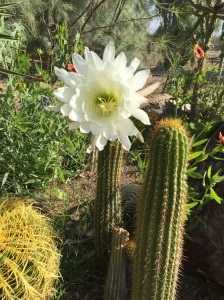
There was the idea of challenging everyone to describe these cacti. I couldn’t do it, so I passed. mental-pictures, which take me to new and often beautiful places, was an idea I started a post about. And a corollary thought to location imagery, is the imagery of ideas and emotions. In my mind, right beside scenes from movies, are the imagery Louise Penny brings forth in How the Light Gets In, Carlos Ruiz Zafon in The Shadow of the Wind, Robert Haig in Fire Horses, Paul Alan Fahey in Lovers and Liars, and P.D. James in all her novels–but especially in The Black Tower.
- Then there’s the small topics—only paragraph explanations at the most, like alliteration[ii]) such as “nattering nabobs”[iii] which has always tickled my ear. It’s not the meaning, it’s the sound. Another paragraph is on writing customs and conventions; such as Prefaces, Prologues, Lists of Character, and town/village maps. The thought here is, I had an idea of writing about how many of these writing customs were around as I grew up reading—and now they’re gone, which saddens me.
- And then there was the post I was going to tackle about writing styles, right after I’d read P.D. James’s posthumous latest, then read James Patterson’s latest, both of which I enjoyed.[iv] Totally different though, with P.D. being more to my taste. Next I started Carlos Ruiz Zafon’s latest (and haven’t finished yet), where he combines story telling ability, plot movement, atmosphere, and approaches the beautiful imagery of P.D. James. The thought was about the successful bringing together of different styles.
And what is the writing advice or inspiration to myself and anyone looking for writing tidbits from my this ‘n’ that hodge-podge? I think it is to take a moment once in awhile, then take stock of what you love in and about writing. Continue questioning and striving. And here, I’m stealing directly from P.D. James, “Write what you need to write, not what is currently popular or what you think will sell.” I’m taking that thought and running with it. My version is, I’m going to try to make 2017 a Julia Child type of year—live with (writing) abandon when possible, and for me, also with plenty of butter!
[i] “Read Widely and with discrimination.” P.D. James
[ii] As mentioned by G. B. Pool in an earlier post.
[iii] William Lewis Safir “nattering nabobs of negativism”
[iv] Trying to find my next book-club selection/recommendation! Haven’t found just the right one yet…


 My fellow fish in the sea of writing, Writers In Residence in particular, have finished products that are enduring; books bound in soft or hard covers, given as gifts, re-read, treasured, shared among friends, and at the very least, end up on Friends of Library book shelves or even at yard sales at discounted prices to be bought and re-read again.
 About being the odd man (woman) out…I actually feel comfortable among my book writing and selling sisters. And if I can promote them, inspire them, write about them or their books, I will. (Look forward in the next months for some blog posts in which I feature these WWWs, or WIRs – you know, the talented, passionate, fun, interesting friends in our little lake of scribes.)

 If you ever come to my house you will see small notebooks all over the place that I can grab and jot down an idea if it drops out of the sky. And they do on occasion. My fellow author, Bonnie Schroeder, gave all us Writers-in-Residence ladies a notebook and pencil set for the shower that writes in the wet. What a concept. So I am covered wherever an idea strikes.
 Stories are everywhere. The writer just has to see the possibilities. But remember, as a writer, you control your world and you can twist the story into something unique if you try. Just try not to twist it into something that doesn’t make any sense. More and more TV shows are turning into pretzels that barely make sense. That’s why I read more books than watch television.
 Now how about the middle? There it sits. Is it a big, hulking middle that the reader has to push around the dance floor with no music or is it thin and bony with no rhythm at all? This middle section is where the reader learns all the little things that hold the story together. Some backstory and some character traits are sprinkled in along with the bulk of the plot. Whether it’s on the high-calorie side with lots of detail or maybe a diet plate with most of the fat is trimmed off, you have to make the middle tasty.
 Editing happens here. Add a little to enhance the story. Cut some off to make the pages turn faster toward the climax. Sweeten it with some good dialogue. Add some choice settings to give it flavor.


 my hands trembled; and my previously well-organized thoughts scattered like dandelion fluff. I could tell from the pitying looks on my colleagues’ faces that my talk was a total disaster.
 g Dreams, I was able to jump right in and pitch my novel to the group, and their enthusiasm and encouragement carried me through the launch and on into a string of other appearances. Several of the club members even came to the book launch to show their support. The group has become a treasured part of my writing life.
 , I realized I’m not scared anymore, and that awareness was the same kind of high I get when the solution to a thorny story problem suddenly comes clear.
 ng to make your words heard, you can focus on more important issues. I used to be afraid of microphones, until I realized how much easier they made things. Take whatever’s available—and if you’re using a hand-held mike, clamp that arm to your side and keep it there; gestures are great, but you don’t want to be waving that mike all over the place.
 The Writers in Residence
You must be logged in to post a comment.