Mystery People, Jessica Speart

by Jill Amadio

Few mystery writers pour their personal passion into their fiction to get their message across as successfully and as brilliantly as multi-book author Jessica Speart.  Published traditionally by such as Severn House, William Morrow, and others as one of the most addictive thriller series, the acclaimed American author’s plots are based on true, wildlife issues.

Elephants slaughtered for their tusks, sharks for their fins, rhinos for their horns, and other species for their rarity, many endangered, form the focus of Rachel Porter’s action-packed sleuthing. An agent for the U.S. Fish and Wildlife Service, (USFWS), the fictional character is a composite based on real agents who investigate smuggling, murders, and criminals who break the laws that cover illegal species trading.

Casting a worldwide net, Speart sets her mysteries in several American states, and peoples them with characters in Mexico, Russia and other countries where illegal hunting is at its most prevalent such as Hawaii for its rare reptiles and exotic birds in Florida, but what stands out the most is the remarkably meticulous and detailed research that Speart brings to her books. The reader learns a wealth of fascinating facts told in an often-humorous style while at the same time learning how poachers work, the tools needed to trap tortoises, and the clever ruses criminals use that include the rich and famous with their collecting obsessions.

Doing research is essential to my writing,” she said. ”The idea is not to just make things up [but] to provide facts in a compelling way.”

An investigative freelance journalist for several years after studying theater at the Boston University College of Fine Arts, and stints as an actress off-Broadway, in commercials, and soap operas, Speart switched from acting to writing.

“I needed to get away for a while and ended up going to Africa. It was there that I witnessed the poaching of elephants for their ivory and rhino for their horns. I came home determined to do something to try and help.”

Speart took a direct approach and began her magazine career writing stories about the USFWS special agents and their investigations. She became fascinated with their work. Many of her articles involved wildlife and drug-trafficking crimes and were published in the New York Times, Mother Jones, and many other outlets.

But the subject matter, she discovered, wasn’t high on the list of law enforcement agencies. An animal lover, she decided to take justice into her own hands by starting a crime series, knowing the popularity of mysteries and thrillers could give her topic a voice.

My first ten books are the fictional Rachel Porter mystery series,” she said, “which sprang from my magazine work. I became frustrated with the outcome of many wildlife cases. The illegal trade in endangered species is worth between $15-20 billion a year and yet the fines and punishment remain low.”

In the process Speart became an expert in demand at endangered species conferences, a keynote speaker at a wide range of distinguished forums including the American Museum of Natural History, John Jay College of Criminal Justice, chapters of the Audubon Society, and others, and a frequent guest on television shows and documentaries..

“The transition from non-fiction journalism to fiction wasn’t difficult, given the reality of the issues,” she said, having covered cases from initial suspicious behavior to arrest and conviction.

The fast-paced Rachel Porter series begins with what could be considered fragments of the author’s own life. Titled GATOR AIDE, it takes place in the steamy bayous of Louisiana and the New Orleans French Quarter, featuring an alligator chained to a bathtub with a dead stripper nearby. The book’s characters include cops, killers, drag queens, and corrupt politicians.

Speart’s second book, TORTOISE SOUP, crosses the country to a new assignment in Nevada where endangered tortoises have disappeared, while book 3, BIRD BRAINED, sends the USFWS agent back to the southeast coast and Florida, where exotic cockatoos and parrots are smuggled out. The cast includes a wonderfully-rendered sleazy snake dealer, Cuban cigar smugglers, airboat cowboys, and Castro terrorists. The action never stops.

Primates inhabit book 4 and the locale is the Mexican border. Not too surprisingly because they exist in real life, there’s a game ranch stocked with rare antelopes, Indian deer, and African oryx for the rich to hunt down and kill for sport. Rachel Porter unwittingly joins the group on the wrong side of the party.

Caviar, anyone? BLACK DELTA NIGHT explains how Tennessee’s Mississippi River paddlefish becomes a rival to Beluga for the Russian mafia to exploit. This time Rachel goes undercover when murder is on the menu.

While her methods eventually result in catching the criminals, her way of operating tends to irritate her bosses and, once again, she is shipped off to another state. Montana, long known as home to private militias and survivalists, also has more than its share of grizzly bears. But why are they being killed along with several Native Americans? A KILLING SEASON provides a dazzling backdrop to the puzzle.

Books 7, 8 and 9 see Rachel once again shuttled off to other states to get her out of her boss’ hair. This time she is sent to Georgia with its manatees in COASTAL DISTURBANCE, and then to northern California with BLUE TWILIGHT in which a collector is obsessed with a rare butterfly. Again, Speart’s research brings reality to the characters, locales, and plot lines. In RESTLESS WATERS Rachel is back in Hawaii to chase down those who upset the fragile ecological balance.

Book 10 winds up the series with UNSAFE HARBOR involving the importation of illegal Tibetan antelope fur clothing, before Speart turns to non-fiction for her 11th book, WINGED OBSESSION: The Pursuit of the World’s Most Notorious Butterfly Smuggler.

“It deals with an actual case that is so crazy no one would believe it if I wrote it as fiction,” she said. “A Japanese national began prowling around America’s national parks. One butterfly he chased was the Apache Fritillary, catching 500 of them and shipping them back to Japan to sell.”

Following up on the true case she flew to Japan and went undercover to make friends with the man. Soon, she discovered he was setting her up. A thriller, indeed.

Whether writing non-fiction or fiction Speart spends time outlining her books before giving it its freedom. “I’m a big outliner, especially when it comes to writing a mystery. Otherwise, it’s like driving your car through a tunnel without lights on a dark night. You are bound to have an accident.”

She noted that some authors spend a year-sometimes two or three – nurturing their book. “Then comes the morning when we finally have to let go and the book takes on a life of its own.”

Speart finds that releasing a published book is exciting and frightening both at the same time. “There’s the rush of having the published book hit the stores, there’s the fear that no one will like it. But what about those folks who read your book and become angry?”
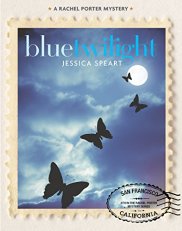
After BLUE TWILIGHT went on sale a small group of butterfly collectors felt she had attacked them, and, in turn, began attacking her.

“Apparently, I’d hit a nerve,” she said. “I’m not saying butterfly collecting is a crime but there are those who cross the line between collecting legal butterflies versus collecting protected and endangered butterflies. There are instances where even legal butterflies have been over-collected.”

The author points out that there is a class system when it comes to species being valued, and that if they were chimps, tigers and others public reaction would be one of horror. She continues the argument on her website in one of her blogs. She also discusses the difference between the two styles, saying that narrative non-fiction is fact-based storytelling employing some of the same skills that are used in fiction, setting each scene, presenting fascinating characters, and creating a strong narrative persona.

As for specific dialogue in non-fiction, Speart again brings her research to the forefront. It requires, she says, exhaustive digging which is something she enjoys. She also points out that narrative non-fiction doesn’t have to be told as purely objective journalism. Writers can bring emotion to their characters and create a sense of drama while following the story arc.

A few books that fit into the discussion are some of her favorites including In Cold Blood by Truman Capote; Into Thin Air by Jon Krakauer; The Orchard Thief by Susan Orlean; The Perfect Storm by Sebastian Junger, and Midnight in the Garden of Good and Evil by John Berendt, a book that began Speart’s love affair with the city of Savannah.

Jessica Speart teaches an advanced mystery writers workshop in Connecticut, and reminds students: “You have to believe in your work and not give up. Writing is a rough business and not for the faint of heart.

A Thank-You Note That Led to Story

by Jackie Houchin

Do you like receiving a thank you note for some little thing you did (or even said)?  I recently received “three thank yous” via email (one was from my very well-trained, sweet granddaughter for a gift I sent).

It used to be something we would pound into our kids’s heads when they got birthday or Christmas gifts. “Write Aunt Dottie a thank you!”  “Tell grandma you loved her gift!” 

One boy at church ALWAYS wrote such sweet notes to me as his Sunday School or AWANA teacher. They were well thought out, and even used “bigger words” than I expected. Many had little drawings of something I might have given him. I would tell his mom that she sure trained him well, but she told me, “Oh, that’s his idea. I don’t say anything.”  Sadly he’s graduated out of my class now.  I miss his notes and illustrations.  (Yes, I’ve saved them.)

I enjoy writing thank you notes as well. I’m always surprised when someone I sent a card to exclaims “Oh, what a wonderful surprise! That was so nice of you!” Sometimes I send an email, and very occassionally a quick text message. But I enjoy writing out my thoughts on real-life cards. And since my granddaughter now has a little business* making greeting cards, I get to use all kinds of them. She’s the artist and designer.

I also write birthday and holiday cards . Dear Kerry!  Don’t make so many cute ones I just HAVE to buy and use!!

    *     *     *

Recently there was an article in our newspaper, The Epoch Times, January 26, 2022, titled “The Importance of Thank-You Notes”. I loved the sentiments and agreed with what was written.

This morning, February 25, 2022, there was a response in the form of letter in The Readers’ Turn section.  It is a wonderful story of one particular thank you.  Here it is (I hope it’s clear enough to read.)

As we here at The Writers In Residence are always encouraging our readers to WRITE, have any of you recently received something in the mail – snail, email, or text – that you could turn into a short story, essay, blog post, or even a poem? Ok, yes, even a utility bill that came. (Have you seen how Natural Gas prices have skyrocketed?? You could write a letter to the editor, or the company!! Haha.)

But I had something else in mind. Something creative. I recently got a snail mail letter from my sister who will be 89 next month. She is super spry physically and mentaly. She is now taking a writing class, and had to write a small piece from each of 30 prompts. She did it, and now she says her local newspaper wants to publish a few of them. Wow! Who knew? MY sister!!!

So… a thank you note that caught your attention, a birthday card, a GALentine’s Day card (yes, my granddaughter makes those!) or perhaps a mailing from a charity with a photo of a needy child, a disaster, or a pet who needs a home might spark a thought. Maybe even a gardening catalogue with seeds from an old variety of flowers that your grandma grew might inspire you to write a mini-memoir.

Go look through your mail. If you’ve got an idea now, let us know below. If it turns out nice, I might consider posting it in one of our GUEST BLOG spots this year. Just go do it! Write!

#

*PacificPeachDesigns.com

Every Day is Valentine’s Day 

by Maggie King

For lovers, every day is Valentine’s Day. But February 14 is the official day when Cupid’s arrow strikes and big business rakes in billions spent on candy, flowers, jewelry, and fine dining.
How did Valentine’s Day get its start? Who was St. Valentine? Good questions, with no easy answers. The history of the saint and the day that honors him is murky, to say the least.

Pope Gelasius I established St. Valentine’s Day in the 5th century to pay homage to two saints named Valentinus who were martyred on February 14. Some believe there was only one saint. A popular legend has it that Valentine was a temple priest who was arrested after ministering to Christians being victimized by the Roman empire. While in prison, he fell in love with a young woman who may have been the warden’s daughter. Before his execution, he sent her a note and signed it “Your Valentine.”

When Emperor Claudius forbade young soldiers to marry, another legend was born: Valentine was beheaded for performing secret weddings for the soldiers.

And then there’s Lupercalia, a Roman fertility festival celebrated from Feb. 13 to Feb. 15. Some say the festival inspired Valentine’s Day.

There’s a suggestion of romance in these stories, but the link between romantic love and Valentine’s Day is credited to the works of Chaucer and Shakespeare. In the middle ages couples expressed their love with handmade paper cards (valentines). In time, factory-made cards became available; but Hallmark Cards of Kansas City, Mo. came on the scene in 1913 and made the holiday the big business it is today.

How do the characters in my Hazel Rose Book Group Mysteries celebrate Valentine’s Day? I’ve yet to set a story in February, so I can only guess. But my main characters, Hazel Rose and her husband, Vince Castelli, would certainly celebrate the day in style.

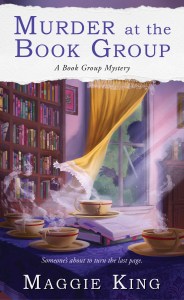
In Murder at the Book Group, the series debut, Hazel describes Vince as her on-again, off-again lover. She attributes their sporadic relationship to their inability to get along. She doesn’t offer details as to why they don’t get along but the reader can guess that the real problem is Hazel’s cold feet about committing to a permanent relationship. She’s been married four times and isn’t eager to make a fifth trip to the altar, only for the relationship to sour soon afterwards. Does she love Vince? She doesn’t want to commit to that either, but she definitely has a soft spot for him.
When Carlene Arness dies after drinking poisoned tea at a book group meeting, Vince finds out that Hazel was there. He’s surprised by her determination that Carlene didn’t commit suicide and dismayed that she’s hell bent on finding the killer on her own. Someone needs to protect her and he figures it might as well be him. Hazel doesn’t make that an easy task.

At first, Hazel sees Vince as a liaison with the police (he’s a retired homicide detective), but soon realizes that she needs him for more—much more.

Will solving the mystery of Carlene’s death put Hazel and Vince on the road to happily-ever-after?

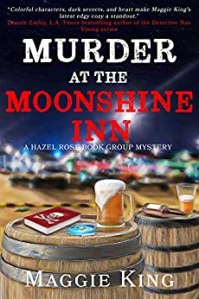
If you read #2 in the series, Murder at the Moonshine Inn, you will know the answer is “yes.” They married in beautiful Costa Rica. Hazel becomes a successful romance writer. The very name Hazel Rose conjures romance.
Hazel and Vince are best friends who respect each other and share a great passion. The passion is only suggested. I close the bedroom door on the reader.

Marriage definitely suits this couple. But they do have conflicts, the main one being when Hazel goes off on her own. Vince knows he can’t stop her from investigating, but he has her promise to always have him or another friend with her. But Hazel manages to find spur of the moment sleuthing opportunities that she can’t pass up. She knows she has to mend her ways. Trust is very important to their relationship.

The book group members don’t fare as well as Hazel and Vince in the romance department:

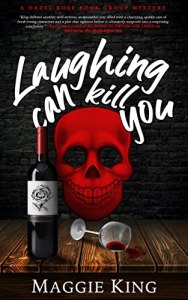
  • Hazel’s cousin Lucy (the “perfect” one) is having marital issues in Laughing Can Kill You, #3 in the series. She was very happy with her husband Dave until a chance discovery made her question his faithfulness.
  • In the first two books, Sarah Rubottom was married to a paraplegic Vietnam war veteran who was an outrageous flirt. In Laughing Can Kill You, he has died and Sarah chooses global travel over romance.
  • Trudy Zimmerman is the ex-wife of the victim in Laughing Can Kill You. She almost remarried aboard a cruise, but her fiancé dumped her (figuratively) for another passenger. Trudy is happy on her own.
  • Eileen Thompson has no romantic interest and is content without one.
  • Lorraine Popp’s own mother calls her an “old maid.”

The characters outside the book group are also unlikely to celebrate Valentine’s Day in any big, or even small, way. In the Hazel Rose mysteries, marriages and relationships are plagued with infidelities, addiction, women with bad boys, men with bad girls. There are women with husbands in prison. There’s a woman with a husband who may not even exist!

Then there’s the colorful and free-spirited Kat Berenger. Kat enjoys casual flings with a number of men. Perhaps she and her lover du jour exchange valentines.

Of course, I’m writing murder mysteries. Conflicts, misunderstandings, and unrealized expectations can lead to murder. I can’t have too many happy and romantic couples like Hazel and Vince.

Now my mind is abuzz with ideas for Valentine mysteries. I can see Hazel and Vince finding romance and murder while zip-lining in Costa Rica.

Happy Valentine’s Day+2. Because every day is Valentine’s Day!

#

Maggie King is the author of the Hazel Rose Book Group mysteries and short stories set in Virginia. Her story, “The Last Laugh,” appears in the recently-released Virginia is for Mysteries III anthology.

Maggie is a member of the Short Mystery Fiction Society, International Thriller Writers, James River Writers, and is a founding member of the Sisters in Crime Central Virginia chapter. Maggie lives in Richmond with her husband, Glen, and cats, Morris and Olive. She enjoys walking, cooking, travel, film, and the theatre. Visit her at MaggieKing.com.

Facebook: https://www.facebook.com/MaggieKingAuthor

Twitter: https://twitter.com/MaggieKingAuthr

Instagram: https://www.instagram.com/authormaggieking

#

POSTED FOR MAGGIE KING by Jackie Houchin

A Life of Strange Inspirations

 by Linda O. Johnston

I wrote last time I was here about how a writer might decide what to write.  I’m going to expand upon that a bit today since I’ve been considering some strange inspirations. 

There’s one we all have these days: Covid. Should we include the pandemic in stories we’re writing now? What about a series that deals, in a fictional way with a lot of the issues and arguments and other matters relating to the disease, and how people deal with them—or don’t? I’m fascinated with the idea, but doubt I’ll dive into it.

 And then there’s what happened on my very nice residential street the other night. 

My husband and I were walking our dog Cari around the block. When we got to the fence behind the property next to our home we saw that one of the fronds of the cacti growing behind it near the street had been broken. (We live in LA.) And then my husband saw a large, dangerous-looking knife lying there and we assumed it had been used to cut the cactus. We saw blood on the sidewalk and we then assumed whoever did it had cut him or herself. My husband moved the knife but hid it to show neighbors later. We weren’t thrilled, especially my husband, who’d planted the cactus with the neighbor’s approval. 

Cut to an hour or so after we got home. Our doorbell rang, and when I answered a couple of uniformed police officers were there. Turned out someone had been stabbed in the area in the middle of the night. We have security cameras outside but they weren’t connected at the time, unfortunately. The cops had hoped we would have footage of what happened—since someone was apparently stabbed there by another person, which resulted in the fallen cactus. 

My husband gave them the knife, of course, and said he hoped they’d make it clear why his fingerprints are on it. We still have no details about what happened or why or if the police are still investigating, but you can imagine that led my mind to start wondering if I could use that in a story. 

And then a dear relative, after we related what had happened, made a suggestion about a whole mystery series based on some matters relating to that incident. 

My mind is still churning around that. But I don’t know if I’ll follow through. I’m concerned about such things happening nearby, in any event. But as a writer, of course I let it potentially inspire me for a story or more. 

And yes, some strange things can become inspirations. When should we include reality in our stories? Whenever it works—with embellishments!

Words on the Page

by Gayle Bartos-Pool

We here at The Writers-in-Residence are writers. Whether it’s a novel, short story, news article, play, movie script, or even a How-To book on writing, words are our life and love and sometimes our nemesis because it can be hard to get those words on the page when life gets in the way. But we have all had our work published and know how hard it is to get that done. Whether it’s more than fifty books in print like our Linda O. Johnston or a few books like some of us or newspaper articles like Jackie Houchin, we have gotten those words out.

I have taught writing classes and have spoken to numerous people in my daily life who wanted to write, but they didn’t know exactly how to go about it. I’m very sure they actually knew how to write. We all learned to do just that in the first grade, at least we learned how to get a few words down on that wide-lined paper way back in the Dark Ages before computers. I would ask these folks who wanted to be writers what had they written so far and over half said nothing. Not a chapter, an opening paragraph, an outline or even a concept. Nothing. They have a long way to go, but perhaps they are more interested in the “idea” of writing rather than have an idea of what to write.

I remember speaking with a nurse in a hospital lunchroom when Richard was ill. I had mentioned that I was a writer and she said she wanted to write. I told her that everybody had a story or two in them whether it was a fiction tale or the story of one’s own life. She started telling me some of her family’s stories. They were fascinating. This gal had a story in her that should be written even if only her family reads it, but the way she told those few tidbits, lots of people would enjoy reading about her life. I wished her well.

But talking doesn’t get those words on paper. Whether writing it in longhand like Ray Bradbury did with every single book he ever wrote including The Martian Chronicles and Fahrenheit 451 which he wrote with a pen, he got those stories written down. Don’t get mesmerized by the “idea” of writing, or the “fame” (that’s only if you sell a million copies the first week your book is in print), or the “money” you’ll make (authors usually get a small percentage of the cover price after the publisher and the distributor and the bookstore get their cut; sorry, that’s the reality unless you have sold that previous million copies). Don’t let that stop you from writing. Write.

Do you have a story you want to tell? After these past two years being basically isolated due to the flu that has kept most of us living in solitary confinement, you just might have something you were tossing around in your head or maybe even you got a chapter or two written or an outline dashed off so you wouldn’t forget the story line. I can tell you from personal experience, if you don’t write it down, you will definitely forget it. Dear Bonnie Schroeder, a fellow scribe, gave me a notepad that hangs up in the shower along with a pencil that allows one to write down that elusive idea that pops into your head while the hot water is calming you and you are free to let those creative juices flow. Write.

You can always run an idea past a friend to see how it sounds. If you belong to a writers’ group, you might toss the idea out during a meeting and see what the group thinks. They might have some suggestions to help you focus your story. If they shred your idea like a head of cabbage, perhaps join another group. I’m serious about this. Some groups aren’t there to help. But then again, you might get a good story out of the fact the group was all wrong because of the hidden agendas of the other members of said group. Hey, ideas are everywhere. Write.

Nevertheless, if you actually have an idea for a story, write that outline. Who are the characters in the story? Don’t have a cast of thousands. Readers won’t be able to follow Who’s on First. Next, where does the story take place? Location, location, location. They do that all the time in the movies. Where do you want your small cast of characters to be situated? You’ll get to describe the place. Don’t make it a travelogue, but make it interesting. Visual. Maybe even astonishing. The moon, a sinking ship, a haunted house. A jail cell. Write.

When your characters speak do they have something to say? Again, I’m serious. Make whatever they say part of the story. If their dialogue doesn’t add anything to the story, cut it. And make a character or two colorful in his or her speech. It adds to the flavor. Write.

Then of course you have to have a plot. Why are those interesting characters in that interesting place saying those interesting things? That is your story. You have had this idea running around in your head; what is it? You will realize (hopefully) that the story you are telling has a point to make. You might think that the story is the point. Ask Aristotle about that. Since he’s busy, let me say this: After someone reads your story and has gotten to know your characters and has visualized that intriguing setting and has listened to the witty dialogue your characters are saying while the story progresses, when the reader gets to the end of your story they need to be able to say, “Ah! That was a story about Man against Nature or Woman against Society or Man Struggling against Himself.” That’s the point of the story, not the plot.

Say you want to tell a story about Man against Himself. Now you have a goal to come up with a story that centers on that Theme. The man keeps setting up roadblocks to stop himself from doing something he really wants to do. You must construct that plot. You will define those roadblocks and his excuses to not do what he needs to do to fulfill himself, to reach his goal. You create the characters that both help and hinder him. You design a setting that either lulls him into complacency or he thinks is above his lot in life. And you write the dialogue that has him expressing his dreams and desires along with those who tell him can or can’t achieve his goal. And Voilà, you have that story. And you might actually realize that the stubborn character you are creating is really you and then get more of those words on the page.

We are finishing up one hell of a year, actually two. Soon a New Year will open up those dreams you have buried because you keep telling yourself you’ll write that story later. It is later. Write it. What do you want to say? Get those words on the page. Write it.

Have a Merry Christmas and a Happy New Year! Write on!

A Life of Unfinished things…


By Rosemary Lord

Many of us get very reflective around this time of year, as we look forward to spending Thanksgiving with friends and loved ones.  I love this American tradition. As a transplanted, naturalized American, over the years, I have spent this annual celebration in so many different places, with many different people. I’ve listened to memories of childhood Thanksgivings, of different family traditions across the nation, handed downfrom great grandparents to sons and daughters and then to their offspring, in due course.

Frankly, I envy these traditions. And I just love the importance of all the special family dishes that are served. The recipes handed down through the generations have their ownstories. And the simple custom, at so many tables, of each person sharing what they are thankful for. It’s a wonderful time when everything else stops for a while, and people from different generations, different religions and all walks of life get together to simply say “Thank you.”

 After such a strange couple of years, I think many of us realize we have a lot to be thankful for. Maybe for things that we previously had taken for granted. Such as walking out in public bare-faced and exchanging smiles with strangers… an impulsive stop by your favorite family-run café – that is still in business. Or simply – hugs with friends.

As writers, we are more easily able to notice these little things that have come to mean so much. And as writers, we are especially fortunate that, whatever external restrictions the dastardly Covid plague inflicted on so many people, for us scribes, we could just keep on writing.

However, so often we get our story ideas from a chance remark in a casual conversation overheard – or eavesdropping (‘ear-wigging’ is the more colorful informal English term.) I would often make up my own version of the end of some snippet I’d heard and that would sometimes turn into a whole story.  

But during these cloistered times, we’ve missed out on overhearing strangers’ conversations.

The Covid situation affected people differently. All around us, some were having meltdowns, dramas, or ‘wobblies’ – as in “She/he’s having a wobblie” – a charming current English phrase. Others found a strength and a fortitude they hadn’t realized they possessed. They found a new purpose, as they stepped into the fray to help the home-bound, the elderly living alone, or the children without an open school to attend. They volunteered wherever they were needed. Many new friendships were created. Everyday heroes emerged, as people found innovative and creative ways to handle the situations we all found ourselves thrust into – and along the way, found ways to improve other people’s lives.

For writers, fascinating tales appeared for our writing brain to feed on. People stories.

These interminable lock-downs have given many people the chance to write that novel they always felt they had in them – but never had the time to pursue. For the uninitiated, they had their first crack at completing that novel. For us old-timers, it was the opportunity to maybe write outside our normal field. (Did I tell you I have a quarter of a noir, dark and creepy contemporary novel done? Who knew I could write that?) And for writers at every level, the burgeoning self-publishing market has been a boon and a blessing.

I have discovered so many new writers from all over the world – especially when I can get the bargain price of a used book, I don’t feel so guilty if I don’t like it. Plus, I have a whole slew of new books to read on my Kindle.

I must confess that my own, personal reading, at the end of a long day wrestling with Woman’s Club administrative ‘stuff’ is more and more escapist. Often tales of a newly widowed or newly divorced woman who decides to start a new life on the other side of the world and open a bakery or her own winery.  I’m re-reading my Rosamunde Pilcher favorites and re-discovering what a good, simple, nuanced writer she was. Her books are inspiring – usually about starting again, uncovering deep family secrets that lead to wonderful, happy endings. I like a happy ending. Especially these days. 

I think I have a life of unfinished things….  That’s what it seems like to me at the moment. Some painting and fixing things around my apartment. Some sewing bits and pieces. But mostly unfinished novels and stories, which is a good thing, because I have started some new writing projects and my busy mind keeps thinking of more. Not so good because I haven’t had time to complete them. And the characters in my stories are still whispering, nay yelling, in my head to share them with the world…

But I’m thankful for every moment when I am able to write – and plan that “next year it will be different. Promise!” Hmm, I think I’ve said that a time or two before. But I really, really mean it this time!

………………………………………………

Another Look At Descriptions

by Miko Johnston

In my contributions to this blog, I’ve written about descriptions several times. Describing, or as Jackie likes to say, illustrating in our writing has always presented a challenge to me. Part of it is how much? and is this necessary? There’s also how well…? – am I using fresh word pairings and metaphors that impress, not impede? Will readers not only ‘see’ it, but believe it?

All writing needs description to bring the story to life, but contemporary fiction usually depends on what we see around us. Science fiction, fantasy and, to a lesser extent, alt-reality requires more description as the reader can’t assume anything in a newly created world. So does the procedures of a character with an unusual or highly technical occupation, or day to day life in historical fiction to avoid anachronisms.

Writing historical fiction, as I do, requires a great deal of research, not only of history but images that represent the time. Clothing, hairstyles, machinery and tools, art and architecture infuse the story with the flavor of authenticity. In managing the word count, one picture can truly be worth a thousand words – if you find the right words.

I faced an insurmountable challenge in my latest novel. I wanted a character to wear a dress I’d seen illustrated in a period catalogue, a flamboyant style from the early 1920s. Today I’d describe it as having a side hooped (pannier) skirt with rolls of fabric resembling vertical soda can stackers hanging from each hip. However, that would not be time-appropriate for the era I write in and I couldn’t come up with a better way to depict the dress. It forced me to change her garment into something equally ridiculous but more describable, something Little Bo Peep might have worn.

That wasn’t the first time I’ve had trouble describing something in a way that a reader could visualize it. I envy writers who have that knack. I recently read a piece by Eric Asimov, who writes the Wine column for the New York Times, describing the ideal corkscrew, sometimes referred to as a waiter’s friend. He writes:

“It’s essentially a knifelike handle with a spiral worm for inserting into the cork, a double-hinged fulcrum for resistance and a small, folding blade for cutting the foil that protects the cork.”

Brilliantly descriptive and clear. You can not only see it, but see how it’s used.

Another challenge is trying to describe a situation that many have gone through; for example, pregnancy and labor. If you’ve given birth, you would probably rely on your personal recollections. If not, you’d research what others have endured, like I did. Either way, some readers will tell you that’s not what they experienced. In my first literary pregnancy, I was so concerned about the birth that I left that scene ‘off the page’; my character leaves town a month before her due date and returns with babe in arms.

Now several of my characters have gone through pregnancy and childbirth. I’ve gotten more controversial feedback on that subject than any other, and always from mothers. Certain suggestions, such as those little moments you could never envision unless you were ‘there’, helped. Other comments were less beneficial, for although there is much commonality in the experience, little of it is universal. “That’s not how it was for me,” they’d say, and I’d tell them “Okay, but that’s how it was for my character.”

*          *          *

As I’ve recently finished my fourth novel in a series, I’ve reviewed the manuscript multiple times and also reread sections of the earlier books. In doing so I learned something about my method of describing. The more important an element is, the more I’ll usually describe it. For instance, in my second book, my character meets a family that will play a prominent role in the rest of the series. It’s my young protagonist’s first impression of them, so I devote at least a full paragraph to the description of each person, I’ve augmented the descriptions as time passed to show how they’ve changed with age. Minor characters, such as the housekeeper, merit a phrase, enough to picture the woman when she returns later in the story. Thanks to Gayle’s tutelage, I’ve learned a title – waiter, shopkeeper – often suffices for ‘walk-on’ characters, though I might include a glimpse to set the scene, such as the wizened mother-in-law of a black marketeer, opulent earrings hanging from her lobes like chandeliers.

The character’s perspective also plays a role. My heroine, Lala, is introduced as a child, “almost eight”, who grew up poor. Her thoughts and observations had to be filtered by her age and experience, which is why it took me weeks to come up with a way for her to ‘describe’ a terrazzo floor (…like flat pebbles floating in a sea of cream). As she matured, so did her perceptions and understanding of human nature. Whatever captures her interest, or she feels passionate about, will inspire a more detailed description.

I approach themes in the same way. In my most recent novel, I chose to represent the political and social turmoil of post-WWI Europe with an image I found in my research. Lala, now married with child, observes it while stuck in traffic:

She perused the art work, most of it propaganda celebrating the recent wave of Communist Party member assassinations in Germany. One placard illustrated a macabre street scene in Hungary, judging by the uniforms worn by a line of soldiers hanging from gallows. Wives and children wept at the dead men’s feet while, standing in the middle of the road, a Bolshevik in uniform observed the carnage with a haughty air of satisfaction. The caption read, Erzet Harcoltunk? – ‘This is what we fought for?’…The artist had placed the smug-looking Bolshevik in the foreground, hands on hips, an unkempt uniform wrapped around his fat middle. Skinny legs stuffed into unpolished boots. Thin arms as well, implying physical weakness…Then she noticed the slight alteration of the Bolshevik’s cap, a subtle nod to a trait he shared with many of the political assassination victims.

The gold star affixed above the brim did not have five points, but six.

Rather than rely on the headlines of the day, I chose to let the reader “see” what she’s describing and understand the meaning behind the images.

This method works for me. What techniques do you rely on to get the right balance of description and imagery in your writing?

###

Miko Johnston, a founding member of The Writers In Residence, is the author of the historical fiction saga A PETAL IN THE WIND, as well as a contributor to anthologies, including LAst Exit to Murder. She has recently completed the fourth book in her series. Miko lives in Washington (the big one) with her rocket scientist husband. Contact her at mikojohnstonauthor@gmail.com

A Revelation and a Lesson in Reality

Moving from California to Connecticut, coast-to-coast, during the first months of the COVID pandemic resulted in flying out of an airport almost devoid of staff and passengers. I sailed through Security with only two other people in line. In fact, the airport was a ghost town, as was LaGuardia when I reached New York. No coffee shops or stores were open, but, warned ahead of time, I’d brought my own travel cup and, of course, my kindle loaded with eBooks.

It had been 23 years since I had lived in CT and discovered that I knew not a soul any longer except for my son and daughter. I searched the Obituaries pages for news of long-lost friends and called up a newspaper I used to work for but no one had heard of my fellow reporters from so long ago.

Needing to get back into the writing community I joined the New York chapters of Mystery Writers of America, Sisters in Crime, and renewed my Authors Guild membership, but there were no actual meetings scheduled except for Zoom. Like most writers I thrive on in-person contact where we have an opportunity to pick up characteristics of other humans, locales, and other, often small, details we put to use in our books.

I cast around for any group related to writing that met in person and this month, lo and behold, I was told of a women’s book club that was actually meeting at a coffee shop. There was also a memoir group at someone’s home. I’d been to several book clubs in California as their speaker when one of my books was the subject of discussion but what would it be like sitting on the other side of the table? I’d been treated with great respect, gentleness, and politeness each time with questions that were easy to answer and expected the same for this author and his work.

Instead, it was a revelation and a lesson in reality.

The book under discussion was a pretty hefty novel by a renowned author.  I was struck the most by everyone’s intensity, enthusiasm, and deep knowledge of each character and their supposed intent; the proposed meaning of every scene, and talk about the author’s hidden message on almost every page even if there were none. It was fascinating to hear that three members said they were in disagreement with the author because one character didn’t really mean what he said and other members backed her up. Another lady said a character should not have done what she did and offered an alternative to what the author wrote, and yet another lady said two of the characters should never have had the argument they did if only they had done so-and-so.

Wow!

Suggesting rewriting parts of an important classic to suit varying ideas about where the plot and its people should have gone gave me an introspective that I knew was impossible to achieve. There are a couple of classics wherein the author addresses the reader as “dear reader,” in his/her books but I doubt it is a plea for understanding the book’s intent. Authors cannot please everyone, and occasionally cannot please themselves when they re-read a book they wrote years earlier, perhaps, and see one or two parts they’d like to edit.

I enjoyed the back and forth between the ladies who were diplomatic in their critiques despite opposing opinions. One tended to hog the limelight by going on and on until the group leader gently cut her off. I was surprised that 4 or 5 of the 14 in the group remained mute the entire time but the others made up for their silence with well-articulated points of view, albeit wishing the author had written some scenes a bit differently.

As the newcomer I mostly listened and didn’t reveal I was an author.  Maybe it wouldn’t have mattered but I was there to discuss someone else’s work.  Only at the end did I disagree with the general conclusion that the main character had redeemed herself by her ringing endorsement of a couple in love rather than try to split them apart as she had earlier in a book-long fit of jealousy. One member asked if the author wished readers to come to like his previously nasty main character at the end by having her do a complete turn-about of herself.

My take was that she was self-serving by pretending to have changed in order to receive everyone’s good wishes instead of their usual disparaging remarks when she dissed them ad nauseum. She was congratulated and basked in their comments, but to me she was still living up to her me-me-me attitude. My statement was then discussed and agreed to by a slim majority of members, while others said they hadn’t thought of it that way but, yes, it made sense.

Perhaps had the author been at this meeting he would have been flabbergasted at the suggestions for changes, as sensible as they were, and probably even a little daunted at the thought but, all in all, I liked the fact that these book clubbers genuinely loved books and discussing them in depth was important to their lives. I am glad I joined and plan to attend every month.

Should I take a lesson from the discussion? Yes, very much so except I am still writing what I want to write. If a reader finds problems in a book that is fictional the author can be excused. What have been your book club experiences?

###

Jill Amadio is a ghostwriter and cozy mystery writer. This is her new novel.

A leggy wildflower of a girl, teenage Sofia runs away from rural Oregon to big city Portland where she meets and marries a charismatic Saudi Arabian later known as 9/11 hijacker #13. While a slumbering America embraces feng sui and pizza she is present when terrorist sleeper cells are organized in her home, maps of landmark buildings, airports, and bridges are studied, and teams of recruits take flying lessons.

IN TERROR’S DEADLY CLASP, a novel, is based on her true story, providing a rare, chilling glimpse under the radar of the terrorists’ daily lives as they enjoy strip clubs, fast food, and freedom from their religious rules. After warning the FBI of the Arabs’ photo sessions, driving several men into America illegally from Mexico, and other suspicious activities, she goes undercover for U.S. intelligence agencies with deadly consequences.

Space to Write

Guest Post by Hannah Dennison

Thank you so much for inviting me to Writers in Residence today. As it happened, just last week, I was a writer in residence … if you can call hunkering down in my friend’s converted coal shed in the wilds of Wensleydale, a “residence.” It’s a six-hour journey by train but worth it.

My friends have a small farm and I have an open invitation to stay whenever I’m on deadline. I have known this wonderful couple, since we were all just 21. They are fiercely private otherwise I would announce their names in big bold font.

The day starts with eggs from their own chickens for breakfast, followed by four hours of solid writing, a break for lunch, a nap, a walk on the Fell, tea with homemade cake. After another hour or two of writing, the sun is over the proverbial yard arm and it’s time for a gin and tonic.

From the original coal chute window, I have an uninterrupted view of red squirrels (it’s a red squirrel sanctuary), sheep, (this is the home of Wallace and Gromit after all), and, when I’m lucky, I can enjoy watching the hares who really do box.

But, if it sounds like I need peace and quiet to be able to write, that’s not strictly true. One of my favorite books is “Becoming a Writer” by the formidable Dorothy Brande. She urges all writers to train themselves to be able to write at a specific time and anywhere, even if it’s just for fifteen minutes. I can write in a departure lounge, a train station, definitely on a plane, in fact, more or less anywhere.

I was listening to a panel of authors discussing the pros and cons of listening to music when they write. I can’t but I can write to the sound of a coffee shop! I subscribe to an app called Freedom. Not only can you block distracting websites on your Internet for set periods of time—in my case it’s the dreaded Daily Mail—it also has a white noise “coffee shop” feature with the low hum of voices and the occasional hiss and burble from the espresso machine! You can also choose the location of your coffee shop such as Stockholm, Berlin, New York or San Francisco. Believe it or not, they all sound very different.  Another author admitted that she writes to the sound of a World War Two Flying Fortress just cruising along (no bombs dropping) from Mynoise.net.

Although it’s great to have the ability to write anywhere, I truly believe in having a dedicated space only for writing—even if it is the size of a cupboard. My space is the tiny guest bedroom. I pushed the narrow single bed against the wall and made it into a day bed. If I have visitors (which is rare), then I take sleep there with two huge dogs and give up my bedroom.

Speaking of dedicated spaces, just before the pandemic I taught a writing retreat on a small island called Tresco in the Isles of Scilly. Among the participants was a wonderful Methodist minister who shared how he always approached his writing with a ritual. He liked to put something on the back of his chair—usually a scarf. It was a way of indicating to the creative muse that he was entering his space with intention. I adopted that idea too and, unless I’m in the departure lounge where I’d most certainly be given “looks,” do this 99% of the time.

Since I mentioned Tresco, I wanted to share my latest release, Danger at the Cove (An Island Sisters Mystery), the second book in my new series. I mention it because I was inspired by the beautiful setting of this remote resort, twenty-eight miles off the southwest Cornish coast. I was also intrigued by the idea that there is no police presence, no cars, no streetlamps and no hospital. I have it on good authority that seasonal workers are usually running away from something or hiding from someone. I couldn’t think of a better location to set a mystery. The series is about two sisters who find themselves chatelaines of a crumbling Art Deco hotel on a fictional island in the Isles of Scilly and naturally, murder and mayhem ensure.

I’d love to hear your thoughts on writing to music or white noise and if you do have a dedicated writing space, what can you see from your window?

Thank you so much for hosting me today.

BIO

British born, Hannah originally moved to Los Angeles to pursue screenwriting. She has been an obituary reporter, antique dealer, private jet flight attendant and Hollywood story analyst. Hannah has served on numerous judging committees for Mystery Writers of America and teaches mystery writing workshops for the UCLA Extension Writers’ Program now on Zoom. After twenty-five years living on the West Coast, Hannah returned to the UK where she shares her life with two high-spirited Hungarian Vizslas.

Hannah writes the Island Sisters Mysteries (Minotaur), the Honeychurch Hall Mysteries (Constable) and the Vicky Hill Mysteries (Constable)

Social Media Links

https://www.hannahdennison.com

https://twitter.com/HannahLDennison

http://instagram.com/hannahdennisonbooks

https://www.facebook.com/HannahDennisonBooks/