A Thank-You Note That Led to Story

by Jackie Houchin

Do you like receiving a thank you note for some little thing you did (or even said)?  I recently received “three thank yous” via email (one was from my very well-trained, sweet granddaughter for a gift I sent).

It used to be something we would pound into our kids’s heads when they got birthday or Christmas gifts. “Write Aunt Dottie a thank you!”  “Tell grandma you loved her gift!” 

One boy at church ALWAYS wrote such sweet notes to me as his Sunday School or AWANA teacher. They were well thought out, and even used “bigger words” than I expected. Many had little drawings of something I might have given him. I would tell his mom that she sure trained him well, but she told me, “Oh, that’s his idea. I don’t say anything.”  Sadly he’s graduated out of my class now.  I miss his notes and illustrations.  (Yes, I’ve saved them.)

I enjoy writing thank you notes as well. I’m always surprised when someone I sent a card to exclaims “Oh, what a wonderful surprise! That was so nice of you!” Sometimes I send an email, and very occassionally a quick text message. But I enjoy writing out my thoughts on real-life cards. And since my granddaughter now has a little business* making greeting cards, I get to use all kinds of them. She’s the artist and designer.

I also write birthday and holiday cards . Dear Kerry!  Don’t make so many cute ones I just HAVE to buy and use!!

    *     *     *

Recently there was an article in our newspaper, The Epoch Times, January 26, 2022, titled “The Importance of Thank-You Notes”. I loved the sentiments and agreed with what was written.

This morning, February 25, 2022, there was a response in the form of letter in The Readers’ Turn section.  It is a wonderful story of one particular thank you.  Here it is (I hope it’s clear enough to read.)

As we here at The Writers In Residence are always encouraging our readers to WRITE, have any of you recently received something in the mail – snail, email, or text – that you could turn into a short story, essay, blog post, or even a poem? Ok, yes, even a utility bill that came. (Have you seen how Natural Gas prices have skyrocketed?? You could write a letter to the editor, or the company!! Haha.)

But I had something else in mind. Something creative. I recently got a snail mail letter from my sister who will be 89 next month. She is super spry physically and mentaly. She is now taking a writing class, and had to write a small piece from each of 30 prompts. She did it, and now she says her local newspaper wants to publish a few of them. Wow! Who knew? MY sister!!!

So… a thank you note that caught your attention, a birthday card, a GALentine’s Day card (yes, my granddaughter makes those!) or perhaps a mailing from a charity with a photo of a needy child, a disaster, or a pet who needs a home might spark a thought. Maybe even a gardening catalogue with seeds from an old variety of flowers that your grandma grew might inspire you to write a mini-memoir.

Go look through your mail. If you’ve got an idea now, let us know below. If it turns out nice, I might consider posting it in one of our GUEST BLOG spots this year. Just go do it! Write!

#

*PacificPeachDesigns.com

A Life of Strange Inspirations

 by Linda O. Johnston

I wrote last time I was here about how a writer might decide what to write.  I’m going to expand upon that a bit today since I’ve been considering some strange inspirations. 

There’s one we all have these days: Covid. Should we include the pandemic in stories we’re writing now? What about a series that deals, in a fictional way with a lot of the issues and arguments and other matters relating to the disease, and how people deal with them—or don’t? I’m fascinated with the idea, but doubt I’ll dive into it.

 And then there’s what happened on my very nice residential street the other night. 

My husband and I were walking our dog Cari around the block. When we got to the fence behind the property next to our home we saw that one of the fronds of the cacti growing behind it near the street had been broken. (We live in LA.) And then my husband saw a large, dangerous-looking knife lying there and we assumed it had been used to cut the cactus. We saw blood on the sidewalk and we then assumed whoever did it had cut him or herself. My husband moved the knife but hid it to show neighbors later. We weren’t thrilled, especially my husband, who’d planted the cactus with the neighbor’s approval. 

Cut to an hour or so after we got home. Our doorbell rang, and when I answered a couple of uniformed police officers were there. Turned out someone had been stabbed in the area in the middle of the night. We have security cameras outside but they weren’t connected at the time, unfortunately. The cops had hoped we would have footage of what happened—since someone was apparently stabbed there by another person, which resulted in the fallen cactus. 

My husband gave them the knife, of course, and said he hoped they’d make it clear why his fingerprints are on it. We still have no details about what happened or why or if the police are still investigating, but you can imagine that led my mind to start wondering if I could use that in a story. 

And then a dear relative, after we related what had happened, made a suggestion about a whole mystery series based on some matters relating to that incident. 

My mind is still churning around that. But I don’t know if I’ll follow through. I’m concerned about such things happening nearby, in any event. But as a writer, of course I let it potentially inspire me for a story or more. 

And yes, some strange things can become inspirations. When should we include reality in our stories? Whenever it works—with embellishments!

Are You RESOLUTE? Or not…

Yeah, yeah, I know. Nobody makes resolutions at New Year’s anymore.  A least not ones they can keep beyond the 31st of January. (Surveys report that 47% of resolution makers can’t keep them until February 1st.)

WHY?

I have some suggestions, tips, and encouragements if you really want to change something in your life/writing in 2022.

From the Hints From Heloise column, I found these believable suggestions.

  1. Be specific.
  •  Don’t vow to “Lose weight” but, to Lose 20 pounds by May 1st.
  •  Don’t vow to “Exercise more” but, to Walk 2 miles a day for 4 days a week.
  •  Don’t vow to “Write more in 2022” but, to Write 2 chapters, or 2,000 words, or a complete short story or article each week.

2. Then add your answer to the question, “why?”

  •  Because I’m too young to be heavy and it makes me look matronly.
  •  Because walking is healthy for me, and the kids (dogs, Hubby) can go with me.
  •  Because I’m a writer and I want to finish my book and/or publish my work.
  1. Put these (your) resolutions on 3×5 cards and tape them to your bathroom mirror. Read them aloud to yourself every morning.
  2. Keep track of your progress.
  3. Reward yourself when you accomplish each one!

(If you try this, let me know how it works!)

Hey, have you heard this one? “I was going to quit all my bad habits for 2022. But then I remembered: Nobody likes a quitter!”

Here’s a unique take from The Victoria Magazine, letters, Jan/Feb.

        Says Wendy J. “Decades ago, a friend and I came up with the idea of “un-goals” instead of resolutions. This gave us permission to give up things we detested! I gave up zucchini. For years I had tried one recipe after another to use the piles of this vegetable that I received from neighbors’ gardens or the market. I finally decided that they all tasted the same because I truly dislike zucchini!”

Do you have something you really dislike and will renounce in 2022?

(Let me know, and I’ll rejoice with you!)

Do you have a (mental) list of what you want to do “someday?” Here are a few examples: (I love #2.)

  •  Finish the book I’m writing
  •  Spend a season living abroad
  •  Read that stack of books I’ve been accumulating
  •  Add weight training to my workouts
  •  Plan day trips with my family
  •  Schedule those _____________ lessons I promised myself I would take

Resolve to move these from the  “Someday” to the “In-progress” column.

(Maybe I’ll join you on those lessons!)

From Cathy Baker’s Creative Pauses Facebook group, Dec 31, 2021.  Choose a word or two as a theme for 2022. (Easier than a whole resolution.)

There are many websites that can suggest words to you, or give you ideas. Think of your goals/hopes for the New Year, and use these or other sites to help you choose.  Some even give you ideas on how to make the word stick for 365 days.

        https://elisabethmcknight.com/word-of-the-year-ideas/

(Scroll down to the 100-word list at the bottom, Abundance to Zest.)

        https://www.happinessishomemade.net/word-of-the-year-ideas-one-little-word/

(Schroll down to the 150-word, printable, non-alphabetized list.)

        OR… for heaven’s sake, we are writers & readers… pick your own. Haha!

(Let me know if you pick one and what it is, or maybe keep it secret.)

Here are some suggestions from the Orange County Register newspaper, on the personal side, with specific fill in the blanks.

  •   Mend a relationship with _______________.
  •    Be more kind to _________________.
  •    Call _______________ whom you haven’t spoken to in a long time.
  •    Adopt or foster a ___________ (animal) and take good care of it.

(Or sponsor a child.)

From an article in The Epoch Times:

  •         Get inspired by reading blogs you love (like The Writers in Residence).
  •         Begin with tiny stuff – make it a habit that is “too easy NOT to do.”
  •         Find a friend or family member for support.
  •         And lastly, don’t call them NEW YEAR’S RESOLUTIONS, rename them as “January Objectives” or maybe even “Today’s List.”

(And check those buggers off! I’ll celebrate with you.)

For me, three for ’22:

  • Try new recipes from my “Eating Clean” cookbook at least twice a week.
  • Shorten my “screen time” by half (PC and phone). Use a timer if needed.
  • Cut out sugar (again) to help with inflammation issues.

(And YOU can check on ME at the end of the month/year. Really!)

###

Our Faith Bible Church pastor gave us this verse for the year:

Romans 12:9b. “Detest evil; cling to what is good.”

#

Why Aren’t You Writing?

By Miko Johnston

It’s a valid question. Maybe a few of you can’t think of an idea, but I’m willing to bet that you’re in the minority. In most cases we have an overabundance of ideas and at least one work in progress, if not more. Why are we having so much trouble writing? In a word:

PROCRASTINATION

Okay, we can admit it. We do procrastinate. Why? There are many reasons why, and they’re tied to different types of procrastination.

A dear friend and fine writer often wore a sweatshirt that said, EASILY DISTRACTED BY BRIGHT SHINY OBJECTS. This describes procrastinators who get sidetracked by other projects. Often they take on more than they can handle, or they get diverted by the next big thing. The only cure is to acknowledge writing is important enough to do. Focus on what’s in front of you for a set amount of time and literally time yourself.

Do you suffer from perfectionism syndrome? If you have a deadline and still can’t make progress, this may be why. If we can’t get it right, we don’t want to commit to working on our projects. I have a suggestion: GET OVER IT. You can argue about whether there’s crying in baseball, but there is no perfection in writing. Commit to doing the best that you can, then review it and make it better.

Sometimes I open a work-in-progress document and stare at the last bit I wrote, wondering where to go next. Then I close it because I can’t think of anything. Does this happen to you?

Try creating a separate ‘work’ sheet, copy the last paragraphs you’ve written onto it and then…just write. Don’t concern yourself with anything other than getting words down on the page. This technique opens the door to creativity; once your mind is free to explore ideas without judgement, the ideas will flow. Write until you come to a natural concluding point, then read back what you’ve written. I guarantee that most times you’ll find something useful for some part of the story, and sometimes you’ll get what you need. If the block occurs at a point where the story is still open-ended, your ideas may give you some direction to move forward, or warn you, “don’t go there”. If you’re trying to connect your scene with an approaching plot point, try the bridge technique I explained in an earlier post .

Easier said than done, you say? True. But I’m guessing that none of you became writers because you expected to become rich, famous, younger and more beautiful. You did it because you had a passion to write, or a story to tell, or characters whom you’ve created who deserve to live. The world is not an easy place right now; has it ever been? We need your stories out there, whether to entertain or to educate, distract us from our problems or understand them better. Or all of the above. So please sit down, take out your computer, or notebook, or whatever you use to write, and WRITE!.

And why not begin by commenting on this post – do you procrastinate, and if so, how do you get past it?

###

Miko Johnston, a founding member of The Writers in Residence, is the author of the historical fiction saga A Petal In The Wind, as well as a contributor to anthologies, including LAst Exit to Murder. She has recently completed the fourth novel in her series. Miko lives in Whidbey Island in Washington (the big one) with her rocket scientist husband. Contact her at mikojohnstonauthor@gmail.com

FUN WITH WRITING (AGAIN)

by Miko Johnston

It’s summertime, so let’s have some fun. Inspired by Jackie’s piece on Spine Stories, I decided to update my “Fun With Writing” post from five years ago –  here goes:

One Picture Is Worth….

Many groups and websites offer pictures for writing prompts; this is different. If you’ve seen any of the greeting card lines that use old photographs and insert funny comments, then you know what this is about. Select a picture from your photo album or a magazine and write a line or two about it. It can be funny, like one of my favorite birthday cards, which shows a pregnant woman with two pre-school children. The caption: All I wanted was a back rub. It can be poignant, a reminder of how things were vs how they are now.  See if you can come up with a clever interpretation of the photo.  You don’t have to write a thousand words.

Rapid Writing

This is an exercise that my local Whidbey Writers Group has done in the past. One person (usually the host) comes up with a concept and the group has ten minutes to write something. Previous ideas include rewriting a scene from an iconic book, describing an event from the past, and having everyone volunteer a word, then write a short piece incorporating all the words.

Crossover Appeal

If you’re in a writers group or have friends who are authors, try writing a scene featuring a character from another writer’s novel. Compose it in first person so the name isn’t revealed, avoid using any characters’ names or obvious settings. Then see if anyone can guess who you’ve written about. You can also have one of your characters interact with one of theirs.

If you write mysteries, you probably love at least one mystery series. Write a scene where your character meets that detective or P.I. Select a character from the same era as yours if possible, otherwise consider time-traveling the classic character to the present; think of how many modern-day iterations of Sherlock Holmes have been done.

“Honku”

Based on a witty book of haiku – “the zen antidote to road rage” – a  subject rife with possibilities. It you want to attempt poetry, try writing dedicated to driving. If cars aren’t your thing, pick any topic that lends itself to commentary and use the 5-7-5 syllable format to ‘haiku’ your idea. For example, my take on social media:

Why do you delight

 in photographing your meal?

I’d rather eat it

“Spelling Bee”

Last year I discovered this word-making game on the New York Times website’s puzzle section. I got myself and hubby hooked; we played it daily. It helped keep us sane during the pandemic lockdown as well as stimulated our brains. You don’t need a subscription to access the letters, only to play online. Or, play the DIY version:

24/7

Come up with as many seven letter words that don’t repeat letters or include S or X – a challenge in itself. When you have a list, pick a word at random; whatever day of the week it is, use that for your center number. Then make as many words out of the letters that include your center letter. Letters can be used more than once and four letter word minimum. No proper nouns, hyphenates, contractions or foreign words unless they’re in general usage, like pita or latte. Play alone or challenge a friend. Return the word to the pile and use it again on another day, when the center letter would change.

For example: Take the word MIRACLE.  Today is Wednesday, the fourth day on the calendar. My 24/7 challenge would be to make words that include the letter A. Had I picked MIRACLE on a Friday, I’d have to include L in each word.

DYI “Mad Libs”

Take a page from a book, edit out a series of key words and play “Mad Libs”. If you’re not familiar with the classic game, you create a list of nouns, adjectives and verbs and insert them into a story. Try it with a classic novel, a current best-seller, something awful, or if you’re brave, your own work.

“The Dating Game” for words

The clever pairing of an adjective and noun can replace a thousand words, a great way to create the sense of languid prose with brevity. It’s how I came up the phrase, overpriced abscess, to illustrate a McMansion enclave set in a wilderness area in my first published short story.

An interesting two-word combination works in any type of writing, and when it succeeds, it’s like a love match. As an exercise, see how many ‘matches’ you can make. Then save them; they could be incorporated in one of your WIPs.

We at The Writers In Residence always say “writing is writing”, and sometimes mixing it up can encourage creativity. Try an exercise for fun or to stimulate the creative brain.

###

Miko Johnston, a founding member of The Writers in Residence, is the author of three novels in the A Petal In The Wind saga, as well as a contributor to anthologies including LAst Exit to Murder. She has recently completed the fourth novel in the series. Miko lives on Whidbey Island in Washington (the big one) with her rocket scientist husband. Contact her at mikojohnstonauthor@gmail.com

Photo by Agence Olloweb on Unsplash

Creating “Spine” Stories

If you are like me, you’ve never heard of a Spine Story (or Poem) before.  I hadn’t until I read Erica’s wonderful children’s blog “What Do We Do All Day?” about a Summer Literacy BINGO game.

In the game, some of the squares were titled; learn a new song, finish a crossword puzzle, read a book outside, listen to an audiobook, and write a comic strip. As the the kids do each thing, they cross off the square. Five in a row means a BINGO win.

The square that caught my eye  was, create a spine poem.

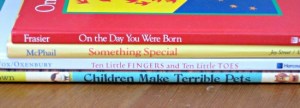
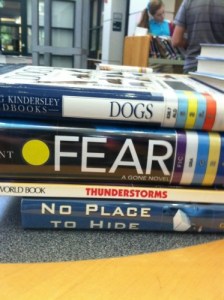
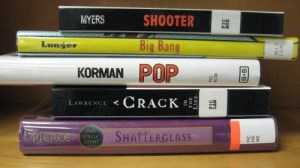
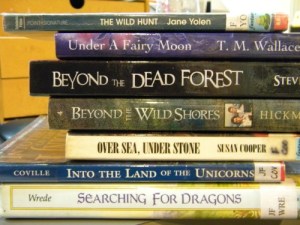
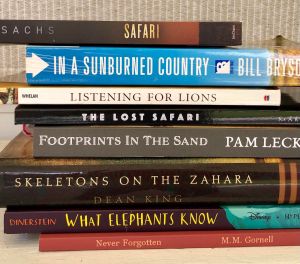
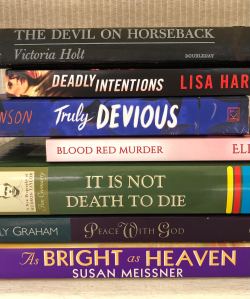
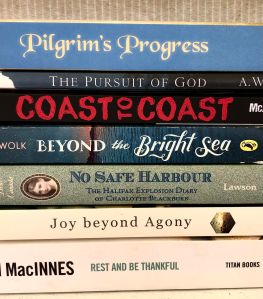
I’d never heard of a spine poem before so I clicked on a link to her page that explained them. Of course, if you’ve viewed the photos in this post, you will already know what one is. I call them stories instead of poems. A real challenge would be to do a Haiku poem in Spines.

I’ve yet to create one myself, but by the end of this post, I promise to put one together to share. Meanwhile, here are a few in Erica’s post.

(In case you can’t read the above Spines, they say “How to Write Poetry” “Brainstorm” “Where do You Get Your Ideas?” “All the world.”)

At the end of her blog on Spine Poems, she added a link to 100 Scope Notes which had a slew more of these poems/stories, titled “2013 Book Spine Poem Gallery”. There are other years of galleries available too. Lots of laughs and some really good Aligned Spines.

Okay, here are a few I tried. (haha) It was actually more fun than I thought. Once I’d done two, I saw many more possibilities!

Now it’s your turn.

Gather some of the books on your shelves or TBR stacks and try to create a few stories or poems?  I’d love to see a photo, or just write the titles in your comment below. Hey, you are very talented storysmiths. Let’s see what story you can tell… from your bookcase? Create a cool, scary, funny, mysterious, clever, or romantic “aligned spines” story.

###

Erica’s Literacy Bingo page: https://www.whatdowedoallday.com/reading-bingo-for-kids/

Erica’s Spine Poetry page:  https://www.whatdowedoallday.com/spine-poetry-activity-for-kids/

100 Scope Notes Book Spine Galleries:  https://100scopenotes.com/2013/04/02/2013-book-spine-poem-gallery/

The Fun and Frustration of Ideas


CREATIVE 126236010_10218132203763090_554863446815973653_n

by Linda O. Johnston

Like many of you who may be reading this, I’m a writer. A fiction writer. That means what I write is rarely true, though of course it needs to be logical and, hopefully, enjoyable.

And how do I figure out what I’ll be writing? Well, my mind is always at work. Whether I’m intending to or not, I’m always coming up with ideas. That, too, probably sounds familiar to many of you.

While watching a TV show a couple of weeks ago, my mind glommed onto its theme as being a great idea for a story. A mystery? Probably. A series? Hopefully. 

But unlike many of my ideas, how to proceed with this one didn’t become automatically clear.  As a result, I’ve been doing a lot of pondering and research and jotting down possibilities. And reading what I can about the general concept.

That’s an important part of writing, of course. The plotting and writing and character development are all essential. But so’s figuring out how you will determine each of them and where your story’s likely to go.

I knew I was scheduled for the WinR blog today and, while at first not knowing what I’d write about, this blog idea finally came to me, too. It’s important for writers to recognize how their minds work at least some of the time. Ideas and me–well, I’d better make note of them and run with them when it makes sense. And writing here about coming up with and following up with ideas–why not?

 So how do you do it? Where do ideas come to you? How do they come to you? Is it always by a similar way, or, like me, do you just keep your mind open to whatever it wants to throw at you and then follow up on those ideas? 

And me? Well, I’m sure I’ll figure out the direction I want to go, probably soon. Will I run with it? Depends on whether I wind up liking my direction as much as the initial idea.


Artwork Design by Cher Schriefer(Groch)


Cruises Can Be Murder**

by Jackie Houchin

(**See disclaimer at the end)

Ahoy there Maties! Have ye sailed the Seven Seas yet?  What’s stoppin’ ye?  Oh… murder!  That!

In January my Hubby and I went on the most amazing 15-day cruise from Florida to Los Angeles by way of the Panama Canal.

What made it amazing?

IMG_5504The Canal transit, of course!! (#1 on Hubby’s bucket list), But the perfect sunny weather, the deep blue sea(s), the small, uncrowded ship (just 670 passengers), the funny and very personable Captain, the amenities (food, lounges,  gorgeous library, spa, pool, Internet café, crafts & games, casino, theater), our beautiful cabin with a balcony (oh, the views!), breakfast in bed, the lack of crowds and lines, the cool excursions in Aruba, Costa Rica, and Chiapas and Cabo San Lucas in Mexico were all definitely fantastic.

IMG_5214(Yes, we are in our 70’s, but we had a blast zip-lining in the Rain Forest!)

If EVER you go on a sea cruise, be sure to book passage on a small ship (unless you have kids). The Princess line has only one, and the Oceania Line has just three. And yes, they can and do travel around the world in 111-195 days. (I’m still dreaming of that!)


IMG_5638Imagine, if you will, 4-6 months in luxury, with everything taken care of for you, the occasional excursion ashore, time spent in one of several lounges or the library or your room, even out on the balcony with a laptop, with a bunch of characters eager to do malice, and a twisted mystery plot to direct them!

Yep, I could write a book on a World Cruise.*  (sigh)  Oh, yeah, writing and books, that’s what this blog is about…


Since we’ve come home, I have noticed the abundance of mysteries aboard ships.  There are the dark ones like The Poseidon Adventure by Paul Gallico, Dangerous Crossing by Rachel Rhys, The Woman in Cabin 10 by Ruth Ware, Birds of Pray by J.A. Jance, and Death on The Nile by Agatha Christie.  (Perhaps you’ve read a few.)

On Goodreads, there is a list of 47 Cruise Ship mysteries/adventures for Young Adults and Kids, including some with the new Nancy Drew and Hardy Boys, and the Boxcar Kids.

And of course, the cozy and humorous mysteries; Killer Cruise by Laura Levine, Cruising for Love by Tami Cowden, Princess Charming by Jane Haller, and Murder on the Oceana by Elizabeth Martin.  Whew!!  With all that written murder, mystery, and danger, I can see why you might be hesitant to walk up a ship’s gangway.


IMG_5146But what about on OUR cruise ship, the Pacific Princess?  I asked the Capitan Paolo Ariggo several questions during our two weeks, but one of them was about this topic.

“I’m a part-time mystery writer, and I want to know, does the ship have a morgue and a brig?”

He grinned and in a very soft voice said, “Ahhh, yes. There are two refrigerators that could be used for that…” then in a normal voice, “but a brig, what is this?”

“A jail,” I said.

“No-o-o,” he said with that Italian accent and a quick shake of his head.

“So where would you keep a prisoner until the ship docks?”

Silence, then, with a laugh, “In the Captain’s quarters!”

(Yeah, right.)


The seasoned passengers were more forthright. One related this story.

“On the world cruise we took two years ago, there was a murder. Late one night on the pool deck (#10), a man and a woman, obviously drinking, had a loud argument. The man (he was quite large) back-handed the woman.  She fell to the deck and lay still.  He thought she was dead! (she wasn’t). So he picked her up and threw her overboard.  BUT she landed on top of one of the life boats. She did die that time.  They found her body the next day.

“They searched the ship. Everyone was called to their muster stations.  We had to wait there until he was found. It was two hours!  And when we docked in Aruba no one was allowed off the ship until the police had come and taken him away.”

Wow.

Another told of a husband being poisoned to death. They thought it was the wife.

I bet you writers are thinking of possible crimes now that could be set aboard a cruise ship. What would be YOUR angle?  How would it happen? Would it lead to other murders? Would a passenger become the sleuth, or would there be a retired/recovering detective aboard? And… who would be the killer?


Bonbon voyageRight now, I’m reading an ARC (Advanced Reader’s Copy) of a cozy mystery for review, Bonbon Voyage by Katherine H. Brown about the Chef being murdered. (Oh, no!!)

And I’ve recently reviewed Death on the Danube by Jennifer S. Alderson which you can read here.  Review on my Here’s How It Happened blog This one was a river cruise.

After the BonBon book, I’m looking forward to reading The Cunning Cruise Ship Caper by Sally Carpenter, and the humorous “geezer-lit” mystery,  Cruising in Your Eighties is Murder by Mike Befeler.

How about you? What is on your TBR pile? Have you got a mystery or memoir set on a cruise ship?  Or… perhaps you know a dark true tale that could be made into a short story or book?

Well, dive right in!  Launch that story! All aboard!


(Disclaimer: First of all, this seems like a very untimely post. I am so sorry about the unfortunate cruise ship in Asia and the number of sick people on it. I pray all those among the 3,500 passengers plus crew will recover soon. But please don’t let that stop you from an ocean voyage in the future!)

*A 111-day cruise on the Pacific Princes in a balcony cabin like ours begins at $60,000 double-occupancy.


Time-Tripping to 1902: The Mary MacDougall Mysteries

By Richard Audry

When I first saw the movie adaptation of E.M. Forster’s Room with a View, I immediately fell in love with the passionate, rebellious Lucy Honeychurch character.  At that same time, my wife and I had become big fans of Masterpiece Mystery’s Sherlock Holmes series, with Jeremy Brett playing the coldly logical, unemotional detective. I had been toying with the idea of writing a mystery for a while, and I had an inspiration: What would you get if you mashed up Lucy Honeychurch with Sherlock Holmes? And that is the origin story of Mary MacDougall.

My Mary MacDougall series takes place in the Upper Midwest c. 1900 and stars the eponymous 18-year-old heiress, whose unlikely and socially inappropriate dream is to become a consulting detective. I wrote the first book a number of years ago, in period style. And that’s when I stumbled across my first principle of historical mystery writing:

Begin with primary historical source material, if it’s available.

For that original Mary MacDougall novel, I spent weeks in a university library hunched over a microfilm machine, reading newspapers from that period. I immersed myself in the real news and life of the early 1900s. I learned what people were thinking back then, how they were behaving, what the news of the day was at a granular level. Occasionally, serendipity struck, such as the time I stumbled across a full-page feature story titled “Women As Detectives.” The thousands of advertisements were another valuable window on that era.

I also obtained two sources from the period that have proven to be vital. One, which I found in the back recesses of a used bookstore, is a world almanac from 1904, packed with general information—nearly a thousand tissuey pages. Another is my reproduction copy of the 1902 Sears & Roebuck catalog, now close to falling to pieces.

(Wishbook Web.com is a great source for writers who need details about clothing and products from the mid-20th century and later. It has every Sears catalog of that era. Even if you don’t need it for research, it can also be nostalgic trip back in time. Project Gutenberg is a great place to find thousands of free public domain books from the 19th and early 20th century, including travelogs and non-fiction.)

Doing research for a historical mytery can actually be quite enjoyable, especially if you’re a history buff. We booked a trip to Michigan’s Mackinac Island a couple years ago, to flesh out scenes for Mary’s vacation there in A Daughter’s Doubt (Book 3 in the series). The island was a popular tourist destination at the turn of the 20th century, with notables such as Mark Twain booked in for lectures and presentations.

More difficult than doing the research, I think, is deciding what to use. How much is too much? Some readers love rich immersion in historical detail. This seems especially true if you’re writing straight historical fiction. But I think with the historical mystery genre, readers’ expectations are a bit different. When I decide what to include, I have one clear guideline:

The research has to serve my characters and their stories, not the other way around.

In other words, I don’t want to be showing off my research and bogging down the plot. I’ve seen it happen too often. By oversharing research, you run the risk of boring readers and losing them. But determining what to include and what to exclude isn’t easy. For my mysteries, I find that watercolor brush strokes of history work better than photographic specificity. Still, on my second or third reads through the manuscripts, I’ll end up cutting descriptive sections that I know are slowing down the tempo of the narrative.

When I finished my first Mary MacDougall, I received compliments about its authentic voice but the book failed to sell—to agents, publishers, or readers. Discouraged, I set it aside and concentrated on a couple of new contemporary mysteries and an alternative history sci-fi ghost trilogy. A few years back, I revisited that first Mary MacDougall story. I realized my main character was not very likable—more Sherlock Holmes than Lucy Honeychurch.

I decided to give her a personality makeover. And to loosen the restraints that would have actually been put on a young, wealthy woman back in 1901. Which leads me to my next rule of thumb:

I am willing to fudge some historical outlooks and prejudices for the sake of a good story.

That meant, for example, that Mary’s father, a wealthy businessman, needed to be a bit more accepting than might be expected when his headstrong daughter seeks a career in detecting. True, he disapproves and complains and threatens a lot. But he allows Mary to set up shop with her cousin Jeanette, as secretary/chaperone—trusting that the daily grind of business will wear her down. Then, he hopes, she’ll see the sense in marrying some solid man of business. He even grudgingly tolerates Mary’s infatuation with an unsuitable fellow who happens to be an artist—trusting she’ll grow out of it.

And what about Mary’s corset? Where is the lady’s maid to help her put it on? My heiress/sleuth is no hoity-toity duke’s daughter or snooty Manhattan debutante. She’s a practical Midwestern girl who can take care of herself. And she’s also something else that I think is essential in a historical mystery.

Mary is the modern reader’s agent in a tale from the past. Her point of view is closer to ours than to that of a real heiress of 1902.

I want to be able to identify with any protagonist I write, and I want the reader to feel the same. That requires Mary to be kind of a version of you or me. If you or I were in her shoes, we might attempt the same things, which would be in tune with modern sensibilities.

For instance, in the new book, Mary takes up the cause of a street urchin whose most prized possession, a valuable pocket watch, has been stolen. The matter seems trivial, on its face. But her concern is an expression of her awakening notion that homeless children are deserving of justice just as much as anyone. In fact, it’s this particular epiphany that gets Mary in the gravest peril of her career. I believe it’s that sort of thing that makes her resonate with readers in 2020. She is our champion.

Writing about the bawdy, brilliant historical comedy The Favourite, New Yorker film critic Anthony Lane put his finger right on it: “…all historical reconstruction is a game, and to pretend otherwise—to nourish the illusion that we can know another epoch as intimately as we do our own—is merest folly, so why not relish the sport?”

I certainly have relished putting Mary through her paces in her first four adventures. And I have many more plots in mind than time to write them. I’d love to bring her out to the Carmel/Monterey artist colony to try and talk some sense into Edmond Roy, the man she loves who refuses to follow her advice and stay in Duluth. And then there’s the possibility she may go spying in Europe for the State Department—imagine how much fun that story would be to research. There could even be some cloak and dagger during the Atlantic crossing. (A tip of the hat to Jackie for that idea.)


RichardAudry (1)In closing, I have a request for writers in this group.

I’m starting work on a non-mystery novel about two young nurses who travel from the Midwest to work in California right after WWII. I’m looking for sources that would give me a flavor of what life in Santa Barbara was like in that period. Any suggestions for books (fiction or nonfiction), articles, websites, or libraries would be much appreciated. You can contact me at drmar120@netscape.net.


Here are the Mary MacDougall Mysteries in order, in their Kindle editions. The first three titles are currently available from other booksellers such as Barnes and Noble, Kobo, and Smashwords. A Fatal Fondness will be available in Epub versions later in February.

A Pretty Plot  A Pretty Little Plot

Stolen Star  The Stolen Star

DaughtersDoubt  A Daughter’s Doubt

A FATAL FONDNESS   A Fatal Fondness

Also, please consider visiting my website  and liking my Facebook author page.


This article was posted for Richard Audry by Jackie Houchin (Photojaq)


For a preview of Richard Audry’s A Fatal Fondness, please check out my FIVE STAR REVIEW on my:  Here’s How It Happened – A Fatal Fondness


Keeping It Real: Developing Characters Throughout a Series

by Miko Johnston

I became an author when I finished the first in my series of fiction novels – my first book, period. Interestingly, Lala, the character I inaugurated thirty years ago, recently turned thirty herself. Is that a coincidence?

Maybe not.

Petal InTheWindMy writing has matured over those thirty years, as has my heroine. Granted, when introduced in my first book, she was “almost eight”, so her voice and thoughts had to reflect her age. However, the book was meant for adults, therefore it had to present the story at a more mature level. Much of the storyline and the tension springs from a child who’s unable to fully understand her situation and an adult audience who clearly can.

As the story develops, and Lala ages, she had grown up in the eyes of my readers as well as my own. I sometimes feel like thirty years ago I gave birth to this young girl, though I’m thrilled not to have actually given birth to an eight-year-old! Still, having lived with these characters for almost half my life and four books, they’ve become very familiar, and I’ve grown close to them. I sense a greater intimacy between the characters with each novel, in part because of my growing familiarity with them.

I feel the same way about characters in the series I still read. I’ve become invested in their lives, curious to see how they play out. It’s become an even more important aspect of pleasure in reading than the storyline. I’ve stuck with a few series with formulaic plots because of my attachment to the people who populate the stories.  I’ve also dropped a few series from my must-read list and always for the same reason – stagnant characters.

I asked several writers of serialized fiction about how their relationship with their characters – and their characters’ relationships with each other – has changed with each book, and each passing year.

51pZwz0PBbL GOTUMike McNeff introduced his hero Robin Marlette in GOTU (pronounced Got-U, it’s short for Guardians of the Universe). His action/adventure series features a covert ops team that has to balance work with home life. Mike’s currently writing the fourth book in the series. When I asked him how his characters have evolved over time, he decided to let Robin speak for himself:

“We were once cops who tried not to hurt anyone, including suspects. Now we kill just to survive and it has reached the point where killing has become a mere afterthought. I’ve killed sleeping men, men who didn’t know I was near them and men who were simply doing an assigned task at a particular moment. They were all involved in acts threatening innocent people, but I gave them no warning…no chance to surrender. I just killed them.” Robin’s eyes met the admiral’s. “My men and I have become dark and dangerous shadows moving through the night grappling with a squirming underworld. I’ve become unsure of just what and who the enemy really is…I just react to threats to the innocent people on this earth.”

I’ll add that the series has grown darker, but as Mike’s characters have developed into a close-knit team, they’re more comfortable teasing each other, and their humorous banter provides comic relief that lightens up the action.

*

41SMl8rQs0L IndelibleWhat began for Heather Ames as a stand-alone novel turned into a deftly blended mystery, suspense and romance series featuring Detective Brian Swift and socialite/club owner Kaylen Roberts (due in part to encouragement from some members of this blog). Ames says, “My characters have evolved from two people who didn’t even trust each other enough to share confidences into two people who have been trying to work through various challenges. They weren’t sure they could work things out by the end of Book one, but they both wanted to try.”

In each subsequent novel she balances the suspense between solving the mystery and navigating their evolving romance. Readers root for the couple, but Ames keeps us wondering as we follow their emotional roller coaster ride. “Being mismatched soulmates isn’t an easy gig. Brian’s profession is a huge stumbling block for Kaylen (while) Brian feels like a fish out of water in Kaylen’s world, and isn’t so sure he wants to try fitting in.”

The couple has progressed with each book. “Kaylen has evolved into a much stronger character than she was at the beginning of the series, while Brian has developed chinks in his armor that make him more vulnerable.”

*

41SMgxyg59L Last ConfessionPat Kelley Brunjes traveled a similar route with her characters as I, opening her series with a story loosely based on her family history. In her first novel, The Last Confession,  her protagonist serves as a stand-in for Brunjes. “Maggie was me seeking to find the truth about my grandmother’s relationship to the Catholic Church.” Although based on her research, she fictionalized the story, which allowed her to take Maggie in a non-biographical – and more dangerous – direction. In the sequel she’s writing, her heroine gets entangled in a cold-case murder and human trafficking. “In the second novel, Maggie has evolved into her own person dealing with what fate has thrown her, and how her personal beliefs guide her decision to help others.” Having given herself the freedom to step away from semi-autobiography, Brunjes will have much flexibility in plotting future entries in the series.

*

51sKIWU-ULL._SX322_BO1,204,203,200_ PaulineAvis Rector faces a unique challenge in writing her historical fiction series, based on the early life of her family on Whidbey Island. In her first book, Pauline, the heroine and her husband settle on the island during the Depression. “So much of the first Pauline was based on my memories of the stories I heard as a child from my father who loved to tell stories—usually real happenings, but many embellished.” However, in her sequel, the story moves into the 1940’s, a time Rector lived through. She’s having to reinterpret her childhood memories through an adult’s perspective. “Actually, I’m having a hard time writing how the adults felt about the time. Pauline has changed.”

Part of that involves Pauline’s maturing. Rector admits she struggles to find the right balance between the irrepressible gal readers meet in the first novel and the responsible parent she becomes after adopting two children. “It was difficult for her to become a mother. She’s no longer the fun-loving young wife (as in the first book), but a serious, not so much fun, mother. I’m sorry about this, and feel I should…try to soften her personality, to enjoy the experience of being a mother like she always wanted to be.”

***

Most of us in WInRs have written, or are writing, series – I’m interested in hearing their take on this. I also know some of you reading this post write serialized fiction. What challenges have you faced moving your characters through the years, either in ‘book-time’ or real time? Have they evolved over the course of your series, and if so, how?


mikoj-photo1

Miko Johnston is the author of the A Petal In The Wind Series, available through Amazon and Barnes and Noble. Miko lives on Whidbey Island in Washington. Contact her at mikojohnstonauthor@gmail.com

#


This article was posted for Miko Johnston by Jackie Houchin (Photojaq)