
By ROSEMARY LORD
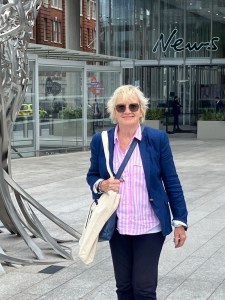
“London Bridge is falling down…” so the song goes. Well, it’s not. It is thriving, bustling with people, merchants, tourists and local inhabitants who love this very special part of London.
I was there recently visiting my family in England. I had a meeting with my new Editor at Harper Collins Publishing offices (I still get a kick being able to say that: “My publishers, my editor”!) at London Bridge. Many of the major publishers and newspapers are housed in this towering building that is right next to London Bridge tube station.
Security was very tight. As I approached the main entrance to the office tower, security guards stopped me, ready to turn me away. But I had an appointment and had to show my ID, which was checked against the computer appointments records before I could walk through those hallowed doors. Once inside the lobby, I was checked again by security and ushered through a metal detector. Just like at the airports. I had to wait until someone came to escort me upstairs. And when I left, I was chaperoned back through the same security system. So, this is what it’s like working in London today! Not quite the fun, easy-going offices I recall from my days of writing for the teenage magazine Jackie and the host of women’s magazines in Fleet Street.
My brother Ted had accompanied me and waited patiently nearby until my meeting was done. We had decided to explore the area of London Bridge and Borough Market – the new Hot Spot in London. The hip, cool place where the young hangout. Pop-up food stalls proliferate; vintage clothing stalls, cosmetics, tattoos, stacks of vintage records for sale, ‘Bubble Tea’ adverts and music from all over the globe wafted through the crowds. I never did find out what ‘Bubble Tea’ was. But it seemed very popular. The market was wall-to-wall students and young entrepreneurs in their eye-catching, colorful attire. Creativity and innovative ideas abounded.
One of the reasons for the throngs of young people in the vicinity selling and buying was, I realized, because the market was so close to the medical colleges and universities. Lots of medical students.
I also learned that this market began life in 1756 as a cluster of stalls at the foot of London Bridge. It’s come a long way, baby!
The tall, grim buildings on St. Thomas Street are a focal point of the medical world. The famous Guy’s Hospital, founded in 1721 by philanthropist Thomas Guy, stands cheek-by-jowl with St. Thomas’ Teaching Hospital – where Florence Nightingale trained her dedicated nurses. This hospital was named for St. Thomas Becket and founded in the Middle Ages but located here in Lambeth since 1871. These are part of the Kings College, London Medical Education programs.
Just across the road is the tiny Operating Theatre Museum, in the Herb Garret at the top of the narrow 17th century brick building. A museum of surgical history housed in the old apothecary. Herbs and flowers used in those days are displayed, with mortar-and-pestle and hand-written notes on their efficacy. Completed in 1822 is the operating theatre is the oldest surviving operating theatre in Europe for surgeries that predated anesthetics and antiseptics.
What fun! It offers learning experiences for all ages. I especially loved the large yellow rubber ducks placed around the exhibits. They were each painted with some dreadful disease: blobs of green goo representing gangrene, or drooling, lumpy additions depicting small-pox, syphilis, or the black plague. Symptoms were written on a card next to the duck. You had to guess what they represented. The answer was found underneath the duck. I noticed medical student visitors taking great delight in guessing the correct answers. The enormous, black all-encompassing metal head gear with the long snout, for the brave doctors during the plague in 1660 London was there. Various operating tools were displayed, including the large hacksaw next to the operating table that was labeled “for the removal of legs and arms”.
There were rows of seats where the medical students sat to observe the operations by doctors who had no awareness of cleanliness, let alone surgical gowns, masks or even handwashing. Hand-written notes, instructions and explanations of the various implements (of torture?) used, as well as reports of individuals’ surgical successes – or traumas!
Today’s root-canals are easy-peasy by comparison!
This part of London shared so many stories, characters, tragedies and successes. I made copious notes, as Ted and I later stopped for a delicious cake and coffee in a little corner French café. A quiet haven amidst the noise and bustle.
Everywhere I looked were stories, historic revelations and wonderful new ideas and a revitalized energy.
Charles Dickens strolled through these London streets at night when he couldn’t sleep, and claimed this was where he found inspiration for his timeless novels. Incidentally, did you know that in 1847 Dickens founded a ‘Home for Homeless Women’ in London?
We walked down to the water’s edge and followed the River Thames as it snakes its way through London, past Shakespeare’s Globe Theatre towards Charing Cross, watching such a polyglot of people of all ages – “a seething mass of humanity” moving on its way through lives humdrum, urgent, desperate, happy, exciting. Who knows?
There is so much written about London through thousands of years. It’s difficult for a writer not to come away with a myriad of story ideas, a cacophony of images and circus of characters. Painters and artists of all fields must be similarly affected.
As Dr. Samuel Johnson wrote in 1777, “When a man is tired of London, he is tired of life. For there is in London all that life can be.”
What is your favorite source of inspiration?





 USA Today bestselling author Sara Rosett writes lighthearted mysteries for readers who enjoy atmospheric settings, fun characters, and puzzling whodunits. She loves reading Golden Age mysteries, watching Jane Austen adaptions, and travel. Publishers Weekly called Sara’s books “enchanting,” “well-executed,” and “sparkling.”


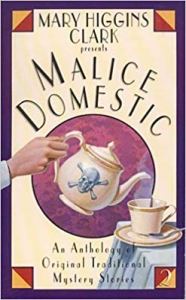 The event is the largest annual gathering in America for writers and fans of traditional mysteries in the genre of Agatha Christie, which places them in a genre called ‘cozy.” It appears that publishers here prefer authors to be strictly categorized into the type of book they write: romantic suspense, noir, thriller, psychological suspense, hard-boiled, legal thriller, historical, private investigator, cozy, police procedural, and sub-genres such as a sci-fi and the newest, cyber-crime mysteries.
 The second book in my series, “Digging Up the Dead: A Tosca Trevant Mystery” was published just in time for this premier annual event. My main character hails from Cornwall and comes to live in Newport Beach, like me, so the “Fish Out of Water” panel was perfect for us both. It was fun to explain to the audience that Tosca Trevant, a London gossip columnist (me too!) had rattled the royals by discovering yet another scandal at Buckingham Palace. This led her editor to re-assign her temporarily to America. Cussing mildly in the Cornish language, and coping with a culture that sees no need for a teashop on every corner, the meddlesome, outspoken and humorous Tosca turns amateur sleuth when she stumbles upon human remains in a neighbor’s garden, in the best Miss Marple tradition although Tosca is a younger version.
 She was instantly contradicted by a voice behind my chair shouting out, “Yes! You did know!” The voice was male and sounded exactly the way I had described his gravelly voice in a previous chapter. I swung around, dumbfounded. Of course, there was no one there and no one else was in the house. Some writers say their characters often take over their role in a book but this was different. Sam spoke a line of dialogue that added another dimension to the plot. It worked well, surprisingly, giving an extra twist to the story. I didn’t hear from him again nor from anyone else I created so I guess he and the others were satisfied with how the plot was progressing.

 I had the pleasure of getting to know one of our Writers in Residence bloggers, M.M. Gornell, more in depth last month and decided to write up my talk with her for the monthly column I write for a UK magazine called Mystery People.
 One of the most famous, nostalgic, fascinating and historic highways that wagon trains of homesteaders traveled, along with migrants seeking fortunes in gold mines, land, and new opportunities, U.S. Route 66 was originally a 2,500-mile dirt trail that ran from Chicago, Illinois to Santa Monica, California. It was eventually smothered in asphalt and became known as the Mother Road, and the Main Street of America, passing through a total of seven states.
 Although her former residences have included other towns and the Sierra Nevada with its rich palette of Red Rock Canyon (the setting for her thriller, DEATH OF A PERFECT MAN), Madeline’s move to Newberry Springs inspired her to set the majority of her eight crime novels, including two series, along the famed highway. “For me,
  But California and Route 66 beckoned in the 1990s, due to mental pictures and expectations she had of the Mother Road twenty years earlier. It was not as easy as she had imagined, but new settings presented themselves and the majestic Sierra Nevada Mountains provided magnificent, magical scenery, inspiring her “Raven” mystery series, then LIES OF CONVENIENCE, and more recently her “Rhodes” mystery series.
 Although the romance of the route was a fixed American landmark, it was soon bypassed by the new Interstate Highway System which either paralleled it, resurfaced portions, or went elsewhere, leaving Route 66 abandoned and lined with ghost gas stations and tiny deserted communities. Eventually, it was officially designated as “ceasing to exist.” But you can’t keep an icon like the Mother Road down. It was rediscovered by musicians, hippies, artists, movie makers, and writers.


 I’d asked a wise librarian in Burbank if there was something beyond Nancy Drew, but kind of like her, that I could read. She looked at this budding, though still gangling young teen, and recommended Mary Stewart’s first book, Madam, Will You Talk? (1955)
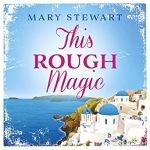 This Rough Magic (1964), my opiate. ***
 Mariner’s Compass (1999) is Earlene Fowler‘s sixth Benny Harper mystery, set along California’s central coast. Each of her books is named for a quilting pattern although Benny is not a quilter herself. She is a rancher and married to a cop, but she helps maintain a historical museum in town that features old quilts.
 Old Bones (1987) *** by Aaron Elkins is another favorite on my list. His protagonist Gideon Oliver is a forensic anthropologist, but his moniker in the series is “bone doctor.” It is absolutely amazing what you (he) can discover from a set of fresh or ancient bones. Who they were, yes, but more importantly in the book, how, where, when, and why a person becomes bones.
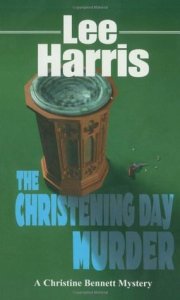 A freaky location again is the reason for my listing The Christening Day Murder (1993) by Lee Harris as a memorable favorite. (All Lee Harris’ Christine Bennett – a former nun – mysteries have a special “day” as their title.) I can’t even remember the mystery, but I remember where a good portion of it takes place.
 And lastly, the wonderfully warm and well-written family saga by the gifted Rosamunde Pilcher… The Shell Seekers (1987) **** (all 582 pages ) This is not a mystery, but a lovely women’s novel featuring Penelope Keeling, a 64 year old woman whose days are limited, and whose family does not understand her. A woman whose past is calling her, but whose present threatens to fence her in.
 The Writers in Residence
You must be logged in to post a comment.