
Jill Amadio
 Slogging away as we do on our mysteries, enjoying making sure we’ve planted subtle and not-so-subtle clues and fascinating red herrings, it’s a marvelous feeling to write The End and look forward to working on the second draft.
After the third or fourth draft and you’ve decided that your manuscript is publication-worthy, how often has the thought flashed through your mind of it being picked up by Hollywood? Have you sat and imagined the different scenes coming to life, your characters personified by, say, Meryl Streep and Anthony Hopkins? I’ve always dreamed of Emma Thompsonplaying my amateur sleuth, Tosca Trevant, but she’d have to dye her hair dark and grow it to her waist.
A few days after I tried to picture Emma thus transformed and realized it probably wouldn’t work unless I switched Tosca’s dark hair to Emma’s blonde locks, I received an invitation to Fox Studios. Charlie, a screenwriter and author friend who lives nearby, is a member of the Screenplay Development Group at Fox. Each month the group is supplied with the script of a current movie, urged to see the film, and invited to critique both forms of entertainment. At the meeting we were to discuss and voice our feedback while comparing the two genres.
Coincidentally, our script last month was “Late Night,” a comedy starring Emma Thompson and Mindy Kaling who produced and wrote it. Be still my heart! The first three pages of the script were evaluation sheets for discussion at the meeting. Charlie pointed out to me that the script itself was held together by only two staples, the middle hole left empty. If a third staple was added the writer would be considered an amateur and the script immediately dumped in the rubbish bin.
We decided to drive up early to LA for lunch, see the movie, and then go on to Fox. We had both read the script and discussed it between ourselves a few days earlier over coffee and found we agreed that the premise was excellent, the execution of the idea rated a Very Good, and the dialogue was spot on and very funny. We were to rate the character roles, settings, visuals, writer intentions, relationships, plot, etc. We also had to consider the cost of making the movie and were provided with amounts ranging from $5-200 million. Charlie and I figured we’d need only $10 million because there were very few set changes. Most of the action took place, coincidentally, in a studio’s Writers Room.
I knew that the Writers Room was where the magic happened, having seen Writers Rooms on TV shows. Reminded me of my first job in the newsroom of a newspaper. To me, both magical places. At Fox I envisioned all those creative types sitting around thinking up jokes, sex, violence, and crazy dialogue. I remember a movie wherein two writers were locked in the Room until they came up with a better script. On the other hand, I need complete silence and solitude when I write but I hoped being thrown into this new environment might spark some new book ideas.
Charlie and I drove down Pico Blvd to make sure Fox Studios was still standing, then headed off in the opposite direction to the Westside Pavilion, a large shopping mall, for lunch. We found an entrance to the parking garage and Charlie, for some reason, said it was best to drive up to the roof. We noticed no cars parked anywhere and decided the mall had not opened yet, must be too early. We proceeded blithely up the ramp, saw boarded up windows everywhere and realized the Pavilion was closed. Permanently. We turned the car around and drove down but were stopped at the exit by a large wooden barrier arm that refused to raise. Charlie pressed all the buttons and finally shouted into the ticket slot. Eventually a guard came out, shook his head at us for not knowing the mall had closed a year ago and let us out, no charge.
On Sunset Blvd we found a coffee shop that sold lattes and blueberry muffins for outrageous prices. Charlie pointed out that the meeting would be catered. In Hollywood language that meant tons of food. Slightly fortified but poorer we drove over to the Landmark cinema to watch the matinee of “Late Night.” We noted that the first several pages of the script had been scrapped and the action began in New York, not London. Emma, in the script, is depicted as something of a loose woman, married, with lots of lovers. In the movie she indulges in only a single one-night stand. Wonder who changed that around? Also, the ending was entirely different, so we knew there’d be lots of pro and con at the meeting.
Along Pico Blvd we spotted the Fox Studios sign. Exciting! We’d received two pages of instructions on how to enter and what to say to the guard at the studio gate, where to find the Steven Bochco Building, where to park, and told in VERY LARGE BOLD LETTERS not to enter any other building on the lot. No sir!
Pretty soon several others arrived and we went inside to register and find a seat at the immensely-long writers table. Must have been carved from a redwood tree. My blood pressure rose, I am sure, because this was such an adventure and we were in a real, real movie studio. Despite my many years interviewing celebrities and a bit part in “Dr Zhivago” that was filmed in Spain when I lived there, this sent my heart racing. It’s one thing to be on an outside set, fun but okay, and another to be on a lot where several movies are filmed simultaneously and buildings are named after the famous.
There were about 38 of us sitting around the table, average age was, surprisingly, 40s with a few maybe in their 30s. Several older men and women were there and were veteran writers. Long-time producer Bill Taub led the discussion and we went around the table describing what we were working on. Blatant but truthful, I announced I was an author and had just finished adapting my third script to a book after my clients had been told to Write the Book First. Everyone else was a screenwriter. One person had adapted her novel to a script, and three attendees were in film school at UCLA. No one had a movie in production but three had sold to studios.
The actual discussion was lively, a little argumentative, and revealing. I kept quiet most of the time, making notes for a possible future murder in a Writers Room. The changes between the “Late Night” script and the movie, of course, were the subject of much talk as well as a learning curve and a warning that such cuts were typical. We all wondered why Emma’s persona was cleaned up and agreed that cutting the first ten pages unfortunately eliminated the set-up of how Brit Emma came to be a famous late-night TV talk show host in New York and was married to some old chappie.
Charlie and I continued our discussion driving home, me still high with excitement, and decided we would join the group again at a later date. I’m not sure if any of the talk helped me with my own writing because the genres are so different. Even so, input about dialogue was valuable as far as getting to the point of a scene and knowing that instead of a character being described in a script simply as Female Comic, 19, nervous, I can flesh her out in my book, paint word pictures, and endow her with thoughts and emotions I want her to have rather than a character re-created by a film director who probably hadn’t read my book.
Still, when all is said and done, getting your sleuth onscreen must be very special indeed.
Late Night – Official Trailer | Amazon Studios
****
(Posted for Jill Amadio by Jackie Houchin.)
.

 When returning home from a recent trip in April and touching down in Washington D.C., the South African pilot announced, “Ladies and Gentlemen, welcome to the United States of America.” I have to admit, I got a lump in my throat and tears welled in my eyes. So often I take the privilege of living in “the States” for granted. So many in the world would change places with me in a heartbeat!
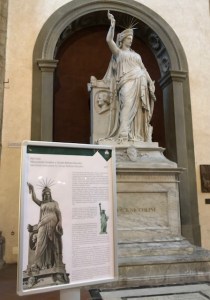 In a church in Florence, Italy, I discovered (along with the burial place of Michelangelo and Marconi) a statue that very well could have been the inspiration for the French gift of the Statue of Liberty. Softer, more feminine, but amazingly similar!

 My “This” today is a written-versus-spoken mea culpa, and words of encouragement I meant to say in person the first Thursday of this month. There’s a “trying-to-be” startup writing group that is getting together the first Thursday of every month at our local Newberry Family Center. But I didn’t make the last lunch. I wanted to come, and I wanted to offer to the few that might have shown up, encouragement to write, write, write… So, I decided to post my undelivered spoken writing group encouragement thoughts and words here, since I couldn’t make it to that meeting
 I’m a firm believer that if you aren’t a “pen to paper genius protégé”—which I’m definitely NOT!—you have to make the MISTAKES that make you better: and if you don’t WRITE and REWRITE, you never make those growing mistakes, and consequently, your writing doesn’t improve—and often, doesn’t even get done. You never get that “Great American Novel” out there, or that wonderfully enjoyable cozy series with protagonists you love and hope everyone else will too, or the chronicling of your special hero, or the biography of someone you admire, or your book of poetry, or book of songs, or how to do something you’re good at, or your own memoir… I know, it’s rather trite and obvious words of encouragement—but I don’t think the sentiment can be expressed too often. Write and make those mistakes that move us forward, make us better writers.
 and on—which I wouldn’t have noticed because I liked the character (smile). And there isn’t a lot of thriller/adventure type action throughout the entire book, which didn’t really jump out at me. My editors of course saw these areas for improvement—and in line with my “This” above, pointed out opportunities for me to improve my craft.
 So, here’s the big questions(and my answers) I’m presenting in this post—aimed especially to “in process” authors. Do you want to write? Then doing is the answer, no matter how daunting it might seem. Do you want to be the best author you can be? Then pay attention to areas we can improve for readers to enjoy our work. My thinking is—”writing” is a process, not a done-deal.
 In the case of The Caretakers, I’ve whittled out three pages from the opening, and I think I’ve “livened up” some scenes.
 by Gayle Bartos-Pool
 Polishing the Gem
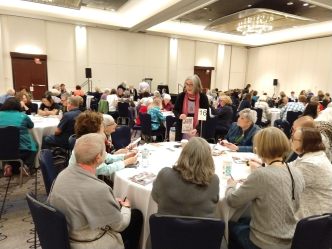 Let me explain what Author Speed Dating is first. In two hours, two authors pitch their works to approximately 144 readers at 18 tables seating 8 people. Each author has 2 minutes to pitch their book/project and then the next author pitches their book for 2 minutes. I partnered with
  After that point I ceded my time to Ann who spoke about her protagonist Inez Stanner traveling from Leadville to San Francisco in the 19th century and then a quick pitch for her friend



 ell, I’ve finished manuscripts for the first two. I’ve also completed initial edits for the first one after I received changes and questions from the editor, and I sent it back this week–and already received the final version back to review. I need to make more


 I was recently chatting with my family over coffee in a
 Speaking of imaginations: We went to see the stage version of
 Of course I came back from my travels with more books in my suitcases.

 The 17h century English poet Andrew Marvell wrote the line,
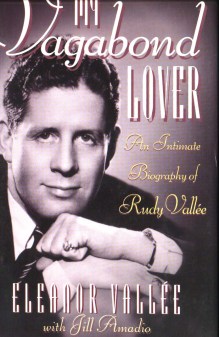 and the discipline is still embedded in my bones, which helps me with setting up and meeting deadlines today, especially for my column in the UK magazine, Mystery People. When I began to write books after settling in America I discovered I need privacy to write my books. Plus perfect silence, a fine view, classical music, and endless cups of tea. I need my files that are always brimming with notes, press clips, drafts, character bios, settings, maps, and travel guides. When I wrote the Rudy Vallee biography I had close to 86 separate folders, one for each year of his life (he died watching television as President Reagan presided over the centennial in New York harbor.
 Like many writers, I jot down notes while travelling or dictate into a digital recorder if I’m visiting settings in my books, luckily all local so far. I also love eavesdropping. Restaurants and airport terminals are great places for this. But for writing crime-ridden scenes no other place beats sitting in front of my laptop at home.
  Last year I picked up Catriona McPherson at the Orange County airport. She was the main speaker at a conference. When I arrived she was sitting on a bench in baggage claim tapping merrily away upon her computer, oblivious to the crowds coming and going. A few days later we were early for her return flight. I went into the café for some tea. When I brought it over to her, there she was again, still tapping away.
 In the spring of 2018, I organized a volunteer program at a local high school. Together with three other writers, we mentor students in a
  Each time we begin a new round of submissions, we, too anxiously await the material, hoping to find both familiar names and new ones. Having worked with the class for over a year, including several students who’ve been in the program since it began, I’m delighted to see a steady improvement in their work.
 (Student), I am stopping my critique here, since this is where your words end and the essay you copied and pasted from (organization’s website) begins. What continues below is called plagiarism – taking someone else’s work and passing it off as your own. Aside from being illegal and dishonorable, you’ve weakened your message.
 On a recent short-term mission trip to Malawi for my church, I had the opportunity to teach Writing classes to two groups of home schooled MKs (Missionary Kids). These were children from American, Canadian and South African families. There were nine in the 3rd-4th grade group and seven in the 5th grade and up group.
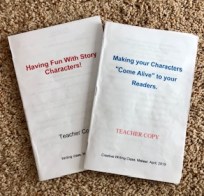 After reviewing the stories and talking to the other home school teachers, we all agreed that the kids needed help in character development. The action was amazing; the worlds they created were vivid, but the heroes, helpers, and villains were flat and hard to imagine.
 Before I arrived I asked that the kids (both classes) bring the first several paragraphs of a story they had written to class. In class, I had them each read their paragraphs aloud. There were Captain Jack, Commander of a Starship, twin girls named Peace and Harmony, and a 20-year old girl named Ella who wanted to become a princess (and a dozen others).
 For the younger class, I had them draw in their workbooks a circle for a face, then slowly add features (eyes, nose, mouth, ears, hair) and write a description of each as they went. Next they drew bodies with any kinds of clothes and shoes (or not) they wished. I had them write why these “characters” were smiling, wearing… glasses, a soccer jersey, a swim suit, a long dress, a tutu, and had on sandals or swim fins. They began to see how to show what their story characters looked like by writing descriptions, and in the process developed more interesting information about them. (I could see “light” dawning in their eyes!)
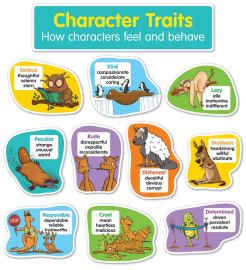 Next, we had fun with thirty-six
  For the older class (all boys, and most writing sci-fi or fantasy) we delved a bit deeper into making their characters memorable by using various ways to describe physical as well as personality traits. They practiced describing a character in an action scene (showing fear or bravery without actually using those words) and played around with using an occasional quirk, flaw, or unconscious mannerism to reveal hidden traits.


 The Writers in Residence
You must be logged in to post a comment.