
By guest blogger, Alison Wearing
“I think it’s so much easier to define memoir by what it’s not…Memoir is not a chronological recitation of a life. It’s not therapy. It’s not an accusation. It’s not a boast. It’s not fiction. It’s not gossip. Memoir is a search to understand the human condition—to tell a personal, resonating story. Memoir writers look back with empathy—toward themselves and toward others. They fabricate nothing on purpose. They know what to leave out. And they recognize—explicitly and implicitly—they are not the only ones in the room. Their readers matter, too.”
~ Beth Kephart, author of Handling the Truth
It used to be that only famous people wrote about their lives: retired politicians, Hollywood personalities, rock stars. They wrote their memoirs; they still do. The aim of a person’s memoirs is to cover as much of a life as possible, to draft an overview that touches on all the essential points: family, education, relationships, influences, crucial turning points, successes, failures, accomplishments. Memoirs can also be called autobiographies.
More often than not, memoirs and autobiographies are structured chronologically, and generally, we are drawn to read them because the authors (or, in the case of ghostwritten autobiographies, the subjects) are people already familiar to us. There is absolutely nothing wrong with writing an autobiography, as long as your intended audience is your family or those close to you (unless you are famous, in which case your fans await your story!).
I once had a woman in one of my workshops who was creating a handwritten and hand-bound autobiography, complete with sketches of floor plans of the houses the family had lived in, paintings of significant buildings, black-and-white photographs. It was a magnificent creation and will be a priceless treasure for her family and future generations. Those of us in the workshop enjoyed paging through the volumes, admiring certain drawings and photographs, but the story itself didn’t invite or include us. It was a series of details that had relevance only to the people involved in the life described. For what it was, it was spectacular. I don’t want to detract from that approach and the author was very clear about what she was doing and for whom. The reason she joined my workshop was to learn how to write more personally, to delve into the realm of communicating emotion rather than simply the facts. I’m not sure she’ll choose to include that kind of writing in her book, but her family might treasure that intimacy if she does. Either way, this kind of a work isn’t a memoir. It’s an autobiography. It’s the whole kit and caboodle. It’s the wide-angle photo of a life.
An autobiography can be a beautiful endeavor, but it is markedly different from a memoir. For while an autobiography is the story of a life, a memoir is a story from a life.
A memoir may visit different parts and elements of a person’s life, but the intention is not to tell or describe the whole thing. It may deal with a period of time, a place, a relationship, a journey, or several of those things, but the story is delineated, it has a container far smaller than the span of the writer’s life. A memoir has a focus; ideally, it has a clear and narrow focus. And paradoxically, the narrower the focus, the greater the freedom the writer may have to talk about the breadth and fullness of her life. We’ll delve into that more deeply when we get into structure, but for now, let’s just cover the basics of the genre.
In addition to a clear focus, a memoir has, at its heart, a transformation of some kind, a shift in perspective or understanding, a new way of seeing one’s life, a place, a relationship, the world, whatever the theme of the story.
In this way, a memoir often chronicles an emotional journey of some kind, a departure from one aspect of oneself and an arrival at another (often more enlightened) state of being. The author might be trying to achieve resolution, to solve of a problem, or to achieve a higher understanding or acceptance of circumstances, events.
Or, as Mary Karr, author of the now-classic memoir The Liar’s Club, puts it: “In a great memoir, some aspect of the writer’s struggle for self often serves as the book’s organizing principle, and the narrator’s battle to become whole rages over the book’s trajectory.”
The “battle” Karr refers to may take a variety of forms, and it might not be a dramatic fist-fight-of-a-battle so much as a peaceful and gradual unfolding. It could be a recollection of travels written from a broader perspective than what was available at the time.
It could be a revisiting of a traumatic incident from a place of recovery or empathy. Whatever its focus, a memoir is more than just an honest account of an event or a time, more than a simple recounting of events, more than a detailed reportage of a journey from A to B.
It is an effort to make sense of—and perhaps make peace with—an aspect of the writer’s life.
It is an exterior and interior expedition, a quest for meaning.
“Memoir is not about you, or me. It’s about something universal. That is, if you want anyone else to read it. Good memoir takes on something universal and uses you as the illustration of that larger idea.” ~ Marion Roach Smith, author of The Memoir Project
##

Alison Wearing is a best-selling, multiple-award winning writer, playwright, and performer.
She is also the creator and facilitator of Memoir Writing Ink, an interactive online program that guides people through the process of transforming personal stories into memoir.
Do you have a personal story you wish to write?
Do you wonder how to craft your story to make it compelling reading for others? Or how to structure it so it holds together? Or how to write about difficult memories? Or how to write truthfully about something that happened decades ago? Or what to do if someone else remembers the same events differently, or if they don’t want you to write your story?
These questions can paralyze us, but that doesn’t need to be the case. In fact, those same questions can be the doorways to the finest iterations of your story.
If you’d like to learn more about her 12-week course, visit: Memoir Writing, Ink
##
Alison also leads Memoir Writing Retreats – next up is in Tuscany, Italy in October 2022 and in April 2023. Interested? Tuscany Retreats
..

 Those of you who are reading this are most likely writers and readers. And some of you are also techies. You know what you’re doing when you sit down at the computer and write. Well, that part also works for me.
 Is it ‘Yak Shaving’ again? For those of you who weren’t there: ‘Yak Shaving’ is when you find yourself doing something as irrelevant as shaving a yak (don’t ask!), instead of the goal you set out to accomplish. MIT student Carlin Vieri invented the term and blogger Seth Gordon, explained, “the seemingly unrelated, endless series of small tasks that have to be completed before the next step in a project can move forward.” Hmmm.
 Sometimes I feel like Sisyphus – the Greek Mythology, evil sinner Sisyphus was condemned to an eternity of pushing a boulder up a mountain. Once he got to the top, the weight of the boulder forced it to start rolling down to the bottom, wherein he had to start again. According to Albert Camus, the Greek gods felt that there is no more dreadful punishment than this futile and hopeless labor for Sisyphus. Hmmm.
 We sit at our computers – or with pad and pen – and spill our imaginations onto the page. We aim to entertain, to educate, to inspire, to elevate people’s lives and show them different possibilities – escape into other worlds. Or perhaps just to make them laugh. Everyone needs to laugh. Charlie Chaplin said, “A day without laughter is a day wasted.” And then some of us write because we just want to.
 ……………………………

 Books, books, books.
  Many writers I know run out of bookshelf space and begin piling books on the floor or finding nooks and crannies to fill. One client for whom I ghostwrote a biography kept a small shelf of paperbacks in her bathroom as many people do. I spotted another who had a penchant for refusing to return library books and not even bothering to removing their old category tags.
 Perhaps paying a visit to your own bookshelves will reveal a treasure you had forgotten. I wish I had bought a book I found at an airport gift shop in Jakarta. It was bound in beautiful red leather and titled “Sukarno.” I opened it up and every page was blank. I guess the publisher wanted to titillate buyers before the Indonesian leader passed away and there would be no repercussions about his controversial reign while he still lived.

 This winding and contradictory mortality thinking road is snaking back and forth for me… For example, in my Rhodes series, it all starts with LC Rhodes setting everything in motion for Leiv’s adventures on his deathbed. And throughout the few books I’ve subsequently written in the series, Leiv often talks to his deceased grandfather, LC.

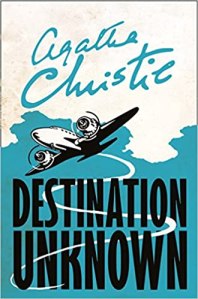 I began this quest waiting at LAX for the flight that would take us to Portugal to meet our ship (with a stop in Montreal). I started with Agatha Christie’s DESTINATION UNKNOWN. (We knew where we were headed, but hey, you never know – as the protagonist in that book soon found out!)
 As for that 4-hour stop in Montreal, I chose A DISAPPEARANCE AT THE BONNE NUIT HOTEL by Dominique Daoust, about a young female newspaper reporter who goes to Montreal in search of that “big story.” It’s the first book of a trilogy.
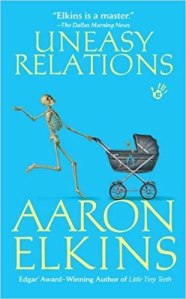 Our ship docked in five ports in Spain, with a stop at Gibraltar (a British Overseas Territory) after the first. I read Aaron Elkins, UNEASY RELATIONS, set in and on that famous rock. Wow, what fun to follow Gideon Oliver, the bone detective, up the cable car to the top for a really scary view, and then inside to St. Michael’s cave where stalactites come together to form of figure of an angel. There is a lecture hall beside it and Gideon spoke there! It totally makes a difference reading a book when you have BEEN THERE!
 I read A FATALITY IN SPAIN by Blake Pierce, which is set in Barcelona (also in Pamplona). Oh, yes, I definitely remember that weird Antoni Gaudi modernistic church in town! And the dancing “giants” with the wooden heads! Reading the story…I was there too, hearing, seeing, smelling. (Although we chose to wear a mask there because of the packed crowds in the streets.)
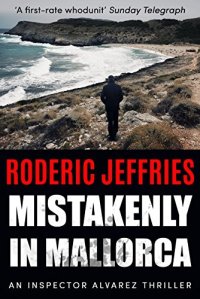 I am currently reading MISTAKENLY IN MALLORCA by Roderic Jeffries, an Inspector Alvarez mystery. It’s number one of 37! (And perhaps I’ll also read HOTEL MALLORCA; AN ELAINE PEARSON MYSTERY by Susan Linden Emde, if I finish the rest in good time. It looks very interesting.
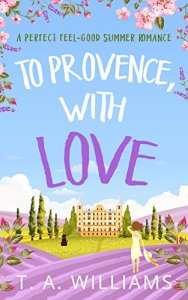 At Marseilles, France, we took a bus an hour inland to Avignon, France. Since high school French classes, I’ve always dreamed of “dancing on the Bridge of Avignon” as the children’s song goes. Finally, after 50 years – I did it! To remember that beautiful time in Provence, with everything lavender, I read, TO PROVENCE, WITH LOVE by T.A. Williams. More of a light romance than mystery, the protagonist is a writer and teacher, who came from England to write the biography of an elderly Hollywood film star. (Rosemary Lord, you would like this one!)
 ONE SUMMER IN MONTE CARLO by Jennifer Bohnet is a sort-of mystery and again a light romance, set in the Principality of Monaco. It featured a lot of action and information about the F-1 Auto Racing circuit. While we were there, they indeed were setting up grandstands, pitstops, and pilon curve barriers for the race that would happen two weeks after we left.
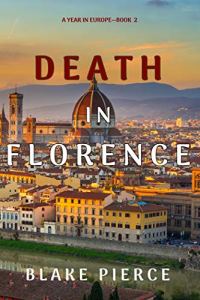 I was able to take my husband to Florence, Italy – a city I’d visited on my own three times before. Sadly, we were not able to go out into Tuscany for a visit to a vineyard and chateau. (Excursion cancelled.) But I was able to show him around one of my favorite cities, eat gelato, have spaghetti Bolognaise at my favorite café. (Sigh) I’ve chosen A DEATH IN FLORENCE by Blake Pierce, or DREAMING OF FLORENCE by T.A. Williams. I’ve read books by both of these authors (A Fatality, and To Provence), so I’m hoping for a different one. Any Suggestions?
 I read AUNTIE POLDI AND THE SICILIAN LIONS by Mario Giordano, while in Sicily, and we actually took a private taxi to Taormino because of that book. We didn’t have an excursion booked there, and, well, why not? It only cost E100.00 for the 30-minute trip each way, and a patient driver while we toured the town for a couple hours. It made the book more real, although we did NOT visit Palermo, where the “mob” lived in the book. Hahaha.
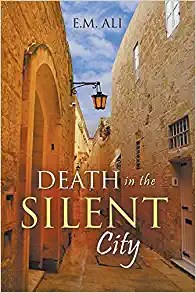 I have yet to begin DEATH IN THE SILENT CITY by E.M. Ali, but I can’t wait. I loved Malta from the moment we first docked. And indeed, the old city has red-stone walls protecting houses in the narrow winding streets just like on the cover. We entered one of those bolted doors with our tour guide, and into a beautiful studio where he was restoring stained glass windows they’d found buried after World War II. I always thought Malta was a part of Italy, but it is a country on its own.
 We had only two “at sea” days between distant ports, so I read two cruise ship mysteries. VANISHING VACATIONERS by Hope Callaghan and PINEAPPLE CRUISE by Amy Vansant.
 Ah, Greece! I finally got to visit the setting of my all-time favorite book by Mary Stewart – THIS ROUGH MAGIC. It is set on the Isle of Corfu in the beautiful Aegean Sea. A romantic-suspense mystery that I first read when I was about 13 or 14. I’m sure I’ve reread it a dozen or more times since. I love it. And now, I’ve seen those lovely clear-water coves and sandy beaches, the castle-like homes way up on the steep mountainside, the winding dirt roads suitable only for a motorbike, the enchanting Corfu Town and the harbor. (sighhh)
 I read A CRUISE TO DIE FOR by Charlotte & Aaron Elkins, an art-forgery mystery set on a fantastic mega-yacht, on Corfu, and in Athens.
 I just finished the most fun, interesting, and un-put-downable audio book that I have listened to in a long time. SACRED GAMES by Gary Corby is set in ancient Olympia, Greece in 460 BC. The still-active archeological dig that we visited and loved is portrayed so clearly in this book (the author must also have visited the old Olympic Games site) that I was sharing bits of it here and there with my husband. “Oh, yeah! I remember that!” he would say. The book is a murder mystery that takes place during the games, and a young Athenian man is the investigator. He has 4 days to find the murderer before the Games end and his best friend is executed. The action, intrigue, fast pace, brutality of the sports, and the setting, well, it was like walking there in person again.
 I can’t believe I actually found a book – another light romance – set in Croatia (and part of it actually in Split, where we visited)! CLUELESS IN CROATIA by Joy Skye was a fun book, and the scenes in the harbor, in the city of Split, even a mention of the cruise ships there was fun.
 I hope to read A GIRL FROM VENICE by Siobhan Daiko, or maybe Jennifer S. Alderson’s DEATH BY GONDOLA, or maybe even one of Donna Leon’s more recent Commissario Brunetti mysteries, set in the floating city. We were not able to visit Venice – I really cried about that – but itineraries change and we make do. We did bus to Venice from Trieste and fly out of the Marco Polo Airport to Heathrow on our way home.
 For the UK, I read Victoria Tait’s book two in her new Dotty Sayers antiques mysteries VALUED FOR MURDER set in the Cotswolds. And I read another UK book since we had that glitch in the British Airways jet – did you hear about that?
 THEN – after hours and hours we were bussed to a hotel for a free over-night stay in London, free dinner and breakfast, and then back to Heathrow for another try at LAX the next morning. Because of the additional day in the UK, I read THE CURIOUS CASE OF THE COPPER CORPSE, a Flavia de Luce novella by Alan Bradley set in England.




 Yep, it’s a radical departure from the First Edition cover, and I confess that neither Paula nor I loved-loved-loved the image itself. However, it does speak to the heart (pun intended) of the story, it’s eye-catching, and it will tell the potential reader/buyer what kind of story this is.


You must be logged in to post a comment.