
By ROSEMARY LORD

I love to see the writing trends and what’s being read in different locales. So here I am doing my research in far away Greece. Well, someone has to do it!
You see, my older brother, Ted, is undergoing treatment for prostate cancer and my sister Angela – an ex-dancer – is recovering from knee surgery. So, the best idea was to scoop everyone up and retreat to this sleepy village on the Greek coast, where we can do family healing and recouping – and where I can get a proper break from running the Woman’s Club of Hollywood.
It seemed like a good idea at the time, during those cold winter months.
And, as I sit on my balcony in the afternoon sun, while my siblings take a siesta, I concluded that this was indeed a very good idea!

Behind me, the Taygata Mountains shield us from the rest of Greece. In front I can see the waves of the Ionian Sea rolling in, then rhythmically retreating. Olive trees and the occasional lemon tree fill in everywhere else, colored by a profusion of wildflowers wherever one looks. The birds – chaffinches, sparrows, house martins and the constantly-cooing doves – provide the background music. With the occasional bleat from a stray goat, or a distant dog bark.
Not many distractions for industrious writers here.
 And there are small writers’ groups in the little villages. Especially poetry writers. Mostly American, German and English ex-pats, who escaped the cold winters of their homelands to have a fresh start here.
An ideal place for writers – except that it’s very hard to get work done in such an idyllic surrounding. It was in the next village that Nicholas Kazantzakis wrote about the legendary local man, Zorba the Greek – the black-and-white film of the book had the iconic music as Alan Bates and Anthony Quinn danced on the local beach. Ernest Hemingway, Lawrence Durrell, Dorothy Parker and other writers would stay nearby at the home of British writer and war hero, Patrick Leigh Fermor. His home has recently been turned into a writers’ retreat, with programs through UCLA and the New York and the British Library. We watched it being restored over recent years and toured the light and airy library and living and writing rooms. A magical place.
But, back to today’s writing. In the small local Katerina supermarkets, I always head for the book stands to see what’s being read. Jeffrey Deaver, Lee Childs and James Patterson head the English-language shelves, with Danielle Steele and Mary Higgins Clarke perennial favorites for holiday reading. The same titles printed in Greek and in German occupy the next shelves. Victoria Hislop’s beautifully written and researched sagas based on Greek and Spanish civil wars are prevalent and, on a lighter note, Joanna Trollop, Lucida Riley, Leah Fleming and, still, Agatha Christie paperbacks remain popular purchases. At one of the nearby cafes there is a “bring one/take one” wall of books, where one can swap a book you’ve finished and read something different.

Here I am with my sister Annie.
There’s a lot of sitting in the shade of the olive trees or under an umbrella on the beach and reading done here. Forget about TV in this part of the world – so there’s a lot of reading and writing going on. Until you nod off, that is, and awaken 40 minutes later, wondering where you are and what you’re supposed to be doing! I have done that many times since being back here! I’m catching up on lost sleep!
But getting away from one’s normal routine can be very productive. As Marcel Proust pointed out: “The real voyage of discovery consists not in seeking new landscapes, but in seeing with new eyes.”
Looking at one’s life and work from afar brings new perspectives.
I have long been working on a book of the history of the Woman’s Club of Hollywood that has occupied my life for lo these many years. Here, I have been able to attack it with a different, fresh approach. I have also taken a different slant with two of my other half-finished novels that really need to be ‘out there.’ And I’ve been sketching a new mystery set in these parts.
I picked up an interesting idea from the prolific Lee Goldberg (who wrote the “Monk” television series, “Diagnosis Murder,” and recently Hallmark’s “Mystery 101”) on my recent trip to the Left Coast Crime Writers’ Conference, where we were fellow panelists.
Lee explained that script writing was much easier and quicker for him than all the novels he had written. Novels take him many months to write. Scripts could be done in a matter of weeks – often due to the pressing time allowed by the studios. So now he does a simple script of his new novel first. In the script, he said, he writes the step by step ‘what happened.’ No back-story and scant descriptions. Because, in a TV or film production, all the other departments fill this in.
The Casting Department bring in the actors whose personality, looks and ability provide the story’s characters. The Costume designers create the clothes for everyone, based on their view of the script they have read. The Production Designer designs the sets and, with the Art Department, select the locations and the back-drops. The Prop Master decides all the bits and pieces that fill the set, bringing it further to life. It’s a collaborative effort. They all meet up and discuss their ideas, along with the Cinematographer, Lighting and sound people. They each add their own talents and experience, orchestrated by the Director and the Producer. Writing the script, Lee says, is the simple part. He may not agree with or recognize the end-product on the screen, but, as long as the check didn’t bounce, he’s okay with this.
And so, he uses that basis for his novels now. He says it’s quicker than the old outline route. He writes the basic storyline as he would a script. With this, he can see if there is a part of the mystery or plot that doesn’t work, or something left unfinished. Once he knows he has the story worked out, he will go back in and fill in the character details, the background, the setting. This is the stage where he adds in any research he has undertaken and adds the touches of flavor and nuances. Whatever that particular novel needs to bring it to life.
And so, as the sun begins to sink behind the olive trees, I have re-assessed my various writing projects with fresh, ‘new’ eyes. Would fresh, ‘new eyes’ change your current writing?
Love from Greece,
Rosemary


 For the past several months I have often wondered when I would succumb to the inevitable and find that one morning I have woken up woke.




 I’ve used the
  Elaine L. Orr writes four mystery series, blogs, keeps in touch with lots of family and friends, and tromps cemeteries looking for long-dead ancestors.




 My historical stories are all set in Imperial China, specifically (at this point) in the late 1300s, the beginning of the Ming Dynasty. The first three—Hidden, Warned, and Trapped—is a young adult trilogy that I had been thinking about and working on for many years. My educational background is anthropology with an interest in Chinese culture and traditions. Of course, that was long before I retired from jobs that did not specifically involve much of this training.
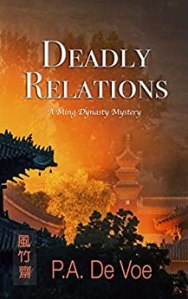 Also, research is needed to get a realistic picture of what’s happening at the local level, beyond the Emperor’s court. In my newest series, A Ming Dynasty Mystery (Deadly Relations and No Way to Die), I wanted to show life from both a male and female perspective. The male character, Shu-chang, was easy to develop. He’s an amalgamation of striving young men struggling to achieve social and economic success through the long-standing Chinese merit system which was based on an examination process. There are many, many examples of such young men.
 The female character, however, was more difficult because I wanted her to be educated and to have freedom to act outside of her home. At the same time, she had to be realistic. I couldn’t simply give her a contemporary mindset in order to create an interesting story. After all, she lived in a period and culture with a different set of expectations for men and women. Fortunately, while reading broadly, I ran across an account of a learned woman who had trained as a professional women’s doctor under her own grandmother. I was able to use her as a model on which to build my character Xiang-hua. I now had a strong female protagonist that I felt was also true to her time and place.

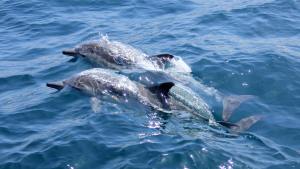 I had mixed emotions about some of it. We’d been to that resort before, and they have a couple of large pools containing dolphins that appear to be well treated considering where they are, but having such smart animals that are originally from vast sea environments contained like that… Well, I’ve researched dolphins. They’re wonderful beings. As smart as humans in their environment. Am I inspired to write about them? I’ve always been inspired to write about them, but definitely not in situations like that—unless they can find a way out and get revenge!


You must be logged in to post a comment.