
by Jackie Houchin
“Raindrops on roses and whiskers on kittens
Bright copper kettles and warm woolen mittens
Brown paper packages (from Amazon) tied up with strings
These are a few of my favorite things (reads)
When the dog bites, when the bee stings
When I’m feeling sad
I simply remember my favorite things (reads)
And then I don’t feel so bad” *
Who doesn’t know the catchy lyrics to that song? I bet you can even picture Julie Andrews singing them while twirling around. And who of us bibliophiles can’t say we have been transported and uplifted during and after reading those few special books that we cherish in our libraries.
The majority of my all-time fave books are mysteries, the old fashioned, clean, puzzling and often romantic reads that still make me smile just thinking of them.
My very favorite book was written by Mary Stewart** in 1964. But it was a few years earlier that I began my journey into this marvelous writer’s world.
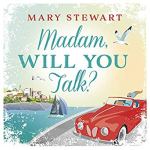 I’d asked a wise librarian in Burbank if there was something beyond Nancy Drew, but kind of like her, that I could read. She looked at this budding, though still gangling young teen, and recommended Mary Stewart’s first book, Madam, Will You Talk? (1955)
I was hooked immediately!
The setting is Southern France and involves a young widow, a lovable mutt, a child in peril, high-speed car chases, and a dark and handsome man who is either villain or saint, and suspense. Delish!
In less than a week I rushed back to the library to check out more of Mary Stewart’s books, reading down the list as fast as I could. Until I came to THE ONE. My favorite book of all time, re-read at least a half dozen times cover to cover, and often, as the song says, “when the dog bites, when the bee stings, when I’m feeling sad…”
 This Rough Magic (1964), my opiate. ***
I’m not sure what makes my breathing slow when I open the book and settle into a soft chair, but in only a few pages I am deep into the atmosphere I love that is written so well by Mary Stewart in all of her books.
A writer’s hidden retreat on the isle of Corfu in Greece… An old house with secret passages… Wisps of Shakespeare’s The Tempest, quoted by the old recluse playwright living there, that seems to foreshadow the events in the book.
A young woman recovering from a career failure, arrives at the retreat with her sister seeking rest and solace but finding danger and death. Fog along the beach at dawn so thick you can only hear the waves slapping the shore… and the wooden oars of a boat bumping in their cradles, soft murmurs and oaths from its occupants, and grunts as they drag something heavy across the sand and into the trees.
A dolphin’s seeming magical appearances play an important role. And an arrogant and handsome figure, rough in clothes and manner slips in and out of the house at all hours. Is he a killer and smuggler, or a hero?
This is no silly Gothic, but is (to me) outstanding storytelling by a “wordsmith extraordinaire” whose sense of descriptive place is beyond amazing. My favorite read!
Next on my list is a puzzle mystery, that just so happens to also have a murder.
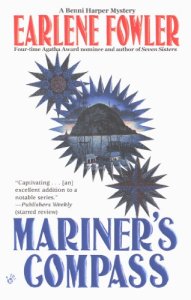 Mariner’s Compass (1999) is Earlene Fowler‘s sixth Benny Harper mystery, set along California’s central coast. Each of her books is named for a quilting pattern although Benny is not a quilter herself. She is a rancher and married to a cop, but she helps maintain a historical museum in town that features old quilts.
What entrances me in this book, unlike any of her other mysteries, is the puzzle. In this story Benny receives a mysterious bequest from a dead stranger. She will inherit his entire estate if she will stay in his home in Morrow Bay for two weeks. Alone. Being alone, abandoned, is something that terrifies Benny.
She agrees, although her protective hubby-cop is not fond of the idea. Soon Benny is on a strange and dangerous scavenger hunt to find the man’s true identity. The clues he leaves hidden, if carefully followed, lead to more clues in a widening spiral of strange places. The deep mystery they reveal piecemeal is totally captivating. It’s a real stunner when she finally discovers who this Jacob Chandler was, and why he was stalking her.
More than the location in Mariner’s Compass, it’s the entwined maze of clues which makes this one of my favorite books. (BTW, if you look on Fowler’s fan page, this book is the favorite of many of her fans.)
 Old Bones (1987) *** by Aaron Elkins is another favorite on my list. His protagonist Gideon Oliver is a forensic anthropologist, but his moniker in the series is “bone doctor.” It is absolutely amazing what you (he) can discover from a set of fresh or ancient bones. Who they were, yes, but more importantly in the book, how, where, when, and why a person becomes bones.
Oliver himself is a big, kind of cute, socially inept “nerd” of a guy, who is brilliant with bones. I like all of his cases, but in this one, it’s the location that grabbed me, chilled me, and after many nightmares, made me book a tour to the real place in France.
Mont St Michel, the small island off the Western coast of France topped by a towering monastery, is tour-worthy for sure. (The original cover pictures the island.) But it is the incoming tides, racing without warning at a speed faster than a man can run, over quicksand riddled mud, that terrifies me.
Yes, I went there, rode in a bus across the long, straight road from the mainland at low tide, trudged up the steep, winding road to the top, and toured the ancient building with a set of huge bells. Very Nice. Reminded me of Notre Dame.
But I could see those swirly patches of mud and sand from atop the “Mont” and in the distance a dark blue-green smudge. Suddenly I couldn’t wait to get into the bus and race back to mainland safety.
You are not so lucky in Old Bones. You will suffer fear, panic and worse, when you read the final chapters. I dare you! But, it’s the reason this is one of my faves.
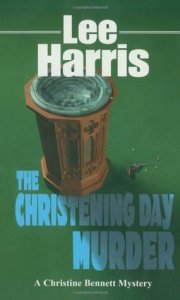 A freaky location again is the reason for my listing The Christening Day Murder (1993) by Lee Harris as a memorable favorite. (All Lee Harris’ Christine Bennett – a former nun – mysteries have a special “day” as their title.) I can’t even remember the mystery, but I remember where a good portion of it takes place.
Thirty years before, the small town of Studsburg was evacuated by the government and flooded to create a reservoir. (Feeling creepy yet?) In this story, a drought has uncovered the town’s forgotten church, along with a gruesome discovery in the dank basement. It is the skeletal remains of a 30-year-old murder.
As Christine tries to piece together the sordid puzzle from the past, the water begins rising again and she is trapped in the basement…..(Gasping scream from me!)
 And lastly, the wonderfully warm and well-written family saga by the gifted Rosamunde Pilcher… The Shell Seekers (1987) **** (all 582 pages ) This is not a mystery, but a lovely women’s novel featuring Penelope Keeling, a 64 year old woman whose days are limited, and whose family does not understand her. A woman whose past is calling her, but whose present threatens to fence her in.
A painting which her children vie for, lusting for the wealth it will bring at her passing, but which is too sweetly precious for Penelope part with, is in the center. Instead of giving it to her children, she uses it – to their chagrin and horror – to fund one last trip into her romantic past.
In the book, sixteen characters have their own section and say. Shell Seekers is not a linear book, so the characters each tell their story, almost as if they are all in a room together, and one steps forward to knit their story into the entire piece. They form a complete picture of “Miss Penelope Keeling,” who speaks last in the book.
These multiple POVs – besides Pilcher’s amazing, evocative, sweeping, tender, gorgeous writing – makes this a favorite. It is the voices of 16 people, separate and yet forever intertwined in the story of one wonderful woman. A tear-jerker. You won’t want it to end. When it does, you’ll fly to the first page and begin again. (PS: Rosamunde Pilcher was 60 when she wrote this book.)
Suspense and romance, locations and mystery
Old Bones and bodies, shrouded in history
Villains and heroes revealing their deeds
These are A FEW of my favorite reads.
Have you got any favorite reads? What is it that makes them memorable to you? Characters, setting, style, genre, author, the writing…?
* Richard Rodgers, The Sound of Music, with my words in italics
** Mary Stewart is credited with developing the genre of romantic suspense featuring intelligent, independent, and capable women who don’t fall apart in a crisis. A reviewer wrote, “There is an old-fashioned elegance about Mary Stewart‘s writing. A stately polish with more than a hint of an old 1950’s Hollywood movie.”
*** Mary Stewart‘s mysteries are now all available in audio through Amazon/Audible. Here’s the link to This Rough Magic
**** 1988 Edgar Award Winner – Best Mystery of the year. (“Look out Sherlock Holmes!”)
***** In her introduction, Pilcher writes that she intended The Shell Seekers to be “A big fat novel for women. Something above all, that tapped into my life and the experiences of my generation.”

 by Gayle Bartos-Pool
 For one thing, both follow a very specific set of rules. Crosswords must be square, they contain a specific number of squares and answers, they must be symmetrical, and they can’t duplicate clues in the grid. Clues and answers must match grammatically. Puzzles must have a theme. Now we’re getting closer to something writers can relate to: themes and grammar. For crossword creators, that means their answers must support the theme. Writers, on the other hand, must develop a theme that carries readers logically from beginning to end. Do I even need to mention that writing should be grammatically correct?
 But solving a crossword puzzle is far removed from the experience of reading an article. The solver of the former is looking for entertainment and a challenge. The reader of the latter wants to be informed, inspired, or educated. Or, at times, to be entertained.
 Semi-retired college English and Spanish instructor. Self-publisher, editor, and entrepreneur. Jeanette has been writing, teaching, editing, mentoring, and publishing for the past four decades. Now she is available online to help writers around the world with their writing ventures. When she’s not writing, she enjoys enjoys traveling to visit family and friends, especially her two grown daughters and her two young grandchildren.

 I attended the Romance Writers of America National Conference last week in New York City. Am I glad I did? Yes, mostly because of the wonderful people I saw, meeting up with those I knew professionally and as friends–or both. I’ve been attending RWA conferences for many years and for different reasons, but that’s the most important.
 Linda O. Johnston, a former lawyer who is now a full-time writer, currently writes two mystery series for
 Do you ever look around and think “What just happened?”
 I’ve lived in England, Paris, Holland, Spain, Malta – and now Hollywood. My movie work has taken me to Germany, France, Spain, Miami, Bermuda, Minneapolis, Colorado, New York. So I really can’t complain. I’ve met and worked with amazing people. I’ve had tremendous adventures – until recent years, when my creative-self got buried.
 I’ve worked at all the major Hollywood film studios as an actress or as a writer. All the dramas and angst of saving the Woman’s Club of Hollywood has taught me a lot about the American legal system, skullduggery amongst women and more about the law courts than I wish to know – as well as how to maintain an old historic building and run a business office.
 I dealt with the sudden death of my darling husband, Rick Cameron. I’ve taken care of elderly, lonely neighbors and an ailing mother-in-law and learned far too much about hospitals, nursing homes and Medicare!


 Slogging away as we do on our mysteries, enjoying making sure we’ve planted subtle and not-so-subtle clues and fascinating red herrings, it’s a marvelous feeling to write The End and look forward to working on the second draft.
 When returning home from a recent trip in April and touching down in Washington D.C., the South African pilot announced, “Ladies and Gentlemen, welcome to the United States of America.” I have to admit, I got a lump in my throat and tears welled in my eyes. So often I take the privilege of living in “the States” for granted. So many in the world would change places with me in a heartbeat!
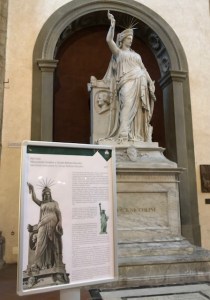 In a church in Florence, Italy, I discovered (along with the burial place of Michelangelo and Marconi) a statue that very well could have been the inspiration for the French gift of the Statue of Liberty. Softer, more feminine, but amazingly similar!

 My “This” today is a written-versus-spoken mea culpa, and words of encouragement I meant to say in person the first Thursday of this month. There’s a “trying-to-be” startup writing group that is getting together the first Thursday of every month at our local Newberry Family Center. But I didn’t make the last lunch. I wanted to come, and I wanted to offer to the few that might have shown up, encouragement to write, write, write… So, I decided to post my undelivered spoken writing group encouragement thoughts and words here, since I couldn’t make it to that meeting
 I’m a firm believer that if you aren’t a “pen to paper genius protégé”—which I’m definitely NOT!—you have to make the MISTAKES that make you better: and if you don’t WRITE and REWRITE, you never make those growing mistakes, and consequently, your writing doesn’t improve—and often, doesn’t even get done. You never get that “Great American Novel” out there, or that wonderfully enjoyable cozy series with protagonists you love and hope everyone else will too, or the chronicling of your special hero, or the biography of someone you admire, or your book of poetry, or book of songs, or how to do something you’re good at, or your own memoir… I know, it’s rather trite and obvious words of encouragement—but I don’t think the sentiment can be expressed too often. Write and make those mistakes that move us forward, make us better writers.
 and on—which I wouldn’t have noticed because I liked the character (smile). And there isn’t a lot of thriller/adventure type action throughout the entire book, which didn’t really jump out at me. My editors of course saw these areas for improvement—and in line with my “This” above, pointed out opportunities for me to improve my craft.
 So, here’s the big questions(and my answers) I’m presenting in this post—aimed especially to “in process” authors. Do you want to write? Then doing is the answer, no matter how daunting it might seem. Do you want to be the best author you can be? Then pay attention to areas we can improve for readers to enjoy our work. My thinking is—”writing” is a process, not a done-deal.
 In the case of The Caretakers, I’ve whittled out three pages from the opening, and I think I’ve “livened up” some scenes.


You must be logged in to post a comment.