
by Miko Johnston
In any story, the beginning sets up the problem that must be solved and the ending solves it. How that happens comprises the plot, which plays out in the middle chapters. A good plot is like a good EKG, with lines that zigzag up and down. When tension and stakes increase, the line climbs upward. You never want a flat line; in matters of the heart and story, it indicates death.
In my last post we reviewed the three basic ways to begin a story as well as some techniques to get those opening pages written. What if you’ve gotten that far but haven’t moved forward?
Many writers get stuck after writing the opening chapter. A common problem is trying to perfect that opening. As a bone fide Brooklynite, I can say fuhgeddaboudit.
Nothing will hang you up more than trying to go over and over that first chapter, endlessly fine-tuning it before moving on. You can’t. You shouldn’t. Put it aside and keep going. Finish your first draft. Once you know how the story unfolds, go back and figure out how to fix the beginning.
Do you have a beginning and an end in mind? Then build your story like a bridge – set down firm spans on both ends and connect them in the middle. I wrote my first novel that way, working the plot backward from the final chapters and forward from the earlier chapters. Mysteries often fall into this category; you know the crime (beginning) and whodunnit (the reveal at the end). Work your clues in both directions until they meet in the middle.
What if you don’t know where the story is going? Many writers prefer to wait for the muse to whisper in their ear rather than draft an outline. In that case, why not choose a path and follow it to its logical conclusion? Think of it like those maze puzzles – a path may lead to a dead end, but then you’ll know it’s a dead end and try another path, eventually finding the one that leads you in the right direction. Everything you write will help guide you to The End. Two caveats, though:
-If you have a beginning and only a vague idea of the end, you’ll want to have enough to get you well into the middle before you tackle a novel, otherwise you may never reach your destination. My second book took over four years to write; I meandered through two plots I ultimately discarded, then conceived a third one worth pursuing.
Some writers feel as soon as it’s on the page, it’s permanent. Not so. In my second novel I found a way to solve a plot problem with a birthday surprise for my heroine, but I’d already given her a different birth date in my first novel. How could I get away with that? It took a week to realize an easy solution: neither book had been published yet, so I could change the date in book one to fit my new development.
***************
Are you stuck in the middle? Writing your middle chapters, but unsatisfied with them? Fortunately, sit-ups and planks aren’t required.
Ways to improve a weak middle:
1 – Always keep your genre and theme in mind.
Your genre can shape how your story unfolds. A humorous cozy should be light and fun. Noir should be steeped in atmosphere. Use your theme or log line as the foundation on which you build your plot, and a guide to move it along.
2 – Take advantage of the multiple uses of dialogue
It can move the story forward, briefly slow the pace, draw our focus to a plot point or clue like a camera close-up, inform us of character, or foreshadow a later development. Dialogue tags like Jon said identify the speaker, but by using a bit of action – Jon tossed his keys on the table – you also add movement. Finally, consider how your characters speak and what they don’t say.
3 – Keep the plot, and your character, active.
Not enough action will bog down the pace, but action means more than shooting and fighting, or running after suspects. Action can be physical or mental. Action is your character DOING whatever it takes to reach her goal.
4 – Have at least one mid-point crisis.
A good story always launches with a crisis and climaxes with a bigger one. Crises generate tension, which keep the middle from sagging. Introduce sources of conflict, whether leads in the investigation that fall through, the death of a material witness or ally, or a setback in the hero’s goal. Just make sure the crisis fits the story’s momentum and doesn’t exceed your climax scene.
5 – Avoid dumping in too much backstory.
Whether you’re trying to bring your character to life or writing a sequel, you need some backstory, just not too much. What are you trying to accomplish with the information? Insight into the character’s past that would explain why she does what she does? A reminder in a sequel of an event in a previous book? Ask yourself three questions:
Is this information necessary for this story?
Does it help to define the character or support the plot?
Does it move the story forward?
If no, leave it out. If yes, then keep it brief. I read a few series and find the best of them will remind readers of characters and events with a line rather than a paragraph.
6 – Watch out for repetition.
We all know best-selling authors of series who, after a dozen or more books, begin padding their sequels with repetition. Just like unnecessary detail will bog down your story, so will repeating events or dialogue over and over and over and….. If you’ve just written a scene where an action occurs, your character doesn’t have to repeat this information to another character in the following scene. She told him what happened or words to that effect will suffice. If we need a reminder of what transpired later in the story, keep it brief.
7 – Reward and surprise us.
What’s worse, a story that’s totally depressing or totally predictable? Trick question; it’s a tie. Even the most dystopic stories must have moments of lightness. Whatever your character’s goal is – trying to solve the murder, find true love, succeed in business or win the battle – mete out some successes along with the setbacks. Lace in enough twists and surprises to hint how the story might end without giving the ending away.
This is particularly true in mysteries. Setting up a good red herring can be tricky since readers expect them. They’re delicious when they surprise us, but like all fish, if they’re mishandled they stink. As much as I enjoyed Girl On A Train, it was obvious who the murderer was a hundred pages before the book’s conclusion. Nothing’s more disappointing than knowing without a doubt exactly how the book will end. You presume the detective will solve the murder, but still want the pleasure of discovering HOW it happens, especially if the manner is unexpected. Just make sure that the reward or surprise is rooted in the story. Don’t plop something in for convenience. Weave a subtle thread back to earlier chapters to set up the surprise properly, or base the reward on something she wants or needs, even if she doesn’t know it.
8 – Keep the dialogue and prose in proportion.
Do you have enough dialogue? Too much? What about sensory detail, setting, character descriptions? There’s no magic formula but we don’t always consider the balancing act. Rereading your story, looking for something you don’t always consider, gets you looking at your pages in a different way. You may catch something that’s not working, even trigger an idea or solution.
9 – Keep the middle in proportion.
I am not partial to using formulas for writing books (and have the luxury of not having to rely on them). However, if you’ve written several chapters and are unsure how the story is progressing, consider the percentage of pages dedicated to the middle versus the beginning and end. Although not a precise measurement, the opening, from Once upon a time to the inciting incident that launches your story, should comprise about a quarter of the total number of pages. So should the final act, from the climax scene to The End. That means the middle should be roughly half of the story. If your opening chapters comprise sixty pages and you’re up to page 300 but nowhere near the climax, your middle is probably bloated. If your middle is proportionally light, flesh it out or shorten the rest.
* * *
Still stuck? If you’re a visual person, try charting out your story, or as much of it as you know, on some kind of diagram. I’ve used line graphs, with peaks for crisis points and valleys for slower parts. I’ve used box charts, where I divide a sheet of paper into sixteen boxes – four for the beginning, eight for the middle and four for the end. In each box I briefly describe what’s happening at that point of the story. This shows me how the plot is developing as well as the balance between the acts. Since I write historical fiction, I also parallel historical events with my characters’ lives. If you write mysteries or thrillers, especially the cat and mouse variety, you can chart your hero’s progress against your villain’s actions.
If you’ve conceived some scenes but not an entire chapter, write it in chunks and assemble it later. If you prefer working with a hard copy, write the individual scenes, conversations or actions, leaving ample white space between them. Print them, cut them into sections and assemble them as you think works best. Move everything around until you have the order you want, and insert blank paper between the sections that need connecting. Pencil in notes about what you need to connect the passages. Use this to guide you through completing the chapter, or flesh out other chapters. It moves you forward. If you don’t like the direction, at least you’ll know another dead end to avoid. This can be done on the computer if you prefer working that way.
Another technique that has proven helpful is to change ‘jobs’; instead of writing prose, think of yourself as a movie director. Can you visualize the scene you’re trying to create? How would you direct your characters? If there’s something missing in the scene, get input from the set dresser or wardrobe coordinator. As authors we tend to see our work from on high. Peering at it from a different angle gives us another perspective. Even closing your eyes and envisioning the words you’ve written (or listening to them being read) will make them pop and come alive, or hint at why they don’t.
Consider writing free-form dialogue, which I’ve described in this earlier post. This gives your characters an opportunity to speak for themselves. Sort of like the director asking the actors to ad lib their lines. If that doesn’t work, you may not know your characters well enough to ‘speak’ for them. In that case:
-Play the “who would I cast as…?” game – think of people, either famous or those you’ve known, and match them with your characters. Consider why you chose that person to help you flesh the character out.
-Try to describe your key characters in a word or brief phrase, then look for signs of commonality and discord between them.
-Define them with an image. For example, think of type fonts as a logo. If you were to assign a different font for each of your characters, which would represent them best?
————————–
Once you’ve written an attention-grabbing beginning and a turn-the-page middle, you need to reward the reader with a satisfying ending. In the final installment, we’ll explore what that means and how to achieve it.
#
Miko Johnston, a founding member of The Writers In Residence, is the author of three novels in the historical saga A Petal In The Wind, as well as several short stories. She is currently completing the fourth book in the series. Miko lives on Whidbey Island in Washington (the big one). Contact her at mikojohnstonauthor@gmail.com


 Marc Jedel writes humorous murder mysteries. He credits his years of marketing leadership positions in Silicon Valley for honing his writing skills. While his high-tech marketing roles involved crafting plenty of fiction, these were just called emails, ads, and marketing collateral.


 Here’s a suggestion for wannabe authors. You’ve pondered that writing project for years; now you have time to get those ideas down on paper (or computer, or recording device). What would it take to turn that dream into a manuscript?
 I’ve opened membership to this site on a temporary basis. Here’s a place for you to learn about the author’s journey from “aspiring” to “avid.” Find out how to improve your writing, where to market your work, and ways to research trends in the industry. Get questions answered from an author who’s been there.
 I’m a semi-retired college English instructor and published author with a doctorate in English composition. I self-published the Self-publishing Guide in 1979 and went on to self-publish print versions of a mystery series and several non-fiction books. I’ve given workshops through libraries, bookstores, writers organizations, and continuing education departments and have written for writers’ newsletters, homeschooling blogs, inspirational magazines, and publications such as the Des Moines Register.


 In closing, I have a request for writers in this group.
 A Pretty Little Plot
 The Stolen Star
 A Daughter’s Doubt

 I frequent a bookshop in a neighboring town that sells books for and about writers, along with writing-related merchandise (if you’ve been to Port Townsend Washington you know which store I mean). They carry postcards and T-shirts with writing slogans like “Avoid Clichés like the Plague”. Cute. Unfortunately, it denigrates clichés. The meaning of the word has been ‘adjusted’, and unfairly so, IMHO.
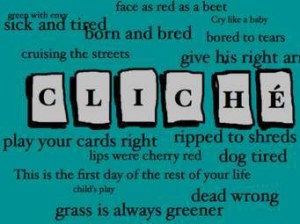 When selectively used, a good cliché expresses wisdom through metaphor. A stitch in time figuratively saves nine. Actions often do speak louder than words. Sometimes it is a dark and stormy night, but since that opening line shows up more in humorous writing nowadays, we expect it to be funny, not dark. Like cliché, the expression’s meaning has been ‘adjusted’.
 I’m a writer.
 Now I’m working on the fourth of those books. I’m first doing a synopsis and three chapters to turn in, then finishing the rest of the manuscript. I have a few months, so I should be fine. But right now I’m looking at all the weekend events, panels and more, that I’ve agreed to in the near future. Then there will be a visit from some dear family members that will probably use up a week. And an annual trip that has been extended to see those family members at their home. So… well, I’m worried about meeting that deadline.
 Yes, deadlines are a part of life.
 Linda O. Johnston, a former lawyer who is now a full-time writer, currently writes

 On a recent short-term mission trip to Malawi for my church, I had the opportunity to teach Writing classes to two groups of home schooled MKs (Missionary Kids). These were children from American, Canadian and South African families. There were nine in the 3rd-4th grade group and seven in the 5th grade and up group.
 After reviewing the stories and talking to the other home school teachers, we all agreed that the kids needed help in character development. The action was amazing; the worlds they created were vivid, but the heroes, helpers, and villains were flat and hard to imagine.
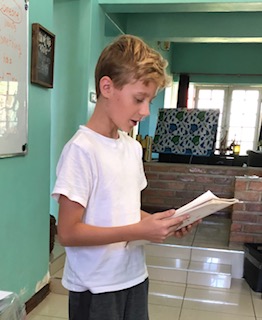
 Before I arrived I asked that the kids (both classes) bring the first several paragraphs of a story they had written to class. In class, I had them each read their paragraphs aloud. There were Captain Jack, Commander of a Starship, twin girls named Peace and Harmony, and a 20-year old girl named Ella who wanted to become a princess (and a dozen others).
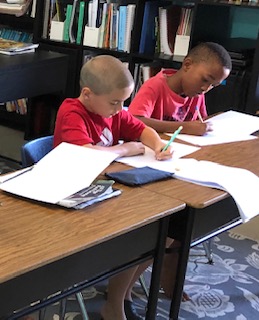 For the younger class, I had them draw in their workbooks a circle for a face, then slowly add features (eyes, nose, mouth, ears, hair) and write a description of each as they went. Next they drew bodies with any kinds of clothes and shoes (or not) they wished. I had them write why these “characters” were smiling, wearing… glasses, a soccer jersey, a swim suit, a long dress, a tutu, and had on sandals or swim fins. They began to see how to show what their story characters looked like by writing descriptions, and in the process developed more interesting information about them. (I could see “light” dawning in their eyes!)
 Next, we had fun with thirty-six
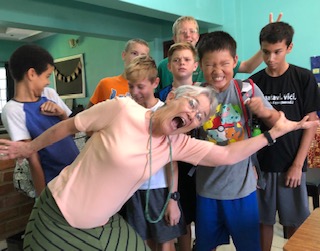
 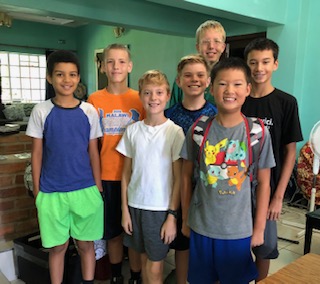 For the older class (all boys, and most writing sci-fi or fantasy) we delved a bit deeper into making their characters memorable by using various ways to describe physical as well as personality traits. They practiced describing a character in an action scene (showing fear or bravery without actually using those words) and played around with using an occasional quirk, flaw, or unconscious mannerism to reveal hidden traits.

 The Writers in Residence
You must be logged in to post a comment.