A “Fake” Ghostwriter

by Jackie Houchin

You have all heard of ghostwriting. That is when famous people who don’t know how to write will hire a writer to tell their story. There are days and weeks of interviews, drafts to check, rewrites to slog through, cover art to approve, and then … the beautiful book. Your book … almost. Your title and name are on the cover, but you did not actually write it.

This is great for the ghostwriter, who can make a tidy sum of money if she is willing to put up with a lot of guff from the “famous person.” She can be proud to see the book printed and perhaps sold on Amazon. But it’s a secret pride. And only if the “famous person” shares her name can she get a few “kudos.”

One of our own Writers in Residence members is a ghostwriter of many volumes.

Now, think about a ghostwriter that any “Mary, Sue, or Kathy” can hire for a very low sum. A brief interview with some questions answered, a few thoughts on how the “not very famous” person sees their book, and a selection of cover art to choose from. Voila! Your book is done, and a copy (or two or three) is mailed to you in a couple of weeks.

One of our own Writers in Residence members has “hired” just such a ghostwriter. Me. And three copies of “my” book cost me a mere sixty bucks.

And, you may ask, just who is this super-cheap ghostwriter? His name is Art. Artificial Intelligence, or AI, as he is more often known. Yes, I crossed into the writer’s no-no land of AI. And you know what? It was super easy.

I found BeThe Author on Facebook (where else?). The advertisement showed several happy people receiving books that loved ones had “written” for them about themselves. They were all surprised and very delighted. Shots showed them deeply engrossed in reading their own stories. The ad ended with an enticing question. Did I want to try BeTheAuthor for a relative or friend?

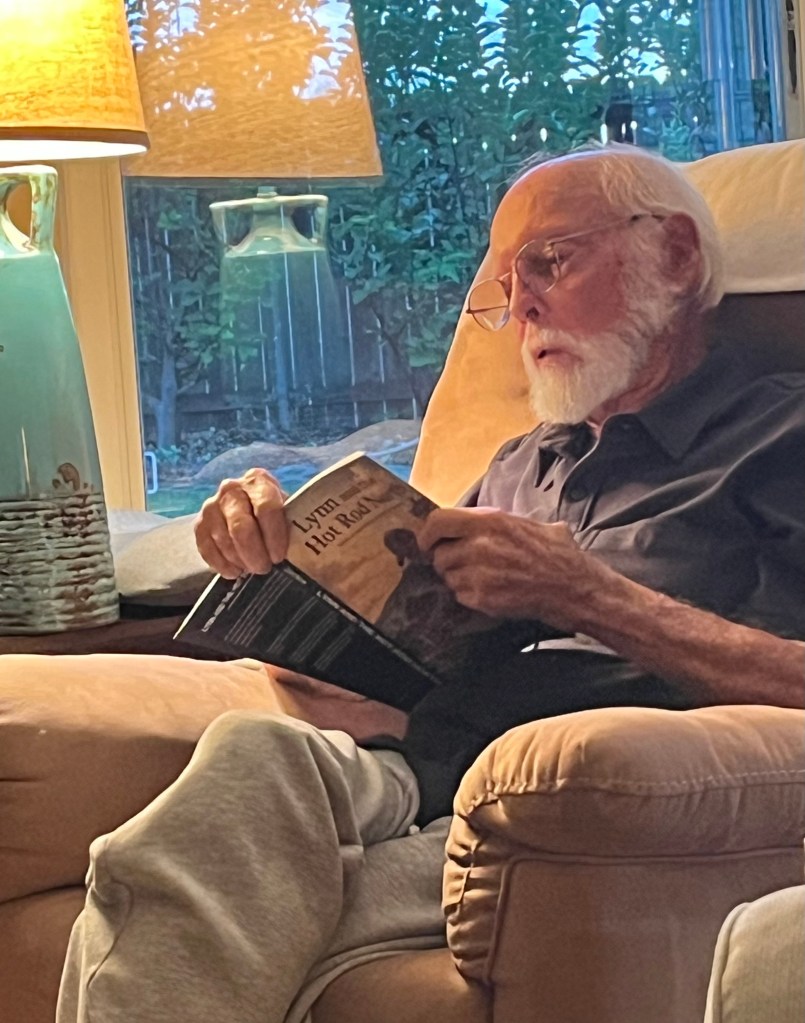
I paused, mesmerized by the possibility. My husband’s birthday was coming up in a matter of weeks. I pictured him with a book in his hands, HIS photo with some automobile art on the cover, and a fun, easy-read adventure/mystery where he was the main guy, with just 200 or so pages.

That’s all it took. I signed up and answered some questions about my Hubby’s personality, likes and dislikes, habits, hobbies, quirks, and dreams. I found a photo of him working on some building project and uploaded it. BeTheAuthor (aka AI) immediately gave me six cover art options featuring my Hubby and his hot rod. I picked one, filled in my address and payment info, and pressed “Do It!” (or actually, “Order.”)

Two weeks later, EXACTLY on his birthday, the package arrived. He picked up “his” book, a slow smile coming to his face. “What’s this?” he asked, turning it over to read the back cover.

I told him what I’d done, and he opened the first page. Standing there, by the kitchen table and the other (forgotten) mail, He began reading. He turned a page and kept reading. Then he moved to a soft chair, leaned back, and read all of the first chapter.

I was so excited and pleased. My Hubby is not a reader, except for a few hot rod magazines. But he was reading.

Today, he’s almost finished. He’d told a few other guys about “his” book and given one of the extra copies to our son.

Would I do it again? Yes, yes, yes. I know it’s not my own creativity. It’s not my own words, or much of my own ideas. But it has given pleasure to someone I love.
…..

.

Since then, I’ve seen many similar offers on Facebook, with different results. BookNova, Booky.ai, Chapter.pub, and WriteABook.com are just a few. Some of these will take YOUR outline or even book draft and create the finished novel. BookVa offers to create a graphic novel for you with a story idea and an extra photo or two.

And some offer elderly people a “memoir” to give to their children. The old gals or gents answer quite a few questions about their lives, some even via recorded phone calls, and “their life story” is created for the generations to come.

There’s a wide audience for these AI Ghostwriting offers, especially these “personalized” books. They are enticing, and I believe some will be thrilled with the results. I truly loved my “Hubby’s Book.” (The only thing I would change would be to offer more DETAILS on the questions they asked.)

But yes, I know. These are not the classics that true, human writers will create and that will endure and inspire. But for now. I’m happy with what I did.

Could I Be An Accomplice?

By Jill Amadio

I am currently editing a book for a client. He has written and published two previous books in his series of life as a Liverpool bank robber who manages to escape prison, flee to America, and be hired by top movie stars as a posh English butler.

All well and good and a fascinating in-depth glimpse into not only his own surprising story but also personal, little-known facts about his famous employers. They included Clint Eastwood, Marlon Brando, and others.

Hired as a waiter and swiftly promoted to a butler with forged credentials that led to his being hired on the QE2 liner sailing from Southampton to New York, his career took an unexpected turn when passenger Elizabeth Taylor advised him to pursue a job with Hollywood celebrities.

The book I am editing describes several crimes he committed as a bank robber in England, but also a crime aboard the QE2 cruise liner, in which he stole Queen Elizabeth II’s Jubilee jewelry that was on display in the ship’s shopping arcade.

A monster hurricane hit the liner in the middle of the North Atlantic, tossing the ship around like a toy, causing damage on all decks, and smashing the glass on the cabinet displaying the British royal family’s diamonds. He had planned the theft differently, but this fortunate moment laid the jewels at his feet.

He was not caught and managed to sell the jewels in New York through a friendly fence whom he’d known since childhood in the UK.

Question: Could I be considered an accomplice by editing his book and keeping quiet about its contents before publication?

Surely, a bonanza of a marketing tool?

I certainly came on the scene merely as an editor and proofreader well after the fact. I had nothing to do with the actual theft, fascinated as I am by its surprisingly fortuitous assistance by a perfectly timed hurricane.

In none of the 17 biographies and memoirs I ghostwrote did a client confess to such an incident. I have no idea whether the statute of limitations has run out on this project, but the possibility does give me pause.

Many crooks have written books about their misdeeds. Truman Capote’s “In Cold Blood” chronicles a famous case, especially when he took the side of one of the two criminals, and books by the Mafia come to mind, as well as the many Michael Connelly mysteries derived from real criminal cases in and around Los Angeles.

So, I believe I am safe from prosecution, especially since my name is nowhere on or in the book, which reminded me that my ghostwriting clients rarely added a brief ‘Thank You’ to their Acknowledgements page. I dream of a client adding, “And thanks to Jill Amadio for writing my book for me.”

I am often asked which of my ghostwriting projects was my favorite. Hands down, it was about a 1912 trial of a student expelled from the University of Chicago for accusing her housemates of theft.

All of which brings to mind another pet peeve – that most writers fail to read passages aloud that may be garbled. Recording them on a tape recorder or your cell phone and playing them back can reveal whether they sound normal, forced, or a mess.

For this editing project, I asked the writer to simplify a particular paragraph and read it aloud. It came back worse than ever. Obviously, he had not followed orders! Another client quit halfway through, saying it was “too hard.”

“But I’m doing all the work!” I said. No matter. He still quit.

Happily, I am enjoying this current editing project despite my grumbling. I am learning new facts about how a criminal operates on both sides of the pond, always helpful for one’s own mysteries.

.

(photo by  Oleg Gapeenko)


Teach A Writing Class?

by Jill Amadio

Teach a writing class? I have enough trouble getting myself to work on my next mystery, of which I only have one-third finished. However, I am working full-speed on my new career as a writing coach.

Westport, CT has more than its share of elderly, I was told at the town’s country-club-style senior center where I use their gym. The executive director figured many of the members would love to write their life story if only they knew how.

Interesting, I thought, because I have been looking for a paying job. I’ve written four biographies under my own name and a few as co-author. My greatest contribution to assist another person’s attempt to get their autobiography on the page has been as a ghostwriter. I’ve written 15 for clients. This is the kind of book you can write with no repercussions tied your own fragile persona. No one can take pot shots at you for you putting on the published page swipes or dislike for certain relatives, remembered experiences that showed others as fools, or perhaps an opportunity to lay bare your absolute hatred of your cousin’s prize poodle. I do, however, urge a client’s caution and I try to appeal to their good nature, if they have one.

So, did I want to take up the challenge of teaching some old fogies like myself how to write their memoir? The idea appealed to me. I had never taught anyone anything in my whole life. Well, maybe a few table manners to my kids.   So, yes, I accepted the challenge to help anyone over 65 jot down their life story in presentable and publishable form.

Creating a curriculum was my first worry. What would I teach? The elements of style came immediately to mind. I’d want to know how to structure a book, create my personal style, and how to write down my thoughts and feelings.  I’d want to know how to describe places and people, events and experiences that had made up my world since birth, and was still occupying my psyche both physically and mentally.

For the first class I asked my students to create a Timeline, a list of each year of their life with a significant note, a few words, to mark why it was memorable.

I decided that handouts were important because I had always loved receiving them at writers conferences, so I found Rudy Vallee’s timeline I’d created back in 1989, as well as a champion cowboy’s timeline that chronicled his trek across America from coast to coast on horseback. One handout was a list of 106 descriptive verbs I’ve used for years.

In addition to the Timeline, I also mapped out writing techniques and elements for the following classes. In addition to Structure, Style, and Context I added how to write Characters, Flashbacks, Settings, Cliffhangers, Editing, Beginnings and Endings, Publishing, and Marketing.  I became so enamored of my advice I began to inspect my own WIP and made changes. I dredged up a few tips and notes I’d taken at various conferences and thus was able to flesh out my curriculum.

An observation about the students. They were exreremely keen to learn how to write their memoirs. It was clear some of them had been thinking about writing such a tome for a few years but had no idea how to go about it. By the homework I gave them, i.e. the Timeline, they returned to class time and time again more enthusiastic than ever. I told them to always interrupt me any time with questions, hoping that my fear they’d forget them before the end of class was not apparent.

Among these senior students, limited to 12,  were a school bus driver, a poet, an attorney, an ad saleswoman, a lady from Germany who escaped the Nazis, a couple of teachers, a financier, and an accountant. One gentleman dropped out after lesson #2 because he said now that he was about to describe his life he found it too painful to do so. Another gentleman said he doubted he would continue because as a reporter he was trained to write lean, and that was the antithesis of writing a book. I told him I’d initially experienced the same hesitation when I was first approached about ghostwriting. My editor at the magazine I wrote for said that a CEO had called asking for a referral to a writer for his business book. Before calling him back with a recommendation she sked me if I’d be interested.

“A book? A whole book? No way!” I said.  “I enjoy writing the 3,000-word articles for the magazine but 70,000 words? Forget it.”

“Think of it this way,” the editor said. “Approach each chapter is an article. And the pay is really good.”

“Oh. Okay, I’ll do it.”

After that first book I received many referrals and became a ghostwriter, a few people contacting me through my website, www.ghostwritingpro.com.  One client, a banker, asked me to ghostwrite her novel about a financial fraud.

“Hmm,” I said. “Sounds a bit boring. How about we add a murder to spice it up?”

“Yes! How many murders can we have?”

The publishing of that book inspired me to create my own Tosca Trevant mystery series while I continued to ghostwrite as my main source of income.

Back to my seniors’ class. The atmosphere was informal, friendly, and focused. I showed them several of my memoirs, and said that although we only had eight hours in total with which to cover the subject, at least it would get them started thinking and planning.

By lesson #4 we all felt comfortable with each other reading aloud the homework. One lady was writing her memoir only for her grandchildren and refused to share with us but everyone else was eager for everyone’s critique. The lawyer fella incorporated funny poems into his memoir, and someone else brought us to chuckles with her descriptions of working in a donut shop as a teenager. The German lady brought us to tears with her childhood memories of fleeing the Nazis

That first 8-hour course was popular enough to be repeated, and later in the spring I shall be teaching How to Write a Short Story or Essay. Luckily, when I lived in Laguna Woods, California, several of my stories were published in the community’s anthologies over the years although I can’t remember ever writing an essay. Tips for my seniors, anyone?

Teaching a Writing Class?

by Jill Amadio

Teach a writing class? I have enough trouble getting myself to work on my next mystery, of which I only have one-third finished. However, I am working full-speed on my new career as a writing coach.

Westport, CT, has more than its share of elderly, I was told at the town’s country-club-style senior center where I use their gym. The executive director figured many of the members would love to write their life story if only they knew how.

Interesting, I thought, because I have been looking for a paying job. I’ve written four biographies under my own name and a few as co-author. My greatest contribution to assisting another person’s attempt to get their autobiography on the page has been as a ghostwriter. I’ve written 15 for clients. This is the kind of book you can write with no repercussions tied to your own fragile persona. No one can take potshots at you for you putting on the published page swipes or dislikes for certain relatives, remembered experiences that showed others as fools, or perhaps an opportunity to lay bare your absolute hatred of your cousin’s prize poodle. I do, however, urge a client’s caution, and I try to appeal to their good nature if they have one.

So, did I want to take up the challenge of teaching some old fogies like myself how to write their memoirs? The idea appealed to me. I had never taught anyone anything in my whole life. Well, maybe a few table manners to my kids.  So, yes, I accepted the challenge to help anyone over 65 jot down their life story in presentable and publishable form.

Creating a curriculum was my first worry. What would I teach? The elements of style came immediately to mind. I’d want to know how to structure a book, create my personal style, and how to write down my thoughts and feelings.  I’d want to know how to describe places and people, events and experiences that had made up my world since birth and were still occupying my psyche both physically and mentally.

For the first class, I asked my students to create a Timeline, a list of each year of their life with a significant note, and a few words to mark why it was memorable.

 I decided that handouts were important because I had always loved receiving them at writers’ conferences, so I found Rudy Vallee’s timeline I’d created back in 1989, as well as a champion cowboy’s timeline that chronicled his trek across America from coast to coast on horseback. One handout was a list of 106 descriptive verbs I’ve used for years.

In addition to the Timeline, I also mapped out writing techniques and elements for the following classes. In addition to Structure, Style, and Context, I added how to write Characters, Flashbacks, Settings, Cliffhangers, Editing, Beginnings and Endings, Publishing, and Marketing.  I became so enamored of my advice I began to inspect my own WIP and make changes. I dredged up a few tips and notes I’d taken at various conferences and thus was able to flesh out my curriculum.

An observation about the students. They were extremely keen to learn how to write their memoirs. It was clear some of them had been thinking about writing such a tome for a few years but had no idea how to do it. By the homework I gave them, i.e. the Timeline, they returned to class time and time again more enthusiastic than ever. I told them to always interrupt me any time with questions, hoping that my fear they’d forget them before the end of class was not apparent.

Among these senior students, limited to 12,  were a school bus driver, a poet, an attorney, an ad saleswoman, a lady from Germany who escaped the Nazis, a couple of teachers, a financier, and an accountant. One gentleman dropped out after lesson #2 because he said now that he was about to describe his life, he found it too painful to do so. Another gentleman said he doubted he would continue because as a reporter, he was trained to write lean, and that was the antithesis of writing a book. I told him I’d initially experienced the same hesitation when I was first approached about ghostwriting. My editor at the magazine I wrote for said that a CEO had called asking for a referral to a writer for his business book. Before calling him back with a recommendation, she asked me if I’d be interested.
“A book? A whole book? No way!” I said.  “I enjoy writing the 3,000-word articles for the magazine, but 70,000 words? Forget it.”

“Think of it this way,” the editor said. “Approach each chapter as an article. And the pay is really good.”

“Oh. Okay, I’ll do it.”

After that first book, I received many referrals and became a ghostwriter. A few people contacted me through my website, www.ghostwritingpro.com.  One client, a banker, asked me to ghostwrite her novel about financial fraud.

“Hmm,” I said. “Sounds a bit boring. How about we add a murder to spice it up?”

“Yes! How many murders can we have?”

The publishing of that book inspired me to create my own Tosca Trevant mystery series while I continued to ghostwrite as my main source of income.

Back to my seniors’ class. The atmosphere was informal, friendly, and focused. I showed them several of my memoirs and said that although we only had eight hours in total with which to cover the subject, it at least would get them started thinking and planning.

By lesson #4, we all felt comfortable with each other reading aloud the homework. One lady was writing her memoir only for her grandchildren and refused to share it with us. But everyone else was eager for everyone’s critique. The lawyer fella incorporated funny poems into his memoir, and someone else brought us to chuckles with her descriptions of working in a donut shop as a teenager. The German lady brought us to tears with her childhood memories of fleeing the Nazis

That first 8-hour course was popular enough to be repeated, and later in the spring, I shall be teaching How to Write a Short Story or Essay. Luckily, when I lived in Laguna Woods, CA several of my stories were published in the community’s anthologies over the years, although I can’t remember ever writing an essay. Tips for my seniors, anyone?  

.

Jill’s article was posted by Jackie Houchin