Teach A Writing Class?

by Jill Amadio

Teach a writing class? I have enough trouble getting myself to work on my next mystery, of which I only have one-third finished. However, I am working full-speed on my new career as a writing coach.

Westport, CT has more than its share of elderly, I was told at the town’s country-club-style senior center where I use their gym. The executive director figured many of the members would love to write their life story if only they knew how.

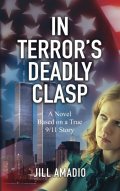
Interesting, I thought, because I have been looking for a paying job. I’ve written four biographies under my own name and a few as co-author. My greatest contribution to assist another person’s attempt to get their autobiography on the page has been as a ghostwriter. I’ve written 15 for clients. This is the kind of book you can write with no repercussions tied your own fragile persona. No one can take pot shots at you for you putting on the published page swipes or dislike for certain relatives, remembered experiences that showed others as fools, or perhaps an opportunity to lay bare your absolute hatred of your cousin’s prize poodle. I do, however, urge a client’s caution and I try to appeal to their good nature, if they have one.

So, did I want to take up the challenge of teaching some old fogies like myself how to write their memoir? The idea appealed to me. I had never taught anyone anything in my whole life. Well, maybe a few table manners to my kids.   So, yes, I accepted the challenge to help anyone over 65 jot down their life story in presentable and publishable form.

Creating a curriculum was my first worry. What would I teach? The elements of style came immediately to mind. I’d want to know how to structure a book, create my personal style, and how to write down my thoughts and feelings.  I’d want to know how to describe places and people, events and experiences that had made up my world since birth, and was still occupying my psyche both physically and mentally.

For the first class I asked my students to create a Timeline, a list of each year of their life with a significant note, a few words, to mark why it was memorable.

I decided that handouts were important because I had always loved receiving them at writers conferences, so I found Rudy Vallee’s timeline I’d created back in 1989, as well as a champion cowboy’s timeline that chronicled his trek across America from coast to coast on horseback. One handout was a list of 106 descriptive verbs I’ve used for years.

In addition to the Timeline, I also mapped out writing techniques and elements for the following classes. In addition to Structure, Style, and Context I added how to write Characters, Flashbacks, Settings, Cliffhangers, Editing, Beginnings and Endings, Publishing, and Marketing.  I became so enamored of my advice I began to inspect my own WIP and made changes. I dredged up a few tips and notes I’d taken at various conferences and thus was able to flesh out my curriculum.

An observation about the students. They were exreremely keen to learn how to write their memoirs. It was clear some of them had been thinking about writing such a tome for a few years but had no idea how to go about it. By the homework I gave them, i.e. the Timeline, they returned to class time and time again more enthusiastic than ever. I told them to always interrupt me any time with questions, hoping that my fear they’d forget them before the end of class was not apparent.

Among these senior students, limited to 12,  were a school bus driver, a poet, an attorney, an ad saleswoman, a lady from Germany who escaped the Nazis, a couple of teachers, a financier, and an accountant. One gentleman dropped out after lesson #2 because he said now that he was about to describe his life he found it too painful to do so. Another gentleman said he doubted he would continue because as a reporter he was trained to write lean, and that was the antithesis of writing a book. I told him I’d initially experienced the same hesitation when I was first approached about ghostwriting. My editor at the magazine I wrote for said that a CEO had called asking for a referral to a writer for his business book. Before calling him back with a recommendation she sked me if I’d be interested.

“A book? A whole book? No way!” I said.  “I enjoy writing the 3,000-word articles for the magazine but 70,000 words? Forget it.”

“Think of it this way,” the editor said. “Approach each chapter is an article. And the pay is really good.”

“Oh. Okay, I’ll do it.”

After that first book I received many referrals and became a ghostwriter, a few people contacting me through my website, www.ghostwritingpro.com.  One client, a banker, asked me to ghostwrite her novel about a financial fraud.

“Hmm,” I said. “Sounds a bit boring. How about we add a murder to spice it up?”

“Yes! How many murders can we have?”

The publishing of that book inspired me to create my own Tosca Trevant mystery series while I continued to ghostwrite as my main source of income.

Back to my seniors’ class. The atmosphere was informal, friendly, and focused. I showed them several of my memoirs, and said that although we only had eight hours in total with which to cover the subject, at least it would get them started thinking and planning.

By lesson #4 we all felt comfortable with each other reading aloud the homework. One lady was writing her memoir only for her grandchildren and refused to share with us but everyone else was eager for everyone’s critique. The lawyer fella incorporated funny poems into his memoir, and someone else brought us to chuckles with her descriptions of working in a donut shop as a teenager. The German lady brought us to tears with her childhood memories of fleeing the Nazis

That first 8-hour course was popular enough to be repeated, and later in the spring I shall be teaching How to Write a Short Story or Essay. Luckily, when I lived in Laguna Woods, California, several of my stories were published in the community’s anthologies over the years although I can’t remember ever writing an essay. Tips for my seniors, anyone?

Teaching Seniors to Write A Memoir

by Jill Amadio

Invited to give as class on How to Write Your Memoir at the Westport, CT senior center, I agreed, somewhat reluctantly. It would be six 1-hour sessions and limited to 10 people. I almost wrote ‘students’ which, I suppose, they are, but somehow the idea of a group of elderlies didn’t seem to fit.

Having written what I now regard as a rather staggering number of biographies and autobiographies when I pulled all 18 of them from my bookshelves to show the class and let them know I felt confident to consider myself qualified to a certain extent, I realized that no matter how young or old such students would be, I had over the years accumulated the knowledge and experience to write and be published. Thus I would share my insights as an instructor. Of course, six hours is a laughably insufficient time to teach someone how to write their life story but I decided that covering the basics could start them on their journey.

All but six of my books were ghostwritten. The remainder were authored by me or co-authored – often a surprise as my contracts specifically identified me as the ghostwriter and thus hidden and forbidden to reveal who actually wrote the story. I am usually mentioned at the end of the ‘author’s’ Acknowledgements page, with a simple ‘Thank you to Jill Amadio.’ I am still waiting for a client to add – ‘for writing my book for me.’

One traditional publisher insister I be listed as co-author, much to the chagrin of the client’s boyfriend, and a UK publisher graced another book with my name as co-author without asking my permission. Quibble? Ha! It was a delightful surprise which earned me author talks at area locations including to a large group of auto racing drivers and vintage car collectors.

However, this first teaching gig to seniors gave me a few pre-class jitters. Would I have to speak very loudly if they were hard of hearing? Would they be able to read the handouts, meaning I’d probably have to print them in 18-point font? Would they find me boring and self-serving by passing around my hoard of books to establish my credentials?

I need not have worried. The first class was a group of extremely enthusiastic six women and two gentlemen who sat at our conference table with pens and pads ready to jot down my golden advice. I’d created a syllabus, and explained the subject matter each of the six sessions would cover. I also told everyone that they could interrupt me at any time with questions. I thought that if they held their questions until afterwards they might forget them.

All went well and I was bombarded with queries about all aspects of writing, not just memoirs. By the way, I had decided to lump the telling of life stories under the term ‘memoir’ because these days it appears to include biographies and autobiographies, and to my mind has a more important ring to it. Time was when ‘memoir’ meant a telling of a slice of one’s life, a particular incident, but these days many media outlets, for example, have called Prince Harry’s whiny-fest book, ‘Spare,’ by that description (whiny-fest is my own opinion)

My only admonition to the class was that they should not give in to temptation and use their book as a bludgeon against relatives, friends, employers, or others who have, perhaps, wronged the writer at one time or another. I hope they will remember this advice from Omar Khayyam’s poem, “The moving finger writes, and having writ, moves on. Nor all your piety nor wit shall lure it back to cancel half a line, nor all your tears wash out a word of it.”

As I prepare for my second class, next week, I will explain that bringing in several elements of mystery writing can lift a life story by adding tension and suspense, to name a few. Settings and characters can be enhanced with the addition of the writer’s detailed emotions, feelings, and personal point of view. I had told the class about the rhythm of writing and the very next day there was Tammy Walker’s excellent post on our site!

While researching my subject I came across a marvelous list of more than a hundred descriptive verbs. Using them is a great way to bring a scene alive – as we do in our mystery and thriller writing.

Interestingly, as a final note, there was a general consensus from the class when I announced there would be no prompts to be written. Many writing classes include a prompt at each class, whereby students are given a subject, a phrase, or a sentence, and must write a page around it. To my mind, this is a waste of time that can be better employed writing your book. Everyone agreed with me! However, I do encourage journaling as one way to loosen up that creative s spirit.

Do any of my fellow Writers in Residence have any relevant tips?

##


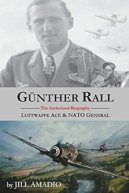
A few of Jill Amadio’s ghostwritten biographies.

Teaching Writing in Africa

Ah, the stories they tell!

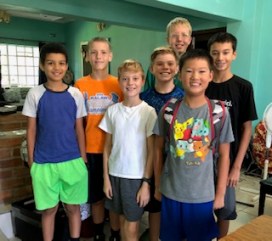
IMG_0643MeTeachOn a recent short-term mission trip to Malawi for my church, I had the opportunity to teach Writing classes to two groups of home schooled MKs (Missionary Kids). These were children from American, Canadian and South African families. There were nine in the 3rd-4th grade group and seven in the 5th grade and up group.
Two years ago I taught most of these kids “How to Write A Short Story.” Their creations were marvelous, and in fact, I posted some of the stories on my blog, Here’s How It Happened. (See the mystery, “The Tay Diamond”,  the action-packed, “The Adventures of Timmy, the Squirrel”,  and the creepy, Twilight Zone-esque “The Mirror”)

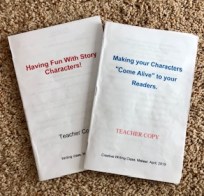
IMG_1133Booklet coversAfter reviewing the stories and talking to the other home school teachers, we all agreed that the kids needed help in character development. The action was amazing; the worlds they created were vivid, but the heroes, helpers, and villains were flat and hard to imagine.

This would be my topic then. I prepared workbooks for each of the classes. We did some work in them in class, but there were “homework” assignments for them to do at home as well.

IMG_0645MeTeach Young classBefore I arrived I asked that the kids (both classes) bring the first several paragraphs of a story they had written to class. In class, I had them each read their paragraphs aloud.  There were Captain Jack, Commander of a Starship, twin girls named Peace and Harmony, and a 20-year old girl named Ella who wanted to become a princess (and a dozen others).

I asked the listening students how they “pictured” each of these characters. There was either confused silence or vague and differing descriptions.  I then asked the authors to describe how their characters looked in their own mind’s eye. They came up with a lot of colorful descriptions that were not in their stories. Suddenly they “got the picture,” and from there I showed them ways and examples of taking the images of their characters from their minds and putting them on paper for their readers.

IMG_0640MeTeach Micah,TylerFor the younger class, I had them draw in their workbooks a circle for a face, then slowly add features (eyes, nose, mouth, ears, hair) and write a description of each as they went. Next they drew bodies with any kinds of clothes and shoes (or not) they wished.  I had them write why these “characters” were smiling, wearing… glasses, a soccer jersey, a swim suit, a long dress, a tutu, and had on sandals or swim fins. They began to see how to show what their story characters looked like by writing descriptions, and in the process developed more interesting information about them.  (I could see “light” dawning in their eyes!)
We talked about what a boy’s face and posture would look like if he were angry, sad, or excited, and how to describe that in words.  Then I had volunteers come to the front and walk like someone angry, sad, sick, old, or excited. The class called out descriptions of the body movements (facial features, arms swinging, shoulders slumped, stumbling, skipping, marching etc.) that portrayed the emotion.  Suddenly they began to see how they could “show” these actions in their stories instead of simply “telling” the reader that the character was sad or happy.

We talked briefly about similes (and metaphors for the older group). Wow, did they come up with some doozers! At this point I had to remind them not to overload the story with these, but to sprinkle in descriptions as the story progressed in action or conversations.

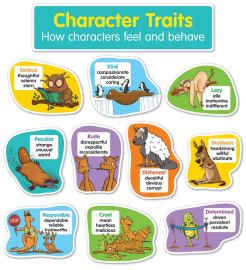
Character traits 71T4QNm+soLNext, we had fun with thirty-six Character Trait cards (ten seen at left) that I purchased from Amazon.  I had them each choose a positive trait and a negative trait and to explain their choices. I asked them to describe the animals in the picture illustrating the trait.  We talked about how they could write about the kind of person (animal) their character was by using these traits (such as, mischievous, responsible, persistent, mean, honest, loyal, etc.)

As an exercise I had them use these two opposite traits and write a short paragraph in their workbooks, describing how that character trait would look in actions.  “Harmony was dishonest because she….. or  Timothy was peculiar because he….”

For another exercise, I had them draw a large “T” diagram on one page, labeling the left side “What a character looks like” and the right side” How a character behaves.”  They made a few comparisons from their own story characters. At home, they would make more of these diagrams and fill them in for other characters, or ones from books they liked.

IMG_0654 Older writing classFor the older class (all boys, and most writing sci-fi or fantasy) we delved a bit deeper into making their characters memorable by using various ways to describe physical as well as personality traits. They practiced describing a character in an action scene (showing fear or bravery without actually using those words) and played around with using an occasional quirk, flaw, or unconscious mannerism to reveal hidden traits.

We talked about body language and how personal beliefs and moral standards could affect their characters actions and words in certain situations.  These t’weens and teens also enjoyed acting out emotions and physical limitations while the rest of the class called out descriptions. It’s a great exercise in noticing small things and putting them into words. Their favorite was imagining a large magnet across the room, and a piece of iron stuck on various parts of their body (forehead, stomach, etc). They were to show being pulled by that force and trying to resist. (Some were hilarious!)

IMG_0651MeTeach MatthewIMG_0653MeTeach AndrewThese boys also wanted to read from their stories, using some of the descriptions they’d learned inserted here and there.

I think they got it! By George, they got it!  

(I can’t wait to read the complete exciting, imaginative tales!)

At the end of the two-hour sessions, I sent both groups home with assignments to sharpen their skills. Hopefully they will follow through and I will have a new pack of stories to post on my blog, with characters you can clearly imagine, love, or love to hate.

I love these kids, and I really had fun…. as you can see!

IMG_0667MeTeach fun


Post Script:  I used several limericks in the classes, to illustrate teaching points, add humor, and keep the class attentive.  One of the kids in the older group took one of these limericks, combined it with a vocabulary assignment from his home school writing class and came up with a HILARIOUS story – The Virtuous Walking Fish.  Check it out too, and leave a comment for Jacob K.


Those OTHER Blogs on Writing

signHow many blogs besides this one do YOU read regularly (daily, weekly, monthly)?  Yes, you can confess. We don’t mind. Reading them will help you become a better writer.

Of course there are thousands to choose from. Just Google a topic and you’ll see. Bloggers will give you tips on everything, from where to get ideas to how to publish and market your final product, be it a book, short story, poem or article.

Some writer magazines and blogs publish lists of the Top 50 or 100 from the previous year.  Here’s a link to the Top 50 Blogs in 2018

I have THREE blogs that I read daily and usually take notes on. Okay, sometimes I only peruse them, if the topic is not relative to my needs right then.

  1. Mia Botha’s Writers Writehttps://writerswrite.co.za/

Every day, Mia posts links to articles on a wide variety of subjects. Each article will offer other links to follow on related subjects in an Alice In Wonderland type trail that is positively addicting! And time consuming.  Watch out!

Her daily Writing Prompts will tickle your imagination and sometimes get a story going.

There are usually cute (or smarmy) writing cartoons to make you chuckle.

Finally, there is a list of “famous” authors whose birthday is that day. Each gives his/her advice on some aspect of the writing life.

Writers Write also hosts the “12 Short Stories Writing Challenge” each year beginning in January.  Using a monthly prompt that they supply, you write, finish and polish a 1500 word (exactly) story to submit. You comment on 4 other stories and receive feedback on your own piece. One a month for 12 months. Whew!

Writers Write also offers a variety of online classes which you need to pay for.


  1. Edie Melson’s The Write Conversationhttp://thewriteconversation.blogspot.com/

Each day Edie, or one of 10 or so guest writers, presents short articles that inspire, encourage, inform, and teach you all facets of the art of writing and publishing. It is a Christian site, but usually only one in seven posts talks about the author’s beliefs in her writing process.

Here are some topics on recent posts: (You can click on these to go to the blog.)

YOU HAVE A GREAT SCENE, BUT WHAT TO DO WITH IT?

7 TIPS TO MAKE YOU A MORE OBSERVANT WRITER

WHEN AN AUTHOR SHOULD SEEK PERMISSION FOR QUOTES

QUOTATIONS—HOW WRITERS FIND THE ORIGINAL SOURCE

WRITING SO THEY CAN’T PUT IT DOWN

GET YOUR BLOG READY FOR 2019

Edie also uses a technique for readers to easily sharing her posts on Twitter. She types the title of the post or another phrase that describes the topic, and gives it a hyperlink. Readers can click on this and it takes them to their Twitter account. The title and ping-back to the blog posts are already there. They click on “Tweet” and voila’, they have effortless shared your message!

She calls them TWEETABLES.

I tried it in a blog post I wrote on The Writers In Residence about a year ago. It takes a little effort the first time you do it, but it’s a great tool!


  1. Tara Lazar’s Story Writing for Kids with January’s StoryStorm Challenge https://taralazar.com/storystorm/

What is StoryStorm? It’s an amazing, month-long, story idea brainstorming event. It’s designed for children’s books mostly, but can be useful for any genre. The weird and whimsical, and sometimes serious topics by a new author each day, are really wonderful!

The Challenge is to create 30 story ideas, one or more each day in 31 days. Maybe it will be a clever title idea, or a lovable character, or a skeleton of a plot. If you follow through, you’ll have a list of at least 30 new, fantastic ideas to flesh out at the beginning of February.

And…. if you read it each day and post a brief comment, you are eligible for a bunch of prizes and free services.

From the topic “Double Story Lines” …. I came up with “I know an old woman who lived in a shoe…store. She had so many shoes she couldn’t fit in any…more.

Enter Old Mother Hubbard who went to the display case to buy some soft slippers for her poor aching “dogs.” But she found nary a moccasin or “mule”.

Enter a Fairy God Mother who felt sorry for the old ladies and turned every shoe into a slipper.

Ms Hubbard bought all 365. The Old Woman sold her shoe store and moved to Tahiti, where NO ONE wears ANY kind of shoes at all!”

From the topic “Stop, Look, Listen” …. I came up with a tale of a musician who paid for an extra seat on an airplane to carry his very valuable and fragile guitar in its case.  But his seatmates complained – I can’t see over the top of it, it’s on my armrest, etc., and caused a near riot. Crew and pilot intervened so the plane could go up on schedule. Ends with the man strumming and all the cabin requesting songs and singing along.

StoryStorm is a really fun Challenge, one of many throughout the year on a colorful, kid-friendly, idea-stuffed blog.


And then there are blogs that are more like OUR blog – The Writers In Residence – where multiple member writers and the occasion guest, wax eloquent on some aspect of their writing life.

Here are a few examples, check them out:

Make Mine Mysteryhttp://makeminemystery.blogspot.com/  –  Mystery writing ladies.

Ladies of Mystery https://ladiesofmystery.com/  –  Mystery writing ladies.

Pens, Paws, and Claws http://penspawsandclaws.com/  – Animal loving ladies and gents writing about pets, mystery and other topics.

eat poto


I hope this post has whet your appetite for reading OTHER blogs besides ours.  If you already indulge in this “sweet” pastime, will you share some of your favorites with our readers?  Or… if you write one of your own, please share a link to it. Our readers might like to “read you” too!


PS: I’m adding a few “OTHER” blogs that I remembered after posting.

Creative Writing Nowhttps://www.creative-writing-now.com/  –  They offer Writing tips, Ideas, Courses (free and paid)

Penny Sansevieri’s  Author Marketing Expertshttps://www.amarketingexpert.com/book-promotion-blog/   –  Wonderful articles about promoting/marketing your book.  You can also sign up for a free weekly “5 Minute Book Marketing Tip” via email or more extensive and personal, direct coaching on selling your book (for a fee).

A Boost Up!

By Jackie Houchin

Boost up2“A boost up”….when someone holds their clasped hands together next to a horse, and you put your foot in like a stirrup, and they propel you upward into the saddle.
#

Sometimes a beginner (or lazy) writer needs a boost up into the writing saddle.  That’s where The Write Practice came into the picture for me. (I’m one of those lazy ones!)

The Write Practice

”If you want to become a better writer, you need to practice,” says Joe Bunting, creator of The Write Practice organization and blog. What’s involved? Fifteen minutes a day, five days a week, practicing with fresh writing prompts, unique lessons on technique, and getting feedback from a supportive community.

There are over 1000 practice exercises and lessons on the blog in such categories as; better writing, genre & format, characterization, grammar, journalism, plot & story, writers block, inspirational writing, publishing, and blogging. And it’s free.  http://thewritepractice.com/about/

I’ve attempted two lessons so far in the Short Story category. The first lesson was to read at least six short stories from the many magazine links supplied. The second lesson was to free-write for at least 15 minutes, post what you wrote in the comments section, read three of what other people wrote, and give them brief feedback.  Simple as that; practice writing and give feedback. It’s really the basis for everything Bunting does.

I wrote a short ditty on ‘Pig, Porcupine & Pineapple.’  It was totally fun!  Now to see with my fellow writers say about it

The Becoming Writer Community & Challenge

 If you are ready to go to the next level and start writing finished pieces (and get published), then the Becoming Writer community is the next step. Bunting compares this with what the “Inklings were for Tolkien and C.S. Lewis, the expats in Paris were for Hemingway, and the Bloomsbury group was for Woolf.”

I discovered Becoming Writer because membership in it (yes, it does cost a little) was a requirement to submit to The Write Practice’s quarterly short story writing contest. But what you get with membership is a lot more than the contest.

Like the free practice lessons above, you share your writing with a community of writers to get and give feedback.  Actually giving feedback on another’s work helps you when it comes time to edit your own piece.

The Challenge is to write ONE piece EACH WEEK, submitted on Fridays.  It can be a short story, blog post, poem, essay, or a chapter in a book.  This is what us “lazy” writers call accountability.

And finally, besides actually finishing your pieces (Yay!), you get opportunities to submit to magazines like Short Fiction Break, Wordhaus and others.

The feedback on my first piece, an essay I wrote about Africa, brought a suggestion for submission to a specific online magazine. I submitted it and am waiting to hear.  http://thewritepractice.com/members/join

The Fall Contest

This is what caught my attention at first, a writing contest that promised cash prizes, free books, and publication. The theme was “Let’s Fall in Love.” Stories had to contain the two elements FALL and LOVE and be no longer than 1,500 words.  I told myself, “I can do that.”

The name “Autumn Gold” sprang to my mind and I quizzed my writer friends on Facebook as to how a girl with that name might look. The first answer – a stripper – caused me to cringe because that’s not what I had in mind. But when another person confirmed what he said, it left no doubt.

The story I eventually wrote keeps the title “Autumn Gold,” but the girl’s name is Audrey Gould.  I wrote an outline of sorts, showed it to a friend for her opinion, and then pounded out a story about LOVE that takes place in AUTUMN. It was 1,948 words. Lots of cuts and edits later, I submitted it to the Becoming Writer Contest community.

For the contest (548 entrants) the community is divided into ten groups, A–J, with about 40-50 writers in each. I landed in Group D. There are 46 of us, and we’ve become a close-knit group.

I’ve gotten about nine feedbacks on “Autumn Gold,” and I’ve given at least many more on other stories.  Some are VERY good! Others will need some work.  Reading my story’s feedback and the feedback on the other stories has opened my eyes to what works and what doesn’t, and what readers “get” from what you write, even if it’s not what you intended.

Invaluable!

I’m considering rewriting the ending and running it past them one more time. The final deadline to submit the story to the judges is September 4.

Other Programs

The Write Practice offers other programs for writers and authors on building a platform, publishing & marketing, Twitter, and the 100 Day Book challenge.  http://thewritepractice.com/products

#

Now I’m up in the saddle. I’m trotting around and loving it. I can’t wait to press my calves against my steed’s sides and rise into a canter.  I needed that boost up.  Do you?  Perhaps you should consider a writing community.

I suggest The Writing Practice. Take advantage of the discipline and the getting and giving of feedback.  Pick the lessons you are interested in and go for it. They are free! You might also consider Becoming Writer.

Or join a critique group and begin giving your work over to new eyes and opinions.

Get up there and get galloping!

###

Currently the Becoming Writer and the 100 Day Book programs are closed until next semester.  Future contests in Becoming Writer will be on Flash Fiction, Essay writing, Novels, and Poetry.


Finding a Writer’s World by Rosemary Lord

      
Someone recently asked me: “My friend just moved to L.A. and wants to be a science-fiction writer. Where would she meet other science fiction writers?”  Hmmm.
It made me think: we write alone. Writing is such an isolated profession – it can be a lonely world. So how did I end up with such a terrific, diverse group of writer friends? I also have an endless source of answers to my literary questions – and heartfelt encouragement and feedback when I get ‘The Writer Blues.’
I had been a journalist for many years, specializing in Old Hollywood. So my world was the Old Time Movie Stars, their publicists and the movie studios. What did I know about fiction writing?  The heady world of mystery writers, from P.D. James, Agatha Christie, to Michael Connolly and Lee Childs, was something for the privileged, really grown-up writers. How could I ever be part of that circle? Where would I start?
Then I came across a slim volume titled, Making a Literary Life by Carolyn See. I learned it’s not just about the writing, but being part of the writer’s world. Beyond the basic tenet of  writing a certain number of words each day, See suggests seeking out and supporting other writers. If you want to be a novelist, then support other novelists.  Write a charming note to at least one author a week.( Just acknowledge their work. Don’t ask for their help.) Attend at least one writer’s book signing or event each week. This way you meet published writers and can ask them questions. This is how I met all sorts of writers, readers and people in the publishing world. I learned a lot and made new friends and acquaintances in the writing spheres.
I learned about the best writing classes for my needs. I took novel and mystery writing courses at UCLA, where I made more friends. There I learned about different writer’s groups and joined Mystery Writers of America and Sisters-in-Crime-LA. These all have local chapters. If it’s Science Fiction or Romance novels, there’s a group you can find with the same interests. Once I looked beyond my typewriter (this was pre-computers) I found I was now part of a writer’s domain. Heady indeed!
Writers are amazing. They have curious minds. You need that in writing fiction, to create realms different from your own. They are supportive and encouraging to new writers.  We hang out together, drink lots of coffee (or something stronger), complain about our problem areas of our latest writing projects, ask questions or offer advice. I attend lectures, writers’ lunches, conferences, book-signings and launch parties. I have made friends in all areas of the literary and publishing world, and continue to learn from them.
I am now writing mysteries set in the Hollywoodof the 1920s: The Lottie Topaz Hollywood Mysteries. But I can write anywhere, thanks to computers.  And thanks to Skype and Face Book, writers no longer have to feel alone or isolated – unless that’s what they want.   So there is a way in from the outside. I came in from the cold…and into a writer’s world.