
by Jill Amadio
 Mystery writers are often asked how they decided to choose not only the genre but the plot itself. My revelation for my debut novel came about when I moved to the United States. I’d been a reporter and figured on continuing in that profession forever. I loved it. However, life has a way of setting one down a different path than planned.
Balboa Island isn’t too shabby a place to live if you are banished to the colonies as I was. As a result of my divorce conditions I agreed to live in America with our three children. A job on a magazine brought me to Balboa Island that is part of Newport Beach on the edge of the Pacific Ocean, and the ritziest coastal town in Orange County, California. A virtual village, quaint and stunningly beautiful, Balboa is a place where nothing untoward ever, ever happens. Many of the beach “cottages” are stylish mansions with yachts bobbing at private docks and everyone goes to bed at 10 p.m.
In order not to confuse readers or tourists, I moved a few streets around for the plot and changed the name of the island to a fictional one in my book, “Digging Too Deep” naming it Isabel Island. When I lived there crime was non-existent except for an occasional purloined bicycle. In short, the perfect setting for a murder or two.
After ghostwriting a crime novel for a Beverly Hills financier who never read books but wanted his name on one I decided mysteries were for me. I’d created a series character for him hoping we’d continue, and I was paid, to boot. But he declined after a lengthy book tour including a cruise while signing my book. Thus I plunged into writing my own first mystery.
A terrorist plot seemed the most shocking event to wake up the islanders but after meeting many authors who were writing violent, brutal thrillers I changed my mind. In my bones are the books of Agatha Christie, Ruth Rendell. M.C. Beaton and P.D. James whose gentler murders fit more into the solve-the- puzzle, cat-and-mouse games I prefer rather than the graphic police procedurals and private detective plots so popular in the U.S.
Like most authors I bring a few personal experiences to my work and I wanted to establish a series character so my amateur sleuth, Tosca Trevant, is from Cornwall, UK. I’d dumped her onto Isabel Island where she grumbles about the lack of rain.
I asked poet and professor Pol Hodge in Redruth, Cornwall who teaches Cornish, for a supply of Cornish cuss words for my main character. He sent two pages of unbelievably descriptive and naughty ones – just as well my modified translations aren’t too precise — and I got to work on plot and setting.
I joined Sisters in Crime and its offshoot called Guppies, the Great Unpublished. I also joined Mystery Writers of America, another national organization. Both offer excellent workshops and speakers but as we all know it’s the bum-on-the-chair that puts the words on the page.
After the book was polished I paid a professional editor to give it a look. He said I’d broken most of the Rules of Writing a Mystery; I had not followed The Formula publishers insisted upon; I was too free-wheeling with my character’s humor, and I should start all over again. Fat chance.
Next, there was the dreaded Perfect Query to be created. Queries to agents must be specific, beautifully shaped, and, again, adhere to their golden rules as posted on their web sites. This time I paid great attention, followed the submission guidelines, reluctantly whittled my prose down to the required three paragraphs, and made up a list of unsuspecting agents.
There must be five thousand of them in America. The list was so lengthy I went to sleep reading it. I finally got it down to 60 agents after spending weeks checking each of their websites, a time-consuming exercise but no way around it at that time although today one can define the search. I queried six simultaneously. I’d already talked to two agents – at $50 a pop – at writers’ conferences which were so frequent one’s bank balance is constantly depleted.
No takers. I queried 45 before giving up. Many sent me form letters of rejection, two asked for chapters before telling me No Thanks, and several never answered at all. It was depressing but my fellow writers urged me to keep submitting. So I next tried the small presses that can be approached directly without an agent. However, a few of those too have strict rules – no violence, no cruelty to animals, no swearing (Oh, dear), and no sex. That last bit was easy. I was British, after all.
After three editors rejected me the next on my list was Mainly Murder Press. Frankly, I fell in love with the name. It stated exactly and honestly what it published, and was on the East coast where all the big publishers were located, a fact that appealed to my snobbish instincts. MMP only produced 12-15 books a year and its site stated “Absolutely No Submissions Until Late Spring.” Gosh. It was only January and I was impatient. Then I thought, well, it may be January on the East Coast but I was in Southern California and the daffies were already nodding their lovely yellow heads. I sent my query in, claiming that where I live it was already late spring.
The very next day MMP asked for chapters, then the full manuscript, and one week later I’d signed a 3-book contract. They thought my book was “wonderful”! All of their editors and beta readers (a new term to me) loved “Digging Too Deep,” and I was in heaven. I liked the book cover design although I requested the flag of Cornwall be added unobtrusively somewhere; the font was fine, and I waited anxiously for their digital ARC I was to send out to reviewers.
MMP did not promote nor send ARCs out early but it did distribute through Ingram, which was peachy, I thought. This publisher also did not give author advances but paid standard royalties and mailed catalogues to 650 independent U.S. bookstores, and to 4,000 public libraries.
Alas, the ARCs arrived barely a week before the paperback was published. Most reviewers refuse to accept such tardiness so I missed out on many reviews. However, I did my best. I thought that the bookstore on my island would order dozens of copies. Ha! I took the book in, asked them to stock it, and asked, May I please have a book signing here?
Again, I’d done everything wrong. I was told, No, no, you have to create some buzz first! So I called a couple of local editors I knew. After they reviewed the book in their newspapers I took the clippings to the bookstore, thrust them into the owner’s hand, and said, Right. Here’s your buzz. I also sent the book to my UK hometown bookstore but never heard a word.
Nevertheless, I lined up more signings. One of the most enjoyable was at the annual Gathering of the California Cornish Cousins, a sly move I admit, but I sold a lot of books. Thinking outside the box I also joined the Cornish-American Heritage Society which holds annual Gatherings along with a pasty-toss contest. Heaven forbid a pasty splits open and covers someone in meat and potatoes. My second mystery, “Digging Up the Dead,” earning a review from author Anne Perry.
So, while I am still ghostwriting biographies for a living having just finished a memoir and moved to Connecticut, Tosca’s third adventure is underway. After all, I have only used up nine Cornish cuss words.






 And there are small writers’ groups in the little villages. Especially poetry writers. Mostly American, German and English ex-pats, who escaped the cold winters of their homelands to have a fresh start here.


 I had mixed emotions about some of it. We’d been to that resort before, and they have a couple of large pools containing dolphins that appear to be well treated considering where they are, but having such smart animals that are originally from vast sea environments contained like that… Well, I’ve researched dolphins. They’re wonderful beings. As smart as humans in their environment. Am I inspired to write about them? I’ve always been inspired to write about them, but definitely not in situations like that—unless they can find a way out and get revenge!




 While her methods eventually result in catching the criminals, her way of operating tends to irritate her bosses and, once again, she is shipped off to another state. Montana, long known as home to private militias and survivalists, also has more than its share of grizzly bears. But why are they being killed along with several Native Americans? A KILLING SEASON provides a dazzling backdrop to the puzzle.
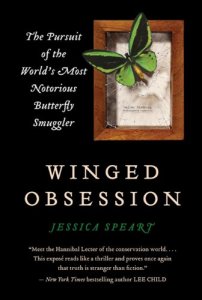 “It deals with an actual case that is so crazy no one would believe it if I wrote it as fiction,” she said. “A Japanese national began prowling around America’s national parks. One butterfly he chased was the Apache Fritillary, catching 500 of them and shipping them back to Japan to sell.”
 After BLUE TWILIGHT went on sale a small group of butterfly collectors felt she had attacked them, and, in turn, began attacking her.
 by Jackie Houchin

 For lovers, every day is Valentine’s Day. But February 14 is the official day when Cupid’s arrow strikes and big business rakes in billions spent on candy, flowers, jewelry, and fine dining.
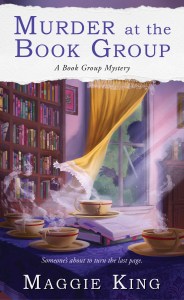 In Murder at the Book Group, the series debut, Hazel describes Vince as her on-again, off-again lover. She attributes their sporadic relationship to their inability to get along. She doesn’t offer details as to why they don’t get along but the reader can guess that the real problem is Hazel’s cold feet about committing to a permanent relationship. She’s been married four times and isn’t eager to make a fifth trip to the altar, only for the relationship to sour soon afterwards. Does she love Vince? She doesn’t want to commit to that either, but she definitely has a soft spot for him.
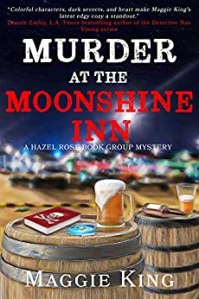 If you read #2 in the series, Murder at the Moonshine Inn, you will know the answer is “yes.” They married in beautiful Costa Rica. Hazel becomes a successful romance writer. The very name Hazel Rose conjures romance.
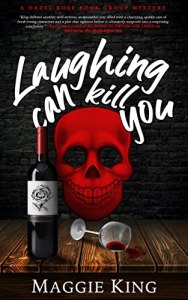 The book group members don’t fare as well as Hazel and Vince in the romance department:
 Maggie King is the author of the Hazel Rose Book Group mysteries and short stories set in Virginia. Her story, “The Last Laugh,” appears in the recently-released Virginia is for Mysteries III anthology.
 Cut to an hour or so after we got home. Our doorbell rang, and when I answered a couple of uniformed police officers were there. Turned out someone had been stabbed in the area in the middle of the night. We have security cameras outside but they weren’t connected at the time, unfortunately. The cops had hoped we would have footage of what happened—since someone was apparently stabbed there by another person, which resulted in the fallen cactus.



 The Writers in Residence
You must be logged in to post a comment.