AI as a Beta-Reader?

by Jill Amadio

Many of my writer friends are “gung-ho enthusiasts” of Artificial Intelligence,  or AI. They run their projects through, often chapter by chapter, to test their writing skills.

When the results come through, there is great interest in what the non-human synthetic experts have to say. While AI is a huge help, I suppose, if we need to be assured that our style and other fundamentals of our writing are up to par, does AI also diminish our confidence in our creativity?

Why do we trust an automatic machine to judge our writing rather than a person with a brain, a soul, and emotions, muddled as they may be? Why do writers believe that feelings expressed by AI have more depth and provide more compelling characters than those from human intelligence?

Certainly, we often feel a need for support when we aren’t sure we are on the right path with our plots and settings, but research can frequently send us on fascinating journeys when we use that old-fashioned tool.

Then, too, a friend might shoot down our joy by criticizing work we’ve spent weeks creating, but at least we can open a debate with said friend to challenge their viewpoint.

I read online that writers should not wait until a first draft is completed before checking it through AI. One should pass our writing chapter by chapter or paragraph by paragraph if we want our books to sell well.

However, brainstorming with AI can be a revolving door if we rely solely on it to give us feedback with which we disagree. We already have Spell Check in our Word program, and there are also grammar sites if we are unsure. Yet, do we want that advice?

I recently edited a book for a client from Liverpool, U.K., who writes in the way he speaks, a style that is occasionally ungrammatical but beautifully reflects his upbringing in a poverty-stricken family. He writes honestly and in detail about his criminal activities before reforming and brings the reader into his world in a personal, delightfully unself-conscious and un-generated-by-AI manner. His style takes us into heartfelt statements about his culture, his bitterness growing up, and how he turned his life around.

His book doesn’t flow strategically or logically. Instead, it takes us on a journey most of us could not imagine but feel compelled to follow to its happy ending. Would AI have come up with anything as mind-blowing as this man’s true story? Granted, AI is consulted mostly for its judgment of our writing, even its relevance to a central theme, but it seems to create doubt rather than determination to follow our own path.

All of which leads to the question of who is actually writing AI’s advice and training AI, and who is instructing us with strategic decisions we are told to make. Perhaps the AI originators are best-selling authors. Maybe they are paid a royalty for each bit of AI advice activated.

I read that AI can be biased and can misrepresent your writing style. It can tell you to make changes with which you disagree, but you can’t help believing that AI knows best.

Seems to me that human creativity is one of the most perfect parts of our mind, albeit for good or evil, and that if AI flags it, then we follow patterns and look twice at what we are thinking.

It also appears that AI can figure out if you are falling into the trap of writing patterns that annoy readers or structures that don’t make sense. All of which leads us to wonder if we could be accused of plagiarism if two or three writers receive the same rewriting from AI. Maybe we need to become our own amateur detectives to discover such an activity, and instead of fact-checkers, we need to become text-checkers for artificial intelligence.

I admit that AI is an excellent tool for writers who dither and are unsure of their characters, plots, and settings. It is normal to want an outside opinion, but there can be a nagging worry that AI cannot truly understand where our plot is going, or how characters can change as we write. Taking the guesswork out of our plots, sub-pots, and themes can lose us readers for future books in our series, and perhaps even prompt an admission that we used AI as an assistant to write the book in a Disclaimer or Introduction.

In conclusion, I am honestly pleased that some of my writer friends enjoy a foray into AI. I just ask them to be transparent and honest about it.

A Final Pass

by Miko Johnston

By the time you read this, the manuscript for my fourth A Petal In the Wind novel will be back from the editor and ready for its final draft before publication. Prior to sending it out, I made several passes through it, each time searching for ways to fix or improve the work.

In my first pass I searched for everything from formatting issues to misspelled words. In light of recent events I found parts of the story, which I’d begun writing in 2017, had become dated. I couldn’t gloss over a worldwide pandemic and the social rifts that emerged from political discord. Several new characters who were introduced in chapters written years before the book’s conclusion sounded too generic; I’d gotten to know them better as the story progressed and that needed to be reflected in their earlier dialog and mannerisms.

Other passes looked for repetition, excess verbiage, more precise word choices, missed misspellings, lapses in logic, and incorrect information. With that complete, I sent out my manuscript, anticipating a few more changes would be needed once I heard back from my editor. I took advantage of the wait time to put together all the additional material needed – logline, book blurb and synopsis.

Whenever I have to write marketing stuff, I cringe. It’s not what like to do, or do well. I view it as a necessary evil, and many authors I know feel the same way. However it must be done, and the good news: I’ve found an advantage to it beyond promoting the book.

When you have to encapsulate your x-hundred page novel into a one page summary, then a teaser for the back cover, and finally a one-sentence logline, it forces you to look at your theme in a different way. Gone are the long passages of prose, the snappy dialogue, the transitional scenes and flashbacks. You must have a laser focus on what your story is about – what you’re trying to get across to the reader in terms of theme, character, and plot. By doing so you sometimes will see aspects of the story that are important but may not have been shown in a compelling or complete way. So beyond my editor’s input, I saw that I wasn’t done with my revising.

I came to that conclusion when I encapsulated a 106,500 book into a few paragraphs with just a hint of where the story will eventually wind up. I had my external conflict and internal struggle, and pointed that out in my blurb. Then I wrote my logline:

Amidst the social and political upheaval in the aftermath of WWI, a woman who identifies as an artist marries the love of her life, but chafes at being relegated to wife and mother.

We can understand the difficulties a woman would face in giving up her career to marry and have children, especially at a time when such notions weren’t as accepted as they are today. But had I adequately shown how she feels in the book? Could I have made it not only clearer, but on a much deeper level?

The logline hints at the deeper issue. What she rails against is not being married to the man she loves, or even the challenges of motherhood. It’s losing her identity, having to see herself as only a reflection of her husband and children. When Jane marries John Doe, she becomes Mrs. John Doe. Her baby’s mama. She’d wonder—what happened to Jane?

My character Lala is a woman who’s accomplished a great deal despite her youth. She not survived the trauma and hardships of WWI and kept her family alive, but her home town as well. It’s described as a factory town north of Prague throughout the series. In America we’d call it a company town, where a single business – in this case a furniture factory – provides the economic base of the area.  Circumstances force her to take charge of the factory and oversee its conversion to wartime production. If it had closed, which it nearly did, the town would have been devastated. How can someone like this ignore all she achieved, the skills she developed, the talent that resides within her?

When the manuscript returns from the editor, I will review the comments and make some changes, including a few of my own – adding more layers of my character’s internal dilemma to the story. Then I’ll probably rework my promotional material. A writer’s work is never done…that is, until it goes to the publisher.


Miko Johnston, a founding member of The Writers In Residence, is the author of the historical fiction saga A PETAL IN THE WIND, as well as a contributor to anthologies, including “LAst Exit to Murder” and the soon-to-be-released “Whidbey Landmarks”. The fourth book in her series is scheduled to be published later this year. Miko lives in Washington (the big one) with her rocket scientist husband. Contact her at mikojohnstonauthor@gmail.com


Words, Words, Words. Who keeps track? Writers!

By Jill Amadio

Words, words, words. More than three million of them.

That’s how many a Tamil in India wrote. Granted, the words were spread over 26 volumes but still, quite remarkable. Chinese authors wrote lengthy books, too, while contemporary writers like J.R.R. Tolkien confined himself to a mere 558,003 words to complete The Lord of the Rings.  J.K. Rowling wrote 1,084,170 words in the Harry Potter series. Carl Sandburg threw half a million words onto the pages of Remembrance Rock, while Stephen King prefers to write long, and his thriller, It, has a whopping 1,138 pages for a paperback price of around $30.  A bit heavy for reading in bed. Kurt Vonnegut’s Slaughterhouse Five is around 500 words under 50,000, and Tolstoy’s War and Peace that everyone thought to be the longest book in the world offers 587,287 of text.

I was curious last week as to word count while putting the finishing touches to my 9/11 novel. Based on a true story, I found, to my horror, that the manuscript only contained 61,000 words. I know for cozies that is acceptable but anxious to check out what the going word count was for novels these days I went online to research.

Happily, the consensus is that the majority of publishers are content with a range of 50,000 to 100,000 of an author’s polished prose. One site claimed that anything over 40,000 is acceptable. However, books by C.S. Lewis, Roald Dahl, and George Orwell among others were bestsellers with books under that number of words.

It actually depends on genre. A literary novel, one site tells me, and by the way what the heck is a literary novel as all writing is, by definition, literary, no? No. It turns out that literary fiction must be intellectual, have depth, character and style. Surely, mysteries fit right into the middle of those requirements.

Publishing industry standards can vary. Authors of romance novels typically write between 80,000 to 100,000 words, and science fiction and fantasy can exceed 140,000. Westerns are, surprisingly, shorter, between 45,000 and 75,000, and novellas can be from 18,000 to 40,000 words The Reedsy blog site points out that a too-long word count is a symptom of a major plot or pacing problem.  First drafts can usually tell us whether we’ve overstepped the yardstick, and where to cut. Most editors warn writers not to edit their manuscript until that first draft is complete, and keep an eye on bringing too many characters into your story.

It is tempting to include extraneous material when your write about a favorite hobby or pastime you love but it’s a no-no for publishers unless it’s a theme like knitting, baking, or cheese. Frankly, I enjoy learning something new and my current read, The Crossing Places by Elly Griffiths is an archaeological mystery that briefly explains many of the basics of the discipline in dialogue, the perfect place.

Thus armed, I began to edit my latest novel’s first draft and found I was right in the ballpark of acceptable word count. Of course, if you are going to self-publish with KDP, or other places, you can make up your own rules. But if readers expect a certain number of pages in your series it makes sense to adhere to that. Another point to keep in mind is that if you are adding an audiobook to your editions it could require a rather lengthy listening period that could get tiring.

A godsend to writers is the software that continually counts your words as you write and at the same time posts the page number you are currently on. A few writers I know never look at those results over periods of days or weeks in order to be wonderfully surprised when they finally do take a peek. Or not. They say that being required to produce or eliminate a certain number of words is soul destroying.

As several authors have commented when considering word count: “When it’s done, it’s done. When the tale is told, it’s told.”  End of story.

How To Earn $1 Million on Your First Book… or NOT!

Jackie Houchin

bag of moneyI was going to write this post on “how to make $1 million on your first book” and follow the story of paranormal-romance writer Amanda Hocking who actually sold 1.5 million eBooks in 2010 and made $2.5 million. “All by her lonesome self. Not a single book agent or publishing house or sales force or marketing manager or bookshop anywhere in sight.”
Following tips she’d gleaned from the blog of JA Konrath (an internet self-publishing pioneer, who boasted of making $100,000 in three weeks), she also uploaded to Smashwords to gain access to the Nook, Sony eReader and iBook markets.  “It wasn’t that difficult. A couple of hours of formatting, and it was done.”

Then… she got a $2 million contract from St Martin’s Press and… yada, yada, yada.   Here’sHerStory

Today the self-published book market is flooded with books, and unfortunately a lot of them are inferior in quality in one way or another.  Authors in a rush to publish don’t take time to write a quality story, edit, format, proofread, and design a cover professionally. And less than half of them make even $500.

So what’s a newbie author like me to do?

I’m currently working on a middle grade children’s book manuscript. It is a collection of twelve stories from the POV of seven kids who are the children of Missionaries in Africa. The kids take turns writing emails to their friends back home, telling of adventures, mishaps, mysteries, and lessons learned. In the process they reveal amazing bits of African culture, as well as showing how kids anywhere can use the Bible to help them in life.

Because it is unabashedly a Christian book and might be difficult to market, I decided to self-publish.  I’m also determined to make it the best possible book I can.

Okay. No problem.

I’m a journalist and a reviewer. I’ve written tons of stories for my granddaughters over the years. And these twelve stories have been “kid tested” to more than a dozen children at my church. (They loved them.)

So all I have to do is a minor rework so they fit together smoothly, check for typos and grammar errors, and ask a friend to help me upload it to Kindle and Createspace. Right?

WRONG!

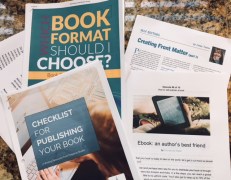
IMG_3243As I began to read blogs about self-publishing and downloaded PDFs like “Checklist for Publishing Your Book” and “Which Format Should I Choose” and followed marketing blogs with tips on using  social media, launching your book, advertising, newsletters, and websites, I discovered there’s a lot more to consider.

How to self publish your bookI bought and read “How to Self Publish Your Book” by Craig Gibb, which details about titles, pen names, and blurbs, as well as editing, cover designs, formatting, promoting and marketing options.

Word by Word Editing“Word by Word, An Editor Guides Writers in the Self-Editing Process” by Linda Taylor describes in detail the process of content and copy editing, proofreading, formatting, and all the front and back matter I would need to write for a complete “up-loadable manuscript package.”

 

My take away, if I am determined enough to do it:

  1. Write/rewrite my stories so they are polished to a mirror shine and have a kid-compelling first chapter.
  2. Get my manuscript professionally edited. (I sent in a sample 750 words to be edited free to one publisher, and was aghast at all the track changes suggested!) A proofreader is also high on my list.
  3. Get professional help in formatting my manuscript for the various eBook and print options. (There are just too many things that can go wrong, and I know from a dear friend on this blog that the learning curve is steep.) This is especially important because I want to include photos or illustrations.
  4. Get a cover designer/illustrator who can format for both eBook and Print, and who can portray the vision I have for the stories.

How much is this going to cost me?  A lot.

Can a middle grade children’s book with a Bible slant recoup that in sales?  Only God knows. I’m really NOT out to earn $millions. Any profit I make will be channeled back into the Africa ministries that I love.

But… I DO have a person who has promised to read the book and write a foreward for it. He’s worked with Wycliffe Bible Translators and travels the world as a Partnership Facilitator. He’s been to Malawi many times.  Who knows where THAT contact might lead.

And YOU might even know a 7-12-year-old who thinks it would be fun to grow up in deepest, darkest Africa!  And want to read my book.

IMG_3208

Bloodbath at the Keyboard

4618c-bonnie

Bonnie Schroeder has been a storyteller since the fifth grade, when her teacher suggested she put her vivid imagination to work as a writer.  She took the advice to heart and has pursued the craft of fiction ever since. In addition to her women’s fiction novel Mending Dreams, she is the author of numerous short stories, screenplays, and nonfiction articles. She lives in Glendale, California.


Over a year ago, I wrote a post about editing, full of measured and objective advice about reducing one’s word count. I boasted that I had trimmed 5,000 words from my Work in Progress and had “only about 10,000 words” more to cut. I achieved that goal almost painlessly.

Proof that the Universe has a sense of humor: I was offered a publishing contract, but only if I could remove another 3,000 to 5,000 words from the manuscript.

“You’ve got to be kidding,” I muttered as I started reading, convinced I had already pared the word count to the bare bone. At this point the manuscript consisted of about 109,000 words.stack-of-papers

This last read-through, performed after the manuscript had “cooled” for a couple of months, was a humbling experience.

There was still plenty of fat left in those pages.

I had apparently developed a fondness for the word “so,”—to the extent that it had become invisible to me on past readings. As in “So,” she said, “what have you been up to?” Or, “So, are you going to tell me what happened?”red-pen

Removing all those “so’s” made a tiny dent in the word count, but I had to get more aggressive.

You know the edict, “Kill your darlings”?

I’d done that, sliced them out with a push of the “Delete” button, and I was convinced I’d purged them all. But oh, no.

The number of darlings I found on this last go-round astonished me.

delete-key

Out went some of my favorite paragraphs, ones that looked lovely but added nothing to the storyline.

The bloodbath continued unabated, and this time there was pain. I loved some of those passages—I loved them too much. I’d labored over every sentence, every phrase, every word, and removing them from the manuscript was like ripping off pieces of my skin.

What made it worse, as I highlighted passages and pressed “Delete,” was the realization that no one but me would ever see these words arranged just so, words I’d sometimes had to wrestle onto the page to convey a certain image, a certain feeling. I hated myself for condemning them to obscurity.

“But wait,” cried a tiny voice at the moment of my deepest despair. These precious prose snippets weren’t really gone; they were safely housed in a prior version of the manuscript, safe within a digital file on my computer, backed up to the cloud and three separate flash drives. They could live on, forever if need be, waiting for me to resurrect them in another book, another time.

Maybe I will, and maybe I won’t, but I sleep better knowing they’re there, waiting patiently, and if they never get their moment in the sun, they won’t know.

After all, they’re only words.

Aren’t they?

I did meet my publisher’s requirement, so the agony was worth it. I trimmed another 3,998 words from the manuscript, and it is now a relatively svelte 105,000 words. But I still miss some of those paragraphs. . .