
By guest author, Sally Carpenter
If you saw a stranger walking down the street, what can you tell from her clothes? Sherlock Holmes could determine the social standing, wealth, occupation, education and gender of persons by their clothes.
Authors use to spend much time in describing their characters’ garments, sometimes to a fault. Without TV or film, writers felt they needed many words to help readers depict the characters in their minds.
In the story “A Scandal in Bohemia,” Arthur Conan Doyle writes: “His dress was rich with a richness which would, in England, be looked upon as akin to bad taste. Heavy bands of astrakhan were slashed across the sleeves and fronts of his double-breasted coat, while the deep blue cloak which was thrown over his shoulders was lined with flame-colored silk and secured at the neck with a brooch which consisted of a single flaming beryl. Boots which extended halfway up to his calves, and which were trimmed at the tops with rich brown fur, completed the impression of barbaric opulence . . .” Sensory overload!
Nowadays writers limit their characters’ physical description, because readers often skip over lengthy sketches to get to the action, and also to encouraging readers to imagine their own selves in the story.
 The only physical description we have of Nancy Drew is her “titian hair” and “blue eyes.” However, we hear a lot about her chic wardrobe and apparently endless clothes closet. Beyond her stylish threads, Nancy often dresses in costumes and old garments found in attic trunks. When the books were originally released in the 1930s, low-income readers could imagine wearing Nancy’s pretty outfits for themselves.
Cozy mysteries continue the trend of “less is more.” Clothes are mentioned briefly, if at all. With the modern heroine’s casual lifestyle, her wardrobe consists of tee-shirts, sweats and jeans. Readers want a quick and easy read without wading through mounds of description.
But when I started writing my Psychedelic Spy retro-cozy series, clothing was crucial.
 The books are set in 1967, an era of vibrant and varied clothes. Poodle skirts and bobby socks gave way to miniskirts and pillbox hats. East Indian garments were in style. The “British invasion” of roc
k music also brought English designers such as Mary Quant. African Americans adopted styles that expressed their ethnicity. The hippies had their own unique forms of dress.
Clothing of the 1960s differs so much from today’s styles that I had to describe nearly everything that people wore. I tried to keep such explanations to a minimum, yet the clothes were essential to place the reader into the era.
My protagonist, Noelle McNabb, is single and 25 years old. She apparently spends most of her income on clothes. In the first book, “Flower Power Fatality,” Noelle wears 14 different outfits! And her clothes are new, many purchased at the big city mall. She talks about how she loves shopping and checking out the latest fashions.
In finding clothes for Noelle, I’ve used a few costumes that I’ve seen in 1960s TV shows. I also have a great reference book, “Fashionable Clothing from the Sears catalogs: Mid 1960s.” The book has actual photos (and prices) from the era’s Sears mail order catalogs. I’d love to see those clothes come back into style, as they’re more beautiful and feminine than the women’s tee-shirts and leggings sold today.
Clothes also express the generation gap. When Noelle wears a miniskirt to church, her mother complains that the dress is too short. Mom is clad old, fussy dresses with below-the-knee skirts. Mom wears stockings and garter belts; Noelle is in pantyhose and colored tights.
In the 1960s, women wore dresses more frequently than today. I put Noelle in dresses most of the time. Even when she wears pants at her record store job, she’s in nice slacks and pant suits. The only time she’s in dungarees is when lounging around home.
Jeans are reserved for my “bad boy” characters, a group of young males who spend their time racing their choppers, shooting craps and smoking Marlboro cigarettes. In the mid 1960s denim was only slowing becoming acceptable as a fashion choice.
 Destiny King is an African American agent who takes Noelle on her spy missions. Destiny sports a trimmed Afro and frequently wears jumpsuits. Her clothes are functional in more ways than one way. For example, she has a pair of earrings that are really plastic explosives.
My hippie couple, Rambler and Moonbaby, are the most fun to cloth. Hippies wore an eclectic style, often put together from castaways and thrift store finds. Styles, patterns and colors did not need to match. One useful reference book is “The Hippie Handbook” by Chelsea Cain, which has a chapter on “How to Dress Like a Hippie” and information on making skirts out of old jeans and how to tie-dye a shirt.
Trevor Spellman is a newspaper reporter on the prowl for a big scoop. He rebels against the small-town norms by wearing his hair long—below his ears—and he never puts on a tie. In the 1960s the collarless shirt became appropriate for formal/dress wear.
The clothing of Mr. Baldwin, the audio-visual technician at the high school, describes him well: white shirts, skinny dark ties, dark pants, plastic-rim glasses and a “dorky haircut.” Did “geek” and “nerd” pop into your head?
What the retired Army colonel wears also paints a picture. He’s in an Army bomber jacket over a khaki shirt. “His voice was as crisp and sharp as the creases pressed into his khaki pants.” Even in retirement he runs his life with military precision.
Clothes can describe a character more efficiently than a long list of traits, helping a reader to visualize a person more so that relying on the reader’s imagination alone.
###
 Sally Carpenter is native Hoosier living in southern California. She has a master’s degree in theater, a Master of Divinity and a black belt in tae kwon do.
Her Sandy Fairfax Teen Idol books are: The Baffled Beatlemaniac Caper (2012 Eureka! Award finalist), The Sinister Sitcom Caper, The Cunning Cruise Ship Caper and The Quirky Quiz Show Caper.
Her Psychedelic Spy series has Flower Power Fatality and the upcoming Hippie Haven Homicide (2020). Sally has stories in three anthologies and a chapter in the group mystery Chasing the Codex.
She’s a member of Sisters in Crime/Los Angeles. Reach her her at Facebook or http://sandyfairfaxauthor.com or scwriter@earthlink.net.
This article was posted for Sally Carpenter by Jackie Houchin

 I’d asked a wise librarian in Burbank if there was something beyond Nancy Drew, but kind of like her, that I could read. She looked at this budding, though still gangling young teen, and recommended Mary Stewart’s first book, Madam, Will You Talk? (1955)
 This Rough Magic (1964), my opiate. ***
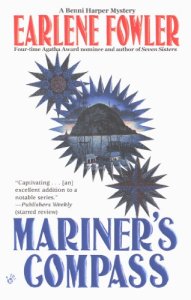 Mariner’s Compass (1999) is Earlene Fowler‘s sixth Benny Harper mystery, set along California’s central coast. Each of her books is named for a quilting pattern although Benny is not a quilter herself. She is a rancher and married to a cop, but she helps maintain a historical museum in town that features old quilts.
 Old Bones (1987) *** by Aaron Elkins is another favorite on my list. His protagonist Gideon Oliver is a forensic anthropologist, but his moniker in the series is “bone doctor.” It is absolutely amazing what you (he) can discover from a set of fresh or ancient bones. Who they were, yes, but more importantly in the book, how, where, when, and why a person becomes bones.
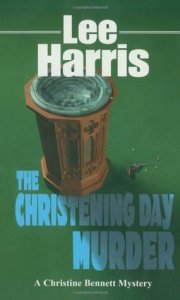 A freaky location again is the reason for my listing The Christening Day Murder (1993) by Lee Harris as a memorable favorite. (All Lee Harris’ Christine Bennett – a former nun – mysteries have a special “day” as their title.) I can’t even remember the mystery, but I remember where a good portion of it takes place.
 And lastly, the wonderfully warm and well-written family saga by the gifted Rosamunde Pilcher… The Shell Seekers (1987) **** (all 582 pages ) This is not a mystery, but a lovely women’s novel featuring Penelope Keeling, a 64 year old woman whose days are limited, and whose family does not understand her. A woman whose past is calling her, but whose present threatens to fence her in.
 On a recent short-term mission trip to Malawi for my church, I had the opportunity to teach Writing classes to two groups of home schooled MKs (Missionary Kids). These were children from American, Canadian and South African families. There were nine in the 3rd-4th grade group and seven in the 5th grade and up group.
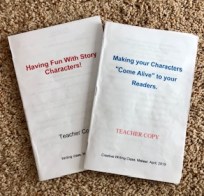 After reviewing the stories and talking to the other home school teachers, we all agreed that the kids needed help in character development. The action was amazing; the worlds they created were vivid, but the heroes, helpers, and villains were flat and hard to imagine.
 Before I arrived I asked that the kids (both classes) bring the first several paragraphs of a story they had written to class. In class, I had them each read their paragraphs aloud. There were Captain Jack, Commander of a Starship, twin girls named Peace and Harmony, and a 20-year old girl named Ella who wanted to become a princess (and a dozen others).
 For the younger class, I had them draw in their workbooks a circle for a face, then slowly add features (eyes, nose, mouth, ears, hair) and write a description of each as they went. Next they drew bodies with any kinds of clothes and shoes (or not) they wished. I had them write why these “characters” were smiling, wearing… glasses, a soccer jersey, a swim suit, a long dress, a tutu, and had on sandals or swim fins. They began to see how to show what their story characters looked like by writing descriptions, and in the process developed more interesting information about them. (I could see “light” dawning in their eyes!)
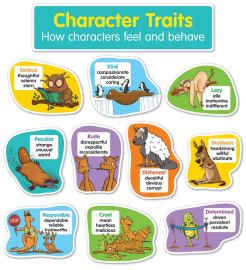 Next, we had fun with thirty-six
 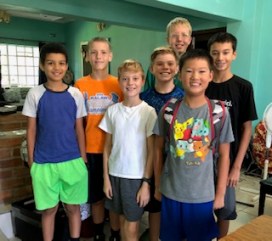 For the older class (all boys, and most writing sci-fi or fantasy) we delved a bit deeper into making their characters memorable by using various ways to describe physical as well as personality traits. They practiced describing a character in an action scene (showing fear or bravery without actually using those words) and played around with using an occasional quirk, flaw, or unconscious mannerism to reveal hidden traits.


You must be logged in to post a comment.