
by Miko Johnston
Frequent readers of this blog may recall me referring over time to the fourth novel in my A Petal In The Wind series, which I’ve been writing for more than a year. I got stuck. My plot points kept stalling out, but I had a breakthrough after my last post. Whew! Until then I worked on revising earlier chapters. In one I found something I not only rarely do, but scold other writers for doing – I repeated myself in consecutive scenes. The actual scene played out first, and on the next page my protagonist Lala told another character what happened.
Then it occurred to me – maybe I didn’t repeat myself; maybe instead, I wrote the scene in two different perspectives. I didn’t need both, but I could compare them and keep the better of the two. Out went the full scene; the gist from her dialog worked better. Lala had to have her say about the incident, and that clarified why I got stuck finishing the novel. Lala found my direction for her ‘wanting’. I realized I kept forcing the plot in a way that wasn’t true to the character, so I ‘asked’ Lala to explain, in a few sentences, what she sought for herself. That solved the mystery. I feel confident she – and my readers – will agree this new direction sounds like the Lala we’ve watched grow up.
* * *
Our characters must be real to us, for if we can’t envision them, body and soul, no one else will. It’s why I always write: characters ‘who’, rather than ‘that’, and say they’re created, not invented. KEEPING IT REAL: PART I focused on writing series, where you have more time and pages for character development. When creating and developing characters for a short story or stand-alone novel, how do we keep them ‘real’?
- Give them a background
Begin with a basic police description of gender, age, and physical size: Asian male, mid- thirties, five foot ten, 170 pounds. Ask them what you’d ask any person you’ve just met – what’s your name, where are you from, what do you do? Delve further and observe. How are they groomed and dressed? What do they sound like? Are they eloquent, plain-spoken or inarticulate? Adventurous or timid, gregarious or shy? Many writers, including our own GB Pool, recommend writing biographies for your primary and secondary characters. It’s helpful in writing a short story but vital in a novel.
- Find inspiration in real life
Often we base characters on actual people we know. We observe strangers in public places, listen in to their conversations. We play-act, or fantasize about what a celebrity might be like. That may make them real to us, but it doesn’t always translate onto paper. If you write fiction, you don’t have to recreate an exact duplicate. Instead, borrow traits from the person, like appearance, personality, or history. Use those elements as a foundation to write a unique character who reminds you of what you love, or hate, about their real counterpart. I based one character on a dear departed friend who suffered more than she deserved, and gave her a better life. I’ve also created some who resemble people I know and have one trait in common – their taste in clothes, or their bluntness. The rest I fictionalize, but with qualities I’ve found in real people.
- Get to know them
We must become familiar enough with a character to understand what they will say and do. Talking to your characters, questioning or interrogating them will flesh out little details. Are they outgoing or shy, active or couch potatoes? Do they like to travel, or are they homebodies? Do they eat to live or live to eat? If they could change any aspect of their life, what would it be? What flaws does your hero possess, and in contrast, what are your villain’s fine points? The more you know the better you’ll know them. To grow interrelationships, try free-form dialog, where you write a conversation between two of your characters. Sit down and begin to write without pausing, without dialog tags or punctuation. Just write, and after a few minutes your logical left brain will switch over to your more creative right brain. Try this for at least ten minutes and see what your characters have to say about each other, and by insinuation, themselves.
- Go beyond words and actions to thoughts and motivations
To really understand someone, we need to know more than what they say or do, but why they say or do it. Your biography will help with this, but like the exception proves the rule, contradictions in characters prove their ‘realness’. Look for contradictory traits, for everyone has a touch of hypocrisy within them. Even if your characters don’t know why they say or do something, as often happens in real life, you – their creator – must know and present it in a way the reader can deduce it without being told.
- Set them apart
To create characters who are not cardboard cutouts, begin by avoiding clichés and stereotypes. Not everyone from Mexico is named José (or Maria) Gomez, and you can’t always tell by appearance or mannerisms if someone is gay. Real folks are a mixture of commonality and individuality. What we share in common makes us recognizable, but our uniqueness sets us apart. Think of anyone you know and list five traits that they share with many people. Then list two or three that are different. My five shared traits would include compassionate, sensible, impatient, analytical, and curious. What sets me apart? Despite being a mature adult, put me in an environment with animals and I turn into a giddy three-year-old, as I recently demonstrated in the Monterey Bay Aquarium.
- Let them be
Once you’ve created your characters, allow them their voice. Let them tell you what they want and don’t want, and listen to them. It could save you hours, weeks, even months of writers block. You don’t always have to obey, but trust and respect them enough to hear them out. Also allow them some privacy. Instead of writing in every detail, give enough to flesh out the character and let readers have the pleasure of filling in the rest.
All this may seem like a lot to compact into a story or book, but the sum of big picture and little details about characters humanizes them. It also makes them vivid in our minds, which enriches the story, for even above plots, great stories revolve around the people who occupy them.
To find more writing on the subject throughout this blog – just put CHARACTERS in the search line. For an in-depth look at how to create villains, see my earlier post: https://thewritersinresidence.com/2015/07/15/building-a-better-villian-by-miko-johnston/ If you have any advice you’d like to share, we’d love to hear from you.

Miko Johnston is the author of the A Petal In The Wind Series, available through Amazon and Barnes and Noble. Miko lives on Whidbey Island in Washington. Contact her at mikojohnstonauthor@gmail.com
This article was posted for Miko Johnston by Jackie Houchin (Photojaq)

 The only physical description we have of Nancy Drew is her “titian hair” and “blue eyes.” However, we hear a lot about her chic wardrobe and apparently endless clothes closet. Beyond her stylish threads, Nancy often dresses in costumes and old garments found in attic trunks. When the books were originally released in the 1930s, low-income readers could imagine wearing Nancy’s pretty outfits for themselves.
 The books are set in 1967, an era of vibrant and varied clothes. Poodle skirts and bobby socks gave way to miniskirts and pillbox hats. East Indian garments were in style. The “British invasion” of roc
 Destiny King is an African American agent who takes Noelle on her spy missions. Destiny sports a trimmed Afro and frequently wears jumpsuits. Her clothes are functional in more ways than one way. For example, she has a pair of earrings that are really plastic explosives.
 Sally Carpenter is native Hoosier living in southern California. She has a master’s degree in theater, a Master of Divinity and a black belt in tae kwon do.
 On a recent short-term mission trip to Malawi for my church, I had the opportunity to teach Writing classes to two groups of home schooled MKs (Missionary Kids). These were children from American, Canadian and South African families. There were nine in the 3rd-4th grade group and seven in the 5th grade and up group.
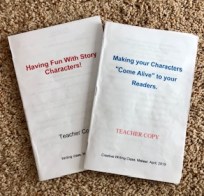 After reviewing the stories and talking to the other home school teachers, we all agreed that the kids needed help in character development. The action was amazing; the worlds they created were vivid, but the heroes, helpers, and villains were flat and hard to imagine.
 Before I arrived I asked that the kids (both classes) bring the first several paragraphs of a story they had written to class. In class, I had them each read their paragraphs aloud. There were Captain Jack, Commander of a Starship, twin girls named Peace and Harmony, and a 20-year old girl named Ella who wanted to become a princess (and a dozen others).
 For the younger class, I had them draw in their workbooks a circle for a face, then slowly add features (eyes, nose, mouth, ears, hair) and write a description of each as they went. Next they drew bodies with any kinds of clothes and shoes (or not) they wished. I had them write why these “characters” were smiling, wearing… glasses, a soccer jersey, a swim suit, a long dress, a tutu, and had on sandals or swim fins. They began to see how to show what their story characters looked like by writing descriptions, and in the process developed more interesting information about them. (I could see “light” dawning in their eyes!)
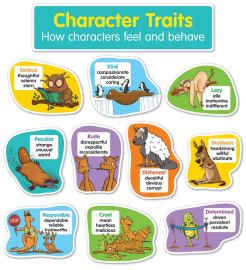 Next, we had fun with thirty-six
 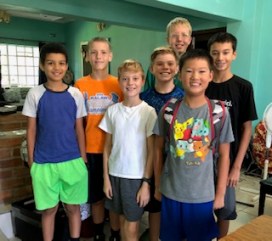 For the older class (all boys, and most writing sci-fi or fantasy) we delved a bit deeper into making their characters memorable by using various ways to describe physical as well as personality traits. They practiced describing a character in an action scene (showing fear or bravery without actually using those words) and played around with using an occasional quirk, flaw, or unconscious mannerism to reveal hidden traits.


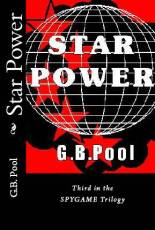
 A former private detective and once a reporter for a small weekly newspaper, Gayle Bartos-Pool (G.B. Pool) writes the Johnny Casino Casebook Series and the Gin Caulfield P.I. Mysteries. She also wrote the SPYGAME Trilogy: The Odd Man, Dry Bones, and Star Power; Caverns, Eddie Buick’s Last Case, The Santa Claus Singer, Bearnard’s Christmas and The Santa Claus Machine. She teaches writing classes: “The Anatomy of a Short Story” (which is also in workbook form), “How to Write Convincing Dialogue” and “How to Write a Killer Opening.” Website:
 “Johnny worked for me several years until he had enough P.I. hours under his belt to go out on his own. I hated to see him go, but I knew he worked better alone. Most of the time I do my work solo like the case at the racetrack in Hedge Bet. I should amend that statement because I got my husband, Fred, to do some work for me. His trip to Mexico to bring back a witness led to a few choice words from him, mostly unprintable. But the guy’s a natural P.I.

 or at least I thought it was his real name, until another story in the Johnny Casino Casebook series uncovered something that even Johnny didn’t know. It changed everything for him. It’s in The Johnny Casino Casebook 2 – Looking for Johnny Nobody. That’s when I started seeing a pattern.”







 The Writers in Residence

You must be logged in to post a comment.