September Memory

by Miko Johnston

When you read this my husband and I will in France for an annual international conference that we’ve attended most years since 1993. All have been wonderful and enriching experiences, but one will always stick out in my memory until my dying day.

We arrived in Grenoble on a warm Saturday and after checking into our hotel, wandered to the main street for dinner. We’d been attending these conferences for enough years to have met and befriended many of the attendees, so when we passed a few of them sitting outside a restaurant they invited us to join them. The organization chairman ordered mussels and white wine for the table.

zan-ilic-WrueFKpTlQs-unsplashSoon waitstaff brought out steaming five-gallon pots filled with briny shellfish, loaves of French bread and bottles of chilled wine – a white Beaujolais, which I’d never heard of before. I took one sip and delighted in its light freshness, its unpretentiousness, like young girls in summer dresses.

More attendees showed up and joined our group, and soon extra tables were added as our numbers grew. We ate and drank, laughed and caught up with each other’s lives as more orange-enameled cast iron pots of mussels emerged from the kitchen, more bread, and more of that innocent young wine.

This was September 8, 2001.

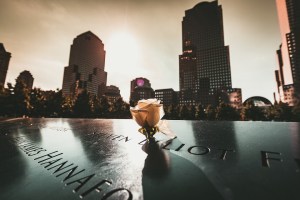
Three days later, as I returned from a morning of hiking up La Bastille hill and riding down the spherical cable cars known as “Les Bulles” (bubbles), I returned to my hotel room shortly after three and turned on the television to CNN. I saw coverage of a plane that had crashed into one of the World Trade Center towers in New York. My first instinct was to blurt, “What the ___?” but before I could get the words out I watched as a second plane hit the other tower.

world-trade-center-67695_960_720Not wanting to be alone, I found my husband and we gathered with other Americans in the lobby, where we watched the horror continue to unfold on a big screen. We gathered in small groups to commiserate. One friend had a brother who worked in the first tower (miraculously, he wasn’t there that day). Another recognized a name from the passenger list of one of the planes that hit the tower – his former boss. All of us were too shocked to respond until he said, “If anyone deserved to go like that, it was that SOB.”

Then the first tower collapsed.

That evening the conference attendees and their guests had been invited to the Hotel de Ville  – the administrative building of the city – for the annual reception hosted by the mayor. It usually involves a brief greeting and welcome, followed by drinks and refreshment. Instead, we gathered with the mayor and city officials in a moment of silence followed by the usual greetings to the attendees, albeit in a more subdued manner.

Then we left, passing the restaurant we’d dined in Saturday night. Someone inquired if they could accommodate our group for dinner. They could, but for our numbers, not outside. They took us to a separate room upstairs.

Once again we gathered, not outside but in a converted attic to eat and talk. You can imagine the conversation. The pots of mussels soon appeared, along with the bread, but not that delicate wine. Every bottle of white Beaujolais was gone, along with our innocence.

new-york-4321235_960_720

##


mikoj-photo1

Miko Johnston is the author of the A Petal In The Wind Series, available through Amazon and Barnes and Noble. Miko lives on Whidbey Island in Washington. Contact her at mikojohnstonauthor@gmail.com


This article was posted for Miko Johnston by Jackie Houchin


Web Site Ads, Anyone?

by Jill Amadio

How many of us buy site ads to promote our books?

Grinding my teeth at low sales in August I was able to ask a couple of successful authors how they manage to keep their titles before the public. Brenda Novak, who writes the Dr. Evelyn Talbot thrillers, said that one of the publicity tools she uses are book marketing sites.  Although her wallet is somewhat fatter than those of many of us with four million copies of her books sold, Brenda still sends some of her personal advertising dollars to these sites.

business close up commerce computer

Among her tactics: Organize your own book group on Facebook. It’s free. Offer inexpensive swag such as commemorative pins in exchange for downloading only your book titles from her web site – not the books themselves.

Add a shopping page to your own website to sell T-shirts, mini-totes, Christmas ornaments, etc. Brenda said that it cost her $2,000 initially to set up her online shop and now it is hugely successful. 

Another tactic she uses is to create a Foodie Friday recipe which she cooks and posts on her Facebook and Instagram accounts, including a video.

Book trailers are one of her favorite ways to attract attention although she cautions that changing it regularly is key. To keep costs low (still expensive!!), the video company she contracts with uses stock video for much of the content.

Another tip: offer giveaways – one of her most popular was on Facebook Live in which she read from her books.  

Find a company that sells “scrap” advertising which are spots in major magazines discounted at the last minute. But don’t let the “scrap” description fool you. Brenda says that even discounted, it can cost a bundle. Nevertheless, one she found available was in People magazine, and she is always on the lookout for deadline deals with women’s magazines. 

“Not all marketing endeavors achieve the same goal. Some are more about brand building,” she told me. “I look at marketing my books like a farmer might his fields – it’s what I put into the soil before planting that makes the biggest difference in the end.”

*

Away from Brenda’s heady, enterprising and pricey ads are the less expensive and free methods used by some of us Writers in Residence and by our colleague, psychological thriller writer Sheila Lowe. Like Brenda, Sheila subscribes to www.BookBub.com, a web site that sends out daily emails advertising books to millions of readers, although costs can be high.

Here’s how it works: you set a maximum price you’ll pay for the exposure, say $100. When someone clicks on your book cover you get charged a certain amount of money for the impression. After your stated maximum budget, the $100, is reached, BookBub takes down your ad. You can choose which readers and audiences you want to target by genre, interests, retailers, and location, and you can monitor your campaign on the site’s dashboard.  Extremely popular, the site has a waiting list of authors eager to sign up. 

While Sheila takes advantage of the benefits Facebook offers including its Authors Page, she likes affordable subscription sites such as www.BargainBooksy.com and www.RobinReads.com. The latter is a free author promotion service affiliated with Amazon and you don’t have to be part of Amazon’s Prime/Kindle Unlimited yourself to use it.  The site focuses on promoting eBooks which are now enjoying a massive surge. RobinReads buyers pay for discounted books if they choose to buy them only on Amazon. However, the deals are swift, lasting only 24 hours before they are retired for fresh offers.

man wearing pink polo shirt with text overlay

At BargainBooksy with around 3,000 subscribers, advertising for eBooks is also king along with print books. After a buyer clicks on a link to a specific book they are taken to Amazon’s web site, where the book can cost 0.99 cents or less, while pricing is based on your genre. This, of course, affects your royalties, so unless you are only targeting publicity you might want to reconsider. However, the site also links to your books at Kobo, Apple, and Nook, and to your own web site.

To splurge, you can buy a $50 BargainBooksy Deal of the Day promotion on FreeBooksy, a specialized-genre readers’ site designed to boost your click-through rates and purchases with free books that are not available on the main site.  

So, there you have it. A few costly as well as reasonably-priced ideas. Raid your piggy bank!

money pink coins pig


JillAmadioHeadJill Amadio is from Cornwall, UK, but unlike her amateur sleuth, Tosca Trevant, she is far less grumpy. Jill began her career as a reporter in London (UK), then Madrid (Spain), Bogota (Colombia), Bangkok (Thailand), Hong Kong, and New York. She is the ghostwriter of 14 memoirs, and wrote the Rudy Valle biography, “My Vagabond Lover,” with his wife, Ellie. Jill writes a column for a British mystery magazine, and is an audio book narrator. She is the author of the award-winning mystery, “Digging Too Deep.” The second book in the series, “Digging Up the Dead,” was released this year. The books are based in Newport http://www.jillamadio.com

Books: Digging Too Deep, Digging Up the Dead

Non-Fiction: My Vagabond Lover: An Intimate Biography of Rudy Vallee; Gunther Rall: A Memoire, Luftwaffe Ace and NATO General


***


This article was posted for Jill Amadio by Jackie Houchin


These Are a Few of My Favorite … Reads

by Jackie Houchin

Raindrops on roses and whiskers on kittens
Bright copper kettles and warm woolen mittens
Brown paper packages (from Amazon) tied up with strings
These are a few of my favorite things (reads)

When the dog bites, when the bee stings
When I’m feeling sad
I simply remember my favorite things (reads)
And then I don’t feel so bad” *


Who doesn’t know the catchy lyrics to that song? I bet you can even picture Julie Andrews singing them while twirling around. And who of us bibliophiles can’t say we have been transported and uplifted during and after reading those few special books that we cherish in our libraries.

The majority of my all-time fave books are mysteries, the old fashioned, clean, puzzling and often romantic reads that still make me smile just thinking of them.

My very favorite book was written by Mary Stewart** in 1964. But it was a few years earlier that I began my journey into this marvelous writer’s world.

Madam Talk audio 51B6UTiH4GL._SX342_I’d asked a wise librarian in Burbank if there was something beyond Nancy Drew, but kind of like her, that I could read. She looked at this budding, though still gangling young teen, and recommended Mary Stewart’s first book, Madam, Will You Talk? (1955)

I was hooked immediately!

The setting is Southern France and involves a young widow, a lovable mutt, a child in peril, high-speed car chases, and a dark and handsome man who is either villain or saint, and suspense.  Delish!

In less than a week I rushed back to the library to check out more of Mary Stewart’s books, reading down the list as fast as I could. Until I came to THE ONE. My favorite book of all time, re-read at least a half dozen times cover to cover, and often, as the song says, “when the dog bites, when the bee stings, when I’m feeling sad…”

Rough Magic Audio; 61gkNEBPKYL._SX342_This Rough Magic (1964), my opiate. ***

I’m not sure what makes my breathing slow when I open the book and settle into a soft chair, but in only a few pages I am deep into the atmosphere I love that is written so well by Mary Stewart in all of her books.

A writer’s hidden retreat on the isle of Corfu in Greece… An old house with secret passages… Wisps of Shakespeare’s The Tempest, quoted by the old recluse playwright living there, that seems to foreshadow the events in the book.

A young woman recovering from a career failure, arrives at the retreat with her sister seeking rest and solace but finding danger and death. Fog along the beach at dawn so thick you can only hear the waves slapping the shore… and the wooden oars of a boat bumping in their cradles, soft murmurs and oaths from its occupants, and grunts as they drag something heavy across the sand and into the trees.

A dolphin’s seeming magical appearances play an important role. And an arrogant and handsome figure, rough in clothes and manner slips in and out of the house at all hours. Is he a killer and smuggler, or a hero?

This is no silly Gothic, but is (to me) outstanding storytelling by a “wordsmith extraordinaire” whose sense of descriptive place is beyond amazing. My favorite read!


Next on my list is a puzzle mystery, that just so happens to also have a murder.

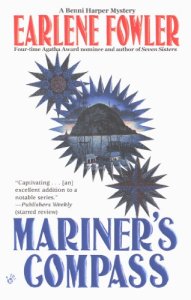
marinersCompass2Mariner’s Compass (1999) is Earlene Fowler‘s sixth Benny Harper mystery, set along California’s central coast. Each of her books is named for a quilting pattern although Benny is not a quilter herself. She is a rancher and married to a cop, but she helps maintain a historical museum in town that features old quilts.

What entrances me in this book, unlike any of her other mysteries, is the puzzle. In this story Benny receives a mysterious bequest from a dead stranger. She will inherit his entire estate if she will stay in his home in Morrow Bay for two weeks. Alone. Being alone, abandoned, is something that terrifies Benny.

She agrees, although her protective hubby-cop is not fond of the idea. Soon Benny is on a strange and dangerous scavenger hunt to find the man’s true identity. The clues he leaves hidden, if carefully followed, lead to more clues in a widening spiral of strange places. The deep mystery they reveal piecemeal is totally captivating. It’s a real stunner when she finally discovers who this Jacob Chandler was, and why he was stalking her.

More than the location in Mariner’s Compass, it’s the entwined maze of clues which makes this one of my favorite books. (BTW, if you look on Fowler’s fan page, this book is the favorite of many of her fans.)


Old Bones, maginfierOld Bones (1987) *** by Aaron Elkins is another favorite on my list. His protagonist Gideon Oliver is a forensic anthropologist, but his moniker in the series is “bone doctor.” It is absolutely amazing what you (he) can discover from a set of fresh or ancient bones. Who they were, yes, but more importantly in the book, how, where, when, and why a person becomes bones.

Oliver himself is a big, kind of cute, socially inept “nerd” of a guy, who is brilliant with bones. I like all of his cases, but in this one, it’s the location that grabbed me, chilled me, and after many nightmares, made me book a tour to the real place in France.

Mont St Michel,  the small island off the Western coast of France topped by a towering monastery, is tour-worthy for sure. (The original cover pictures the island.) But it is the incoming tides, racing without warning at a speed faster than a man can run, over quicksand riddled mud, that terrifies me.

Yes, I went there, rode in a bus across the long, straight road from the mainland at low tide, trudged up the steep, winding road to the top, and toured the ancient building with a set of huge bells. Very Nice. Reminded me of Notre Dame.

But I could see those swirly patches of mud and sand from atop the “Mont” and in the distance a dark blue-green smudge. Suddenly I couldn’t wait to get into the bus and race back to mainland safety.

You are not so lucky in Old Bones. You will suffer fear, panic and worse, when you read the final chapters. I dare you! But, it’s the reason this is one of my faves.


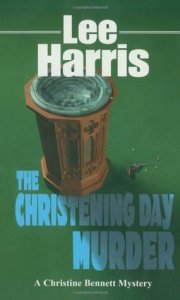
Christining Day MurderA freaky location again is the reason for my listing The Christening Day Murder (1993) by Lee Harris as a memorable favorite. (All Lee Harris’ Christine Bennett – a former nun – mysteries have a special “day” as their title.) I can’t even remember the mystery, but I remember where a good portion of it takes place.

Thirty years before, the small town of Studsburg was evacuated by the government and flooded to create a reservoir. (Feeling creepy yet?) In this story, a drought has uncovered the town’s forgotten church, along with a gruesome discovery in the dank basement. It is the skeletal remains of a 30-year-old murder.

As Christine tries to piece together the sordid puzzle from the past, the water begins rising again and she is trapped in the basement…..(Gasping scream from me!)


Shell SeekersAnd lastly, the wonderfully warm and well-written family saga by the gifted Rosamunde PilcherThe Shell Seekers (1987) **** (all 582 pages ) This is not a mystery, but a lovely women’s novel featuring Penelope Keeling, a 64 year old woman whose days are limited, and whose family does not understand her. A woman whose past is calling her, but whose present threatens to fence her in.

A painting which her children vie for, lusting for the wealth it will bring at her passing, but which is too sweetly precious for Penelope part with, is in the center. Instead of giving it to her children, she uses it – to their chagrin and horror – to fund one last trip into her romantic past.

In the book, sixteen characters have their own section and say. Shell Seekers is not a linear book, so the characters each tell their story, almost as if they are all in a room together, and one steps forward to knit their story into the entire piece. They form a complete picture of “Miss Penelope Keeling,” who speaks last in the book.

These multiple POVs – besides Pilcher’s amazing, evocative, sweeping, tender, gorgeous writing – makes this a favorite. It is the voices of 16 people, separate and yet forever intertwined in the story of one wonderful woman. A tear-jerker. You won’t want it to end. When it does, you’ll fly to the first page and begin again. (PS: Rosamunde Pilcher was 60 when she wrote this book.)


Suspense and romance, locations and mystery

Old Bones and bodies, shrouded in history

Villains and heroes revealing their deeds

These are A FEW of my favorite reads.


Have you got any favorite reads? What is it that makes them memorable to you? Characters, setting, style, genre, author, the writing…?


* Richard Rodgers, The Sound of Music, with my words in italics

** Mary Stewart is credited with developing the genre of romantic suspense featuring intelligent, independent, and capable women who don’t fall apart in a crisis. A reviewer wrote, “There is an old-fashioned elegance about Mary Stewart‘s writing. A stately polish with more than a hint of an old 1950’s Hollywood movie.”

*** Mary Stewart‘s mysteries are now all available in audio through Amazon/Audible. Here’s the link to This Rough Magic

**** 1988 Edgar Award Winner – Best Mystery of the year. (“Look out Sherlock Holmes!”)

***** In her introduction, Pilcher writes that she intended The Shell Seekers to be “A big fat novel for women. Something above all, that tapped into my life and the experiences of my generation.”

Improve Your Introductions and Conclusions in Non-fiction Writing

by Jeanette F. Chaplin

I recently discovered I’m a cruciverbalist. It’s chronic, incurable, and inoperable. Don’t worry, it’s not contagious. But it’s probably terminal. And it has absolutely nothing to do with the subject of this blog post, which is the whole point.

The purpose of this somewhat puzzling introduction was to get your attention. Using a word that is probably unfamiliar is one way of doing that. I “hooked” you in one of two ways: either you didn’t know the word and read on to learn the meaning, or you know the term because you are one. In that case, you decided to keep reading to see what I have to say about a topic that already interests you. Or, I may have lost you while you left to look up the word.

For your enlightenment:

cruciverbalist [ kroo-suh-vur-buh-list ] noun.  a person skillful in creating or solving crossword puzzles

Two of the most challenging aspects of writing non-fiction are effectively introducing the topic and wrapping it up satisfactorily when you’re done. The trick is to find a natural and interesting way to lead into the topic in the beginning and close it off at the end.

Movies do this quite well. A classic example is The Princess Bride. The opening and closing scenes have nothing to do with the actual story (although some might challenge that statement). The well-meaning grandfather comes to read to his ailing grandson. After watching the story that’s enacted, the viewer is returned to the modern-day scene and Peter Falk excuses himself with, “As you wish.”

Using a narrator to tell the story can be useful, but it has been overdone and doesn’t lend itself too well to non-fiction. One way to make this “bookending” happen is to connect a seemingly unrelated idea with the theme of your essay, article, or blog post. Then weave it in seamlessly from beginning to end.

To accomplish this, come up with an idea, a concept, or premise that seems far removed from your topic, as I did with crossword puzzles and introductions and conclusions. Nothing is off limits: waterfalls, RV life, grandkids, politics. Well, maybe not politics.

Make a list or a cluster chart of your ideas and think of any connections between those random concepts and the topic of your essay or article. Let’s try waterfalls as an example. Waterfalls flow, they are refreshing, it may be difficult to reach them, they could present a danger, are challenging to cross, and they can be inspiring—or frightening. Those descriptions could apply to any number of topics. Do any of them spark a connection? If not, keep playing with ideas until you find a comparison that works. Brainstorming with a friend or family member may help.

So, back to my off-the-wall, totally irrelevant introduction. What connection could crossword puzzles possibly have to with writing non-fiction?

crossword-146860_960_720For one thing, both follow a very specific set of rules. Crosswords must be square, they contain a specific number of squares and answers, they must be symmetrical, and they can’t duplicate clues in the grid. Clues and answers must match grammatically. Puzzles must have a theme. Now we’re getting closer to something writers can relate to: themes and grammar. For crossword creators, that means their answers must support the theme. Writers, on the other hand, must develop a theme that carries readers logically from beginning to end. Do I even need to mention that writing should be grammatically correct?

Non-fiction also needs an attention-getting beginning and an introduction to the topic, which may include why it is important to the reader. The author has to explain the concept in a way that is understandable to the reader, preferably in an interesting way, and conclude with a reminder of what was discussed.

In the crossword puzzle, the creator may attempt to misdirect the solver to make it more challenging. In the really difficult puzzles, generally scheduled for Saturday, creators often turn to wordplay, slang, unusual punctuation, or the ultimate twist of the knife: heteronyms (words that are spelled the same but have different pronunciations and meaning, Polish and polish, for example). 1

But ultimately, the creator wants the solver to succeed. According to crossword expert David Kwong, a New York Times puzzle constructor, “A good enigmatist makes the solver feel smart.” 2

newspaper-news-media-spectacles-53209But solving a crossword puzzle is far removed from the experience of reading an article. The solver of the former is looking for entertainment and a challenge. The reader of the latter wants to be informed, inspired, or educated. Or, at times, to be entertained.

The crossword challenge ends when the cruciverbalist either a.) solves the complete puzzle unaided, b.)  resorts to subterfuge to find answers, or c.) tears it up and tosses it into the trash.

In written work, the writers’ goals are accomplished when they convey the ideas to the reader as clearly and convincingly as possible and possibly even stir them to action. A good ending helps to achieve the desired result.

A satisfying conclusion should in some way reflect the introduction. It can be a restatement, an echo, a contrasting statement, or an illustration of the point. Or as in our example in this blog post—a bookend. Which means, at this point, I’m expected to return to the original crossword puzzle illustration.

Just as puzzle solvers come to a crossword with certain expectations, so do readers. Construct your non-fiction writing to smoothly lead them into your topic, cover the main point clearly, and tie it up neatly at the end. Make your reader feel smart.

Unlike the crossword creator, your goal is not to bewilder or stump your reader. You want to skillfully lead them from the hook to the denouement. Directly from 1. Across to 31. Down.

##

JFC_RomyBestSemi-retired college English and Spanish instructor. Self-publisher, editor, and entrepreneur. Jeanette has been writing, teaching, editing, mentoring, and publishing for the past four decades. Now she is available online to help writers around the world with their writing ventures.  When she’s not writing, she enjoys enjoys traveling to visit family and friends, especially her two grown daughters and her two young grandchildren.

Jeanette F. Chaplin, Ed.D.


Look for Jeanette Chaplin on Facebook, LinkedIn, & Twitter

Sign up at http://www.WordsAreForever.com

Chaplain-esque      https://chaplainesquethoughts.wordpress.com/


1 Amlen, Deb. “How to Solve The New York Times Crossword.” n.d. https://www.nytimes.com/guides/crosswords/how-to-solve-a-crossword-puzzle?module=inline

2 Kwong, David. “How to Create a Crossword Puzzle.” WIRED MASTERMINDS  S1  E3. n.d. https://youtu.be/aAqQnXHd7qk


This article was posted for Jeanette Chaplain by Jackie Houchin

Conferences and Writing

by Linda O. Johnston

RWA2019_FINAL LOGOI attended the Romance Writers of America National Conference last week in New York City.  Am I glad I did?  Yes, mostly because of the wonderful people I saw, meeting up with those I knew professionally and as friends–or both.  I’ve been attending RWA conferences for many years and for different reasons, but that’s the most important.

I also attended three other conferences this year, some of which I have mentioned here.  One of the others, California Dreamin’, was a local romance writers’ conference.  Two of the others were mystery writers’ conferences: Malice Domestic, and the California Crime Writers Conference.  Yep, that’s a lot of conferences.

So why do I do it?  Yes, to meet up with those kinds of people I mentioned.  And that’s the most important reason for me these days.  But I also attend workshops and meals and other related events.

Do they help my writing career?  I think so, or I wouldn’t go.

But if you’re a writer, should you attend conferences?  Why not?  At least those for the genres you write in.  I always tell other writers, especially those just starting out, to join writers’ organizations in their genres and attend local meeting of their chapters.  Conferences help you meet others in different stages of writing and sales, which can also help your career.

Did I enjoy the RWA conference this year?  Yes, but I had some issues with it, too–one of which was the hotel we were in and its horrible elevator service. But I did get to visit the AKC Dog Museum.

Plus, this year, I hardly attended any conference workshops. No time, thanks to the various Harlequin meetings and workshops. I also had less interest in most of the topics than in the past, although the ones I did attend were helpful for research purposes. My favorites were, one on creating  series, where I got some other people’s takes on how they do it, another workshop on forensics in fiction, and another on twists in stories.

Will I attend RWA next year?  Most likely.  I’m under contract for four new Harlequin Romantic Suspense books, some of which will be published by then, and it’s always good to make contact with the editors and others at a publishing house in person like that.  Plus, it’s in San Francisco, which is a lot closer to LA than New York is.

Maybe I’ll see you there!

lindaphotoLinda O. Johnston, a former lawyer who is now a full-time writer, currently writes two mystery series for Midnight Ink involving dogs: the Barkery and Biscuits Mysteries, and the Superstition Mysteries.  She has also written the Pet Rescue Mystery Series, a spinoff from her Kendra Ballantyne, Pet-Sitter mysteries for Berkley Prime Crime and also currently writes for Harlequin Romantic Suspense as well as the Alpha Force paranormal romance miniseries about shapeshifters for Harlequin Nocturne.


***


This article was posted for Linda O. Johnston by Jackie Houchin. 


What Did You Say?

By Miko Johnston

I’ve been thinking a great deal about words lately. Part of the reason is that I recently pitched a story I’d written almost two decades ago to a producer who’s shown some interest in the project. It contains language that would be inappropriate for this blog, but while the comic murder mystery at the heart of the story is meant to entertain, its satirical backdrop illustrates society’s relationship with certain words over the last half-century.

Anyone who’s lived more than a few decades has seen a loosening of standards in the media as well as in general life. While this blog – and  I suspect some of you – may eschew using certain words, I’ll bet your standards have changed along with the rest of our world. I’ve seen words in newspaper articles I’d never expect to see in print. I rarely watch TV except when I travel, but even with my limited exposure I’ve heard language in television programs – and I’m talking network TV, not cable – that wouldn’t have been permitted in the past.

Do you recall George Carlin’s Seven Words you can’t say on TV? Lately a few have slipped by. I recently heard a TV news anchor say a word I never expected to hear, having to do with bovine excrement, without a peep from the network or FCC. One of the Democratic candidates uttered another Carlin no-no during the first debate. A few words are still off-limits, and by my account we’ve added a new one to the list (hint: it starts with an N).

I’m not only thinking about obscenities. I’ve also noticed how many ‘ordinary’ words have been redefined or had their meaning augmented. Take the word average. It’s a mathematical term, yet it’s taken on social connotations. We hear about the average person and equate it with falling straight down the middle of a ranking system, not being good or bad. No one aspires to be average anymore; it has become something to avoid, either as a person or as an opinion.

As a writer, I find I must be more precise in my usage of certain words because of this. It concerns me that something I say or write could be misinterpreted. As a former journalist, my goals in reporting were ABC: Accuracy, Brevity, Clarity. Let’s not get into accuracy in news. Brevity translates into sound bites – catch phrases and such, or interrupting a speaker who takes more than a microsecond to get a point across. These days Clarity must include weighing a word’s intended meaning against what it’s perceived to mean. Social shifts, political correctness, and cultural rebranding have all contributed to this landscape, opening up new possibilities for writers as well as new dangers.

On occasion I’ve read lines of writing that could be misinterpreted. In each case I had close ties to the author, so I knew better than to take offense at what they wrote. However, readers who lack that personal advantage might not see it that way. I also worry a great deal about doing that myself and have on more than one occasion censored my work rather than risk the possibility of having someone take my words to mean something I never intended.

Have you thought about this as well? Are you concerned with the possibility that something you’ve written could be taken as insulting or offensive even if that wasn’t your intent?


mikoj-photo1

Miko Johnston is the author of the A Petal In The Wind Series, available through Amazon and Barnes and Noble. Miko lives on Whidbey Island in Washington. Contact her at mikojohnstonauthor@gmail.com

*****


(Posted for Miko Johnston by Jackie Houchin)


“Late Night” At The Writers Room

Jill Amadio

JillAmadioSlogging away as we do on our mysteries, enjoying making sure we’ve planted subtle and not-so-subtle clues and fascinating red herrings, it’s a marvelous feeling to write The End and look forward to working on the second draft.

After the third or fourth draft and you’ve decided that your manuscript is publication-worthy, how often has the thought flashed through your mind of it being picked up by Hollywood? Have you sat and imagined the different scenes coming to life, your characters personified by, say, Meryl Streep and Anthony Hopkins? I’ve always dreamed of Emma Thompsonplaying my amateur sleuth, Tosca Trevant, but she’d have to dye her hair dark and grow it to her waist. 

A few days after I tried to picture Emma thus transformed and realized it probably wouldn’t work unless I switched Tosca’s dark hair to Emma’s blonde locks, I received an invitation to Fox Studios. Charlie, a screenwriter and author friend who lives nearby, is a member of the Screenplay Development Group at Fox. Each month the group is supplied with the script of a current movie, urged to see the film, and invited to critique both forms of entertainment. At the meeting we were to discuss and voice our feedback while comparing the two genres.

Coincidentally, our script last month was “Late Night,” a comedy starring Emma Thompson and Mindy Kaling who produced and wrote it. Be still my heart! The first three pages of the script were evaluation sheets for discussion at the meeting. Charlie pointed out to me that the script itself was held together by only two staples, the middle hole left empty. If a third staple was added the writer would be considered an amateur and the script immediately dumped in the rubbish bin.

We decided to drive up early to LA for lunch, see the movie, and then go on to Fox.  We had both read the script and discussed it between ourselves a few days earlier over coffee and found we agreed that the premise was excellent, the execution of the idea rated a Very Good, and the dialogue was spot on and very funny.  We were to rate the character roles, settings, visuals, writer intentions, relationships, plot, etc. We also had to consider the cost of making the movie and were provided with amounts ranging from $5-200 million. Charlie and I figured we’d need only $10 million because there were very few set changes. Most of the action took place, coincidentally, in a studio’s Writers Room.

I knew that the Writers Room was where the magic happened, having seen Writers Rooms on TV shows. Reminded me of my first job in the newsroom of a newspaper. To me, both magical places. At Fox I envisioned all those creative types sitting around thinking up jokes, sex, violence, and crazy dialogue. I remember a movie wherein two writers were locked in the Room until they came up with a better script. On the other hand, I need complete silence and solitude when I write but I hoped being thrown into this new environment might spark some new book ideas.

Charlie and I drove down Pico Blvd to make sure Fox Studios was still standing, then headed off in the opposite direction to the Westside Pavilion, a large shopping mall, for lunch. We found an entrance to the parking garage and Charlie, for some reason, said it was best to drive up to the roof. We noticed no cars parked anywhere and decided the mall had not opened yet, must be too early. We proceeded blithely up the ramp, saw boarded up windows everywhere and realized the Pavilion was closed. Permanently. We turned the car around and drove down but were stopped at the exit by a large wooden barrier arm that refused to raise. Charlie pressed all the buttons and finally shouted into the ticket slot. Eventually a guard came out, shook his head at us for not knowing the mall had closed a year ago and let us out, no charge.

On Sunset Blvd we found a coffee shop that sold lattes and blueberry muffins for outrageous prices.  Charlie pointed out that the meeting would be catered. In Hollywood language that meant tons of food. Slightly fortified but poorer we drove over to the Landmark cinema to watch the matinee of  “Late Night.”  We noted that the first several pages of the script had been scrapped and the action began in New York, not London. Emma, in the script, is depicted as something of a loose woman, married, with lots of lovers. In the movie she indulges in only a single one-night stand. Wonder who changed that around? Also, the ending was entirely different, so we knew there’d be lots of pro and con at the meeting.

Along Pico Blvd we spotted the Fox Studios sign. Exciting! We’d received two pages of instructions on how to enter and what to say to the guard at the studio gate, where to find the Steven Bochco Building, where to park, and told in VERY LARGE BOLD LETTERS not to enter any other building on the lot.  No sir!

Pretty soon several others arrived and we went inside to register and find a seat at the immensely-long writers table. Must have been carved from a redwood tree. My blood pressure rose, I am sure, because this was such an adventure and we were in a real, real movie studio. Despite my many years interviewing celebrities and a bit part in “Dr Zhivago” that was filmed in Spain when I lived there, this sent my heart racing. It’s one thing to be on an outside set, fun but okay, and another to be on a lot where several movies are filmed simultaneously and buildings are named after the famous.

There were about 38 of us sitting around the table, average age was, surprisingly, 40s with a few maybe in their 30s. Several older men and women were there and were veteran writers. Long-time producer Bill Taub led the discussion and we went around the table describing what we were working on. Blatant but truthful, I announced I was an author and had just finished adapting my third script to a book after my clients had been told to Write the Book First. Everyone else was a screenwriter. One person had adapted her novel to a script, and three attendees were in film school at UCLA. No one had a movie in production but three had sold to studios.

The actual discussion was lively, a little argumentative, and revealing. I kept quiet most of the time, making notes for a possible future murder in a Writers Room. The changes between the “Late Night” script and the movie, of course, were the subject of much talk as well as a learning curve and a warning that such cuts were typical. We all wondered why Emma’s persona was cleaned up and agreed that cutting the first ten pages unfortunately eliminated the set-up of how Brit Emma came to be a famous late-night TV talk show host in New York and was married to some old chappie.

Charlie and I continued our discussion driving home, me still high with excitement, and decided we would join the group again at a later date. I’m not sure if any of the talk helped me with my own writing because the genres are so different. Even so, input about dialogue was valuable as far as getting to the point of a scene and knowing that instead of a character being described in a script simply as Female Comic, 19, nervous, I can flesh her out in my book, paint word pictures, and endow her with thoughts and emotions I want her to have rather than a character re-created by a film director who probably hadn’t read my book.

Still, when all is said and done, getting your sleuth onscreen must be very special indeed.


Late Night – Official Trailer | Amazon Studios


****


(Posted for Jill Amadio by Jackie Houchin.)


.

Four P’s for Independence Day Writing

by Jackie Houchin

Patriotism

What authors come to your mind as you think of Patriotism? First in my mind are David Baldacci and Tom Clancy for action, suspense, and adventure. I also love David McCullough (1776), and Joseph J. Ellis (Founding Brothers) for making American history come alive. For kids, who could forget Esther Forbes’ Johnny Tremain.

These books make me love my country and stand proud when I hear the national anthem sung or see our flag pass by in a parade.

flag.libertyWhen returning home from a recent trip in April and touching down in Washington D.C., the South African pilot announced, “Ladies and Gentlemen, welcome to the United States of America.”   I have to admit, I got a lump in my throat and tears welled in my eyes. So often I take the privilege of living in “the States” for granted. So many in the world would change places with me in a heartbeat!
Privilege

Along with all the abundance and freedom we have and love, come the costs. We commemorate some of them each Memorial and Veteran’s Day…. lives and limbs lost by brave young men who freely took up arms to defend our way of life.

The other “cost” of living free is not free at all. Yep, it’s all those income, sales, and property taxes that keep on coming… until we die. (There is even a death tax!) But yeah, you have to admit, highways, police and fire protection, security, courthouses, judges and jails that assure our rights all come at a cost. And we pay it, even if grudgingly, because America is the best place in the world to live.

And where else can we write what we will without fear (as long as it does no harm to others or plagiarizes).

Posterity

Those who follow us; whether our own children and grandchildren, or as writers, our faithful readers. What sense of loyalty and passion are we inspiring in them for our country? Or gratitude for our way of life?

Here’s a challenge. Why not write a short (short) story, article, or poem this week that promotes some good aspect of America. Research a monument, a funny law, one of the Rights, or interview a policeman or fireman for the reason they became what they are.

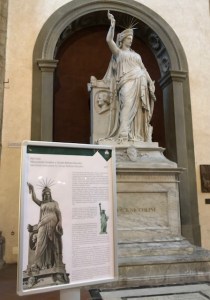
IMG_2221In a church in Florence, Italy, I discovered (along with the burial place of Michelangelo and Marconi) a statue that very well could have been the inspiration for the French gift of the Statue of Liberty. Softer, more feminine, but amazingly similar!

And for a contest, I once wrote a short story about an immigrant man who loved “another woman.” His wife was heartsick as he visited her often and sighed in admiration for her beauty. It was a happy day for her when she discovered her husband’s ‘love’ was “Lady Liberty.”

Peace

Usually, unless you are writing Literary Fiction, your stories will end with some sort of resolution, some sense of justice done or won, and things restored to a peaceable if not perfect situation.

Usually there are many struggles and conflicts that your protagonists must face in your mystery or romance or adventure. Horrible things happen to them (at your hand), but at the end? Law and order reigns, and your readers can sigh in relief. (And maybe write a cool review!) Peace in a story or in a country is worth the struggle.

***

As we celebrate the Fourth of July with fireworks, hot dogs, macaroni salad (Yankee Doodle called that feather in his hat, macaroni after all) and red, white, ‘n blue paper plates, streamers and clothing, remember to look around for possible story ideas or characters who would die for their country … and the villains who will try to make sure they do.

God has blessed America so much! Be a writing patriot.


stars


Teaching Writing in Africa

Ah, the stories they tell!

IMG_0643MeTeachOn a recent short-term mission trip to Malawi for my church, I had the opportunity to teach Writing classes to two groups of home schooled MKs (Missionary Kids). These were children from American, Canadian and South African families. There were nine in the 3rd-4th grade group and seven in the 5th grade and up group.

Two years ago I taught most of these kids “How to Write A Short Story.” Their creations were marvelous, and in fact, I posted some of the stories on my blog, Here’s How It Happened. (See the mystery, “The Tay Diamond”,  the action-packed, “The Adventures of Timmy, the Squirrel”,  and the creepy, Twilight Zone-esque “The Mirror”)

IMG_1133Booklet coversAfter reviewing the stories and talking to the other home school teachers, we all agreed that the kids needed help in character development. The action was amazing; the worlds they created were vivid, but the heroes, helpers, and villains were flat and hard to imagine.

This would be my topic then. I prepared workbooks for each of the classes. We did some work in them in class, but there were “homework” assignments for them to do at home as well.

IMG_0645MeTeach Young classBefore I arrived I asked that the kids (both classes) bring the first several paragraphs of a story they had written to class. In class, I had them each read their paragraphs aloud.  There were Captain Jack, Commander of a Starship, twin girls named Peace and Harmony, and a 20-year old girl named Ella who wanted to become a princess (and a dozen others).

I asked the listening students how they “pictured” each of these characters. There was either confused silence or vague and differing descriptions.  I then asked the authors to describe how their characters looked in their own mind’s eye. They came up with a lot of colorful descriptions that were not in their stories. Suddenly they “got the picture,” and from there I showed them ways and examples of taking the images of their characters from their minds and putting them on paper for their readers.

IMG_0640MeTeach Micah,TylerFor the younger class, I had them draw in their workbooks a circle for a face, then slowly add features (eyes, nose, mouth, ears, hair) and write a description of each as they went. Next they drew bodies with any kinds of clothes and shoes (or not) they wished.  I had them write why these “characters” were smiling, wearing… glasses, a soccer jersey, a swim suit, a long dress, a tutu, and had on sandals or swim fins. They began to see how to show what their story characters looked like by writing descriptions, and in the process developed more interesting information about them.  (I could see “light” dawning in their eyes!)

We talked about what a boy’s face and posture would look like if he were angry, sad, or excited, and how to describe that in words.  Then I had volunteers come to the front and walk like someone angry, sad, sick, old, or excited. The class called out descriptions of the body movements (facial features, arms swinging, shoulders slumped, stumbling, skipping, marching etc.) that portrayed the emotion.  Suddenly they began to see how they could “show” these actions in their stories instead of simply “telling” the reader that the character was sad or happy.

We talked briefly about similes (and metaphors for the older group). Wow, did they come up with some doozers! At this point I had to remind them not to overload the story with these, but to sprinkle in descriptions as the story progressed in action or conversations.

Character traits 71T4QNm+soLNext, we had fun with thirty-six Character Trait cards (ten seen at left) that I purchased from Amazon.  I had them each choose a positive trait and a negative trait and to explain their choices. I asked them to describe the animals in the picture illustrating the trait.  We talked about how they could write about the kind of person (animal) their character was by using these traits (such as, mischievous, responsible, persistent, mean, honest, loyal, etc.)

As an exercise I had them use these two opposite traits and write a short paragraph in their workbooks, describing how that character trait would look in actions.  “Harmony was dishonest because she….. or  Timothy was peculiar because he….”

For another exercise, I had them draw a large “T” diagram on one page, labeling the left side “What a character looks like” and the right side” How a character behaves.”  They made a few comparisons from their own story characters. At home, they would make more of these diagrams and fill them in for other characters, or ones from books they liked.

IMG_0654 Older writing classFor the older class (all boys, and most writing sci-fi or fantasy) we delved a bit deeper into making their characters memorable by using various ways to describe physical as well as personality traits. They practiced describing a character in an action scene (showing fear or bravery without actually using those words) and played around with using an occasional quirk, flaw, or unconscious mannerism to reveal hidden traits.

We talked about body language and how personal beliefs and moral standards could affect their characters actions and words in certain situations.  These t’weens and teens also enjoyed acting out emotions and physical limitations while the rest of the class called out descriptions. It’s a great exercise in noticing small things and putting them into words. Their favorite was imagining a large magnet across the room, and a piece of iron stuck on various parts of their body (forehead, stomach, etc). They were to show being pulled by that force and trying to resist. (Some were hilarious!)

IMG_0651MeTeach MatthewIMG_0653MeTeach AndrewThese boys also wanted to read from their stories, using some of the descriptions they’d learned inserted here and there.

I think they got it! By George, they got it!  

(I can’t wait to read the complete exciting, imaginative tales!)

At the end of the two-hour sessions, I sent both groups home with assignments to sharpen their skills. Hopefully they will follow through and I will have a new pack of stories to post on my blog, with characters you can clearly imagine, love, or love to hate.

I love these kids, and I really had fun…. as you can see!

IMG_0667MeTeach fun


Post Script:  I used several limericks in the classes, to illustrate teaching points, add humor, and keep the class attentive.  One of the kids in the older group took one of these limericks, combined it with a vocabulary assignment from his home school writing class and came up with a HILARIOUS story – The Virtuous Walking Fish.  Check it out too, and leave a comment for Jacob K.