by Jackie Houchin
(**See disclaimer at the end)
Ahoy there Maties! Have ye sailed the Seven Seas yet? What’s stoppin’ ye? Oh… murder! That!
In January my Hubby and I went on the most amazing 15-day cruise from Florida to Los Angeles by way of the Panama Canal.
What made it amazing?
 The Canal transit, of course!! (#1 on Hubby’s bucket list), But the perfect sunny weather, the deep blue sea(s), the small, uncrowded ship (just 670 passengers), the funny and very personable Captain, the amenities (food, lounges, gorgeous library, spa, pool, Internet café, crafts & games, casino, theater), our beautiful cabin with a balcony (oh, the views!), breakfast in bed, the lack of crowds and lines, the cool excursions in Aruba, Costa Rica, and Chiapas and Cabo San Lucas in Mexico were all definitely fantastic.
 (Yes, we are in our 70’s, but we had a blast zip-lining in the Rain Forest!)
If EVER you go on a sea cruise, be sure to book passage on a small ship (unless you have kids). The Princess line has only one, and the Oceania Line has just three. And yes, they can and do travel around the world in 111-195 days. (I’m still dreaming of that!)
 Imagine, if you will, 4-6 months in luxury, with everything taken care of for you, the occasional excursion ashore, time spent in one of several lounges or the library or your room, even out on the balcony with a laptop, with a bunch of characters eager to do malice, and a twisted mystery plot to direct them!
Yep, I could write a book on a World Cruise.* (sigh) Oh, yeah, writing and books, that’s what this blog is about…
Since we’ve come home, I have noticed the abundance of mysteries aboard ships. There are the dark ones like The Poseidon Adventure by Paul Gallico, Dangerous Crossing by Rachel Rhys, The Woman in Cabin 10 by Ruth Ware, Birds of Pray by J.A. Jance, and Death on The Nile by Agatha Christie. (Perhaps you’ve read a few.)
On Goodreads, there is a list of 47 Cruise Ship mysteries/adventures for Young Adults and Kids, including some with the new Nancy Drew and Hardy Boys, and the Boxcar Kids.
And of course, the cozy and humorous mysteries; Killer Cruise by Laura Levine, Cruising for Love by Tami Cowden, Princess Charming by Jane Haller, and Murder on the Oceana by Elizabeth Martin. Whew!! With all that written murder, mystery, and danger, I can see why you might be hesitant to walk up a ship’s gangway.
 But what about on OUR cruise ship, the Pacific Princess? I asked the Capitan Paolo Ariggo several questions during our two weeks, but one of them was about this topic.
“I’m a part-time mystery writer, and I want to know, does the ship have a morgue and a brig?”
He grinned and in a very soft voice said, “Ahhh, yes. There are two refrigerators that could be used for that…” then in a normal voice, “but a brig, what is this?”
“A jail,” I said.
“No-o-o,” he said with that Italian accent and a quick shake of his head.
“So where would you keep a prisoner until the ship docks?”
Silence, then, with a laugh, “In the Captain’s quarters!”
(Yeah, right.)
The seasoned passengers were more forthright. One related this story.
“On the world cruise we took two years ago, there was a murder. Late one night on the pool deck (#10), a man and a woman, obviously drinking, had a loud argument. The man (he was quite large) back-handed the woman. She fell to the deck and lay still. He thought she was dead! (she wasn’t). So he picked her up and threw her overboard. BUT she landed on top of one of the life boats. She did die that time. They found her body the next day.
“They searched the ship. Everyone was called to their muster stations. We had to wait there until he was found. It was two hours! And when we docked in Aruba no one was allowed off the ship until the police had come and taken him away.”
Wow.
Another told of a husband being poisoned to death. They thought it was the wife.
I bet you writers are thinking of possible crimes now that could be set aboard a cruise ship. What would be YOUR angle? How would it happen? Would it lead to other murders? Would a passenger become the sleuth, or would there be a retired/recovering detective aboard? And… who would be the killer?
 Right now, I’m reading an ARC (Advanced Reader’s Copy) of a cozy mystery for review, Bonbon Voyage by Katherine H. Brown about the Chef being murdered. (Oh, no!!)
And I’ve recently reviewed Death on the Danube by Jennifer S. Alderson which you can read here. Review on my Here’s How It Happened blog This one was a river cruise.
After the BonBon book, I’m looking forward to reading The Cunning Cruise Ship Caper by Sally Carpenter, and the humorous “geezer-lit” mystery, Cruising in Your Eighties is Murder by Mike Befeler.
How about you? What is on your TBR pile? Have you got a mystery or memoir set on a cruise ship? Or… perhaps you know a dark true tale that could be made into a short story or book?
Well, dive right in! Launch that story! All aboard!
(Disclaimer: First of all, this seems like a very untimely post. I am so sorry about the unfortunate cruise ship in Asia and the number of sick people on it. I pray all those among the 3,500 passengers plus crew will recover soon. But please don’t let that stop you from an ocean voyage in the future!)
*A 111-day cruise on the Pacific Princes in a balcony cabin like ours begins at $60,000 double-occupancy.

 Here’s a suggestion for wannabe authors. You’ve pondered that writing project for years; now you have time to get those ideas down on paper (or computer, or recording device). What would it take to turn that dream into a manuscript?
 I’ve opened membership to this site on a temporary basis. Here’s a place for you to learn about the author’s journey from “aspiring” to “avid.” Find out how to improve your writing, where to market your work, and ways to research trends in the industry. Get questions answered from an author who’s been there.
 I’m a semi-retired college English instructor and published author with a doctorate in English composition. I self-published the Self-publishing Guide in 1979 and went on to self-publish print versions of a mystery series and several non-fiction books. I’ve given workshops through libraries, bookstores, writers organizations, and continuing education departments and have written for writers’ newsletters, homeschooling blogs, inspirational magazines, and publications such as the Des Moines Register.
 Apologies. I’m late with this blog. But… well, as I’m sure all of you reading this know, life is different now from what it’s been.


 The event is the largest annual gathering in America for writers and fans of traditional mysteries in the genre of Agatha Christie, which places them in a genre called ‘cozy.” It appears that publishers here prefer authors to be strictly categorized into the type of book they write: romantic suspense, noir, thriller, psychological suspense, hard-boiled, legal thriller, historical, private investigator, cozy, police procedural, and sub-genres such as a sci-fi and the newest, cyber-crime mysteries.
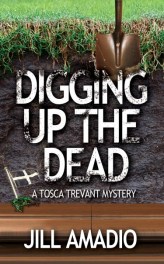 The second book in my series, “Digging Up the Dead: A Tosca Trevant Mystery” was published just in time for this premier annual event. My main character hails from Cornwall and comes to live in Newport Beach, like me, so the “Fish Out of Water” panel was perfect for us both. It was fun to explain to the audience that Tosca Trevant, a London gossip columnist (me too!) had rattled the royals by discovering yet another scandal at Buckingham Palace. This led her editor to re-assign her temporarily to America. Cussing mildly in the Cornish language, and coping with a culture that sees no need for a teashop on every corner, the meddlesome, outspoken and humorous Tosca turns amateur sleuth when she stumbles upon human remains in a neighbor’s garden, in the best Miss Marple tradition although Tosca is a younger version.
 She was instantly contradicted by a voice behind my chair shouting out, “Yes! You did know!” The voice was male and sounded exactly the way I had described his gravelly voice in a previous chapter. I swung around, dumbfounded. Of course, there was no one there and no one else was in the house. Some writers say their characters often take over their role in a book but this was different. Sam spoke a line of dialogue that added another dimension to the plot. It worked well, surprisingly, giving an extra twist to the story. I didn’t hear from him again nor from anyone else I created so I guess he and the others were satisfied with how the plot was progressing.


 In closing, I have a request for writers in this group.
 A Pretty Little Plot
 The Stolen Star
 A Daughter’s Doubt


 Then there’s Romance Writers of America. It’s in San Francisco this year, and I’d certainly planned to go there, only… Well, things have changed in the entire organization. It’s been rocked by a scandal involving discrimination issues. I haven’t entirely followed all the changes and nuances, but a lot of people in charge have been ousted from their positions or resigned, and even a lot of members have decided not to renew their membership, even though the discrimination issues will hopefully all be addressed–and eliminated.
 So, instead of four conferences this year, I doubt I’ll attend any.
 My writing has matured over those thirty years, as has my heroine. Granted, when introduced in my first book, she was “almost eight”, so her voice and thoughts had to reflect her age. However, the book was meant for adults, therefore it had to present the story at a more mature level. Much of the storyline and the tension springs from a child who’s unable to fully understand her situation and an adult audience who clearly can.
 Mike McNeff introduced his hero Robin Marlette in GOTU (pronounced Got-U, it’s short for Guardians of the Universe). His action/adventure series features a covert ops team that has to balance work with home life. Mike’s currently writing the fourth book in the series. When I asked him how his characters have evolved over time, he decided to let Robin speak for himself:
 What began for Heather Ames as a stand-alone novel turned into a deftly blended mystery, suspense and romance series featuring Detective Brian Swift and socialite/club owner Kaylen Roberts (due in part to encouragement from some members of this blog). Ames says, “My characters have evolved from two people who didn’t even trust each other enough to share confidences into two people who have been trying to work through various challenges. They weren’t sure they could work things out by the end of Book one, but they both wanted to try.”
 Pat Kelley Brunjes traveled a similar route with her characters as I, opening her series with a story loosely based on her family history. In her first novel, The Last Confession, her protagonist serves as a stand-in for Brunjes. “Maggie was me seeking to find the truth about my grandmother’s relationship to the Catholic Church.” Although based on her research, she fictionalized the story, which allowed her to take Maggie in a non-biographical – and more dangerous – direction. In the sequel she’s writing, her heroine gets entangled in a cold-case murder and human trafficking. “In the second novel, Maggie has evolved into her own person dealing with what fate has thrown her, and how her personal beliefs guide her decision to help others.” Having given herself the freedom to step away from semi-autobiography, Brunjes will have much flexibility in plotting future entries in the series.
 Avis Rector faces a unique challenge in writing her historical fiction series, based on the early life of her family on Whidbey Island. In her first book, Pauline, the heroine and her husband settle on the island during the Depression. “So much of the first Pauline was based on my memories of the stories I heard as a child from my father who loved to tell stories—usually real happenings, but many embellished.” However, in her sequel, the story moves into the 1940’s, a time Rector lived through. She’s having to reinterpret her childhood memories through an adult’s perspective. “Actually, I’m having a hard time writing how the adults felt about the time. Pauline has changed.”


 “Ideas had space to roll around in my head,” she said. “My thoughts were uninterrupted. It was divine. These days the life of a 21st century writer are frantic, a pressure cooker requiring one to write reviews, connect with fans and friends, and try to stay in the game. ”
 Jill Amadio is from Cornwall, UK, but unlike her amateur sleuth, Tosca Trevant, she is far less grumpy. Jill began her career as a reporter in London (UK), then Madrid (Spain), Bogota (Colombia), Bangkok (Thailand), Hong Kong, and New York. She is the ghostwriter of 14 memoirs, and wrote the Rudy Valle biography, “My Vagabond Lover,” with his wife, Ellie. Jill writes a column for a British mystery magazine, and is an audio book narrator. She is the author of the award-winning mystery, “Digging Too Deep.” The second book in the series, “Digging Up the Dead,” was released this year. The books are based in Newport
 Try the classics. Try some older writers. Try a new writer and hope they have something clever or interesting to say.


You must be logged in to post a comment.