
by Jill Amadio
Having celebrated the New Year a few days ago I am still curious about one of its major symbols, Father Time.
Appearing in books, paintings, music, film, television, and even as industry logos, Father Time is often depicted as a character with his murderous scythe and/or an hourglass. Such images have been used to remind a reader that Time is a potential murder weapon with the hours running out for a victim, or signifying an imminent arrest.
Time.
It rolls along inexorably despite any means we employ to stop it. But wait! Writers sometimes change Time not only in their fiction but even in non-fiction that one expects to be factual and pure.
How often have you read, “Within three short weeks the memoir was finished.” or “It was the longest hour she had ever spent in his company.” What do these Time phrases mean? What is a short hour, 44 minutes? Or a long year, 15 months? How about this recently published mystery wherein the author blithely bent the passage of Time with: “She knew the hours would pass more quickly if she went to a movie…” How could this be? Obviously, it was her perception in play but seconds, minutes, weeks, months, years, and decades pass at their own pace despite anything we can do to speed it up or slow it down.
In his Rubaiyat, Omar Khayyam wrote one of the most dire warnings about Time: “The moving finger writes, and having writ, moves on. Nor all the piety nor wit can lure it back to cancel half a line, nor all they tears wash out a word of it.” However, a clever writer can give the reader an impression of a faster or slower passage of Time through tension, the building of a scene, or a change in writing style with short sentences, even a single word.
In my favorite, faithful much-thumbed 1,350-page Roget’s International Thesaurus, of which I receive the latest edition every five years as a Christmas gift, there are pages and pages devoted to definitions for Time including Duration, Instantaneousness, Perpetuity, Interim, Anachronism, Infinity, Transience, and, rather oddly, Regularity of Recurrences, and a section devoted to for Previousness (Roget’s heading, not mine, which my Spellcheck rejects), plus many more. In fact, a cornucopia of ways to express how Time moves along at its prescribed pace in any situation and circumstance.
How do we live in borrowed Time – what does that mean? We cannot borrow, stretch, shorten, nor cut Time in its literal sense yet we bandy about this commodity as if it were taffy.
Shakespeare took liberties with Time in dozens of plays and called it a “common arbitrator” and, “a bald cheater’ which I prefer to read in its literal sense although he didn’t intend it that way. The Bard was also the first, I believe, to coin the phrase that Britain’s prime minister, Neville Chamberlain borrowed centuries later when he intoned in 1938 there would be “peace for our time.”
How about this one: ‘Time is of the essence.’ Taken verbatim causes one to wonder, which essence? Frankincense, rose water, or perhaps orange peel? Or do we wish to convey that Time is urgent? If so, why not say so with description to match the action.
Metaphors are wonderful but sometimes they can convey a meaning that the author did not intend, or missed an opportunity to raise the stakes. How often have you read, “Time and again she pulled on the chain/rope/handcuffs.…” Would the reader enter into a precise Time frame more personally and feel the victim’s agony and persistence more clearly if the sentence read “after six desperate attempts pulling on the chain, she…
All of which reminds us to remain disciplined because – Time is honestly and truly running out! Do you have a secret method for trying to cheat Time?
Happy New Year, everyone! Do not waste a minute of this brand new year. Write!
#
Jill Amadio is a mystery writer, novelist, journalist, and ghostwriter. She writes a column for the UK-based Mystery People magazine. Her standalone thriller, “In Terror’s Deadly Clasp,” is based on a true 9/11 story, and her memoir of Virginia Bader chronicles the pioneering of the aviation art movement in America. Amadio co-authored a posthumous biography of the singer Rudy Vallee, and ghostwrote a crime novel. She was a reporter for the Bangkok Post, Gannett Newspapers in New York, and the L.A. Daily News, and has written for Conde Nast, Newsweek, the Los Angeles Times Sunday Magazine, Motor Trend, Air Classics, and other publications. Her award-winning mystery series features an amateur sleuth from Cornwall, UK, Amadio’s former residence before relocating to California and Connecticut. She is a member of Sisters in Crime, Mystery Writers of America, and the Authors Guild. Visit Jill’s Website

…

 What is it like to sell 10 million copies of your books? I found it mind-boggling until I recently watched the Jackie Collins documentary. She sold 500 million copies of her 32 novels. But, hold on, Barbara Cartland wrote 723 romances and sold over a billion of them.
 Mystery writers are often asked how they decided to choose not only the genre but the plot itself. My revelation for my debut novel came about when I moved to the United States. I’d been a reporter and figured on continuing in that profession forever. I loved it. However, life has a way of setting one down a different path than planned.
 Books, books, books.
  Many writers I know run out of bookshelf space and begin piling books on the floor or finding nooks and crannies to fill. One client for whom I ghostwrote a biography kept a small shelf of paperbacks in her bathroom as many people do. I spotted another who had a penchant for refusing to return library books and not even bothering to removing their old category tags.
 Perhaps paying a visit to your own bookshelves will reveal a treasure you had forgotten. I wish I had bought a book I found at an airport gift shop in Jakarta. It was bound in beautiful red leather and titled “Sukarno.” I opened it up and every page was blank. I guess the publisher wanted to titillate buyers before the Indonesian leader passed away and there would be no repercussions about his controversial reign while he still lived.
 While her methods eventually result in catching the criminals, her way of operating tends to irritate her bosses and, once again, she is shipped off to another state. Montana, long known as home to private militias and survivalists, also has more than its share of grizzly bears. But why are they being killed along with several Native Americans? A KILLING SEASON provides a dazzling backdrop to the puzzle.
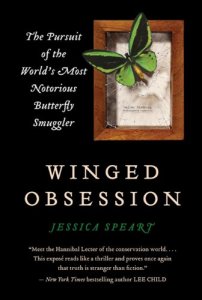 “It deals with an actual case that is so crazy no one would believe it if I wrote it as fiction,” she said. “A Japanese national began prowling around America’s national parks. One butterfly he chased was the Apache Fritillary, catching 500 of them and shipping them back to Japan to sell.”
 After BLUE TWILIGHT went on sale a small group of butterfly collectors felt she had attacked them, and, in turn, began attacking her.
 A leggy wildflower of a girl, teenage Sofia runs away from rural Oregon to big city Portland where she meets and marries a charismatic Saudi Arabian later known as 9/11 hijacker #13. While a slumbering America embraces feng sui and pizza she is present when terrorist sleeper cells are organized in her home, maps of landmark buildings, airports, and bridges are studied, and teams of recruits take flying lessons.






 The Writers in Residence
You must be logged in to post a comment.