Reading For Writers

By Maggie King

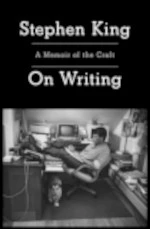
“If you want to be a writer, you must do two things above all others: read a lot and write a lot.” – Stephen King, On Writing: A Memoir of the Craft

Some writers disagree with Mr. King’s reading advice. They fear that by reading they’ll be influenced by other author’s voices, thus compromising their writing.  Mr. King has this to say about that choice:

“You may find yourself adopting a style you find particularly exciting, and there’s nothing wrong with that. When I read Ray Bradbury as a kid, I wrote like Ray Bradbury — everything green and wondrous and seen through a lens smeared with the grease of nostalgia. When I read James M. Cain, everything I wrote came out clipped and stripped and hardboiled. When I read Lovecraft, my prose became luxurious and Byzantine.”

Whether you agree or disagree with this renowned author’s view, you can’t deny his success.

Stephen King has more advice on the subject of reading in this article from VPM. His bottom line: “If you don’t have time to read, you don’t have the time (or the tools) to write. Simple as that.”

Joyce Carol Oates, another prolific and respected writer, also encourages writers to read. I took a Masterclass course she taught and will never forget her suggesting that we read Ulysses! “If you read Ulysses by James Joyce, for example, chances are your vocabulary will improve (or, if nothing else, you’ll want your vocabulary to improve). Your work won’t necessarily come out sounding like his, but your process will be informed and elevated by him.”

More than once, I tried reading Ulysses and never made it past the first chapter. Ulysses was penned in the stream of consciousness style, a technique used to look inside a character’s mind and examine their every thought, action, and motivation. Other authors who used this style are Virginia Woolf, William Faulkner, and Toni Morrison. It is not a style that appeals to me, but I did enjoy Mrs. Dalloway. Perhaps I found the thoughts and actions Virginia Woolf gave her main character especially interesting.

But Ms. Oates is focused on James Joyce’s vocabulary, not his writing style. I didn’t get far enough in Ulysses to enhance my vocabulary. And she only offers this author as an example. She suggests studying the ways many writers compose their sentences, how they structure their stories, and how they handle dialogue.

As for James Joyce, I suggest reading The Dubliners, a fine collection of his short stories. They are not written in the stream of consciousness style. I took this on my trip to Ireland many years ago.

Masterclass offers courses on a variety of subjects. For writers, I highly recommend Joyce Carol Oates’s class on short story writing (I think her course works for novels as well). Here’s the link.

Many, if not most, writers read widely. Over the years, I’ve read classics, short stories, literary fiction, non-fiction, plays, bios, romance, and, of course, crime fiction. What I read is high-brow, low-brow, and everything between. Recent favorites are Lion Women of Tehran by Marjan Kamali, Lula Dean’s Little Library of Banned Books by Kirsten Miller, Miss Marple, The Complete Short Stories by Agatha Christie, and Betty Hechtman’s series of crochet mysteries.

Writers, do you read widely? What are you reading now? What are your thoughts on the stream of consciousness style?
Big Words, Bad Words

By Maggie King

Many years ago I read a mystery with so many words I didn’t know that I had to keep my dictionary close at hand. As I enjoy learning new words I liked the experience the popular author provided. But when I mentioned it to a couple of friends, they said, “Not me. I’d have put that book down, and fast. I want to read words I already know.”

I’ve always had a love of words. I fondly remember vocabulary lists in high school: perspicacious, truculent, vapid, loquacious, polemic, specious, logy. With all those big words swirling through my brain, you’d think my SAT scores would have been more impressive than they were.

When I presented my manuscript for Murder at the Book Group (my debut, published in 2014) to a long-ago critique group, the members advised me to ditch the big words. “What big words?” I asked, bewildered. They named a few but the one that stuck with me was “diatribe.” I didn’t consider diatribe a big word and it would surely be understood in context, as in “Arthur ignored his mother and carried on with his diatribe against Evan.”

The upshot was that I kept diatribe, but changed some of the other “big” words.

A word I recall from reading Nancy Drew was “elated,” as in “Nancy was elated by the news.” The context wasn’t clear, so I ran to the dictionary and learned that Nancy was ecstatically happy by the news. Elated is a wonderful word to teach a ten-year-old.

One of my favorite books on writing is On Writing: A Memoir of the Craft by Stephen King. In the book, King says, “Wherever your vocabulary is at today is fine. There’s no need to learn more words or different words. Whatever words you know right now, you use. This will help you develop your voice and sound unique.”

Is using big words in a story a good idea? In my opinion, the answer is yes—as long as the writer chooses words whose meaning and context is easily understood. A thesaurus is a great tool, but don’t use it to come up with words you think sound cool and sophisticated. Readers have a wide range of word knowledge but even those with an impressive vocabulary feel that showing it off is pretentious.

To sum it up: use your best judgment.

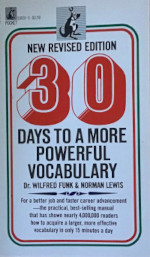
In the meantime, I’ll hang on to my precious dog-eared copy of 30 Days to a More Powerful Vocabulary and see how many of the words I learn end up in my writing. Ceraunophobia, anyone?

To swear or not to swear?


Do your characters swear? Do they swear too much? Not enough? Should they swear at all?

Personally, I don’t get exercised over swearing. Let’s face it, people swear—some a little, some a lot, some only when “necessary.” Swearing can add a touch of realism to our writing (after all, what does one say when tripping over a dead body?). We’ve all known colorful folks who liberally season their conversations with salty words. For one story, I created a character loosely based on a former co-worker who never felt the need to censor her speech. Not a word of it.

But my readers object to profanity and I must respect their wishes. There are ways to suggest swearing and author Naomi Hirahara is so skilled at this that you know the exact word she’s not using. Another author, F.M. Meredith, has this to say about the lack of salty language in her Rocky Bluff P.D. series: “Oh, the characters do cuss, I just don’t quote them.”

Here are ways I’ve suggested swearing in my stories: She shrieked a litany of curse words; She continued to scream and curse …; He included a few four-letter words of a sexist nature; Donna slurred a few non-PG13 adjectives to describe her feelings for her ex; Kat cursed a blue streak (I wouldn’t choose this one again, as it’s a cliché that sneaked past me and my editor).

On several occasions I’ve presented a seminar/webinar on dialogue and tackled the question of profanity. This is how I answered the question “To swear or not to swear?”:

• Know your reader and your genre. Cursing and four-letter words are more acceptable in a thriller than in a romance or a cozy mystery.
• Refrain from profanity in narrative, but an occasional expletive in dialogue is acceptable (depending, of course, on genre).
• Realize that profanity is more noticeable in a novel than it is in real-life conversation.

Again, use your best judgment. And ask your beta readers for feedback.

Your thoughts?

Making Your Words Count

I went to a gathering of local writers from Devon and Cornwall last week. Although I have been living back in the UK for five years, I have been a bit of a recluse. A lot had to do with Covid and the self-enforced isolation that seemed not only to curb my freedom, but my confidence too. It’s only now that I am slowly putting out feelers and making new writer friends.

Anyway, about twenty of us met in a lovely restaurant in Exeter and I found I was sitting next to a writer who epitomizes the word “prolific.” I won’t list the number of books of all genres (from Sci-Fi to Romance and non-fiction to ghost writing), that she churns out annually but what stopped me in my tracks (actually, I almost choked on my Halloumi fries) was her goal to write HALF A MILLION WORDS a year. And she casually said she usually comes close.

My first thought was that she had to be a robot. My second, maybe she uses ChatGPT, or maybe she’s a “first line writer.” I use that phrase because my former husband wrote for a TV show and was once accused of being a “first line writer” which upset him greatly. For those unfamiliar with the term, it’s an insult literally saying, “writing the first thing that comes to mind.” I did ask my new writer friend (who was also very nice which made it hard to dislike her) her process. Was she a Pantzer? Did rewriting, editing, and proofreading count towards the magic 500,000 words but nope, I was assured her words were all brand new.

So what’s wrong with me? If I’m lucky, on a good day, I could write nine hundred new words. I’ll probably go back and rewrite them a few times. My books under contract ask for 70,000 to 75,000 words (relatively small if you are used to 80,000 and above). Once, I wrote two books in one year so that topped at 140,000. I never used to be obsessed with my word count until that lunch.

To make myself feel better, I did a bit of research. In my defence, I still have a full-time job, a sick mother, two demanding dogs and – fanfare of trumpets – I’ve just become a grandmother for the first time … so I’m a little busy.

Even so – here are a few famous authors and their daily word counts.

  • Tom Wolfe: 135 words. As you can imagine, each book takes a very long time to write.
  • Ernest Hemingway: 500.
  • Graham Greene: 500. He said that when he has written his 500 words, he stops – even if it’s in the middle of a scene.
  • Ian McEwan: 600.
  • W. Somerset Maugham: 1,000. Maugham said there was no set formula on writing. “There are three rules for writing a novel,” he said. “Unfortunately, no one knows what they are.”
  • Peter James: 1,000. Once you start writing a book, make time to write every single day. Find a comfortable number of words for you to write each day and stick to that number. I am comfortable with 1000 words.
  • Margaret Attwood: 1,000-2,000.
  • Mark Twain: 1,400 to 1,800. Twain believed that location was important to his word count. I write very well on transatlantic flights, so I think he has a point.
  • Lee Child: 1,800. He says it takes him about six months from the first blank screen until the end.
  • Stephen King: 2,000. As a side note, if you haven’t read his book On Writing: A Memoir of the Craft, or you haven’t read it for a while, it’s worth revisiting. Stephen says that following this would add up to about 180,000 words in three months … well on track for the annual 500,000 goal but what about rewriting? Speaking of Ernest Hemingway, he famously said that “All writing is rewriting.”
  • Nicholas Sparks: 2,000. He says his is a daily goal which takes him about five or six hours to write.
  • Anne Rice: 3,000.
  • Arthur Conan Doyle: 3,000.
  • Michael Crichton: 10,000. Okay, this one got my attention. He’s up there with my new writer friend.

POSTSCRIPT: Okay … yesterday I was part of an event at the Torquay Museum called Crime at the Coast – sitting next to me was another prolific author who writes four, 70,000-word cozies a year, screenplays for her TV job and a standalone. I didn’t have the courage to ask her if she topped half a million words a year but one thing is certain, I’m just desperately slow.

So … what about you? Do you write to a daily word count?