A Woman in Journalism – Nellie Bly

by Jackie Houchin

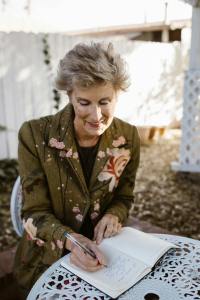
(Note to self: Use this article as a base – review two books written about her – “Ten Days In A Madhouse” and “Nellie Bly & Investigative Journalism for Kids.”  Fill in info from other sources, use the three photos (her in 1890 and the book jackets.) )

Eighteen-year-old Elizabeth Cochrane was living in Pittsburgh when the local newspaper published an article titled “What Girls are Good For” (having babies and keeping house was the answer, according to the article). The article displeased Elizabeth enough that she wrote an anonymous rebuttal, which in turned so impressed the paper’s editor that he ran an ad, asking the writer to identify herself.
When Elizabeth contacted him, he hired her on the spot. It was customary at the time for female reporters to use pen names, so the editor gave her one that he took from a Stephen Foster song. It was the name under which she would become famous—Nellie Bly.
Bly’s passion was investigative reporting, but the paper usually assigned her to more “feminine” subjects—such as theater and fashion. After penning a controversial series of articles uncovering the working conditions of female factory workers, and subsequently being assigned once more to cover society events and women’s pastimes, at the age of 21, Bly embarked on a hazardous and unprecedented (for a woman) mission to Mexico to report on the living conditions of the working-class individuals there.
After her reporting got her in trouble with the local authorities, she fled the country and later published her dispatches into a popular book.
At age 23, having established a reputation as a daring and provocative reporter, Bly was hired by Joseph Pulitzer’s New York World and there she began the undercover project that made her famous. In order to investigate the conditions inside New York’s “Women’s Lunatic Asylum,” Bly took on a fake identity, checked into a women’s boarding house, and faked insanity—so convincingly that she soon found herself committed to the asylum.
The report she published of her ten days there was a sensation and led to important reforms in the treatment of the mentally ill.
The following year Bly undertook her most sensational assignment yet: a solo trip around the world inspired by Jules Verne’s Around the World in 80 Days. With only two days’ notice, Bly set out on November 14, 1889, carrying a travel bag with her toiletries and a change of underwear, and her purse tied around her neck.
Pulitzer’s competitor, the New York Cosmopolitan, immediately sent out one of its reporters—Elizabeth Bisland—to race Bly, traveling in the opposite direction. As Pulitzer had hoped, the stunt was a publicity bonanza, as readers eagerly followed news on Bly’s journey and the paper sponsoring a contest for readers to guess the exact time of Bly’s return (with the correct guess winning an expense-paid trip to Europe).
Seventy-two days later, Bly made her triumphant return (four and half days ahead of Bisland), having circumnavigated the globe, traveling alone almost the entire time. It was the fastest any human had ever made the journey. Nellie Bly was an international celebrity.
At age 31 Bly married industrialist Robert Seaman, a 73-year-old millionaire, leaving behind her journalism career and her pen name. As Elizabeth Cochrane Seaman she helped run the family business. She patented two inventions during her time as an industrialist, but business was not her really in her skillset and under her leadership the company went bankrupt.
When World War I broke out, she returned to journalism, becoming one of the first women reporters to work in an active war zone.
Nellie Bly’s remarkable life ended on January 27, 1922,  when she died of pneumonia in New York at age 57.

SPRING INTO WRITING

by Miko Johnston

Ah, what a year it’s been, beginning with a harsh and, in some places, treacherous winter. So far, spring has not been much better or safer in many parts of the country. It took a long while to arrive and settle down on the West Coast. Hubby and I took a last-minute vacation to sunny Sicily to escape the cold and gloom for a few weeks and postponed our annual winter trip to LA for months until we could travel around by car instead of rowboat. Both escapes kept me away from writing for a while.

I’ve always enjoyed spring, a time of renewal, and probably more so this year after the winter we’ve been through. Thoughts turn from shoveling snow to shoveling dirt in the garden, from watching the overflowing rivers subside to marveling at the regeneration of fauna and flora.

Part of that rejoicing can include a return to writing.  Here are some suggestions to inspire you.

I           Change it up

If you’re finding it difficult to focus on your manuscript, or daunting to consider starting one, then don’t. Think about other things to write: short stories, flash fiction, a travel memoir, a chapter from your life. Perhaps a letter – yes, snail mail – to a long lost friend or relative. Buy (or make) some blank-inside cards and create your own birthday, anniversary, get well, and sympathy messages.

In short, forget about your WIP for now, but don’t stop putting words on the page. As we always say, writing is writing.

II         Revisit

If you’re writing in more than one point of view and your WIP isn’t going forward, you may have the wrong character in the driver’s seat.

I recently critiqued pages from a romantic suspense novel which had two protagonists. One chapter felt stodgy IMO, and the female came off as cold and unkind. The author had written the scenes in the male character’s point of view, so he only got to observe her behavior. I suggested redoing the chapter in the female’s POV, since she was undergoing the emotional upheaval. I felt if the reader understood what led to her bad behavior, they would find her more sympathetic.

If you get stuck, try rewriting the troublesome scene in another character’s POV.

III        Revise

One of my favorite quotes about writing has always been: “Books aren’t written – they’re re-written”. Not everyone accepts or believes that.

Some writers tend to think it’s permanent once you’ve written something. We forget that until a manuscript is published, it can always be changed. In my last book, I introduced new characters whom I barely knew. I stopped writing when Covid hit before returning to the partial manuscript a year and a half later. As the story developed I got to “know” the new characters better. With my first draft complete, I went back to their first appearance to find vague conversations and a lack of detail. Using my more intimate knowledge of these characters, I sharpened their dialogue and expanded their descriptions.

If your characters are flat and generic, get to know them better. If your opening doesn’t grab the reader’s attention, your middle sags, or your ending falls flat, rework that section until you’ve solved the problem (for suggestions and tips, search through our archives, including my BACK TO BASICS: WRITER’S BOOT CAMP series).

IV        Forget about Perfection

The opposite problem is to get locked into revisions, snipping away or changing words, sometimes back and forth, all in an attempt to make the manuscript flawless. It won’t happen. It never happens. Finish it. Polish it. Then hire a good editor who will clean up your grammar as well as plot holes. Lastly, find a beta reader, or readers, to give you an unbiased opinion. Do the best work you can, and then let it go.

Trust me, I understand how difficult it can be to carve out time to write, especially if we have no pressing need (such as a deadline from our publisher) to do it. However, remember this: you can’t call yourself a writer if you don’t write.

Now please excuse me, I have a novel to finish.

##

Miko Johnston, a founding member of The Writers in Residence, is the author of the historical fiction series, “A Petal in the Wind”, as well as a contributor to several anthologies including the about-t0-be-released “Whidbey Island: An Insider’s Guide”. Miko lives in Washington (the big one) with her rocket scientist husband. Contact her at mikojohnstonauthor@gmail.com

Slipped my mind…

Oh, no!  I was so involved with my SELF this week, that I forgot my coveted place here in the rotation for The Writers in Residence. So, this is a quickie catch-up.

HOAG Cancer Center is where I’m now spending my days – like, EVERY day – after the breast cancer surgery I had back in March.  Now I’m going through 15 days of preventative Radiation, so (hopefully) that nasty cancer stuff doesn’t come back. (At least the chances are lessened.)

Meet ELEKTA.

She’s my partner for about 15 minutes every day. She circles me like a rising and setting sun four times, shooting the “anti” death ray at my left chest area. I hear a high-pitched “zinging” noise and feel a slight warmth, but nothing else.  I thought my skin would get “cooked,” but nothing yet, just a feeling of tightness.  I thought I would experience fatigue, but also not yet. (Of course, so many people are praying for me!!)

A woman who was scheduled after me yesterday, says she is on Day 12, and the fatigue has hit her.  My Radiologist talked to me today, and when I told him I was surprised at the lack of skin burning, he said. “The sunburn will come in week three. Just keep applying that radiation cream two to three times each day.”

Believe me, I do.

That funny crunched white glob under ELEKTA’s eye on the table is a molded pillow they made when I was “mapped” for radiation two weeks ago.  It holds my shoulders, head, and left arm stretched above and over my head in the exact same position. So there’s no messing around each time I come in. The molded pillow is situated. I lay back and fit my arm and shoulders in it. They expose my left breast, line up the machine over the markers on my chest, and tell me, “Don’t move.” (Yes, I have weird PLUS and MINUS signs semi-permanently pasted on me for ELEKTA to read.)

About now, you are thinking, “Wait, I thought this was a writing blog. What’s with all this medical stuff.”  Hey, have you ever heard of Robin Cook’s books? (Coma, Toxin, Fatal Cure),  Michael Palmer (Miracle Cure), Tess Gerritsen (The Surgeon), etc.  Yes, so I know I’m not an author like them, but I AM writing about my Cancer Journey, and reviewing books that pertain to it.  I’m writing my “Journey” on Substack, and on Friday, I’ll post the next weekly update, titled “RADIATION & ME.” (You guys get a mini-sneak peek here.)

If you want to read last week’s post, here is the link, VULNERABLE  & EXPOSED. 

If that doesn’t work for you, go on Substack and search for “Jackie’s Musings & Meanderings.”  I have about thirty I’ve been writing, but the last seven are on my cancer journey. You can subscribe (but no pressure), and it’s FREE. Don’t get tricked into paying. Not needed.

So, you see, I AM writing.  Each day, I quiz the technicians on something I want to know about so I can include it in next week’s Substack post.  (And maybe the following week too, as I finish up.)

Do you have any questions or comments? If you click on the title of this post—SLIPPED MY MIND—you can find the spot below to do that.

SEPARATING CRITIQUE FROM CRITICISM

by Miko Johnston

Unlike some of you, I never took creative writing classes. Early in my adult life, thanks to dropping out of college, I floundered in various low-level clerical positions to earn my way, but writing was my dream job. By luck I got to meet a writer whom I admired, and told him of my goal. “I want to be a writer,” I said. He responded, “Then why aren’t you?” I realized I’d asked a meaningless question. I should have been more specific – “I want to write professionally”. That’s when I returned to college and eventually became a journalist. I lost that career after a car crash and five year recovery period. Still, the urge to write persisted.

About forty years ago I decided to switch to writing fiction and began working on a series of short stories based on a childhood pet, thinking they might make good children’s books. I showed them to a good friend, who knew me ‘back when’, as well as the critter in question. I thought the stories were cute, funny and clever; as the character grew up, the storylines and maturity of the writing grew with her. My friend’s reaction? “They’re terrible.” Disheartened, I filed the stories away in a drawer. Care to guess how long it took for me to write again?

Eventually I dipped my toe in the writing world once more, this time with the idea of writing a novel. I slowly built my skills by writing, studying authors whom I respected, and reading books on the subject, but mostly by participating in writers groups.

I joined an established critique group about twenty-five years ago, where I met several of my fellow WInRs. I credit the core members with guiding me though the completion and polishing of my manuscript for publication, and like most who stuck around in the group, I eventually did get it published.

I can still recall presenting Chapters 1 – 5 of what is now my first novel, A Petal in the Wind. I’d compressed what eventually became my entire novel into fifty pages. I also recall the group’s unanimous opinion: to put it kindly, not good, but they explained WHY. No character development, hardly any scene setting or sensory details, and worst of all, an unrealistic reaction by my protagonist, thereby committing the worst crime in fiction by presenting a totally unbelievable situation. Their comments were tough to hear, but I listened and took them to heart. The next time I presented pages for critique, I received a very different response.

I see now the group doubted my ability to write well, based on my initial submission, a reasonable assumption. However, the next time I presented pages, which incorporated their suggestions and advice, the revisions not only impressed them, but convinced them I could do this. Frankly, it convinced me as well. The group treated me differently from then on.

Whenever my turn for submitting pages came up, they mixed praise for the good stuff with very useful suggestions for the problematic parts. Some members had a specialty; one focused on the big picture issues, while another (okay, it was Jackie Houchin) scrutinized each word with forensic precision. The group kept me going with positive and constructive feedback until I finished my first draft. When I presented multiple premises for my follow-up book, their comments helped me find the right path forward in continuing my saga.

I also learned how to give critique. In one of my first meetings, I listened to a short story being read aloud by the writer (okay, it was Jackie Houchin), and all I could contribute was a fashionable woman wouldn’t be wearing a white in winter. With the practice that came with reading or hearing pages from other writers, and picking up clues from their critiques, I began to develop sharper skills for evaluating the good and the not-so-good, not only other’s work, but in my own.

This year I celebrate the twentieth anniversary of my first publishing contract. It would never have happened if not for the support and encouragement of my writers group. Nor would it have happened if I’d disregarded their feedback, or became so insulted by it I’d left the group.

I can take some credit for this, but much should go to the core members. They always knew the boundary line between critique and criticism. Others crossed that line, but thankfully they did not remain in the group for very long because they usually could not accept anything beyond praise for their work. Their loss.

I’ve had the opportunity to pay it forward over the years, in critique groups and through my volunteer work with a local high school creative writing class. Occasionally someone who finds out I’m a published author will ask me to evaluate their writing. The lessons I’ve learned through my groups have helped me do that in a positive, yet helpful way.

Learning the difference between criticism and critique is crucial to the process. Critique must be reassuring, especially when you’re calling out the problems in someone’s writing. Criticism is merely negative. Criticism says something isn’t good, while critique may say that but also explain why. Good critique supports the writer, and encourages them by separating the good from the what-could-be-good-if…. It’s uplifting. It pushed you forward, whereas criticism beats you down.

What if I’m asked to critique a piece that may be beyond redemption? That’s when it helps to have a few key phrases, and a list of recommended reading. I find something, anything to praise or comment favorably on, even if it’s a character’s name. I’ll pick one salvageable problem with the writing and suggest a generic solution. Perhaps there’s too much repetition, the dialog’s clunky, or the genre is unclear. I admit some writers shouldn’t be given false hope, but I needn’t be completely discouraging. I might also remind them there’s nothing wrong with writing for one’s own pleasure, or journaling about one’s life (and keeping it private).

I recently found my pet stories and reread them. Granted, many needed work, but unlike the response I got from my friend, they weren’t awful. Sad that it discouraged me for years, delaying me from doing what I always wanted to do. But I’m writing now, and will continue to do so, having learned the difference between criticism and critique.

On another note, I always love to receive and read your comments, but forgive me if I don’t respond immediately. Today’s post coincides with my 25th wedding anniversary, so hubby and I will be off celebrating. I promise to get back to you soon.

#

Miko Johnston, a founding member of The Writers in Residence, is the author of the historical fiction series, “A Petal in the Wind”, as well as a contributor to several anthologies including the about-t0-be-released “Whidbey Island: An Insider’s Guide”. Miko lives in Washington (the big one) with her rocket scientist husband. Contact her at mikojohnstonauthor@gmail.com

.

This story by Miko Johnston was posted by Jackie Houchin

NEW IDEAS, PAST AND PRESENT

by Miko Johnston

We’re barely two months into the new year, but as I contemplate what we’ll write about in the future, and what will inspire us to keep at it, I’ve found some of my answers to those questions in our posts from the previous year.

Hannah wrote about overthinking. How many of us are guilty of getting obsessive about our writing? Characters, plots and background have to be thought out, but we also must keep it all in balance. That has become harder for me to achieve, partly because age has undermined my ability to multitask and partly because my priorities have shifted. I still enjoy writing and am committed to finishing at least two more books, but I’m reminded of Madeline’s piece on Writing Scared, and the idea of switching up the type of writing you do. I’ve done that in the past, so now I’m adding a new avocation – photography.

Years of writing has given me a sense of what works and what doesn’t, and while I still rely on critiques from fellow writers, I often can figure out problems in my manuscript on my own. Not so with my new hobby. I look at a photo and I may like it, but I don’t know why, exactly, nor can I be certain it’s any good. I’ve joined a photography club and have been invited to participate in their biannual exhibit. I’m going to need a lot of critique and advice before I select which pictures I want to use.

Linda’s piece on attending writers conferences reminded me that many more may be held this year as the risk from the recent pandemic fades from our memory, if not from our lives. Will these events be successful, or will the attendance habit, having been interrupted, be broken? Costs, from registration to travel to hotels and meals, will likely be higher than we remember. I can see where some will be very selective about which they’ll attend while others choose not to register for conferences at all.

Gayle’s piece on The Future of the Written Word really resonated with me. I’m often puzzled, even shocked, by how many words have been usurped and had their meanings altered, some with additions, some with subtractions. Regardless, these 2.0 definitions have led to divisions. A lack of clarification, or precision, makes the word’s meaning, well, meaningless. I suspect if any of the worst offenders of this phenomenon were reading this, they would have stopped at usurped (insert my sarcastic smirk here).

And speaking of the written word, Jill contributed a post on a similar, if lighter, topic – the subtle differences between American and British English. With three Brits in our WinR group and many others within our writing circle, it can be a challenge.

Rosemary’s Collecting Memories touched me. While clearing out closets and shelves in anticipation of a thorough spring cleaning, I’ve uncovered a trove of precious mementos – cards, notes and letters from family and friends, some going back to my birth. Programs from bar/bat mitzvas, funerals, and other events. Menus from private supper clubs, conference galas and corporate dinners at restaurants. Each find brought back wonderful memories of the people and places I’ve enjoyed over the years. That included a copy of the dedication that went into the L.A. Library’s copy of Rosemary’s book, “Hollywood Then and Now”, in memory of her beloved husband Rick. Her post reminded me that these keepsakes – all comprised of words – and the memories they invoke, are precious, something Maggie explained so eloquently in her post based on the “a reason, a season, or a lifetime” quote.

Jackie’s interviews with writers as well as all the fabulous guest posts she’d arranged added dimension to our blog, and her piece on naming characters had many solid tips I’ve come to rely on. And I’ll add a special shout-out for all the technical help she’s provided to us, especially a technical “muggle” like me.

There are many more posts from my co-WinRs that have and continue to inspire me. I can only hope I might have had the same effect on them, as well as our readers.

Miko Johnston, a founding member of The Writers in Residence, is the author of the historical fiction series, “A Petal in the Wind”, as well as a contributor to several anthologies including the about-t0-be-released “Whidbey Island: An Insider’s Guide”. Miko lives in Washington (the big one) with her rocket scientist husband. Contact her at mikojohnstonauthor@gmail.com

Let Me Entertain You!

by Jackie Houchin

Lots of medical stuff going on with me right now, so I thought I’d simply share a fun aspect of our Alaska cruise last fall. That aspect is called MUSH.  No, not yelling at sled-pulling dogs (although we DID do that), but a different kind of Mush.

In Skagway, Alaska, I bought a small toy Husky, a beanie-bag size and shape little guy, with soft gray/white fur, big blue eyes, and the name MUSH printed on the tag. I loved the little guy from the first glimpse and perched him on my pillow in the stateroom when we got back to the ship. Joel, our cabin steward aboard the Oceania Regatta ship, loved Mush too.

When we left for dinner in the evenings the steward would come in to straighten up and turn down our beds. When we returned later, we found the usual chocolate candy on our pillows, AND…..Mush, posed in a series of so cute antics. The first time, he was propped on a pillow with the TV remote, watching a football game on the screen.

Another time he was standing on an open book (that I’d been reading), as if he were reading too.

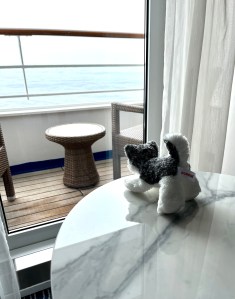
Once when we came back from an excursion ashore and after we’d had lunch at the buffet, we found him on our small room table with the curtains draw slightly, looking out at sea.

And then, every evening HE started getting chocolate candy too, an additional piece placed between his paws. We were absolutely delighted.

Of course “I” started posing Mush for Joel too when we went out for the day, hiding him where the pitcher of ice water was kept, or behind the desk alarm clock, or sometimes just lying on the bed, his head tucked in and front feet up, waiting for a belly rub.

We had such fun with Mush and our very good and so kind cabin steward.  Another sweet memory.  And now, Mush resides on my dresser at night, guarding my glasses, and sometimes on my pillow during the daytime.  (But he’s on a diet now – no chocolate.)

##

Maybe I could write a cute kid’s story starring Mush on an ocean cruise. He could meet friends, find a missing object, solve a mystery, or rescue someone in danger.  Now that’s an idea!! Mush and I might have to put our heads together and come up with a plan!

SHADOWS OF THE PAST

 by Miko Johnston

My first book, A Petal in the Wind, begins a family saga that encompasses a half century. As each subsequent entry in the series carries a subtitle, my fifth and last book, which I’m writing now, will be called Shadows of the Past.

That phrase took on new meaning recently when my husband Allan and I traveled to Europe.

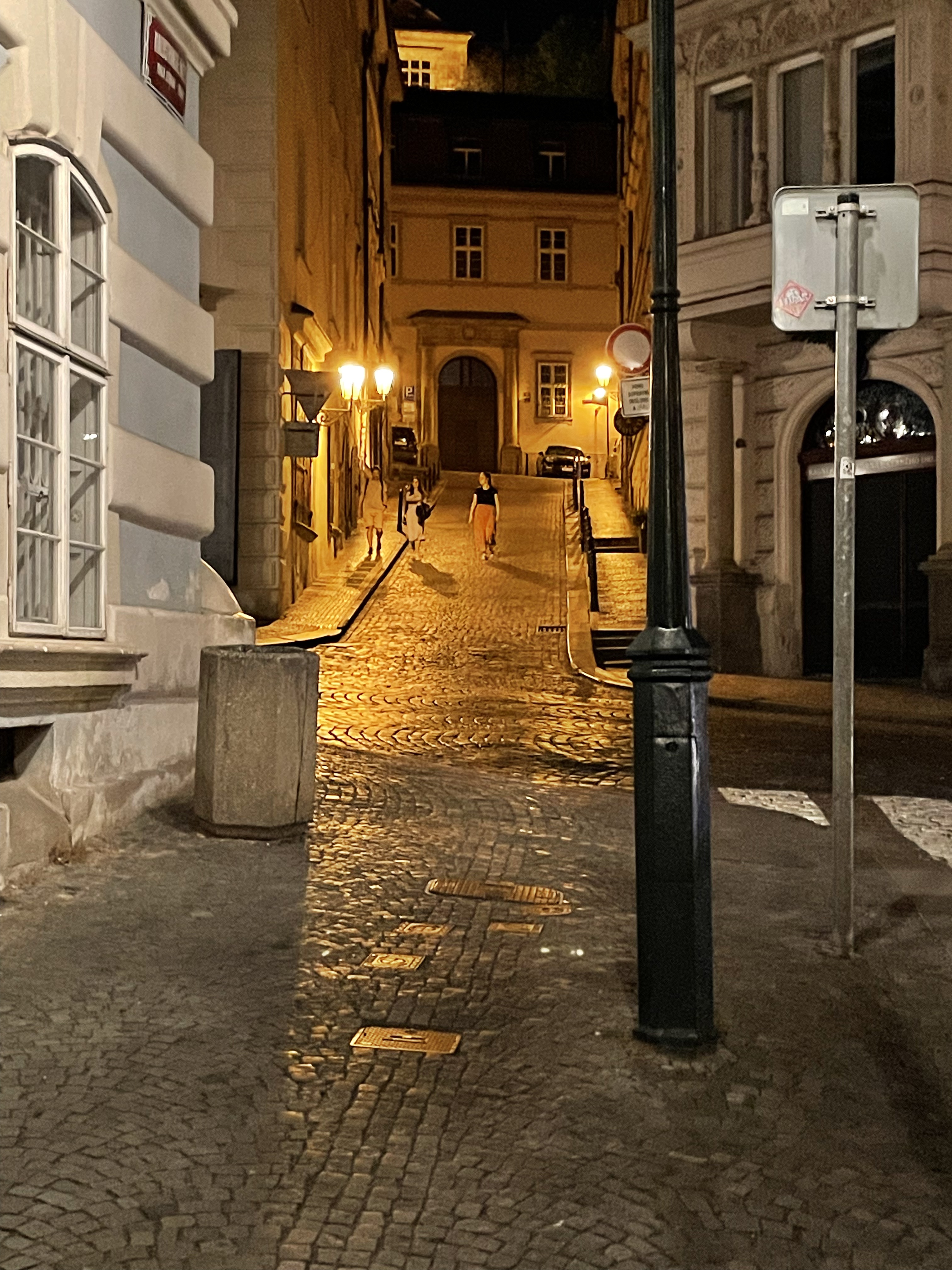
Our trip began in Prague, where much of my series takes place. I spent a day walking in the footsteps of my characters, visiting their homes, businesses and the landmarks mentioned throughout the pages. I’d selected most of the locations on Google Maps, so seeing them for real was, shall we say, enlightening. It took an hour to find U Seminaire, the location of the bachelor pad I’d used for the man who eventually marries my protagonist, Lala. I’d chosen it because it seemed like a quick walk from the Charles Bridge. In actuality it sits underneath the bridge, entangled in a labyrinth of short blocks and alleys. Somehow the building’s image got reversed on Maps – it’s on the opposite side of the street. Ouch. The little greenbelt across from Lala’s mother’s apartment, where ladies sat on benches underneath the shade trees and gossiped, actually sits below street level, though trees do line the sidewalk and there are benches. And the “gentle slope” of the street where Lala’s family lived for twenty years turned out to be a heart-pounding climb on a good day, and treacherous during inclement weather. Sigh. Still, as I stood in front of the building, seeing it for real, I felt thrilled.

In my fourth book, Lala launches her design career by converting a series of buildings into a world-class hotel. Ironically, the palace (the Czech term for a fine home), which I’d chosen for the location is now an actual hotel, and we decided to book it for our visit. It turned out the be the finest hotel I’ve ever stayed in, and although I have no right to take pride in that, I can’t help but feel delighted. On a slow afternoon I cornered the hotel staff and peppered them with questions about the building’s history, particularly during the Second World War. What began as a brief history lesson turned out to be a wild series of stories and gossip, which will inevitably solve some plot issues.

Three days later Allan and I bid ahoj to Prague and boarded a train bound for Poland. After an overnight stop in Katowice, the largest city in the region known as Upper Silesia, we took a cab to the nearby city of Bytom, the hometown of my father and his entire family. Back then Upper Silesia was part of Germany, the city known as Beuthen. As I walked along the streets, I tried to picture what his life must have been like. I gazed at the people who passed, wondering if I’d see any signs of familiarity in their faces.
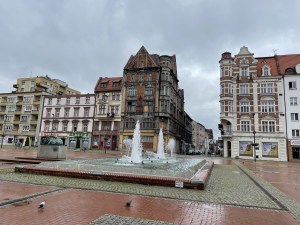
The picturesque parts of the town – with some remarkable architecture and a delightful town square, partially rebuilt after being bombed in WWII – surprised me, but other areas wore the hard reality of over a half-century of decline. I saw it in the run-down buildings left to rot and the pervasive trash, especially cigarette butts, in the street. I also saw it in the faces and the body language of so many, but most strikingly in the older folks, who’d lived through Nazi occupation, followed by decades of Soviet rule, only to be largely ignored by the European Union. They bore a sense of quiet despair, of resignation to the bleakness in their existence. The only signs of joy were in little children interacting with pigeons in the town square, swarming with them, chasing them or karate-kicking them away. I saw no faces that resembled mine, nor any signs of my past in the city. It had been wiped clean.  

Our next stop in Poland was Krakow, a city Allan has always wanted to visit. Rich in history, it has a beautiful castle on a hill overlooking the Vistula River, and the largest town square in Europe. I went for a different reason. On our second day there we boarded a bus to tour the two largest and most infamous Nazi-era concentration camps, Auschwitz and Birkenau.

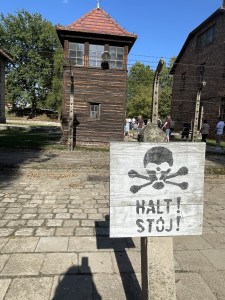
Entering into the first camp, with its ARBEIT MACHT FREI (“Work sets you free”) sign over the entrance gate, I wondered how I would react, or feel. I’m still not sure, to be honest, other than the eerie familiarity of what I heard and saw – from decades of studying photographs accompanied by written accounts, of documentaries and movies filmed on location, and stories I’d heard from survivors, including my father. For many, the trip was a history lesson. For me, it was akin to visiting the cemetery; I lost an estimated ninety members of my family there.

After a brief break, the tour continued to nearby Birkenau. Unlike Auschwitz, which to me felt small and claustrophobic, Birkenau is huge. You’ve seen it in many movies: a long low building with railroad tracks leading to a central tower, open at the bottom to allow trains to enter with their human cargo, like a gaping maw ready to devour all who arrive. Alongside and beyond the entrance, what seems like miles and miles of barbed wire fencing surrounds a huge open area interspersed with low barracks and guard towers. In the distance I could see different tour groups traversing the grounds, and for one brief moment I pictured them in the striped uniforms and hats of prisoners.  

Prior to abandoning the camp in January 1945, days ahead of the advancing Russian forces, the Nazis burned the meticulous records they’d kept of all who were brought to the camps and blew up the gas chambers. Only piles of rubble remain. Many, many piles. They left behind the prisoners too weak to continue; the rest (including my father) went on a forced march from one concentration camp to the next, always trying to stay ahead of the Russians, whom they rightfully feared more than the other Allies. It took several more months until my father was liberated, but at least the Americans freed him. Had he stayed behind in Auschwitz, he would have lived the rest of his life under the thumb of the Soviets. After what I saw in Bytom, I’m grateful he had the strength to wait.

The entire tour took seven hours and, although it allowed for a few bathroom breaks, it did not include a meal. The irony was not lost on me.

We left Poland and continued our travels, with France the next destination. There I stumbled upon traces of history that will influence my writing, and my life, but I’ll save that for a future post.

I can’t say these experiences will enrich the final chapter in my saga, but I can say I truly feel as though I’ve walked in the shadows of the past, both my characters’, and mine.


Miko Johnston, a founding member of The Writers in Residence, is the author of the historical fiction series, “A Petal in the Wind”, as well as a contributor to several anthologies including the about-t0-be-released “Whidbey Island: An Insider’s Guide”. Miko lives in Washington (the big one) with her rocket scientist husband. Contact her at mikojohnstonauthor@gmail.com


(Blog) Housekeeping & Inspiration

(Jackie Houchin is standing in temporarily for another member.)

Before we go on to some inspiring quotes from a dozen great mystery writers, here’s a little housekeeping to help you get the most from our blog.

1. Have you ever been unable to see or post comments on The Writers In Residence blog?  Here’s a trick to try.

When you first open the page, “click on” the title of the post. NOT the site title, but the new posting title. In this case, it would be “Housekeeping & Inspiration.”  The page should adjust, and then you will be able to see the Comments section.  Try it!  PS: You will also be able to see the extended bio of the current posting’s author.

2. If you are curious about the rest of us bloggers, you can go to the top of the site and click on “About.”  This will give you the complete list of bios by author.

3. From the sidebar, you can also search past postings by typing in an author’s name in the “Search” box and clicking. Recent articles by that author will appear. You can also type in a topic. If we have covered that, you will see them as well.

4. If you came upon our blog via social media and like what you see, you can enter your email address in the next box and click on “Subscribe.”  Then you will receive an email every Wednesday with a link to the new post. We’d love for you to join us!

5. Further down the side bar,  you will see “Recent Posts,” and under that, you can search by month and year in the “Archives”.  We go back to 2009!

6. If you have any other questions, you can use the “Contact” feature at the top of the page, but (blush, blush) I’m not sure at this point, whom that will go to! Eek! If all else fails, and you are SERIOUS, you can email me. Photojaq@aol.com.

And now for the INSPIRING QUOTES! *

“The mystery story is two stories in one: the story of what happened and the story of what appeared to happen.”  Mary Roberts Reinhart

“There is nothing more deceptive than an obvious fact.” The Adventures of Sherlock Holmes by Arthur Conan Doyle

Another dead body. Every year it is the same. Every year, another dead body…”  Lion in the Valley by Elizabeth Peters

“All things are poisons, for there is nothing without poisonous qualities. It is only the dose which makes the thing poison.” Paracelsus

“The best crime novels are all based on people keeping secrets.” Alafair Burke

“Revenge is sweet and not fattening.” Alfred Hitchcock

“Conversations are always dangerous, if you have something to hide.” A Caribbean Mystery by Agatha Christie

“People are straightforward enough, on the whole, till one starts to look for crooked motives, and then, oh boy, how crooked can they be!” The Ivy Tree by Mary Stewart

“Truth will come to sight; murder cannot be hid long.” The Merchant of Venice by William Shakespeare

“There simply must be a corpse in a detective novel, and the deader the corpse the better.” S. S. Van Dine

“The great advantage about telling the truth is that nobody ever believes it.” Dorothy L. Sayers

“Very few of us are what we seem” The Man in the Mist by Agatha Christie.

*This collection of quotes is from The Bookish Sleuth, Mystery Reader’s Calendar by mystery writer, Sara Rosett

A Debut Mystery and Using Cornish Cuss Words!

by Jill Amadio

Mystery writers are often asked how they decided to choose not only the genre but the plot itself. My revelation for my debut novel came about when I moved to the United States. I’d been a reporter and figured on continuing in that profession forever. I loved it. However, life has a way of setting one down a different path than planned.

Balboa Island isn’t too shabby a place to live if you are banished to the colonies as I was. As a result of my divorce conditions I agreed to live in America with our three children.  A job on a magazine brought me to Balboa Island that is part of Newport Beach on the edge of the Pacific Ocean, and the ritziest coastal town in Orange County, California. A virtual village, quaint and stunningly beautiful, Balboa is a place where nothing untoward ever, ever happens. Many of the beach “cottages” are stylish mansions with yachts bobbing at private docks and everyone goes to bed at 10 p.m.

In order not to confuse readers or tourists, I moved a few streets around for the plot and changed the name of the island to a fictional one in my book, “Digging Too Deep” naming it Isabel Island. When I lived there crime was non-existent except for an occasional purloined bicycle.  In short, the perfect setting for a murder or two.

After ghostwriting a crime novel for a Beverly Hills financier who never read books but wanted his name on one I decided mysteries were for me. I’d created a series character for him hoping we’d continue, and I was paid, to boot. But he declined after a lengthy book tour including a cruise while signing my book. Thus I plunged into writing my own first mystery.

A terrorist plot seemed the most shocking event to wake up the islanders but after meeting many authors who were writing violent, brutal thrillers I changed my mind.  In my bones are the books of Agatha Christie, Ruth Rendell. M.C. Beaton and P.D. James whose gentler murders fit more into the solve-the- puzzle, cat-and-mouse games I prefer rather than the graphic police procedurals and private detective plots so popular in the U.S.

Like most authors I bring a few personal experiences to my work and I wanted to establish a series character so my amateur sleuth, Tosca Trevant, is from Cornwall, UK. I’d dumped her onto Isabel Island where she grumbles about the lack of rain.

I asked poet and professor Pol Hodge in Redruth, Cornwall who teaches Cornish, for a supply of Cornish cuss words for my main character. He sent two pages of unbelievably descriptive and naughty ones – just as well my modified translations aren’t too precise — and I got to work on plot and setting.

I joined Sisters in Crime and its offshoot called Guppies, the Great Unpublished.  I also joined Mystery Writers of America, another national organization. Both offer excellent workshops and speakers but as we all know it’s the bum-on-the-chair that puts the words on the page.

After the book was polished I paid a professional editor to give it a look. He said I’d broken most of the Rules of Writing a Mystery; I had not followed The Formula publishers insisted upon; I was too free-wheeling with my character’s humor, and I should start all over again. Fat chance.

Next, there was the dreaded Perfect Query to be created.  Queries to agents must be specific, beautifully shaped, and, again, adhere to their golden rules as posted on their web sites. This time I paid great attention, followed the submission guidelines, reluctantly whittled my prose down to the required three paragraphs, and made up a list of unsuspecting agents.

There must be five thousand of them in America. The list was so lengthy I went to sleep reading it. I finally got it down to 60 agents after spending weeks checking each of their websites, a time-consuming exercise but no way around it at that time although today one can define the search.  I queried six simultaneously. I’d already talked to two agents – at $50 a pop – at writers’ conferences which were so frequent one’s bank balance is constantly depleted.

No takers. I queried 45 before giving up. Many sent me form letters of rejection, two asked for chapters before telling me No Thanks, and several never answered at all. It was depressing but my fellow writers urged me to keep submitting. So I next tried the small presses that can be approached directly without an agent. However, a few of those too have strict rules – no violence, no cruelty to animals, no swearing (Oh, dear), and no sex. That last bit was easy. I was British, after all.

After three editors rejected me the next on my list was Mainly Murder Press. Frankly, I fell in love with the name. It stated exactly and honestly what it published, and was on the East coast where all the big publishers were located, a fact that appealed to my snobbish instincts.  MMP only produced 12-15 books a year and its site stated “Absolutely No Submissions Until Late Spring.” Gosh. It was only January and I was impatient. Then I thought, well, it may be January on the East Coast but I was in Southern California and the daffies were already nodding their lovely yellow heads. I sent my query in, claiming that where I live it was already late spring.

The very next day MMP asked for chapters, then the full manuscript, and one week later I’d signed a 3-book contract. They thought my book was “wonderful”!  All of their editors and beta readers (a new term to me) loved “Digging Too Deep,” and I was in heaven.  I liked the book cover design although I requested the flag of Cornwall be added unobtrusively somewhere; the font was fine, and I waited anxiously for their digital ARC I was to send out to reviewers.

MMP did not promote nor send ARCs out early but it did distribute through Ingram, which was peachy, I thought. This publisher also did not give author advances but paid standard royalties and mailed catalogues to 650 independent U.S. bookstores, and to 4,000 public libraries.

Alas, the ARCs arrived barely a week before the paperback was published. Most reviewers refuse to accept such tardiness so I missed out on many reviews. However, I did my best. I thought that the bookstore on my island would order dozens of copies. Ha! I took the book in, asked them to stock it, and asked, May I please have a book signing here?

Again, I’d done everything wrong.  I was told, No, no, you have to create some buzz first! So I called a couple of local editors I knew. After they reviewed the book in their newspapers I took the clippings to the bookstore, thrust them into the owner’s hand, and said, Right. Here’s your buzz. I also sent the book to my UK hometown bookstore but never heard a word.

Nevertheless, I lined up more signings. One of the most enjoyable was at the annual Gathering of the California Cornish Cousins, a sly move I admit, but I sold a lot of books.  Thinking outside the box I also joined the Cornish-American Heritage Society which holds annual Gatherings along with a pasty-toss contest. Heaven forbid a pasty splits open and covers someone in meat and potatoes. My second mystery, “Digging Up the Dead,” earning a review from author Anne Perry.

So, while I am still ghostwriting biographies for a living having just finished a memoir and moved to Connecticut, Tosca’s third adventure is underway. After all, I have only used up nine Cornish cuss words.

Here’s a Novel Idea: Read a Book

By Gayle Bartos-Pool

The first person whoever wrote a book didn’t have libraries and bookstores full of previously penned tomes to read and enjoy and from which to get inspiration to perhaps write their own story. They had a story to tell and wrote it. We, centuries later, don’t have any excuses. We not only have books, but plays, movies, and television shows overflowing with plots, characters, scenery, and dialogue to stir our imagination. Not that writers can’t get ideas from life around them, but sometimes actually reading something from another writer lets us know it can be done. Even a lousy book can inspire a would-be writer to say: “Hey. I can do better than that.” And they do just that every day. But first we have to pick up a book.

You might have friends or family members who recommend a particular favorite. You can always go to a bookstore, if there are any left, and ask the bookseller to point out a few books in a particular genre. Long ago I worked at a Waldonbooks in the Glendale Galleria in California. People were always asking where a particular section was. Mysteries, romance, kid’s books, self-help, religion. At times I would point out a favorite of mine. The store would set out best-selling books on tables in the front of the store complete with advertising paraphernalia from the publisher. We didn’t have to do that with the romance novels. They sold like hotcakes and we would sell down to the wall by month’s end. Unfortunately, the book chain decided they didn’t want to carry lots of books in all kinds of genres, only the top selling books. Obviously they didn’t know avid readers liked to pick out a ton of books of their choosing, old titles, newer ones, or try something different. Oh well. Management must have been more interested in their bottom line than their customers. I love capitalism, but I also love books.

But what can a writer or would-be writer do to get inspiration? They need to ask the one person who will have the most influence on their work what they prefer reading? And who is this veritable font of information? Themselves. Writers usually write what they like to read. But they need to read other writers in their chosen genre to see what’s out there. This means the good, the bad, and the: “Oh, God! That’s the best thing I ever read.” kind of book.

Now I might have loved mystery books and mystery shows on TV, but the first book I wrote, though it took a while to get published, was a disaster novel, CAVERNS. Then I spent ten years writing a spy trilogy, but that wasn’t finding a publisher, either. Then my wonderful husband, Richard, said these immortal words: “You used to be a private detective. Why don’t you write a mystery novel?” Ah!

But what did I know about writing a mystery? My spy novels were based on History and a bit about my dad’s life in the Air Force. I added a ton of facts and made up the rest. But a mystery. I needed to know more about the genre since mystery writing wasn’t like a stand-alone novel where the writer defined the parameters. What did I do? First, I joined Sisters-in-Crime in Los Angeles and Mystery Writers of America so I could hear what other mystery writers did. Those two groups had many famous speakers at their meetings who talked about their writing. I read their books and the books of some of the members of both groups. I was learning.

Since a writer needs a place in which to set a story, a few came up. First, I got called to jury duty. Then Richard got called. He went to downtown Los Angeles the same day the O.J. Simpson jurors were called. He came home and told me about the media circus down there with news cameras, helicopters, and microphones. My first Gin Caulfield book was called Media Justice about a high-profile case, the media’s influence, and Gin gets called to jury duty.

Next, Richard and I got free tickets to the Santa Anita Race Track. That became the opening of the second mystery in the Gin Caulfield Mystery Series, Hedge Bet. But then something else happened. I read another book.

This book was Eighteen by Jan Burke. Jan was a member of Sisters-in-Crime and I picked up her book of short stories. I loved the book and the idea of writing a short story. So I wrote one about an ex-mobster turned private detective. Then I wrote another one about the same guy. Then Sisters-in-Crime announced their latest anthology and asked for submissions. The theme of the anthology was landmarks in Los Angeles. I had to write another story, but it just so happened Richard invited me downtown for lunch one day and we went to the Bonaventure Hotel. That landmark ended up being the one I used in my story and the story got in the anthology. I thanked Jan for her inspiration.

Now I had three stories with the same character. The reviews for my story in the anthology were good, so I wanted to write more with him as the lead. So I wrote a couple more, but can you do a book of short stories all about the same guy?

Then I met another writer. I had read a lot of his books as a teenager and read even more after I met him. His name: Ray Bradbury. Jackie Houchin, a fellow Writers-in-Residence member and good friend, and I went to the opening of his play Fahrenheit 451 since Jackie reviewed plays for a local newspaper as well as an on-line paper. She got to bring a guest, me, but I thought I should review the play, too, since we got in free. On Opening Night Mr. Bradbury mentioned the time he had a batch of short stories he wanted to have published so he asked his publisher what he should do with them. The publisher told Ray to link the stories together which he did and The Martian Chronicles was published. So I had my answer from a writer who got the job done. I linked the Johnny Casino short stories together like a TV series.

I have three books in the Johnny Casino Casebook Series out there now thanks to inspiration from my husband, a book by Jan Burke, some advice from one of the best writers in history, Ray Bradbury, a chance to review Ray’s play because of a friend, and the fact I liked mysteries and wanted to write them.

Ninety present of the books I read are mysteries. I have learned a lot from each one: What to do and what not to do. And also what I can do better. But reading sure made a difference in my writing. If you are a writer: Read On!