A Contrarian View of Cozies

by Miko Johnston

A diva actress infuriates everyone with her demands. A rich businessman takes pride, even joy, out of snookering his customers. A domineering tycoon sets ultimatums for his relatives lest they be cut out of the will. They’re spoiled, stingy, slick, or just plain mean, and the next thing you know, they’ve been murdered. News spreads, often through a small town filled with quirky folks, and soon a person with no experience in criminology (beyond, perhaps, reading or writing mystery novels, or selling them in their charming bookshop) takes an interest in the murder and decides to investigate. They may not have access to the minutiae of crime scene investigations or forensic reports, but thanks to a police force with little skill or interest in solving the mystery, they unmask the perpetrator.

Welcome to the world of cozy mysteries, where life can be pleasant, eccentric, and even humorous in the face of death. Where someone’s humdrum existence can be invigorated by a murder.

A sub-genre of cozies takes crime more seriously, dealing with social issues such as addiction, abuse, homelessness, and trafficking, however peripherally. Others feature amateur sleuths who partner with the real investigators – police detectives – sometimes literally; many have spouses on the force.

Bearing those exceptions in mind, please don’t hate me for what I’m about to say – I do not, and will not, read cozy mysteries that involve murder, for one simple reason: the punishment rarely fits the crime.

People kill or get killed for a variety of reasons.  Some killings are justified, as in self-defense or on the battlefield. And don’t confuse the broader legal term, homicide, with murder, as the former includes the accidental and the justifiable killing of another. The law defines murder as a deliberate act, targeting a person with the “intent to kill,” “cause grievous bodily harm,” or “a depraved indifference to human life”. This does not sound very “cozy” to me. Nor does killing someone simply because they’re not nice, or did something mean-spirited or even ruinous (short of murder) sound justifiable.

Some cozy murders occur “off the page”. I’ll grant the more grisly details of murder can be the exception to the “show, don’t tell” rule,  but even so a murder has been committed. I’ve also heard cozy murders described as bloodless, or even “painless”, but is there such a thing? Any police officer who’s been to a crime scene, or EMT who tried unsuccessfully to save the victim, will tell you NO. Most poisons cause pain, convulsions and organ collapse. And what about other methods, such as strangulation, drowning and suffocation? I feel miserable when I’m congested with a cold. I can’t accept being deprived of oxygen as anything less than cruel and unusual. Even if the crime is violent, such as a gunshot, the description sidesteps the gory details. Really? Please tell me how a gunshot wound wouldn’t be gruesome to an average person. And don’t get me started on humorous murder mysteries. I’ve seen farces that involve a dead body where the death occurred from natural causes, or an accident due to the victim’s stupidity, silly but harmless. However, a murder victim’s body crosses the line for me.

I have two other reasons for not reading cozies. I lived in New York during the crime-riddled seventies. I knew two people who had dear ones murdered. A co-worker’s boyfriend was shot to death in a case of mistaken identity, and a gang of robbers murdered my friend’s nineteen-year-old cousin as he was unloading a delivery truck. Fifty years may have passed, but I still recall the anguish in their faces, the tremble in their voices when they told me what happened. They never witnessed the crime in progress, nor saw the bloody crime scene, but from the moment the police notified them, their lives changed. Forever.

I get it. A mystery can be enjoyable without forensic-level descriptions of crime scenes, as is trying to put the clues together and solve the puzzle. Of course, if that’s what readers want, then there’s no reason to include murder, rape or kidnapping – a non-violent crime would allow the reader to solve the case along with the sleuth. Why does it have to be murder? Apparently, having a cozy revolve around a high crime raises the stakes, and the level of interest, beyond lesser crimes. Making the victim as unsympathetic as possible makes us feel less guilty as we focus on the clues and not on the tragedy.

This is just my opinion, and I don’t expect others to share it. Yet I can’t help but think no matter how horrible, difficult or mean the victim is, and even if the characters in your story aren’t upset by the murder, somewhere in the world beyond your pages is someone who will care, who’ll mourn the loss and be devastated by the cruelty of it.

Miko Johnston, a founding member of The Writers in Residence, is the author of the historical fiction series, “A Petal in the Wind”, as well as a contributor to several anthologies including the recently released “Whidbey Island: An Insider’s Guide”. Miko lives in Washington (the big one) with her rocket scientist husband. Contact her at mikojohnstonauthor@gmail.com

Choosing a Genre

by Linda O. Johnston

Or does the genre choose us?

I’ve written here before about choosing a theme in the fiction we’re writing, but now I’m going to discuss selecting a genre.

Me? I’ve written in many genres, starting with mystery short stories way back when, then moving into time travel romances, mysteries, paranormal romances and romantic suspense. And often writing in more than one of those genres at the same time.

How did I choose the genre each time?

Well, it was partly what popped into my head and hung on there. And that was most often because whatever genre I decided to write in was also one I was currently reading a lot in.

Therefore, in that respect, the genre I’m reading most at the moment does often choose me, insisting that I write my own story or several in that genre.

So… mysteries? For me, always. Well, almost always. Though I’m still reading mysteries, my own mystery writing has slowed down. Not that I don’t include mysteries in what I’m writing, though, since my current focus is romantic suspense.

Yes, you might have noticed that a common tie between many of those genres I’ve written in is romance. I love love stories! Even when I’ve written a strictly mystery story, my protagonist almost always has a romantic relationship.

For example, in my first published mystery series, the Kendra Ballantyne Pet-Sitter mysteries, Kendra is a lawyer on hiatus because of some nasty things that happened in her life, so she’s making a living now as a pet-sitter. Her wonderful Cavalier King Charles Spaniel Lexie is often with her. One way or another, she keeps tripping over murdered bodies. And, of course, sexy PI Jeff Hubbard comes into her life to help her solve all those mysteries.

Oh, yes, that other sort of genre—well, theme—that is almost always include in my stories, especially these days, is animals, mostly dogs, whether or not it’s a romance or mystery or something else. And Kendra’s stories were in some ways about me since I was a practicing lawyer at the time and one of my Cavaliers then was Lexie. But I’ve said all that here before.

Now? Well, I always have dogs around me, and so do the protagonists in my current Harlequin Romantic Suspense stories. The last in my current series, the Shelter of Secrets, is finishing up next year, and I’m already working on the first in the next series.

And you? What’s your favorite genre to read? And if you’re writing, what genre(s) are you writing in?

Research Can Be Dangerous: A Cautionary Tale

By Maggie King

The Confederate statues on Monument Avenue in Richmond, Virginia came tumbling down. For this author, that meant a scene rewrite and a research trip. I didn’t expect the trip to end in the ER.

In my recently released story, Laughing Can Kill You, Hazel Rose investigates the murder of an obnoxious writer given to laughing at others’ expense. In one scene, Hazel and her cousin Lucy attend the victim’s memorial service, hoping to ferret out who killed the man. The service is held in one of the stately homes on Richmond’s Monument Avenue.

Here’s my thumbnail description of the area:

Statues memorializing notable players in the Confederacy punctuated Richmonds Monument Avenue. The statue paying homage to African-American tennis star Arthur Ashe lent an incongruous note to the lineup of Civil War monuments. Various groups clamored for the removal of the monuments that they considered reminders of slavery and racism; other groups believed removing them was tantamount to erasing history. A grassy mall divided the wide avenue, lined with trees and architecturally-significant houses.

If you’ve kept up with events of recent years, you know that the statues (except for the Arthur Ashe one) were taken down in 2020 and 2021, amid a flurry of protests, acts of vandalism, and government orders. But Laughing Can Kill You is set in 2018, when the statues were still in place. So I was okay? Right?

Maybe not. Would my readers be aware it was 2018? While it was clear to me, it may not be to them. Plus, the statues were still a hot-button topic, regardless of one’s position. I’m not looking to get readers riled, I simply want to give them an enjoyable story.

Monument Avenue was not important to the plot, but I could hardly feature it in a scene without mentioning the famous statues that give it its name. Talk about the proverbial elephant in the room. Street, rather. So I needed a different, but similar, location. It didn’t take long to come up with a Plan B: Richmond’s Northside, just ten minutes from Monument Avenue.

Here’s the description that replaced the Monument Avenue one:

The Hermitage Road Historic District on Richmonds Northside started life as a streetcar suburb in the late 19th century. Developing the area north of the city to solve the housing problems caused by a rapidly growing city population became possible with the invention of the electric streetcar. The trolley line ran down the middle of Hermitage Road. At some point, a wide, grassy median replaced the line.

As I drove along the historic stretch lined with trees and architecturally significant houses …

It was a beautiful Saturday in May of 2021 when I drove to the Northside to scope out the area for sights, sounds, traffic patterns, etc. to add authentic detail to my story. I had a house in mind, a Colonial Revival I’d visited on a long-ago walking tour of the area. It was similar to the Monument Avenue house and I could use the same interior details.

This image has an empty alt attribute; its file name is colonial-revival-house.png

I walked down Hermitage Road and what did I see in front of the house? A “For Sale” sign!

I started to cross the street, thinking I’d get a better picture of the place from a distance. I hesitate to take pictures of people’s houses, feeling I’m invading their privacy. If challenged, I could say I knew a prospective buyer. Or I could offer a copy of Laughing Can Kill You when it came out. That should certainly appease them.

I looked around at the other houses, at the trees, flowers, taking in the scene, framing photo shots.

No photos were taken. With all my looking around, I didn’t look where I was walking. In an instant, I fell off the curb, landing splat on my shoulder.

When I picked myself up, my arm felt fairly useless. Thinking, hoping, that I’d only suffered a bruise, I decided to go home and ice my arm. But some persistent voice buzzing in my ear said “Go to the ER.” My guardian angel? Where had she been a moment before? Why hadn’t she grabbed me by the hair and pulled me back from that nasty asphalt? Oh well, God and angels work in mysterious ways.

At St. Mary’s Hospital (incidentally, it’s on Monument Avenue), I learned that I had a fractured shoulder. I went home with a spiffy sling that accessorized my wardrobe for six weeks. Luckily, it was my right shoulder and I’m left-handed.

Back to my rudely interrupted research trip. As the Colonial Revival was on the market, there were plenty of pictures of it online. The owners were asking a cool million. I bet you know what I’m going to say next—-that I purchased the place! Um, no, but I did find lots of beautiful interior and exterior pictures.

Shortly before this unfortunate incident, I’d written a scene where Hazel trips over a crack in a sidewalk and uses balance skills she didn’t know she had, avoiding a spill. Hazel is like me in some ways (except I don’t investigate murders) but apparently I’ve given her better balance and coordination skills.

My original plan was to end the research trip with a latte at Crossroads, a fun and funky coffeehouse on Richmond’s Southside. Hazel and Lucy got to enjoy that treat after the memorial service (although I named the place The Beanery in the story). They needed to compare notes on what was becoming an intriguing investigation.

By the end of a summer spent in PT, my shoulder was declared healed.

Laughing Can Kill You was published just after Thanksgiving of 2021.

There you have it: my cautionary tale on the perils of research.

Originally published in Kings River Life Magazine, January 5, 2022

A New & Short Mystery!

by Guest Writer Alice Zogg

Hello friends, readers, and fellow authors,

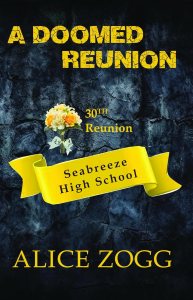
I penned another stand-alone mystery.   A DOOMED REUNION is fresh off the press and available in hardcover, paperback, and e-book editions.

This one is short (170 pages).  Either I have learned to get my point across with fewer words or have become lazy. (haha)

As to the location, I invented a fictional town called Seabreeze and placed it along the California coastline between Del Mar and La Jolla.

People with old school ties attend a 30th high school reunion and are shocked to hear one of the attendees say he knows who murdered a classmate years earlier. That knowledge gets him killed.

Can Detective Scharfkopf with the San Diego County Sheriff’s Department piece together what happened back then to catch the person who has lived with this secret all these years… before another body is added to the list?

Happy reading,

www.alicezogg.com

A Doomed Reunion on Amazon

Alice Zogg was born and raised in Switzerland. She met her husband, a fellow Swiss, in New York City, and the two made their home in the United States. The family relocated to Southern California in 1967, where they have resided. She is an avid traveler and plays racquetball and golf. She has written over 20 books. 

###

BOOK REVIEW – I read Alice Zogg’s new book. Yes, it is short, but the crime, plotting, and investigation are complete.  You don’t feel cheated at all.  The murder happens after a high school class reunion when one person blatantly claims to know the murderer of an unpopular student 30 years previously.  Does he?  Someone believes him and, in unusual circumstances “offs” the guy.  The detective is charged with solving not one but two murders.  The questioning, deduction, and final moments of revelation are well-plotted and written. I enjoyed reading it!  ~~~ Jackie Houchin


How I Set A Mystery In The Galapagos

By Guest Blogger, Sharon Marchisello

For as long as I can remember, I had three goals in life: become a bestselling author, meet and marry the love of my life, and travel the world together. And I always figured I’d do them in that order. Although I achieved my dream of being a published author, I’m still working on that “bestselling” part.  

When I graduated from the University of Southern California with a master’s degree in professional writing, I realized I’d have to get a “real” job. Not only was I not making a living as a writer; I wasn’t even published. Should I go for an opportunity that involved writing but might drain my talent and energy? Or should I look for something mindless that would pay the bills, so I could focus on my stories during off hours? Then a position as a reservations agent at Western Airlines fell into my lap.  

My roommate had a friend who worked there, and one day the friend called to say Western Airlines was hiring. I was the first person to listen to the message on our answering machine and begged to go to the interview too.  

The woman who interviewed me said, “You’re overqualified for this job. You just want it for the travel perks, and I know you’ll quit after a year or so. But I won’t stand in your way.” I stayed with the company for twenty-seven years; my roommate left after six months.  

But she was right about me wanting the travel benefits, and my first few years, I was on a plane every time I had a day off. I met my future husband at the Los Angeles airport, and together we’ve taken 65 cruises and visited over 100 countries on all seven continents.  

Although I kept writing fiction and even published a few travel articles, I never set a story in one of the destinations I’d traveled to. Until the Galapagos.  

If you’re looking for the Galapagos on the map, it’s a group of islands straddling the equator, approximately 600 miles off the Pacific Coast of Ecuador. I never planned to set a book there, either, but six months later, I remembered an experience from our cruise that I thought would make a great opening scene for a mystery.  

Normally, the guides were conscientious about counting heads and watching over all the passengers in their charge whenever we were away from the ship. In an archipelago comprising 97% national park containing flora and fauna found nowhere else on earth, tourists must be carefully supervised.

But one day, my husband and I left another activity to join a snorkeling excursion already in progress, and neither of the guides assumed responsibility for us.  

We were swimming along, marveling at the vast array of colorful underwater life, when I surfaced to see both Zodiac boats motoring back to the ship—without us! I can still feel the panic of being left alone in the middle of the ocean, treading water off the shore of an island populated only by sea lions and blue-footed boobies.  

I waved and screamed, bobbing up and down like a spyhopping whale, and fortunately, someone spotted me. One of the boats turned around and came back to pick me up. I didn’t see my husband right away but told the guide he was still out there. In a moment, he’d swum up and climbed aboard. All was well.  

But what if… What if my protagonist’s companion didn’t get picked up? And what if the person was left behind on purpose?  

I had a great time writing the book, reliving our trip through photos and program notes, plus doing a lot of supplemental research on the internet.  

When Secrets of the Galapagos begins, my heroine, Giovanna Rogers, is snorkeling with her new friend, tortoise researcher Laurel Pardo. The two get separated from the group, and Laurel disappears. No one on the ship will acknowledge that Laurel didn’t make it back.  

To determine a motive, I recalled a conversation I’d had with one of our guides during a visit to the Charles Darwin Research Station in Puerto Ayora, the largest town on Santa Cruz (one of only four inhabited islands in the chain). “I know a secret about Lonesome George,” he said. “But if I tell you, I’ll have to kill you.”

Lonesome George was a Galapagos giant tortoise made famous for being the sole survivor of the Pinta Island species. Unfortunately, efforts to breed George were unsuccessful, and the ancient tortoise passed away in 2012 without an heir.  

But what if someone discovered another giant tortoise from a different subspecies also thought to be extinct? And then a tortoise researcher unearthed information about the animal that the tourist industry didn’t want released?  

You’ll have to read Secrets of the Galapagos to find out what happens next.  

Blurb:  

Shattered by a broken engagement and a business venture derailed by Jerome Haddad, her unscrupulous partner, Giovanna Rogers goes on a luxury Galapagos cruise with her grandmother to decompress. At least that’s what her grandmother thinks. Giovanna is determined to make Jerome pay for what he’s done, and she has a tip he’s headed for the Galapagos.  

While snorkeling in Gardner Bay off the coast of Española Island, Giovanna and another cruise passenger, tortoise researcher Laurel Pardo, become separated from the group, and Laurel is left behind. No one on the ship will acknowledge Laurel is missing, and Giovanna suspects a cover-up.  

When the police come on board to investigate a death, Giovanna assumes the victim is Laurel. She’s anxious to give her testimony to the attractive local detective assigned to the case. Instead, she learns someone else is dead, and she’s a person of interest.  

Resolved to keep searching for Laurel and make sense of her disappearance, Giovanna learns several people on board the ship have reasons to want Laurel gone. One is a scam involving Tio Armando, the famous Galapagos giant tortoise and a major tourist attraction in the archipelago. And Jerome Haddad has a hand in it. Thinking she’s the cat in this game, Giovanna gets too involved and becomes the mouse, putting her life in jeopardy. But if she doesn’t stop him, Jerome will go on to ruin others.

AMAZON 

SUNBURY PRESS

Bio:  

Sharon Marchisello is the author of two mysteries published by Sunbury Press—Going Home (2014) and Secrets of the Galapagos (2019). She has written short stories, a nonfiction book about finance, training manuals, screenplays, a blog, and book reviews. She earned a Master’s in Professional Writing from the University of Southern California and has been an active member of Sisters in Crime since 1995, currently serving as treasurer of the Atlanta chapter. Retired from a 27-year career with Delta Air Lines, she now lives in Peachtree City, Georgia, and volunteers for the Fayette Humane Society.  

Website: sharonmarchisello.com (https://smarchisello.wordpress.com/)  

##

This article was posted by member, Jackie Houchin. If you’d like to read my review of the audiobook version of  SECRETS OF THE GALAPAGOS, click here.   


Mystery People, Jessica Speart

by Jill Amadio

Few mystery writers pour their personal passion into their fiction to get their message across as successfully and as brilliantly as multi-book author Jessica Speart.  Published traditionally by such as Severn House, William Morrow, and others as one of the most addictive thriller series, the acclaimed American author’s plots are based on true, wildlife issues.

Elephants slaughtered for their tusks, sharks for their fins, rhinos for their horns, and other species for their rarity, many endangered, form the focus of Rachel Porter’s action-packed sleuthing. An agent for the U.S. Fish and Wildlife Service, (USFWS), the fictional character is a composite based on real agents who investigate smuggling, murders, and criminals who break the laws that cover illegal species trading.

Casting a worldwide net, Speart sets her mysteries in several American states, and peoples them with characters in Mexico, Russia and other countries where illegal hunting is at its most prevalent such as Hawaii for its rare reptiles and exotic birds in Florida, but what stands out the most is the remarkably meticulous and detailed research that Speart brings to her books. The reader learns a wealth of fascinating facts told in an often-humorous style while at the same time learning how poachers work, the tools needed to trap tortoises, and the clever ruses criminals use that include the rich and famous with their collecting obsessions.

Doing research is essential to my writing,” she said. ”The idea is not to just make things up [but] to provide facts in a compelling way.”

An investigative freelance journalist for several years after studying theater at the Boston University College of Fine Arts, and stints as an actress off-Broadway, in commercials, and soap operas, Speart switched from acting to writing.

“I needed to get away for a while and ended up going to Africa. It was there that I witnessed the poaching of elephants for their ivory and rhino for their horns. I came home determined to do something to try and help.”

Speart took a direct approach and began her magazine career writing stories about the USFWS special agents and their investigations. She became fascinated with their work. Many of her articles involved wildlife and drug-trafficking crimes and were published in the New York Times, Mother Jones, and many other outlets.

But the subject matter, she discovered, wasn’t high on the list of law enforcement agencies. An animal lover, she decided to take justice into her own hands by starting a crime series, knowing the popularity of mysteries and thrillers could give her topic a voice.

My first ten books are the fictional Rachel Porter mystery series,” she said, “which sprang from my magazine work. I became frustrated with the outcome of many wildlife cases. The illegal trade in endangered species is worth between $15-20 billion a year and yet the fines and punishment remain low.”

In the process Speart became an expert in demand at endangered species conferences, a keynote speaker at a wide range of distinguished forums including the American Museum of Natural History, John Jay College of Criminal Justice, chapters of the Audubon Society, and others, and a frequent guest on television shows and documentaries..

“The transition from non-fiction journalism to fiction wasn’t difficult, given the reality of the issues,” she said, having covered cases from initial suspicious behavior to arrest and conviction.

The fast-paced Rachel Porter series begins with what could be considered fragments of the author’s own life. Titled GATOR AIDE, it takes place in the steamy bayous of Louisiana and the New Orleans French Quarter, featuring an alligator chained to a bathtub with a dead stripper nearby. The book’s characters include cops, killers, drag queens, and corrupt politicians.

Speart’s second book, TORTOISE SOUP, crosses the country to a new assignment in Nevada where endangered tortoises have disappeared, while book 3, BIRD BRAINED, sends the USFWS agent back to the southeast coast and Florida, where exotic cockatoos and parrots are smuggled out. The cast includes a wonderfully-rendered sleazy snake dealer, Cuban cigar smugglers, airboat cowboys, and Castro terrorists. The action never stops.

Primates inhabit book 4 and the locale is the Mexican border. Not too surprisingly because they exist in real life, there’s a game ranch stocked with rare antelopes, Indian deer, and African oryx for the rich to hunt down and kill for sport. Rachel Porter unwittingly joins the group on the wrong side of the party.

Caviar, anyone? BLACK DELTA NIGHT explains how Tennessee’s Mississippi River paddlefish becomes a rival to Beluga for the Russian mafia to exploit. This time Rachel goes undercover when murder is on the menu.

While her methods eventually result in catching the criminals, her way of operating tends to irritate her bosses and, once again, she is shipped off to another state. Montana, long known as home to private militias and survivalists, also has more than its share of grizzly bears. But why are they being killed along with several Native Americans? A KILLING SEASON provides a dazzling backdrop to the puzzle.
Books 7, 8 and 9 see Rachel once again shuttled off to other states to get her out of her boss’ hair. This time she is sent to Georgia with its manatees in COASTAL DISTURBANCE, and then to northern California with BLUE TWILIGHT in which a collector is obsessed with a rare butterfly. Again, Speart’s research brings reality to the characters, locales, and plot lines. In RESTLESS WATERS Rachel is back in Hawaii to chase down those who upset the fragile ecological balance.

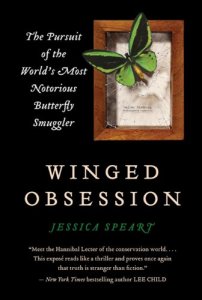
Book 10 winds up the series with UNSAFE HARBOR involving the importation of illegal Tibetan antelope fur clothing, before Speart turns to non-fiction for her 11th book, WINGED OBSESSION: The Pursuit of the World’s Most Notorious Butterfly Smuggler.

“It deals with an actual case that is so crazy no one would believe it if I wrote it as fiction,” she said. “A Japanese national began prowling around America’s national parks. One butterfly he chased was the Apache Fritillary, catching 500 of them and shipping them back to Japan to sell.”

Following up on the true case she flew to Japan and went undercover to make friends with the man. Soon, she discovered he was setting her up. A thriller, indeed.

Whether writing non-fiction or fiction Speart spends time outlining her books before giving it its freedom. “I’m a big outliner, especially when it comes to writing a mystery. Otherwise, it’s like driving your car through a tunnel without lights on a dark night. You are bound to have an accident.”

She noted that some authors spend a year-sometimes two or three – nurturing their book. “Then comes the morning when we finally have to let go and the book takes on a life of its own.”

Speart finds that releasing a published book is exciting and frightening both at the same time. “There’s the rush of having the published book hit the stores, there’s the fear that no one will like it. But what about those folks who read your book and become angry?”

After BLUE TWILIGHT went on sale a small group of butterfly collectors felt she had attacked them, and, in turn, began attacking her.

“Apparently, I’d hit a nerve,” she said. “I’m not saying butterfly collecting is a crime but there are those who cross the line between collecting legal butterflies versus collecting protected and endangered butterflies. There are instances where even legal butterflies have been over-collected.”

The author points out that there is a class system when it comes to species being valued, and that if they were chimps, tigers and others public reaction would be one of horror. She continues the argument on her website in one of her blogs. She also discusses the difference between the two styles, saying that narrative non-fiction is fact-based storytelling employing some of the same skills that are used in fiction, setting each scene, presenting fascinating characters, and creating a strong narrative persona.

As for specific dialogue in non-fiction, Speart again brings her research to the forefront. It requires, she says, exhaustive digging which is something she enjoys. She also points out that narrative non-fiction doesn’t have to be told as purely objective journalism. Writers can bring emotion to their characters and create a sense of drama while following the story arc.

A few books that fit into the discussion are some of her favorites including In Cold Blood by Truman Capote; Into Thin Air by Jon Krakauer; The Orchard Thief by Susan Orlean; The Perfect Storm by Sebastian Junger, and Midnight in the Garden of Good and Evil by John Berendt, a book that began Speart’s love affair with the city of Savannah.

Jessica Speart teaches an advanced mystery writers workshop in Connecticut, and reminds students: “You have to believe in your work and not give up. Writing is a rough business and not for the faint of heart.

Every Day is Valentine’s Day 

by Maggie King

For lovers, every day is Valentine’s Day. But February 14 is the official day when Cupid’s arrow strikes and big business rakes in billions spent on candy, flowers, jewelry, and fine dining.
How did Valentine’s Day get its start? Who was St. Valentine? Good questions, with no easy answers. The history of the saint and the day that honors him is murky, to say the least.

Pope Gelasius I established St. Valentine’s Day in the 5th century to pay homage to two saints named Valentinus who were martyred on February 14. Some believe there was only one saint. A popular legend has it that Valentine was a temple priest who was arrested after ministering to Christians being victimized by the Roman empire. While in prison, he fell in love with a young woman who may have been the warden’s daughter. Before his execution, he sent her a note and signed it “Your Valentine.”

When Emperor Claudius forbade young soldiers to marry, another legend was born: Valentine was beheaded for performing secret weddings for the soldiers.

And then there’s Lupercalia, a Roman fertility festival celebrated from Feb. 13 to Feb. 15. Some say the festival inspired Valentine’s Day.

There’s a suggestion of romance in these stories, but the link between romantic love and Valentine’s Day is credited to the works of Chaucer and Shakespeare. In the middle ages couples expressed their love with handmade paper cards (valentines). In time, factory-made cards became available; but Hallmark Cards of Kansas City, Mo. came on the scene in 1913 and made the holiday the big business it is today.

How do the characters in my Hazel Rose Book Group Mysteries celebrate Valentine’s Day? I’ve yet to set a story in February, so I can only guess. But my main characters, Hazel Rose and her husband, Vince Castelli, would certainly celebrate the day in style.

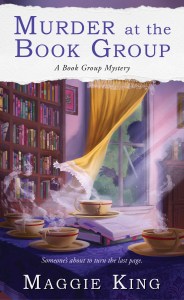
In Murder at the Book Group, the series debut, Hazel describes Vince as her on-again, off-again lover. She attributes their sporadic relationship to their inability to get along. She doesn’t offer details as to why they don’t get along but the reader can guess that the real problem is Hazel’s cold feet about committing to a permanent relationship. She’s been married four times and isn’t eager to make a fifth trip to the altar, only for the relationship to sour soon afterwards. Does she love Vince? She doesn’t want to commit to that either, but she definitely has a soft spot for him.
When Carlene Arness dies after drinking poisoned tea at a book group meeting, Vince finds out that Hazel was there. He’s surprised by her determination that Carlene didn’t commit suicide and dismayed that she’s hell bent on finding the killer on her own. Someone needs to protect her and he figures it might as well be him. Hazel doesn’t make that an easy task.

At first, Hazel sees Vince as a liaison with the police (he’s a retired homicide detective), but soon realizes that she needs him for more—much more.

Will solving the mystery of Carlene’s death put Hazel and Vince on the road to happily-ever-after?

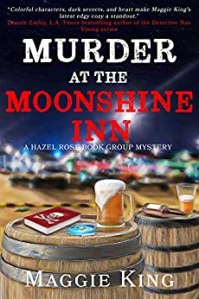
If you read #2 in the series, Murder at the Moonshine Inn, you will know the answer is “yes.” They married in beautiful Costa Rica. Hazel becomes a successful romance writer. The very name Hazel Rose conjures romance.
Hazel and Vince are best friends who respect each other and share a great passion. The passion is only suggested. I close the bedroom door on the reader.

Marriage definitely suits this couple. But they do have conflicts, the main one being when Hazel goes off on her own. Vince knows he can’t stop her from investigating, but he has her promise to always have him or another friend with her. But Hazel manages to find spur of the moment sleuthing opportunities that she can’t pass up. She knows she has to mend her ways. Trust is very important to their relationship.

The book group members don’t fare as well as Hazel and Vince in the romance department:

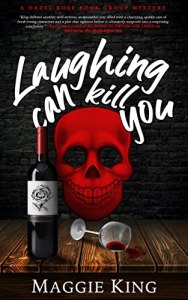
  • Hazel’s cousin Lucy (the “perfect” one) is having marital issues in Laughing Can Kill You, #3 in the series. She was very happy with her husband Dave until a chance discovery made her question his faithfulness.
  • In the first two books, Sarah Rubottom was married to a paraplegic Vietnam war veteran who was an outrageous flirt. In Laughing Can Kill You, he has died and Sarah chooses global travel over romance.
  • Trudy Zimmerman is the ex-wife of the victim in Laughing Can Kill You. She almost remarried aboard a cruise, but her fiancé dumped her (figuratively) for another passenger. Trudy is happy on her own.
  • Eileen Thompson has no romantic interest and is content without one.
  • Lorraine Popp’s own mother calls her an “old maid.”

The characters outside the book group are also unlikely to celebrate Valentine’s Day in any big, or even small, way. In the Hazel Rose mysteries, marriages and relationships are plagued with infidelities, addiction, women with bad boys, men with bad girls. There are women with husbands in prison. There’s a woman with a husband who may not even exist!

Then there’s the colorful and free-spirited Kat Berenger. Kat enjoys casual flings with a number of men. Perhaps she and her lover du jour exchange valentines.

Of course, I’m writing murder mysteries. Conflicts, misunderstandings, and unrealized expectations can lead to murder. I can’t have too many happy and romantic couples like Hazel and Vince.

Now my mind is abuzz with ideas for Valentine mysteries. I can see Hazel and Vince finding romance and murder while zip-lining in Costa Rica.

Happy Valentine’s Day+2. Because every day is Valentine’s Day!

#

Maggie King is the author of the Hazel Rose Book Group mysteries and short stories set in Virginia. Her story, “The Last Laugh,” appears in the recently-released Virginia is for Mysteries III anthology.

Maggie is a member of the Short Mystery Fiction Society, International Thriller Writers, James River Writers, and is a founding member of the Sisters in Crime Central Virginia chapter. Maggie lives in Richmond with her husband, Glen, and cats, Morris and Olive. She enjoys walking, cooking, travel, film, and the theatre. Visit her at MaggieKing.com.

Facebook: https://www.facebook.com/MaggieKingAuthor

Twitter: https://twitter.com/MaggieKingAuthr

Instagram: https://www.instagram.com/authormaggieking

#

POSTED FOR MAGGIE KING by Jackie Houchin

The Secret Books of Poison

by Alan Bradley


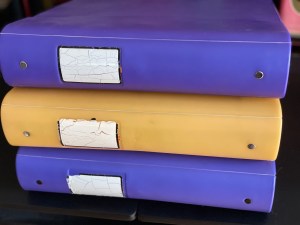
In my library are three slightly repellent books. One is the colour of poisoned custard, and the other two are a poisonous purple.

They look as if they’ve been through a lot. And they have.

These fat volumes, of about 500 pages each, were compiled in a time of disaster, and at the time, I didn’t know what I was doing or why. All I knew was that it needed to be done.

But first, a word of explanation. I am often asked, as are most writers, “Where did your main character come from? How did you go about creating him/her?” The simple answer is “I didn’t”, but the truth lies hidden in the thousand and more pages of these three uneasy books.

We had, at the time, a comfortable home on the edge of a forest – just like in the fairy tales. Until one night, lightning struck, and our forest was ablaze. Although we managed to get out safely with our pets, just ahead of the flames, more than 200 of our neighbours’ homes were reduced to ashes. When we were finally allowed to return, several weeks later, we found ourselves living in a blasted landscape: skeleton trees in a dead landscape of soot and ashes.

Time changed, and everything became different, including ourselves. What were we to do?

Sometime during those long hours and days and weeks that followed, I began compiling a compendium of poisons. The psychologists ought to have a field-day with that! Without knowing why, I had begun collecting and collating everything I could find on poisons and their history, all nicely filed alphabetically and indexed all the way from ‘A is for Arsenic’ to ‘Z is for Zarutin.’

The files grew from a folder, to many, and then to a book, then two, then three.

They contained detailed descriptions of the life and crimes of famous and not-so-famous poisoners, the history of specific poisoners from antiquity until just yesterday, the chemistry of poisons and their medical aspect. Ancient newspaper accounts told many a grim story, all so sadly the same: love gone wrong, ambition gone mad, and cleverness come a cropper.

There were heart-breaking tales of poor children who, in searching for something to eat, had – but enough! You get the idea.

Then, as the world around us restored itself, I put these books away, not knowing if I would ever look at them again. Whatever angel had caused me to compile this stuff had not bothered to leave an explanatory note. When the time came, I would know why.

Several years passed. Five, in fact. And there came a day when I decided that it was time to sit down and write that ‘Golden Age’ mystery novel I had been mulling since my younger days. It was a book that I much looked forward to, a tale that would draw on my years of experience in television broadcasting. Something fresh – something startling.

But it was not to be. I got no farther than the second chapter when, in a scene involving a visit to a crumbling country house in England, an eleven-year-old girl materialised suddenly on the page and would not, in spite of my every effort, be budged. She would not be written out and she would not be ignored. After a time, I realised that she had taken over my book completely. It was her book now, and my role was to sit down, shut up, and write what she told me to write.

And it came as no real surprise that her whole being revolved around a passion for poisons. Her knowledge of the subject was, you might say, voluminous.

Since then, she has more or less dictated ten novels, and has gathered readers around the globe in forty-some countries and forty-some languages. She has been on the New York Times bestseller list.

And that, dear reader, is the origin of Flavia de Luce, as best as I can manage to explain it.

And these three noxious volumes are the only proof I have that all of this is true.

See for yourself!

#


My website is www.flaviadeluce.com  My facebook page is AlanBradleyauthor. My gmail is flaviadeluce@gmail.com
 
Happy to hear from readers.
 
Photo by Jeff Bassett
 
I grew up in a small town in Southern Ontario, and being always fascinated by the magic of light and colored glass, naturally went into television broadcasting, both private and public. After twenty-five years as Director of Television Engineering at the University of Saskatchewan, I took early retirement to write a mystery that never got written. I did manage to write other things, though.
 
Now that I’m retired from retirement, having lived for a while in Malta, my wife and I now live in the Isle of Man, in the shadow of an old castle, where we keep an eye on the sea at our door, which was once frequented by Saint Patrick and the Vikings.


Alan Bradley has written TEN Flavia deLuce books, plus a short story, The Curious Case of the Copper Corpse. His newest novel is The Golden Tresses of the Dead. All the books are available in audiobook form (which I love). 
He also wrote a wonderful ebook memoir, The Shoebox Bible. 


“Write What You Know” : An Author’s Experience of Living in Africa

by Guest Author, Victoria Tait

SONY DSC
SONY DSC

A common piece of advice given to school children and new authors alike is “Write what you know”.  But many established authors dismiss the principle.  Ken Kesey, author of One Flew Over The Cuckoo’s Nest, told The New York Times, “One of the dumbest things you were ever taught was to write what you know.   Because what you know is usually dull.”

So where does an aspiring writer begin?  Unlike most authors, I had no lifelong desire to write a book and only considered it as a potential career two years ago.  We moved back to the UK from Kenya so my husband could begin training for his next military posting in Sarajevo, in Bosnia and Herzegovina.  I realised that as I didn’t speak Bosnian, and the country had a high unemployment rate, I was unlikely to find a job.

Further, as a family we would be moving around the UK, and potentially the world, for at least the next eight years.  I needed to keep myself busy and engaged, but not with a physical business like the farm shop I had set up in Kenya.  My new venture needed to be portable and flexible to work around the demands of my family.

I first considered writing as a method to convey the incredible experience I’d had living in Kenya, in Eastern Africa.  I’m not sure if moving to Kenya or returning to the UK was more of a culture shock.  In Kenya I’d become used to a way of life lived at a slower pace, with no judgement of what people wore or what car they drove, and far less emphasis on the material side of life.

Giraffe samburuIn Africa, the first priority is to survive and so each day, and certainly every birthday, is celebrated.  After that come friendships and community and, of course, enjoying the glorious sunshine, fantastic scenery and amazing wildlife that Kenya is famous for.

P.D. James wrote in her “10 Tips for writing novels” for the BBC, “You absolutely should write about what you know.  There are all sorts of small things that you store up and use, nothing is lost as a writer.  You have to learn to stand outside yourself.  All experience, whether it is painful or whether is is happy is somehow stored up and sooner or later it’s used.”

My Kenya Kanga Mystery Series is set in Nanyuki, a small market town three hours north of Nairobi, Kenya’s capital.   It is dominated by the often snow-capped Mount Kenya which, at over 17,000 ft, is the second highest mountain in Africa.  This is where I lived for six years, and it’s the perfect setting for a cozy mystery series.

Mkt St SceneIn my books I’ve used actual locations, such as Dormans, a town centre coffee shop and a hub of gossip, and the relaxed garden location of Cape Chestnut restaurant.  Other places, such as the Mount Kenya Resort and Spa, are recognisable as being based on real settings which I’ve altered to suit my stories.

Small towns in cozy mystery series can develop the “Cabot Cove” syndrome; if Cabot Cove existed in real life it would top a number of categories of the FBI’s national crime statistics. 

To avoid this phenomenon, I themed the second and subsequent books around actual events.  These include an important elephant focused wildlife summit, a 4×4 off-road charity event in the Maasai Mara and, in the book I am releasing in May, a marathon in a UNESCO World Heritage wildlife reserve.

Elephant Mother & Child PuddleA sense of place is important to me and my writing.  Has a certain smell or the call of a bird transported you back to a memorable location? I try to convey the smells, sounds and sights of the individual settings and it does help that I’ve visited most of them.  And if I haven’t, as P.D. James said, I can use snippets of other places that I have stored up to successfully create them.

The characters are another aspect of my books which I’ve developed as I’ve expanded my writing craft.  Mama Rose is based on an incredible friend of mine, now in her 80s, who is a community vet, a staunch catholic and a member of various committees.  The help and assistance she has given, and continues to provide, those less fortunate than herself can not be fully conveyed in my books. But is it important to recognise, and remember, that there are still people who put others before themselves and work for what is morally right and just in life.

The other characters have developed from meeting people and observing situations in Kenya: the interaction of customers and stall holders at the local vegetable market, street sellers trying to persuade tourists and visitors to buy their wares, and the ability of a charismatic priest to captivate his audience in a town centre park.

A snippet I have woven into one of my books occurred when I took my young children to mitumba; a large jumble sale of donated thrift clothes, and other items, from first world countries which are shipped to Kenya and sold in makeshift markets.

Mitumba 3Two raggedly dressed, and shoeless, children tentatively approached our car holding out their hands in a begging gesture.  I remembered two squares of jam sandwich which my boys hadn’t eaten.  I handed the pieces to the children expecting them to stuff them into their mouths, but instead they just stood and waited.   Slowly they were joined by a group of similarly attired children, and those who had the sandwiches carefully divided them up until every child had a small morsel to eat. 

This was an incredibly humbling experience.  So perhaps it is not necessarily “write what you know” but “write what you feel”. After all, as writers we strive to elicit an emotional response in our readers’ minds.

Finally, Dan Brown said, “You should write something that you need to go and learn about.”  As writers we do need to expand our knowledge, and understanding, and researching is one of my favourite area in the writing process.  I have learnt so much more about Kenya than I knew, or understood, when I lived there.

RHINO CHARGERhino Charge, my third book, has many Kenyan Indian characters.  It evolves around events at a 4×4 vehicle off-road event which is popular amongst the Kenyan Indian community.  Whilst I had Indian friends, I wasn’t aware of how, or why, their ancestors had settled in Kenya.  Researching this aspect of the Kenyan culture was fascinating.  I learnt that Indians came to Kenya with the British and supported the creation of the East African Protectorate, which became Kenya, as clerks, accountants and police officers.

Two and a half thousand Indian labourers died during the construction of the Mombasa to Uganda railway line, including those killed by the infamous man-eating lions of Tsavo.  The rupee was the first currency used in the colony which was ruled using an extension of Indian law.  On the 22nd July 2017, President Kenyatta officially recognised the Indian community as the 44th tribe of Kenya.  Researching and learning this extended my knowledge and increased the depth of Rhino Charge.

Not all authors are luckily enough to live in extraordinary locations such as Kenya, or Bosnia and Herzegovina, but small towns still have their own customs and query characters. 

I’m currently planning my next series which will be set in areas of the UK I have lived in and visited. The theme is antiques, of which I have no knowledge.  I enjoyed, and was fascinated by, auctions which I attended on my return to the UK, to buy furniture for our house.  And I observed some fantastic people for the basis of my characters.  I’ll research collectibles, antiques and related crimes to build interesting stories with “can’t put down” plots.

Mostar, HerzigovinaWhen I can finally move freely around Sarajevo, and Bosnia and Herzegovina, I will begin researching for a future series.  I’ve already discovered that everyone here has a story to tell from the devastating war and various sieges, including the longest in modern history in Sarajevo.  As I search for potential locations, characters and stories my attention will be more focused as I learn to observe and record even the smallest incidents.  Who knows what snippets will make into future books.


Author Links

You can find Victoria at https://www.victoriatait.com/ or on Facebook at https://www.facebook.com/VictoriaTait

Blog/News: https://victoriatait.com/news/

GoodReads: https://www.goodreads.com/author/show/20373879.Victoria_Tait

Pinterest: https://www.pinterest.co.uk/vataitauthor/

Purchase Links – Amazon – B&N – Kobo – 


JH

BACK TO BASICS: WRITERS’ BOOT CAMP PART II

by Miko Johnston

In any story, the beginning sets up the problem that must be solved and the ending solves it. How that happens comprises the plot, which plays out in the middle chapters. A good plot is like a good EKG, with lines that zigzag up and down. When tension and stakes increase, the line climbs upward. You never want a flat line; in matters of the heart and story, it indicates death.

In my last post we reviewed the three basic ways to begin a story as well as some techniques to get those opening pages written. What if you’ve gotten that far but haven’t moved forward?

Many writers get stuck after writing the opening chapter. A common problem is trying to perfect that opening. As a bone fide Brooklynite, I can say fuhgeddaboudit.

Nothing will hang you up more than trying to go over and over that first chapter, endlessly fine-tuning it before moving on. You can’t. You shouldn’t. Put it aside and keep going. Finish your first draft. Once you know how the story unfolds, go back and figure out how to fix the beginning.

Do you have a beginning and an end in mind? Then build your story like a bridge – set down firm spans on both ends and connect them in the middle. I wrote my first novel that way, working the plot backward from the final chapters and forward from the earlier chapters. Mysteries often fall into this category; you know the crime (beginning) and whodunnit (the reveal at the end). Work your clues in both directions until they meet in the middle.

What if you don’t know where the story is going? Many writers prefer to wait for the muse to whisper in their ear rather than draft an outline. In that case, why not choose a path and follow it to its logical conclusion? Think of it like those maze puzzles – a path may lead to a dead end, but then you’ll know it’s a dead end and try another path, eventually finding the one that leads you in the right direction. Everything you write will help guide you to The End. Two caveats, though:

-If you have a beginning and only a vague idea of the end, you’ll want to have enough to get you well into the middle before you tackle a novel, otherwise you may never reach your destination. My second book took over four years to write; I meandered through two plots I ultimately discarded, then conceived a third one worth pursuing.

Some writers feel as soon as it’s on the page, it’s permanent. Not so. In my second novel I found a way to solve a plot problem with a birthday surprise for my heroine, but I’d already given her a different birth date in my first novel. How could I get away with that? It took a week to realize an easy solution: neither book had been published yet, so I could change the date in book one to fit my new development.

***************

Are you stuck in the middle?  Writing your middle chapters, but unsatisfied with them? Fortunately, sit-ups and planks aren’t required.

Ways to improve a weak middle:

1 – Always keep your genre and theme in mind.

Your genre can shape how your story unfolds. A humorous cozy should be light and fun. Noir should be steeped in atmosphere. Use your theme or log line as the foundation on which you build your plot, and a guide to move it along.

2 – Take advantage of the multiple uses of dialogue

It can move the story forward, briefly slow the pace, draw our focus to a plot point or clue like a camera close-up, inform us of character, or foreshadow a later development.  Dialogue tags like Jon said identify the speaker, but by using a bit of action – Jon tossed his keys on the table – you also add movement. Finally, consider how your characters speak and what they don’t say.

3 – Keep the plot, and your character, active.

Not enough action will bog down the pace, but action means more than shooting and fighting, or running after suspects. Action can be physical or mental. Action is your character DOING whatever it takes to reach her goal.

4 – Have at least one mid-point crisis.

A good story always launches with a crisis and climaxes with a bigger one. Crises generate tension, which keep the middle from sagging. Introduce sources of conflict, whether leads in the investigation that fall through, the death of a material witness or ally, or a setback in the hero’s goal. Just make sure the crisis fits the story’s momentum and doesn’t exceed your climax scene.

5 – Avoid dumping in too much backstory.

Whether you’re trying to bring your character to life or writing a sequel, you need some backstory, just not too much. What are you trying to accomplish with the information? Insight into the character’s past that would explain why she does what she does? A reminder in a sequel of an event in a previous book? Ask yourself three questions:

            Is this information necessary for this story?

            Does it help to define the character or support the plot?

            Does it move the story forward?

If no, leave it out. If yes, then keep it brief. I read a few series and find the best of them will remind readers of characters and events with a line rather than a paragraph.

6 – Watch out for repetition.

We all know best-selling authors of series who, after a dozen or more books, begin padding their sequels with repetition. Just like unnecessary detail will bog down your story, so will repeating events or dialogue over and over and over and….. If you’ve just written a scene where an action occurs, your character doesn’t have to repeat this information to another character in the following scene. She told him what happened or words to that effect will suffice. If we need a reminder of what transpired later in the story, keep it brief.

7 – Reward and surprise us.

What’s worse, a story that’s totally depressing or totally predictable? Trick question; it’s a tie. Even the most dystopic stories must have moments of lightness. Whatever your character’s goal is – trying to solve the murder, find true love, succeed in business or win the battle – mete out some successes along with the setbacks. Lace in enough twists and surprises to hint how the story might end without giving the ending away.

This is particularly true in mysteries. Setting up a good red herring can be tricky since readers expect them. They’re delicious when they surprise us, but like all fish, if they’re mishandled they stink. As much as I enjoyed Girl On A Train, it was obvious who the murderer was a hundred pages before the book’s conclusion. Nothing’s more disappointing than knowing without a doubt exactly how the book will end. You presume the detective will solve the murder, but still want the pleasure of discovering HOW it happens, especially if the manner is unexpected. Just make sure that the reward or surprise is rooted in the story. Don’t plop something in for convenience. Weave a subtle thread back to earlier chapters to set up the surprise properly, or base the reward on something she wants or needs, even if she doesn’t know it.

8 – Keep the dialogue and prose in proportion.

Do you have enough dialogue? Too much? What about sensory detail, setting, character descriptions? There’s no magic formula but we don’t always consider the balancing act. Rereading your story, looking for something you don’t always consider, gets you looking at your pages in a different way. You may catch something that’s not working, even trigger an idea or solution. 

9 – Keep the middle in proportion.

I am not partial to using formulas for writing books (and have the luxury of not having to rely on them). However, if you’ve written several chapters and are unsure how the story is progressing, consider the percentage of pages dedicated to the middle versus the beginning and end. Although not a precise measurement, the opening, from Once upon a time to the inciting incident that launches your story, should comprise about a quarter of the total number of pages. So should the final act, from the climax scene to The End. That means the middle should be roughly half of the story. If your opening chapters comprise sixty pages and you’re up to page 300 but nowhere near the climax, your middle is probably bloated. If your middle is proportionally light, flesh it out or shorten the rest.

*          *          *

Still stuck? If you’re a visual person, try charting out your story, or as much of it as you know, on some kind of diagram. I’ve used line graphs, with peaks for crisis points and valleys for slower parts. I’ve used box charts, where I divide a sheet of paper into sixteen boxes – four for the beginning, eight for the middle and four for the end. In each box I briefly describe what’s happening at that point of the story. This shows me how the plot is developing as well as the balance between the acts. Since I write historical fiction, I also parallel historical events with my characters’ lives. If you write mysteries or thrillers, especially the cat and mouse variety, you can chart your hero’s progress against your villain’s actions.

If you’ve conceived some scenes but not an entire chapter, write it in chunks and assemble it later. If you prefer working with a hard copy, write the individual scenes, conversations or actions, leaving ample white space between them. Print them, cut them into sections and assemble them as you think works best. Move everything around until you have the order you want, and insert blank paper between the sections that need connecting. Pencil in notes about what you need to connect the passages. Use this to guide you through completing the chapter, or flesh out other chapters. It moves you forward. If you don’t like the direction, at least you’ll know another dead end to avoid. This can be done on the computer if you prefer working that way.   

Another technique that has proven helpful is to change ‘jobs’; instead of writing prose, think of yourself as a movie director. Can you visualize the scene you’re trying to create? How would you direct your characters? If there’s something missing in the scene, get input from the set dresser or wardrobe coordinator. As authors we tend to see our work from on high. Peering at it from a different angle gives us another perspective. Even closing your eyes and envisioning the words you’ve written (or listening to them being read) will make them pop and come alive, or hint at why they don’t.

Consider writing free-form dialogue, which I’ve described in this earlier post. This gives your characters an opportunity to speak for themselves. Sort of like the director asking the actors to ad lib their lines. If that doesn’t work, you may not know your characters well enough to ‘speak’ for them. In that case:

-Play the “who would I cast as…?” game – think of people, either famous or those you’ve known, and match them with your characters. Consider why you chose that person to help you flesh the character out.

-Try to describe your key characters in a word or brief phrase, then look for signs of commonality and discord between them.

-Define them with an image. For example, think of type fonts as a logo. If you were to assign a different font for each of your characters, which would represent them best?  

————————–

Once you’ve written an attention-grabbing beginning and a turn-the-page middle, you need to reward the reader with a satisfying ending. In the final installment, we’ll explore what that means and how to achieve it.

                                                                        #

Miko Johnston, a founding member of The Writers In Residence, is the author of three novels in the historical saga A Petal In The Wind, as well as several short stories. She is currently completing the fourth book in the series. Miko lives on Whidbey Island in Washington (the big one). Contact her at mikojohnstonauthor@gmail.com