Naming Characters

by Gayle Bartos-Pool

Sometimes the name of a character a writer uses just pops into their head. Other times they use the name of a friend or relative. There are also times when the writer changes the name they started with when they realize it doesn’t fit the character anymore. But how is that possible? The writer is just making up the name and the story.

Well, it’s like this…

When a writer is creating a story, they are creating a new world. It will be filled with things everyone will recognize or at least understand if the writer gives good descriptions. A space odyssey might be made-up, but there will be enough things explained so the reader can follow along. Hey, the people who wrote the Star Trek episodes imagined fantasy gadgets that were actually invented many years later by real scientists who used roughly the same concept and style for actual things we use today… “Scotty, beam me up!”

But character names can be tricky.

If one is writing a story that takes place a hundred years ago, names like Tiffany or Jaiden might not work. Watch an old movie and check out the names used. Or maybe read an old book. But something interesting is happening now in the first quarter of the 21st Century. Names from fifty to seventy-five years ago are making a comeback. This will probably mean that you can use any name for a contemporary story. But there still is the problem of fitting the name to the character.

In most cases you wouldn’t want the “heavy” in a cops and robber tale to have a cutesy name like Willy or Felix. They would more likely be the comic relief characters in another story. The same is true with the hero’s name. It would have to be something a bit stronger like Max or Duke. Remember, studio executives and a director changed Marion Morrison’s name to John Wayne to fit the type of characters he would be playing in the movies. And that’s a fact.

Female names have the same concerns. The female lead in a romantic story could be called April or Amber, not Bertha or Myrtle. Wilhemina could definitely be the name of the amateur sleuth in a cozy mystery. She could be a librarian or maybe an older sleuth like a Miss Marple.

Names can do as much to define a character as what he or she does within those pages. If you start off by introducing your main character with his or her name linked to a strong action, it will help the reader understand the part they are playing.  But that is only if you want the reader to know who they really are from the start.

If, for some reason, you wanted to gradually introduce your hero, you could peel away certain aspects of your lead character by letting him show the reader those special qualities a little at a time, but that method is usually meant for the villain who starts off as just one of the boys or maybe some influential person in the plot, but who knew he was actually the bad guy? The hero will finally see the real person under all that finery and expose him.

As for the hero, usually the reader knows who he is from the beginning, but the hero might have to discover that truth about himself by peeling away his own fears and finding his own strength when push comes to shove at the end of the book. The reader will be rooting for him, but he has to do the work.

But establishing the name for that character will still take some planning. Now that we have access to the Internet, you can type in the name that you have cleverly come up with. It fits the parameters of your story. It isn’t too quirky or too cumbersome. But “what if” there is some famous person with the same name out there? Just about every name I have come up with has two or twenty-two people with the same name on the Internet. I have a rule: If it isn’t some current name in the news and I like it, I’ll go with it.

I seldom use the actual name of a friend in my stories. If I only use their first name, I’ll do that, but I have added little changes to their names just for fun. The reason I do this is because I do want my characters to have a life of their own. After all, my friends have their own lives. But it’s fun to use their first name for a character who makes a “special guest appearance.”  I even used a version of my dad’s name in my spy novels. Dad dealt with spy planes and did some rather interesting things that are still classified, so calling my character “Ralph Barton” instead of “Ralph Bartos” worked. And dad got a kick out of it.

I probably do keep the names of my characters fairly simple. If they are all wildly intricate with too many syllables, the reader might get lost in the multi-syllabic confusion. And several odd names might confuse the reader as well. They might think Henrietta is Hildegard and not understand why the wrong one riding in the taxi with the killer.

So, I keep the names a little simpler and do something else. I don’t have three or four characters in the same story with a name that begins with the same letter. This makes it easier for the reader to follow, and it actually makes writing the story easier, too. I don’t want to confuse my characters while I’m writing.

And I do try to fit the name to the character. One of the fun names I picked was for my second private detective series. It came about this way. I always liked the old detective shows on television back in the 50s, 60s, 70s and 80s. And the private eyes from the old black and white movies I watched on the movie channel. I wanted this new character to be a tribute to those guys. Too bad they don’t have good detective shows on TV anymore. Our loss.

I started with Sam Spade. That was the name of the character Humphrey Bogart played in The Maltese Falcon based on the 1930’s novel written by Dashiell Hammett. A classic. I also liked the television series, “Richard Diamond,” starring David Janssen, that ran from 1956 to1960. I was a fan of “Hart to Hart,” starring Robert Wagner that ran from 1979-1984.

So, I liked all these cool detectives. I noticed that their names were like the different suits in a deck of playing cards – Spade, Diamond, Heart. I needed a Club, but that name wouldn’t work. Sounded like a caveman or something.

Then I thought: what’s another word for “club”?

There’s gaming club, gambling club, and a gambling casino!

How about just casino?

And Johnny Casino was born.

The name fit this character who took a chance, changed his name from Cassini to Casino after he worked on a gambling ship near Maimi and had to leave in a hurry. He then took another chance and moved to Los Angeles and after getting his life together, he became a private investigator.

But I worked on getting his name and his life right…Three books later, I guess the “chance” I took paid off.

And you know what?  There was one more chance in this story. Another character was working his way into my head. His name: Chance McCoy. He got a second chance in life himself. There are three books in his detective series.

You see, names do matter. If they fit the character you’re writing, they can lead you to many new places. Write On!

Acting Class 101

By Gayle Bartos-Pool

If we’re lucky, we learn stuff everywhere we go in life. I did just that when I moved to California when I was twenty-five. I wanted to write for television and the movies. Me and five million other people. Since I didn’t know anything about the “business” of Hollywood, I thought it would be a good idea to take an acting class to see what writers needed to know when creating a screenplay character.

I happened to get a job working for a talent agent, and he got me in an acting class. This one was taught by Bruce Glover. You might have seen him in the James Bond movie Diamonds Are Forever. He played the sinister/funny character that was trying to kill off Bond.

What Bruce taught was when you’re playing a character, large part, small part, or walk-on, have your character do something that makes him stand out. Have a menacing smile or a delivery of your lines that has everybody notice you. Many famous actors started as bit players and went on to fame and fortune when they did something that stood out on the screen. And that doesn’t mean just having a pretty face.

As a writer, I figured that when I wrote characters, large or small, I would give them something that stood out. It might be their clothes that telegraphed what economic bracket they fell into or a whacky giggle to show that maybe their elevator didn’t go up too many floors. Maybe it’s the words they use that show their high-toned upbringing or their lack of education.

While taking that class, I had to do an improvised scene with another actor. We were to be boyfriend and girlfriend who were having problems. As the other actor and I were chatting on stage pretending we were seeing eye-to-eye while all the time pointing out the major problems we were having with the other character, I had a piece of paper in my hand that I said was the love letter he had written to another woman. I kept folding it in half, long-ways, until it looked like a knife. Obviously, my character was signaling what I wanted to do to my soon-to-be-ex boyfriend. Actions speak louder than words sometimes.
I try to give most of the characters I write that little bit extra to define them, too.

That acting class wasn’t the only one I took. I got lessons from Rudy Solari and Guy Stockwell. Both men had long careers in Hollywood. What Rudy had actors do was write a biography for the character they were playing so they knew exactly who they were when they stepped on the stage. It didn’t have to write pages and pages, just a brief background of that character, stating where he came from, how he was raised, his education, and what he wanted out of that scene.

What this did for the actor was let him know what motivates his character because in a screenplay, the writer usually just provides the dialogue, maybe how the line should be spoken like a whisper or yelling, and a few physical actions like running away or punching someone. Of course, the director will provide even more of those directions.

But the writer of a novel or short story needs to know who this character is, what motivates him, and things like his age, hair color, and stature, because when you’re writing a story, you don’t want to get to page 275 and have your twenty-five-year-old character with black hair all of a sudden be a thirty-six-year-old blond.

I write a short biography for all my main characters, adding to it as I think about what their past might have included that will help the current story angle. And I keep a Character List for everybody appearing in the story so I know who is who, and who they know, and why they’re there. It sure helps when I get to a spot and need to know all the previous things I wrote about that character like their age, hair color, or their role in the story.

And something else about those two acting classes, they gave me the confidence to get up in front of an audience when I’m talking about the books I wrote. I already know my motivation: get people to read.

The Case of The Runaway Bride

By Jill Amadio

Outraged at my character deciding to get herself murdered far too early in my mystery, I was also furious that she had the temerity to go out on her own and run off with my carefully organized plot. She wasn’t actually a bride, but she sure was a runaway. And a female.

How dare she!  I had barely sorted out a new setting and spent time researching a lonely location in the UK when this forward young woman opted out of my book. Not only had she escaped from my timeline, but she was also in the wrong place.

Her impulsive decision and demise threw two other characters, one the murderer, into complete confusion. I almost felt them turning to me and saying, “Now what?”

Keeping control of one’s fictional characters is usually a given. Like chess pieces, the author can move them here and there with impunity. We can, and often do, change people and places around but the decision has to be the writer’s.

Something similar happened to me once before. In my second mystery, I knew who the killer was, and I looked forward to her denouement. However, the more I wrote her, the more I came to like her. The upshot was I had to choose a different character as the murderer and thus change his gender and personality, to say nothing of his traits and habits.

However, my runaway person really put me over a barrel with her unexpected death. Should I write her out completely? Force her to stay alive a little longer? What did her early, unplanned demise mean to the rest of the storyline, the remaining characters, and my peace of mind?

It seemed that the best thing to do was to move the chapter in which she wrote herself gone forever to the end of my Word document so that I wouldn’t have to look at that chapter until l I decided where to fit it in, given the new circumstances.

Actually, I knew exactly where and when I wanted her to meet her end, but her decision to die on her own terms threw me into disarray. To say nothing of writer’s block.

I perused my synopsis, wondering if I should wedge her in where she wanted to be, but again, it was clear that her interference meant a lot more work. I would have to rearrange people and places, maybe add a new character and perhaps an extra victim, if any of her shenanigans were to make sense.

Another thought – must I re-think my POV? In order to get her back in line, would she be satisfied with being re-written in first? Her dramatic demise certainly was a plea for help. On the other hand, I had envisioned and written her with poor eyesight and she wore glasses. How did that affect the decision to off herself?  Was she too vain to wish to continue as one of my characters? I saw my authority begin to dissolve.

So, in a heroic effort to re-establish and re-claim my jurisdiction – after all, she was supposedly my creation – I finally decided I needed to be very firm with her. She could not just go around deciding how, when, and where to become the center of the action. What if others followed her lead?

Ah! Maybe that was her problem. She felt like a minor character rather than a major one. She wanted more attention. Still, offing herself hardly seemed the way to go about it since, once she was dead, she had no way to enjoy the fruits of her action. I’d not planned for her to play a prominent part. I guess she realized she was definitely not the important character she thought she deserved to be.

Again, I had a lightbulb moment. Therein lay the danger of a runaway character. They imagine they have a more significant role in the plot or a different personality than the author provides. Writers know that characters make a story. When your fictional book people populate your imagination and come alive their actions determine the story.

Readers want to be swept away into the life of a character. This silly woman ruined that purpose. I was sorely tempted to discard any reference to her and replace her with a male.

As I continued to figure out what to do, I began to question my understanding of human nature. Then I remembered that this runaway lady was not human but a creation—an AI. Perhaps my fellow Residence writers can suggest a solution. Am I being a Pollyanna?

BRINGING CHARACTERS TO LIFE

by Miko Johnston

We can plot our stories well, describe settings vividly, and touch on all the senses, but the heart of any story is its characters, and they need more than a heart to make them come alive.

I began writing fiction, or more accurately, learning how to write fiction, while working in a library. It gave me access to numerous books and magazines for self-study. One book in the collection devoted a chapter to creating characters, complete with a checklist of traits and their opposites – outgoing vs shy; scholarly vs uneducated – from which the prospective writer could choose and assemble. I found the idea silly and worse, useless. Whether in my writing or my reading, I want characters to resemble real human beings, only more interesting than the average person. You can’t achieve that by compiling random parts. Just ask Dr. Frankenstein.

We’re told to have our characters want something and then keep it from them, make them fight for it. Good advice, crucial for plot. We must describe them with enough detail so the reader can visualize them; again, good advice. Backstories and bios, family and friends, strengths and flaws, jobs and hobbies or interests. How they dress. What and who they like or dislike. The dark secret in their past that drives them forward or holds them back. These big picture details lay a foundation for characters. However, it takes more to breathe life into them. Whether you call them quirks, idiosyncrasies or eccentricities, these subtle differences add a realistic quality to them.

Although our individual quirks may differ, we all have them, which makes this a commonality. In other words, a human trait.

Think of Robert Crais’ Elvis Cole and his affection for cartoon characters, the dry humor of Nelson DeMille’s John Corey, or the fussy Inspector Poirot and his eggs in Agatha Christie’s mystery series. Master art restorer Gabriel Allon inherited his talent, as well as trauma, from his Holocaust survivor mother. And while we naturally empathize with a blind girl like Marie-Laure in “All The Light We Cannot See”, the way she copes with it makes her mesmerizing.

There are two general types of quirks – nature and nurture. Nature includes those the character was born with, such as personality types or bio-physical traits like an intellectual disability or a club foot. A life experience, whether an acquired taste or an emotionally painful experience, would fall under the nurture category. In all cases, how the character has internalized the trait leads to the quirk.

Quirks have to be worked organically into the story. They shouldn’t be unrooted in the character’s history or biology. They should play a role in the character’s thoughts, emotions or actions. They need to be noticeable, but not too blatant; subtle, but not too vague. Readers need to discover them on their own by being shown the behaviors rather than being told about them.

A character’s quirks can be related to their physicality, the way they dress or groom themselves, their behavior or personality, or they can be completely random. Here’s one example: money. Most everyone I’ve met has a philosophy, or criteria, about what they’re willing to spend on something. They’ll be tight-fisted about some things and looser, even extravagant about others. What does it say about a character who’ll spend hundreds of dollars on tickets to the opera, a Broadway play, or the Superbowl, but won’t pay two dollars for a can of tuna in the supermarket unless they get a double-off coupon? Or worse, not buy it at all because they can remember when it cost thirty-nine cents? It says they’re “human”.

Ultimately, it’s not so much a matter of “what” a character does or doesn’t do, what they like or dislike, that makes them full-fledged humans. It’s the “why” that makes it interesting and brings them to life. Always listen to your character, for they’ll often tell you what’s right for them. For hints on this, see Gayle’s earlier post.

When treading the fine line between character and caricature, here’s what to avoid:

  • Cliched or overused idiosyncrasies. If I had a dollar for every alcoholic PI, or divorced or widowed detective, I could pay my cable bill for a year. If you’ve seen it before, add a new twist. If you’ve seen it over and over again, avoid it like the plague (humor intended).
  • An assemblage of unrelated quirks, as if selected from a list found in a book (jab intended). Author Rex Stout’s Nero Wolfe tends his orchids, reads voraciously, and feasts on gourmet food from the comfort of his luxurious home. The genius of his character is how all his passions connect.
  • Limit the number of quirks, or else – well, just ask Dr. Frankenstein.
  • Don’t overdo the ones you use. Quirks are like seasoning – you need enough to enhance the flavor without overpowering it.

If you found this post helpful, leave a comment, and feel free to contribute your suggestions for making characters come to life. Frankly, my ulterior motive in writing this comes as much from my goal to write books with believable and engrossing characters as my desire to read them.

Miko Johnston, a founding member of The Writers in Residence, is the author of the historical fiction series, “A Petal in the Wind”, as well as a contributor to several anthologies including the about-t0-be-released “Whidbey Island: An Insider’s Guide”. Miko lives in Washington (the big one) with her rocket scientist husband. Contact her at mikojohnstonauthor@gmail.com

Let Me Entertain You!

by Jackie Houchin

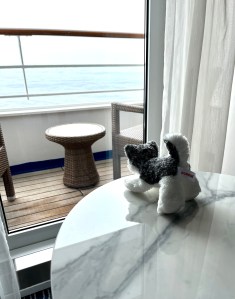
Lots of medical stuff going on with me right now, so I thought I’d simply share a fun aspect of our Alaska cruise last fall. That aspect is called MUSH.  No, not yelling at sled-pulling dogs (although we DID do that), but a different kind of Mush.

In Skagway, Alaska, I bought a small toy Husky, a beanie-bag size and shape little guy, with soft gray/white fur, big blue eyes, and the name MUSH printed on the tag. I loved the little guy from the first glimpse and perched him on my pillow in the stateroom when we got back to the ship. Joel, our cabin steward aboard the Oceania Regatta ship, loved Mush too.

When we left for dinner in the evenings the steward would come in to straighten up and turn down our beds. When we returned later, we found the usual chocolate candy on our pillows, AND…..Mush, posed in a series of so cute antics. The first time, he was propped on a pillow with the TV remote, watching a football game on the screen.

Another time he was standing on an open book (that I’d been reading), as if he were reading too.

Once when we came back from an excursion ashore and after we’d had lunch at the buffet, we found him on our small room table with the curtains draw slightly, looking out at sea.

And then, every evening HE started getting chocolate candy too, an additional piece placed between his paws. We were absolutely delighted.

Of course “I” started posing Mush for Joel too when we went out for the day, hiding him where the pitcher of ice water was kept, or behind the desk alarm clock, or sometimes just lying on the bed, his head tucked in and front feet up, waiting for a belly rub.

We had such fun with Mush and our very good and so kind cabin steward.  Another sweet memory.  And now, Mush resides on my dresser at night, guarding my glasses, and sometimes on my pillow during the daytime.  (But he’s on a diet now – no chocolate.)

##

Maybe I could write a cute kid’s story starring Mush on an ocean cruise. He could meet friends, find a missing object, solve a mystery, or rescue someone in danger.  Now that’s an idea!! Mush and I might have to put our heads together and come up with a plan!

How Do You Name Your Characters?

by Jackie Houchin

NAMES in stories are important in that they have to “fit” the characters, the era, the country, and even class in which they live. You wouldn’t name a society woman, Buster. (Well, unless there was a right good reason for it.)  Also, a native seamstress of New Delhi probably wouldn’t be called Manuela. So how do you find those perfectly fitting monikers?

It used to be you could use telephone books, but who even has seen one of those in the last 15 years??  There are websites that offer names for babies and their meanings. Some even suggest names that were popular in different years. (See below)  Maybe you will name your heroine or villain after someone you love, or love to hate.

SUGGESTION One – A couple years ago I came up with an idea for a short story in a contest. I liked the name Autumn (the story had to be set in the fall). She would be a painter. I know how I wanted her to look – long, wavy auburn hair, green eyes. And she would be the quiet type.

Boy, did I get a shock when I asked my friends on Facebook what a character with the name Autumn Gold would look like and what she might do for a living. Nearly all of them said she would be a sexy night club dancer or even a street walker. Yikes!  I changed her name to Audrey Gould. But I titled the story, and named the fantastical woodland painting her boyfriend made with her hidden image in the colors, “Autumn Gold.”

I got honorable mention out of 400 entries.  Asking around might be a way to check out that clever name you’ve chosen.

SUGGESTION Two – I also wrote a middle grade mystery titled “The Bible Thief” set in a church much like the one we attend. For some weird reason 4 or 5 people (including myself) lost their Bibles at some church event. Some were found, others not.

Hmm. I pondered, and immediately thought of a clever gang of kids who would “investigate” and discover the remarkable solution to this mystery. Because I wanted to share the story with the kids in the 4th-6th grade class I was teaching, I minimally disguised their own names as the gang, their parents, and a few other easily recognizable people (by description) in the congregation.

That was easy!  And maybe YOU have used names of people you know but changing Sheryl to Sherry, or Garrett to Darren.

SUGGESTION Three – And lastly, I also wrote a series of related short stories for the same age children, set in Africa. There were seven kids (one set of twins, and one who passed away at a week old), and they all had names that coordinated in some way with the month they were born in.

The youngest boy, born near Christmas (and since his father was a mission pastor) got named Deacon. “Deek” for short.

There was a girl, April (yeah, I know, too easy) and the twin girls were named Melody May and Charity June. (Know why twins have two months?)

A younger boy was named August, nicknamed “Gus.”  The oldest boy was Marshall (can you guess his month?).

A sensitive girl born in July I named Julie Joy. And the little guy that didn’t make it very long was Freddie, born just after Valentine’s Day.

So, that is how I sometimes choose character names. How do YOU come up with yours?

##

Baby names from Social Security lists by popularity, the top 5 by year, by decade, state, and US Territory – https://www.ssa.gov/oact/babynames/

2023 Baby name finder and the meaning/origin – https://emma.ca/baby-names

70,000 Baby names by gender, alphabet, origin, meaning, and religion – https://www.momjunction.com/baby-names/

The Gift of Procrastination*

by Miko Johnston

* I wish I could take full credit for the title, but a google search uncovered it as the title of another blog post about graduate student life at McGill University in Montreal, Quebec Canada. Suffice it to say this refers to something completely different.

My attitude toward procrastination varies depending on if it’s helping or hindering my progress – as a writer, as a wife, as a friend, and a human being. Sometimes I chastise myself for what I perceive as laziness, or cowardly behavior. I rarely see it as praiseworthy. Nevertheless, I can say procrastination has made me a better writer.

My first book took over ten years to get published. I’d finished it long ago, at least in the “The End” way, but endless tinkering, at first over chapters, then scenes, then words, kept me from getting it into print. I finished my second book in that time. It turned out to be a fortuitous move.

When I finally got up the courage to query a publisher, I had not one, but two completed books in a series, to offer. This probably helped draw interest to my work. Naturally, finding the right match of writer and publisher helped as well, and I was fortunate enough to find myself in that situation.

My first book took eight years to write and my second book, four years. I half-bragged/half-joked that at this rate I’d get book three done in two years, and number four in one. And did I?

Of course not. Some unexpected delays occurred. Part of my writing method is to immerse myself in the time period, right next to my characters, and through research and logic balanced with creativity, I can turn out good scenes. When I can’t get immersed, it’s a problem, as when I tried to write about the suffering in Europe during the tragic “Turnip Winter” of WWI. Picture Ireland’s Potato Famine coupled with an abnormally cold winter in the middle of a war. Now imagine trying to put yourself in that mental state when you’re vacationing on a tropical island where, much to your surprise, you’ve been given luxury accommodations.

The biggest writing lapse I’ve taken so far has been between a promising start on my fourth book and writing the final chapter. An eighteen-month gap lingered between the last pre-pandemic chapter I’d written and when I returned to finish the story in early 2021.

During that time, between Covid and the socio-political turmoil we went through, I saw too many parallels between current events and what occurred a hundred years earlier, when the novel takes place. It seemed disingenuous to ignore, so when I returned to writing it I included many of those similarities into the story, then went back and rewrote the earlier chapters to delve deeper into the effects of a world-wide pandemic and political discord on the characters.

With book four completed, you’d think I’d take advantage of the momentum and begin the final book in my series. To paraphrase Humphrey Bogart’s Rick in “Casablanca,” you’d be misinformed. In the past I’ve taken the last two months of the year off from writing, as I tend to be very busy with holiday plans and travel. This year is no different. I am still working out how to finish the story I’d begun twenty years ago, which will prepare me for writing it after the new year, but should I instead dive in and “just write?” Am I procrastinating yet again? I suppose I am, but it may lead to a better finale. Time will tell.

Miko Johnston, a founding member of The Writers in Residence, is the author of the historical fiction saga A PETAL IN THE WIND, as well as a contributor to anthologies, including “LAst Exit to Murder” and the soon-to-be-released “Whidbey Landmarks”.

Miko lives in Washington (the big one) with her rocket scientist husband. Contact her at mikojohnstonauthor@gmail.com


A Revelation and a Lesson in Reality

Moving from California to Connecticut, coast-to-coast, during the first months of the COVID pandemic resulted in flying out of an airport almost devoid of staff and passengers. I sailed through Security with only two other people in line. In fact, the airport was a ghost town, as was LaGuardia when I reached New York. No coffee shops or stores were open, but, warned ahead of time, I’d brought my own travel cup and, of course, my kindle loaded with eBooks.

It had been 23 years since I had lived in CT and discovered that I knew not a soul any longer except for my son and daughter. I searched the Obituaries pages for news of long-lost friends and called up a newspaper I used to work for but no one had heard of my fellow reporters from so long ago.

Needing to get back into the writing community I joined the New York chapters of Mystery Writers of America, Sisters in Crime, and renewed my Authors Guild membership, but there were no actual meetings scheduled except for Zoom. Like most writers I thrive on in-person contact where we have an opportunity to pick up characteristics of other humans, locales, and other, often small, details we put to use in our books.

I cast around for any group related to writing that met in person and this month, lo and behold, I was told of a women’s book club that was actually meeting at a coffee shop. There was also a memoir group at someone’s home. I’d been to several book clubs in California as their speaker when one of my books was the subject of discussion but what would it be like sitting on the other side of the table? I’d been treated with great respect, gentleness, and politeness each time with questions that were easy to answer and expected the same for this author and his work.

Instead, it was a revelation and a lesson in reality.

The book under discussion was a pretty hefty novel by a renowned author.  I was struck the most by everyone’s intensity, enthusiasm, and deep knowledge of each character and their supposed intent; the proposed meaning of every scene, and talk about the author’s hidden message on almost every page even if there were none. It was fascinating to hear that three members said they were in disagreement with the author because one character didn’t really mean what he said and other members backed her up. Another lady said a character should not have done what she did and offered an alternative to what the author wrote, and yet another lady said two of the characters should never have had the argument they did if only they had done so-and-so.

Wow!

Suggesting rewriting parts of an important classic to suit varying ideas about where the plot and its people should have gone gave me an introspective that I knew was impossible to achieve. There are a couple of classics wherein the author addresses the reader as “dear reader,” in his/her books but I doubt it is a plea for understanding the book’s intent. Authors cannot please everyone, and occasionally cannot please themselves when they re-read a book they wrote years earlier, perhaps, and see one or two parts they’d like to edit.

I enjoyed the back and forth between the ladies who were diplomatic in their critiques despite opposing opinions. One tended to hog the limelight by going on and on until the group leader gently cut her off. I was surprised that 4 or 5 of the 14 in the group remained mute the entire time but the others made up for their silence with well-articulated points of view, albeit wishing the author had written some scenes a bit differently.

As the newcomer I mostly listened and didn’t reveal I was an author.  Maybe it wouldn’t have mattered but I was there to discuss someone else’s work.  Only at the end did I disagree with the general conclusion that the main character had redeemed herself by her ringing endorsement of a couple in love rather than try to split them apart as she had earlier in a book-long fit of jealousy. One member asked if the author wished readers to come to like his previously nasty main character at the end by having her do a complete turn-about of herself.

My take was that she was self-serving by pretending to have changed in order to receive everyone’s good wishes instead of their usual disparaging remarks when she dissed them ad nauseum. She was congratulated and basked in their comments, but to me she was still living up to her me-me-me attitude. My statement was then discussed and agreed to by a slim majority of members, while others said they hadn’t thought of it that way but, yes, it made sense.

Perhaps had the author been at this meeting he would have been flabbergasted at the suggestions for changes, as sensible as they were, and probably even a little daunted at the thought but, all in all, I liked the fact that these book clubbers genuinely loved books and discussing them in depth was important to their lives. I am glad I joined and plan to attend every month.

Should I take a lesson from the discussion? Yes, very much so except I am still writing what I want to write. If a reader finds problems in a book that is fictional the author can be excused. What have been your book club experiences?

###

Jill Amadio is a ghostwriter and cozy mystery writer. This is her new novel.

A leggy wildflower of a girl, teenage Sofia runs away from rural Oregon to big city Portland where she meets and marries a charismatic Saudi Arabian later known as 9/11 hijacker #13. While a slumbering America embraces feng sui and pizza she is present when terrorist sleeper cells are organized in her home, maps of landmark buildings, airports, and bridges are studied, and teams of recruits take flying lessons.

IN TERROR’S DEADLY CLASP, a novel, is based on her true story, providing a rare, chilling glimpse under the radar of the terrorists’ daily lives as they enjoy strip clubs, fast food, and freedom from their religious rules. After warning the FBI of the Arabs’ photo sessions, driving several men into America illegally from Mexico, and other suspicious activities, she goes undercover for U.S. intelligence agencies with deadly consequences.

The Secret Books of Poison

by Alan Bradley


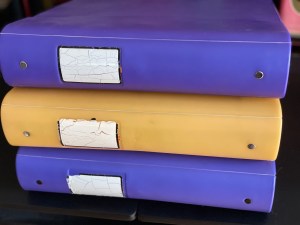
In my library are three slightly repellent books. One is the colour of poisoned custard, and the other two are a poisonous purple.

They look as if they’ve been through a lot. And they have.

These fat volumes, of about 500 pages each, were compiled in a time of disaster, and at the time, I didn’t know what I was doing or why. All I knew was that it needed to be done.

But first, a word of explanation. I am often asked, as are most writers, “Where did your main character come from? How did you go about creating him/her?” The simple answer is “I didn’t”, but the truth lies hidden in the thousand and more pages of these three uneasy books.

We had, at the time, a comfortable home on the edge of a forest – just like in the fairy tales. Until one night, lightning struck, and our forest was ablaze. Although we managed to get out safely with our pets, just ahead of the flames, more than 200 of our neighbours’ homes were reduced to ashes. When we were finally allowed to return, several weeks later, we found ourselves living in a blasted landscape: skeleton trees in a dead landscape of soot and ashes.

Time changed, and everything became different, including ourselves. What were we to do?

Sometime during those long hours and days and weeks that followed, I began compiling a compendium of poisons. The psychologists ought to have a field-day with that! Without knowing why, I had begun collecting and collating everything I could find on poisons and their history, all nicely filed alphabetically and indexed all the way from ‘A is for Arsenic’ to ‘Z is for Zarutin.’

The files grew from a folder, to many, and then to a book, then two, then three.

They contained detailed descriptions of the life and crimes of famous and not-so-famous poisoners, the history of specific poisoners from antiquity until just yesterday, the chemistry of poisons and their medical aspect. Ancient newspaper accounts told many a grim story, all so sadly the same: love gone wrong, ambition gone mad, and cleverness come a cropper.

There were heart-breaking tales of poor children who, in searching for something to eat, had – but enough! You get the idea.

Then, as the world around us restored itself, I put these books away, not knowing if I would ever look at them again. Whatever angel had caused me to compile this stuff had not bothered to leave an explanatory note. When the time came, I would know why.

Several years passed. Five, in fact. And there came a day when I decided that it was time to sit down and write that ‘Golden Age’ mystery novel I had been mulling since my younger days. It was a book that I much looked forward to, a tale that would draw on my years of experience in television broadcasting. Something fresh – something startling.

But it was not to be. I got no farther than the second chapter when, in a scene involving a visit to a crumbling country house in England, an eleven-year-old girl materialised suddenly on the page and would not, in spite of my every effort, be budged. She would not be written out and she would not be ignored. After a time, I realised that she had taken over my book completely. It was her book now, and my role was to sit down, shut up, and write what she told me to write.

And it came as no real surprise that her whole being revolved around a passion for poisons. Her knowledge of the subject was, you might say, voluminous.

Since then, she has more or less dictated ten novels, and has gathered readers around the globe in forty-some countries and forty-some languages. She has been on the New York Times bestseller list.

And that, dear reader, is the origin of Flavia de Luce, as best as I can manage to explain it.

And these three noxious volumes are the only proof I have that all of this is true.

See for yourself!

#


My website is www.flaviadeluce.com  My facebook page is AlanBradleyauthor. My gmail is flaviadeluce@gmail.com
 
Happy to hear from readers.
 
Photo by Jeff Bassett
 
I grew up in a small town in Southern Ontario, and being always fascinated by the magic of light and colored glass, naturally went into television broadcasting, both private and public. After twenty-five years as Director of Television Engineering at the University of Saskatchewan, I took early retirement to write a mystery that never got written. I did manage to write other things, though.
 
Now that I’m retired from retirement, having lived for a while in Malta, my wife and I now live in the Isle of Man, in the shadow of an old castle, where we keep an eye on the sea at our door, which was once frequented by Saint Patrick and the Vikings.


Alan Bradley has written TEN Flavia deLuce books, plus a short story, The Curious Case of the Copper Corpse. His newest novel is The Golden Tresses of the Dead. All the books are available in audiobook form (which I love). 
He also wrote a wonderful ebook memoir, The Shoebox Bible. 


“Write What You Know” : An Author’s Experience of Living in Africa

by Guest Author, Victoria Tait

SONY DSC
SONY DSC

A common piece of advice given to school children and new authors alike is “Write what you know”.  But many established authors dismiss the principle.  Ken Kesey, author of One Flew Over The Cuckoo’s Nest, told The New York Times, “One of the dumbest things you were ever taught was to write what you know.   Because what you know is usually dull.”

So where does an aspiring writer begin?  Unlike most authors, I had no lifelong desire to write a book and only considered it as a potential career two years ago.  We moved back to the UK from Kenya so my husband could begin training for his next military posting in Sarajevo, in Bosnia and Herzegovina.  I realised that as I didn’t speak Bosnian, and the country had a high unemployment rate, I was unlikely to find a job.

Further, as a family we would be moving around the UK, and potentially the world, for at least the next eight years.  I needed to keep myself busy and engaged, but not with a physical business like the farm shop I had set up in Kenya.  My new venture needed to be portable and flexible to work around the demands of my family.

I first considered writing as a method to convey the incredible experience I’d had living in Kenya, in Eastern Africa.  I’m not sure if moving to Kenya or returning to the UK was more of a culture shock.  In Kenya I’d become used to a way of life lived at a slower pace, with no judgement of what people wore or what car they drove, and far less emphasis on the material side of life.

Giraffe samburuIn Africa, the first priority is to survive and so each day, and certainly every birthday, is celebrated.  After that come friendships and community and, of course, enjoying the glorious sunshine, fantastic scenery and amazing wildlife that Kenya is famous for.

P.D. James wrote in her “10 Tips for writing novels” for the BBC, “You absolutely should write about what you know.  There are all sorts of small things that you store up and use, nothing is lost as a writer.  You have to learn to stand outside yourself.  All experience, whether it is painful or whether is is happy is somehow stored up and sooner or later it’s used.”

My Kenya Kanga Mystery Series is set in Nanyuki, a small market town three hours north of Nairobi, Kenya’s capital.   It is dominated by the often snow-capped Mount Kenya which, at over 17,000 ft, is the second highest mountain in Africa.  This is where I lived for six years, and it’s the perfect setting for a cozy mystery series.

Mkt St SceneIn my books I’ve used actual locations, such as Dormans, a town centre coffee shop and a hub of gossip, and the relaxed garden location of Cape Chestnut restaurant.  Other places, such as the Mount Kenya Resort and Spa, are recognisable as being based on real settings which I’ve altered to suit my stories.

Small towns in cozy mystery series can develop the “Cabot Cove” syndrome; if Cabot Cove existed in real life it would top a number of categories of the FBI’s national crime statistics. 

To avoid this phenomenon, I themed the second and subsequent books around actual events.  These include an important elephant focused wildlife summit, a 4×4 off-road charity event in the Maasai Mara and, in the book I am releasing in May, a marathon in a UNESCO World Heritage wildlife reserve.

Elephant Mother & Child PuddleA sense of place is important to me and my writing.  Has a certain smell or the call of a bird transported you back to a memorable location? I try to convey the smells, sounds and sights of the individual settings and it does help that I’ve visited most of them.  And if I haven’t, as P.D. James said, I can use snippets of other places that I have stored up to successfully create them.
The characters are another aspect of my books which I’ve developed as I’ve expanded my writing craft.  Mama Rose is based on an incredible friend of mine, now in her 80s, who is a community vet, a staunch catholic and a member of various committees.  The help and assistance she has given, and continues to provide, those less fortunate than herself can not be fully conveyed in my books. But is it important to recognise, and remember, that there are still people who put others before themselves and work for what is morally right and just in life.

The other characters have developed from meeting people and observing situations in Kenya: the interaction of customers and stall holders at the local vegetable market, street sellers trying to persuade tourists and visitors to buy their wares, and the ability of a charismatic priest to captivate his audience in a town centre park.

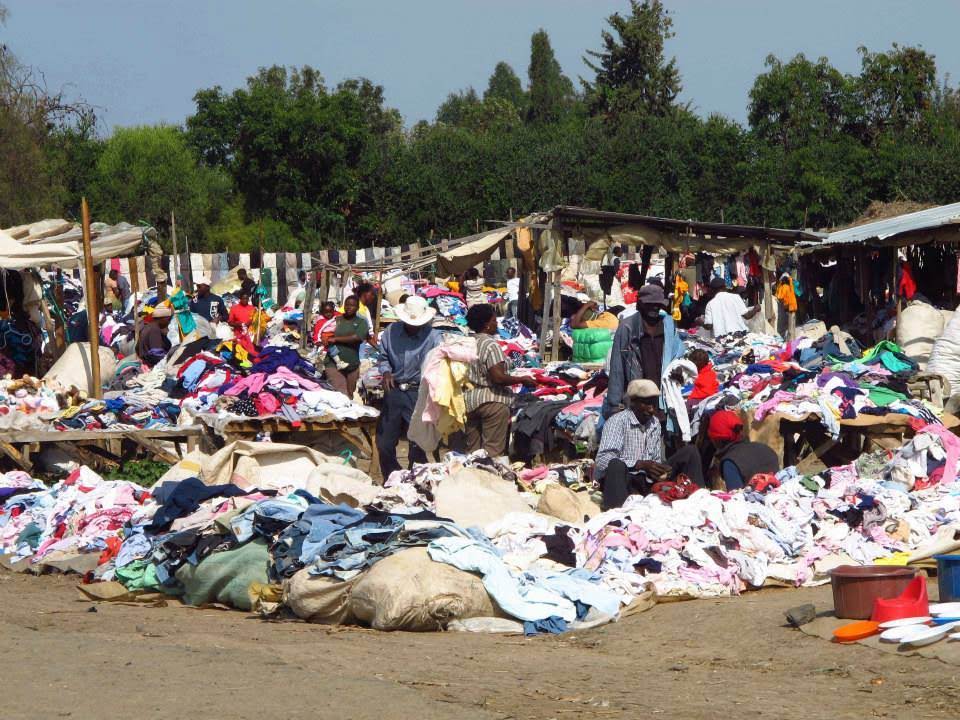
A snippet I have woven into one of my books occurred when I took my young children to mitumba; a large jumble sale of donated thrift clothes, and other items, from first world countries which are shipped to Kenya and sold in makeshift markets.

Mitumba 3Two raggedly dressed, and shoeless, children tentatively approached our car holding out their hands in a begging gesture.  I remembered two squares of jam sandwich which my boys hadn’t eaten.  I handed the pieces to the children expecting them to stuff them into their mouths, but instead they just stood and waited.   Slowly they were joined by a group of similarly attired children, and those who had the sandwiches carefully divided them up until every child had a small morsel to eat. 

This was an incredibly humbling experience.  So perhaps it is not necessarily “write what you know” but “write what you feel”. After all, as writers we strive to elicit an emotional response in our readers’ minds.

Finally, Dan Brown said, “You should write something that you need to go and learn about.”  As writers we do need to expand our knowledge, and understanding, and researching is one of my favourite area in the writing process.  I have learnt so much more about Kenya than I knew, or understood, when I lived there.

RHINO CHARGERhino Charge, my third book, has many Kenyan Indian characters.  It evolves around events at a 4×4 vehicle off-road event which is popular amongst the Kenyan Indian community.  Whilst I had Indian friends, I wasn’t aware of how, or why, their ancestors had settled in Kenya.  Researching this aspect of the Kenyan culture was fascinating.  I learnt that Indians came to Kenya with the British and supported the creation of the East African Protectorate, which became Kenya, as clerks, accountants and police officers.

Two and a half thousand Indian labourers died during the construction of the Mombasa to Uganda railway line, including those killed by the infamous man-eating lions of Tsavo.  The rupee was the first currency used in the colony which was ruled using an extension of Indian law.  On the 22nd July 2017, President Kenyatta officially recognised the Indian community as the 44th tribe of Kenya.  Researching and learning this extended my knowledge and increased the depth of Rhino Charge.

Not all authors are luckily enough to live in extraordinary locations such as Kenya, or Bosnia and Herzegovina, but small towns still have their own customs and query characters. 

I’m currently planning my next series which will be set in areas of the UK I have lived in and visited. The theme is antiques, of which I have no knowledge.  I enjoyed, and was fascinated by, auctions which I attended on my return to the UK, to buy furniture for our house.  And I observed some fantastic people for the basis of my characters.  I’ll research collectibles, antiques and related crimes to build interesting stories with “can’t put down” plots.

Mostar, HerzigovinaWhen I can finally move freely around Sarajevo, and Bosnia and Herzegovina, I will begin researching for a future series.  I’ve already discovered that everyone here has a story to tell from the devastating war and various sieges, including the longest in modern history in Sarajevo.  As I search for potential locations, characters and stories my attention will be more focused as I learn to observe and record even the smallest incidents.  Who knows what snippets will make into future books.


Author Links

You can find Victoria at https://www.victoriatait.com/ or on Facebook at https://www.facebook.com/VictoriaTait

Blog/News: https://victoriatait.com/news/

GoodReads: https://www.goodreads.com/author/show/20373879.Victoria_Tait

Pinterest: https://www.pinterest.co.uk/vataitauthor/

Purchase Links – Amazon – B&N – Kobo – 


JH