
by Miko Johnston
I became an author when I finished the first in my series of fiction novels – my first book, period. Interestingly, Lala, the character I inaugurated thirty years ago, recently turned thirty herself. Is that a coincidence?
Maybe not.
 My writing has matured over those thirty years, as has my heroine. Granted, when introduced in my first book, she was “almost eight”, so her voice and thoughts had to reflect her age. However, the book was meant for adults, therefore it had to present the story at a more mature level. Much of the storyline and the tension springs from a child who’s unable to fully understand her situation and an adult audience who clearly can.
As the story develops, and Lala ages, she had grown up in the eyes of my readers as well as my own. I sometimes feel like thirty years ago I gave birth to this young girl, though I’m thrilled not to have actually given birth to an eight-year-old! Still, having lived with these characters for almost half my life and four books, they’ve become very familiar, and I’ve grown close to them. I sense a greater intimacy between the characters with each novel, in part because of my growing familiarity with them.
I feel the same way about characters in the series I still read. I’ve become invested in their lives, curious to see how they play out. It’s become an even more important aspect of pleasure in reading than the storyline. I’ve stuck with a few series with formulaic plots because of my attachment to the people who populate the stories. I’ve also dropped a few series from my must-read list and always for the same reason – stagnant characters.
I asked several writers of serialized fiction about how their relationship with their characters – and their characters’ relationships with each other – has changed with each book, and each passing year.
 Mike McNeff introduced his hero Robin Marlette in GOTU (pronounced Got-U, it’s short for Guardians of the Universe). His action/adventure series features a covert ops team that has to balance work with home life. Mike’s currently writing the fourth book in the series. When I asked him how his characters have evolved over time, he decided to let Robin speak for himself:
“We were once cops who tried not to hurt anyone, including suspects. Now we kill just to survive and it has reached the point where killing has become a mere afterthought. I’ve killed sleeping men, men who didn’t know I was near them and men who were simply doing an assigned task at a particular moment. They were all involved in acts threatening innocent people, but I gave them no warning…no chance to surrender. I just killed them.” Robin’s eyes met the admiral’s. “My men and I have become dark and dangerous shadows moving through the night grappling with a squirming underworld. I’ve become unsure of just what and who the enemy really is…I just react to threats to the innocent people on this earth.”
I’ll add that the series has grown darker, but as Mike’s characters have developed into a close-knit team, they’re more comfortable teasing each other, and their humorous banter provides comic relief that lightens up the action.
*
 What began for Heather Ames as a stand-alone novel turned into a deftly blended mystery, suspense and romance series featuring Detective Brian Swift and socialite/club owner Kaylen Roberts (due in part to encouragement from some members of this blog). Ames says, “My characters have evolved from two people who didn’t even trust each other enough to share confidences into two people who have been trying to work through various challenges. They weren’t sure they could work things out by the end of Book one, but they both wanted to try.”
In each subsequent novel she balances the suspense between solving the mystery and navigating their evolving romance. Readers root for the couple, but Ames keeps us wondering as we follow their emotional roller coaster ride. “Being mismatched soulmates isn’t an easy gig. Brian’s profession is a huge stumbling block for Kaylen (while) Brian feels like a fish out of water in Kaylen’s world, and isn’t so sure he wants to try fitting in.”
The couple has progressed with each book. “Kaylen has evolved into a much stronger character than she was at the beginning of the series, while Brian has developed chinks in his armor that make him more vulnerable.”
*
 Pat Kelley Brunjes traveled a similar route with her characters as I, opening her series with a story loosely based on her family history. In her first novel, The Last Confession, her protagonist serves as a stand-in for Brunjes. “Maggie was me seeking to find the truth about my grandmother’s relationship to the Catholic Church.” Although based on her research, she fictionalized the story, which allowed her to take Maggie in a non-biographical – and more dangerous – direction. In the sequel she’s writing, her heroine gets entangled in a cold-case murder and human trafficking. “In the second novel, Maggie has evolved into her own person dealing with what fate has thrown her, and how her personal beliefs guide her decision to help others.” Having given herself the freedom to step away from semi-autobiography, Brunjes will have much flexibility in plotting future entries in the series.
*
 Avis Rector faces a unique challenge in writing her historical fiction series, based on the early life of her family on Whidbey Island. In her first book, Pauline, the heroine and her husband settle on the island during the Depression. “So much of the first Pauline was based on my memories of the stories I heard as a child from my father who loved to tell stories—usually real happenings, but many embellished.” However, in her sequel, the story moves into the 1940’s, a time Rector lived through. She’s having to reinterpret her childhood memories through an adult’s perspective. “Actually, I’m having a hard time writing how the adults felt about the time. Pauline has changed.”
Part of that involves Pauline’s maturing. Rector admits she struggles to find the right balance between the irrepressible gal readers meet in the first novel and the responsible parent she becomes after adopting two children. “It was difficult for her to become a mother. She’s no longer the fun-loving young wife (as in the first book), but a serious, not so much fun, mother. I’m sorry about this, and feel I should…try to soften her personality, to enjoy the experience of being a mother like she always wanted to be.”
***
Most of us in WInRs have written, or are writing, series – I’m interested in hearing their take on this. I also know some of you reading this post write serialized fiction. What challenges have you faced moving your characters through the years, either in ‘book-time’ or real time? Have they evolved over the course of your series, and if so, how?

Miko Johnston is the author of the A Petal In The Wind Series, available through Amazon and Barnes and Noble. Miko lives on Whidbey Island in Washington. Contact her at mikojohnstonauthor@gmail.com
#
This article was posted for Miko Johnston by Jackie Houchin (Photojaq)


 “Ideas had space to roll around in my head,” she said. “My thoughts were uninterrupted. It was divine. These days the life of a 21st century writer are frantic, a pressure cooker requiring one to write reviews, connect with fans and friends, and try to stay in the game. ”
 Jill Amadio is from Cornwall, UK, but unlike her amateur sleuth, Tosca Trevant, she is far less grumpy. Jill began her career as a reporter in London (UK), then Madrid (Spain), Bogota (Colombia), Bangkok (Thailand), Hong Kong, and New York. She is the ghostwriter of 14 memoirs, and wrote the Rudy Valle biography, “My Vagabond Lover,” with his wife, Ellie. Jill writes a column for a British mystery magazine, and is an audio book narrator. She is the author of the award-winning mystery, “Digging Too Deep.” The second book in the series, “Digging Up the Dead,” was released this year. The books are based in Newport
 Try the classics. Try some older writers. Try a new writer and hope they have something clever or interesting to say.



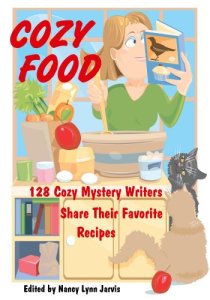 I loved “Cozy Food” edited by Nancy Lynn Jarvis! The cover says it is a compilation of 128 Cozy Mystery Writers’ Favorite Recipes, but it is so much more.
 “A decade ago, I sent a short story to “The Bark,” which is a super-cool, glossy magazine for “dog people.” They rejected it, but the editor wrote a note on the form letter: “We encourage you to keep writing, as you have an interesting voice.”
 *Bonnie Schroeder is a former member of The Writers In Residence and has posted here many times in the past. (Use the search box in the upper right to find her posts.) Since her move to the great North West, she has opted out, but follows the blog and says she misses our monthly lunches. We have promised her a special spot when her next novel is published, with a “tell all” about the extraordinary research that went into it.
 Then, on Sunday, I was on a panel for Sisters in Crime at the Thousand Oaks Library, where several published authors were on Dying Laughing, a mystery authors panel, where we were asked questions about our writing–how it starts, how it continues, and a lot more, including humorous aspects. And I, unsurprisingly and fortunately, was asked a lot about the dogs in my stories.
 Linda O. Johnston, a former lawyer who is now a full-time writer, currently writes two mystery series for
 I frequent a bookshop in a neighboring town that sells books for and about writers, along with writing-related merchandise (if you’ve been to Port Townsend Washington you know which store I mean). They carry postcards and T-shirts with writing slogans like “Avoid Clichés like the Plague”. Cute. Unfortunately, it denigrates clichés. The meaning of the word has been ‘adjusted’, and unfairly so, IMHO.
 When selectively used, a good cliché expresses wisdom through metaphor. A stitch in time figuratively saves nine. Actions often do speak louder than words. Sometimes it is a dark and stormy night, but since that opening line shows up more in humorous writing nowadays, we expect it to be funny, not dark. Like cliché, the expression’s meaning has been ‘adjusted’.
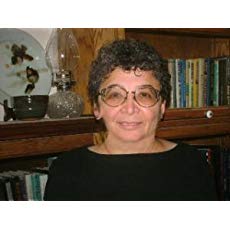 I had the pleasure of getting to know one of our Writers in Residence bloggers, M.M. Gornell, more in depth last month and decided to write up my talk with her for the monthly column I write for a UK magazine called Mystery People.
 One of the most famous, nostalgic, fascinating and historic highways that wagon trains of homesteaders traveled, along with migrants seeking fortunes in gold mines, land, and new opportunities, U.S. Route 66 was originally a 2,500-mile dirt trail that ran from Chicago, Illinois to Santa Monica, California. It was eventually smothered in asphalt and became known as the Mother Road, and the Main Street of America, passing through a total of seven states.
 Although her former residences have included other towns and the Sierra Nevada with its rich palette of Red Rock Canyon (the setting for her thriller, DEATH OF A PERFECT MAN), Madeline’s move to Newberry Springs inspired her to set the majority of her eight crime novels, including two series, along the famed highway. “For me,
  But California and Route 66 beckoned in the 1990s, due to mental pictures and expectations she had of the Mother Road twenty years earlier. It was not as easy as she had imagined, but new settings presented themselves and the majestic Sierra Nevada Mountains provided magnificent, magical scenery, inspiring her “Raven” mystery series, then LIES OF CONVENIENCE, and more recently her “Rhodes” mystery series.
 Although the romance of the route was a fixed American landmark, it was soon bypassed by the new Interstate Highway System which either paralleled it, resurfaced portions, or went elsewhere, leaving Route 66 abandoned and lined with ghost gas stations and tiny deserted communities. Eventually, it was officially designated as “ceasing to exist.” But you can’t keep an icon like the Mother Road down. It was rediscovered by musicians, hippies, artists, movie makers, and writers.


 Na-
Na- “Traditionally, NaNoWriMo works best when you start a brand-new project. It may be an arbitrary distinction, but we’ve seen that novelists do better (and have more fun) when they’re free from the constraints of existing manuscripts. Give yourself the gift of a clean slate!
 The Writers in Residence
You must be logged in to post a comment.