Characters: Real and Imagined

by Gayle Bartos-Pool

Writers create characters. Often, we use people from our own lives, or at least snatches of their personality, as the basis of those people. A favorite relative or friend might form the background for one or two main characters or pop up as a bit player here and there in your story, but if we’re smart, we won’t use someone we don’t like as the villain. Lawsuits can be so messy.

But What if we use real people such as celebrities or legendary individuals who changed the world in one way or another? You know, someone from a movie, a history book or the nightly news.

Would that method work?

Oh, yeah… But with limitations.

For instance, in my spy novels I use many real people like presidents and military generals and famous politicians who helped win World War II and changed the world in other ways through several decades. But my main character is totally fictional. He’s a master spy in my books, but he “knew” a lot of those real folks, “spoke” to them, and his story intertwines with what really happened back then. It took me ten years to research things that went on from WWII though part of the Cold War, because that was when those three novels took place. I read a lot of history books and even watched movies made during those times and some later movies made about those eras. The visuals alone let me “see” what it was like back then.

I have my characters “talk” with real people like Ian Fleming, the guy who wrote the James Bond novels. He was really part of the British government and one of the reasons we got in the war when our country was reluctant. He and my spy hero knew each other…fictionally, at least. But it made for a fun encounter.

I used historical figures who were our allies as good guys in the books. The bad guys like Stalin or Hitler were bad then and that’s the way they were written. I’m not changing history. The other bad guys I created came from my fertile imagination.

Even some of my contemporary books have characters that might be based on a real celebrity. I might not use their actual name, but a clever reader might figure out who it is. But these are the good guys. I come up with the bad guys from whole cloth. I watch the news and know basically what a bad guy does. I prefer to add my own twists to the villain’s personality, so I know how my guy thinks. After all, I’m telling the story. I don’t know what a real killer is thinking.

Mixing fact with fiction gives me that extra layer of reality that makes the story seem…plausible. Why not? Even Science Fiction has reality in it, mostly because the writer is guessing what the future might look like.
But here’s something fun. Take a look at old Star Trek episodes from 1966-1969. Lots of the gadgets the Enterprise crew members used are things we use now like cell phones and tablets. They didn’t have those things when the show was running. And something else. Their time frame was supposed to be in the 22nd, 24th and 32nd Centuries. We’re only in the 21st Century now, and we have those things…

So, when you write, create the world you want and put in characters with those touches of reality gotten from people you actually know and then toss in some character traits you’d like to see in contemporary folks or those coming up after us. You never know, maybe your characters will be the guide and inspiration to a whole new world.  Write On!

Acting Class 101

By Gayle Bartos-Pool

If we’re lucky, we learn stuff everywhere we go in life. I did just that when I moved to California when I was twenty-five. I wanted to write for television and the movies. Me and five million other people. Since I didn’t know anything about the “business” of Hollywood, I thought it would be a good idea to take an acting class to see what writers needed to know when creating a screenplay character.

I happened to get a job working for a talent agent, and he got me in an acting class. This one was taught by Bruce Glover. You might have seen him in the James Bond movie Diamonds Are Forever. He played the sinister/funny character that was trying to kill off Bond.

What Bruce taught was when you’re playing a character, large part, small part, or walk-on, have your character do something that makes him stand out. Have a menacing smile or a delivery of your lines that has everybody notice you. Many famous actors started as bit players and went on to fame and fortune when they did something that stood out on the screen. And that doesn’t mean just having a pretty face.

As a writer, I figured that when I wrote characters, large or small, I would give them something that stood out. It might be their clothes that telegraphed what economic bracket they fell into or a whacky giggle to show that maybe their elevator didn’t go up too many floors. Maybe it’s the words they use that show their high-toned upbringing or their lack of education.

While taking that class, I had to do an improvised scene with another actor. We were to be boyfriend and girlfriend who were having problems. As the other actor and I were chatting on stage pretending we were seeing eye-to-eye while all the time pointing out the major problems we were having with the other character, I had a piece of paper in my hand that I said was the love letter he had written to another woman. I kept folding it in half, long-ways, until it looked like a knife. Obviously, my character was signaling what I wanted to do to my soon-to-be-ex boyfriend. Actions speak louder than words sometimes.
I try to give most of the characters I write that little bit extra to define them, too.

That acting class wasn’t the only one I took. I got lessons from Rudy Solari and Guy Stockwell. Both men had long careers in Hollywood. What Rudy had actors do was write a biography for the character they were playing so they knew exactly who they were when they stepped on the stage. It didn’t have to write pages and pages, just a brief background of that character, stating where he came from, how he was raised, his education, and what he wanted out of that scene.

What this did for the actor was let him know what motivates his character because in a screenplay, the writer usually just provides the dialogue, maybe how the line should be spoken like a whisper or yelling, and a few physical actions like running away or punching someone. Of course, the director will provide even more of those directions.

But the writer of a novel or short story needs to know who this character is, what motivates him, and things like his age, hair color, and stature, because when you’re writing a story, you don’t want to get to page 275 and have your twenty-five-year-old character with black hair all of a sudden be a thirty-six-year-old blond.

I write a short biography for all my main characters, adding to it as I think about what their past might have included that will help the current story angle. And I keep a Character List for everybody appearing in the story so I know who is who, and who they know, and why they’re there. It sure helps when I get to a spot and need to know all the previous things I wrote about that character like their age, hair color, or their role in the story.

And something else about those two acting classes, they gave me the confidence to get up in front of an audience when I’m talking about the books I wrote. I already know my motivation: get people to read.

Choosing a Theme

by Linda O Johnston

Every writer writes what they know and what they love—at least, hopefully. Sometimes, it’s also a specific genre or genres.

Of course we can go all sorts of directions in our writing as well as in our lives.

But me? It’ll come as no surprise to those of you who know me or read my stuff that I love dogs. And they’re not only important in my life. They’re important in my writing. And they’re the general theme of my writing.

I have had sixty-two novels published so far, with the sixty-second, my fourth Shelter of Secrets story for Harlequin Romantic Suspense, available starting now. It’s CANINE PROTECTION. Yes, canine. And number sixty-three, the fifth in my Shelter of Secrets series, CANINE REFUGE, will be published next year. I can’t tell you offhand how many of my books have featured dogs, but the great majority of them have.

Why? Well, they always say to write what you know, and I know dogs, and yes, I love them. My first mystery series, the Kendra Ballantyne, Pet-Sitter Mysteries, featured a tricolor Cavalier King Charles Spaniel named Lexie—the same name as one of the Cavaliers I owned when I wrote those stories. And Kendra was a lawyer who lived in the Hollywood Hills with Lexie. Yes, I was a practicing lawyer then, living in the Hollywood Hills, writing what I knew, kind of.

And right now, my first ruby Cavalier, Roxie, is staring at me as I write this. Her tricolor sister Cari is sleeping somewhere else, but she very often snoozes under my computer desk as I write.

 Yes, I’m hooked on Cavaliers, but I don’t write much about them since I don’t want to overdo it with my readers. But other dogs, including service dogs, K-9s, and even pets—yes!

And including shelter dogs, like those in my Shelter of Secrets series which is ending next year. I’ve started writing the first book in a new series. And surprise, it also features dogs!

I’m always fascinated to learn why other writers write what they do—and if they also have ongoing themes in what they write.

So please comment here, you writers who are reading this. Do your stories contain any ongoing themes, and if so, what—and how did you decide to feature them?

.

.

Image by Ermir Kolonja from Pixabay

The Case of The Runaway Bride

By Jill Amadio

Outraged at my character deciding to get herself murdered far too early in my mystery, I was also furious that she had the temerity to go out on her own and run off with my carefully organized plot. She wasn’t actually a bride, but she sure was a runaway. And a female.

How dare she!  I had barely sorted out a new setting and spent time researching a lonely location in the UK when this forward young woman opted out of my book. Not only had she escaped from my timeline, but she was also in the wrong place.

Her impulsive decision and demise threw two other characters, one the murderer, into complete confusion. I almost felt them turning to me and saying, “Now what?”

Keeping control of one’s fictional characters is usually a given. Like chess pieces, the author can move them here and there with impunity. We can, and often do, change people and places around but the decision has to be the writer’s.

Something similar happened to me once before. In my second mystery, I knew who the killer was, and I looked forward to her denouement. However, the more I wrote her, the more I came to like her. The upshot was I had to choose a different character as the murderer and thus change his gender and personality, to say nothing of his traits and habits.

However, my runaway person really put me over a barrel with her unexpected death. Should I write her out completely? Force her to stay alive a little longer? What did her early, unplanned demise mean to the rest of the storyline, the remaining characters, and my peace of mind?

It seemed that the best thing to do was to move the chapter in which she wrote herself gone forever to the end of my Word document so that I wouldn’t have to look at that chapter until l I decided where to fit it in, given the new circumstances.

Actually, I knew exactly where and when I wanted her to meet her end, but her decision to die on her own terms threw me into disarray. To say nothing of writer’s block.

I perused my synopsis, wondering if I should wedge her in where she wanted to be, but again, it was clear that her interference meant a lot more work. I would have to rearrange people and places, maybe add a new character and perhaps an extra victim, if any of her shenanigans were to make sense.

Another thought – must I re-think my POV? In order to get her back in line, would she be satisfied with being re-written in first? Her dramatic demise certainly was a plea for help. On the other hand, I had envisioned and written her with poor eyesight and she wore glasses. How did that affect the decision to off herself?  Was she too vain to wish to continue as one of my characters? I saw my authority begin to dissolve.

So, in a heroic effort to re-establish and re-claim my jurisdiction – after all, she was supposedly my creation – I finally decided I needed to be very firm with her. She could not just go around deciding how, when, and where to become the center of the action. What if others followed her lead?

Ah! Maybe that was her problem. She felt like a minor character rather than a major one. She wanted more attention. Still, offing herself hardly seemed the way to go about it since, once she was dead, she had no way to enjoy the fruits of her action. I’d not planned for her to play a prominent part. I guess she realized she was definitely not the important character she thought she deserved to be.

Again, I had a lightbulb moment. Therein lay the danger of a runaway character. They imagine they have a more significant role in the plot or a different personality than the author provides. Writers know that characters make a story. When your fictional book people populate your imagination and come alive their actions determine the story.

Readers want to be swept away into the life of a character. This silly woman ruined that purpose. I was sorely tempted to discard any reference to her and replace her with a male.

As I continued to figure out what to do, I began to question my understanding of human nature. Then I remembered that this runaway lady was not human but a creation—an AI. Perhaps my fellow Residence writers can suggest a solution. Am I being a Pollyanna?

HOW I FOUND MYSELF WORKING AS A WRITER IN RESIDENCE OF A HIGH-SECURITY MALE PRISON

by Hannah Dennison

I’m excited to introduce our special guest today Sunday Times bestselling thriller author Jane Corry. As you’ll soon learn, Jane’s writer-in-residence experience is quite simply extraordinary.

Jane – welcome! 

My novelist career took off when I went from being a features writer on a well-known women’s magazine to prison.
I’m not joking. But I should add that I was a writer in residence at a prison rather than being a prisoner myself.

My story started the month I got divorced from my first husband after 27 years of marriage. Two weeks later, my weekly magazine column ended due to a staff shake-up. Although I had maintenance, I found myself in need of extra income in order to bring up my three children.

After moving house, my new neighbor suggested that I look in the papers for work. I hadn’t applied for a job for 27 years—I’d been a freelancer since my children were born. But there it was—an advert saying, ‘Wanted! A writer in residence of a high-security male prison.’

Frankly, I didn’t think I had a chance. After all, I didn’t have any experience of prison, either from the outside or in.  Indeed, the only crime I’d ever committed was to park on a double yellow line.

But the money they offered was exactly what I needed to pay my mortgage – to a penny.

My sister and friends didn’t think I should apply. In fact, they thought I was crazy even to consider it.  I was, as they pointed out, in a bad place emotionally. How was it going to help me to work in a prison? I like to think it helped both me and my students, but I’ll come onto that in a moment.

I was very surprised to get an interview and not at all surprised to fluff it up. The governor asked what I would do if a prison officer came into the room where I was running a writing class and told everyone to get out. I said that I would get them to stop in the middle of the sentence so it would make it easier for them to come back to it – it’s a good writing technique. He looked at me, his eyebrows raised. ‘And by that stage,’ he pointed out drily, ‘half the prison would have escaped.’

He had a point. From that moment, I relaxed because I knew I’d blown it. So you can imagine his surprise when he rang that evening and offered me the job.

On my first day, I was given the keys to the prison. To be precise, I was handed a key belt and told that I had to lock any doors that I unlocked and went through, otherwise I’d be out on my heels. I also had to make sure that I signed in every night and handed the key back.

My role was to be a sort of literary Pied Piper. I wasn’t part of the education department, where people had to come to my lessons. I had to woo them in through notices which I put up round the prison.  I printed them out with titles such as ‘Come and join my workshop to write a letter, novel, short story, life story.’

Life stories were particularly popular. I learnt more about crime than I care to talk about. I will say, however, that I was reduced to tears of shock and horror by one man’s story. He then apologized for upsetting me and I told him he should be apologizing to the people he had held up and threatened with death.

I entered his life story for the Koestler Awards, given to men and women for art and writing in prison and he won a silver. His behaviour immediately changed for the better and the guards said that it was due to his new-found story telling skills. He told me that if he hadn’t expressed his remorse on paper, he might have banged his head against the wall.

On the whole, I was treated very well in the prison, although there were times when I was scared. I was followed around at one point by a man who – when I looked up his crime – had tried to kill his girlfriend. I didn’t look up any crimes after that apart from the former accountant who had been a rapist. I don’t want to go into that. He seemed such a nice man.

One night, the governor asked if I would spend the night in the prison for a charity drive. I would have turned down the invitation but the money was going to help pay for my next year at the prison. So I felt obliged. It was terrifying being locked in. There was a bowl under the bed for my business. I spent all night typing. The gov had allowed me to bring my typewriter in. In the middle of the night, an officer knocked on my door and asked what I was doing. I told him I had permission to write and reluctantly he went away.

On other occasions, I brought in writer friends to talk, including Colin Dexter. The men asked him how he got his inspiration. He told them that it was a large bottle of malt whiskey. This didn’t go down well with the officers, but the men thought he was wonderful.

When I started my prison job, I was told that the men either spent their leisure  time in the gym or in the chapel. That stayed in my mind. Then as I walked past the gym, with sounds of machinery pounding, a title fell into my head. The Book Of Uncommon Prayer. So I asked both the men and the staff to write down sayings that helped them through life. I’d written something similar for the women’s magazine earlier. It seemed to go down well and also improve relations between some staff and men.

My two year contract was extended to 3 years. They then asked me to stay for a fourth but I thought that I might never leave. By then I’d got married again so I said goodbye but I volunteered to be a judge for the Koestler Awards and have done so now for the past ten years. Every summer, I go up to Wormwood Scrubs and leaf through entries. The winners’ work is displayed at the Southbank in London every autumn.

I gave up romantic fiction and began writing gritty suspense novels about families who’d been affected by crime, either as aggressors or victims. I changed agents and my new one sold me to Penguin. I’ve since had eight top ten Sunday Times best-sellers.

People sometimes ask if I miss my old life. Actually, it haunts me.  You can take the girl out of the prison. But you can’t take the prison out of the girl.

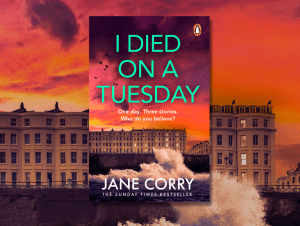
You can buy my new novel ‘I DIED ON A TUESDAY’ in supermarkets, shops and   https://bit.ly/3SE8UVi. Thank you. You can also find out more about my books at www.janecorryauthor.com,   

The book on Amazon

BRINGING CHARACTERS TO LIFE

by Miko Johnston

We can plot our stories well, describe settings vividly, and touch on all the senses, but the heart of any story is its characters, and they need more than a heart to make them come alive.

I began writing fiction, or more accurately, learning how to write fiction, while working in a library. It gave me access to numerous books and magazines for self-study. One book in the collection devoted a chapter to creating characters, complete with a checklist of traits and their opposites – outgoing vs shy; scholarly vs uneducated – from which the prospective writer could choose and assemble. I found the idea silly and worse, useless. Whether in my writing or my reading, I want characters to resemble real human beings, only more interesting than the average person. You can’t achieve that by compiling random parts. Just ask Dr. Frankenstein.

We’re told to have our characters want something and then keep it from them, make them fight for it. Good advice, crucial for plot. We must describe them with enough detail so the reader can visualize them; again, good advice. Backstories and bios, family and friends, strengths and flaws, jobs and hobbies or interests. How they dress. What and who they like or dislike. The dark secret in their past that drives them forward or holds them back. These big picture details lay a foundation for characters. However, it takes more to breathe life into them. Whether you call them quirks, idiosyncrasies or eccentricities, these subtle differences add a realistic quality to them.

Although our individual quirks may differ, we all have them, which makes this a commonality. In other words, a human trait.

Think of Robert Crais’ Elvis Cole and his affection for cartoon characters, the dry humor of Nelson DeMille’s John Corey, or the fussy Inspector Poirot and his eggs in Agatha Christie’s mystery series. Master art restorer Gabriel Allon inherited his talent, as well as trauma, from his Holocaust survivor mother. And while we naturally empathize with a blind girl like Marie-Laure in “All The Light We Cannot See”, the way she copes with it makes her mesmerizing.

There are two general types of quirks – nature and nurture. Nature includes those the character was born with, such as personality types or bio-physical traits like an intellectual disability or a club foot. A life experience, whether an acquired taste or an emotionally painful experience, would fall under the nurture category. In all cases, how the character has internalized the trait leads to the quirk.

Quirks have to be worked organically into the story. They shouldn’t be unrooted in the character’s history or biology. They should play a role in the character’s thoughts, emotions or actions. They need to be noticeable, but not too blatant; subtle, but not too vague. Readers need to discover them on their own by being shown the behaviors rather than being told about them.

A character’s quirks can be related to their physicality, the way they dress or groom themselves, their behavior or personality, or they can be completely random. Here’s one example: money. Most everyone I’ve met has a philosophy, or criteria, about what they’re willing to spend on something. They’ll be tight-fisted about some things and looser, even extravagant about others. What does it say about a character who’ll spend hundreds of dollars on tickets to the opera, a Broadway play, or the Superbowl, but won’t pay two dollars for a can of tuna in the supermarket unless they get a double-off coupon? Or worse, not buy it at all because they can remember when it cost thirty-nine cents? It says they’re “human”.

Ultimately, it’s not so much a matter of “what” a character does or doesn’t do, what they like or dislike, that makes them full-fledged humans. It’s the “why” that makes it interesting and brings them to life. Always listen to your character, for they’ll often tell you what’s right for them. For hints on this, see Gayle’s earlier post.

When treading the fine line between character and caricature, here’s what to avoid:

  • Cliched or overused idiosyncrasies. If I had a dollar for every alcoholic PI, or divorced or widowed detective, I could pay my cable bill for a year. If you’ve seen it before, add a new twist. If you’ve seen it over and over again, avoid it like the plague (humor intended).
  • An assemblage of unrelated quirks, as if selected from a list found in a book (jab intended). Author Rex Stout’s Nero Wolfe tends his orchids, reads voraciously, and feasts on gourmet food from the comfort of his luxurious home. The genius of his character is how all his passions connect.
  • Limit the number of quirks, or else – well, just ask Dr. Frankenstein.
  • Don’t overdo the ones you use. Quirks are like seasoning – you need enough to enhance the flavor without overpowering it.

If you found this post helpful, leave a comment, and feel free to contribute your suggestions for making characters come to life. Frankly, my ulterior motive in writing this comes as much from my goal to write books with believable and engrossing characters as my desire to read them.

Miko Johnston, a founding member of The Writers in Residence, is the author of the historical fiction series, “A Petal in the Wind”, as well as a contributor to several anthologies including the about-t0-be-released “Whidbey Island: An Insider’s Guide”. Miko lives in Washington (the big one) with her rocket scientist husband. Contact her at mikojohnstonauthor@gmail.com

SPRING INTO WRITING

by Miko Johnston

Ah, what a year it’s been, beginning with a harsh and, in some places, treacherous winter. So far, spring has not been much better or safer in many parts of the country. It took a long while to arrive and settle down on the West Coast. Hubby and I took a last-minute vacation to sunny Sicily to escape the cold and gloom for a few weeks and postponed our annual winter trip to LA for months until we could travel around by car instead of rowboat. Both escapes kept me away from writing for a while.

I’ve always enjoyed spring, a time of renewal, and probably more so this year after the winter we’ve been through. Thoughts turn from shoveling snow to shoveling dirt in the garden, from watching the overflowing rivers subside to marveling at the regeneration of fauna and flora.

Part of that rejoicing can include a return to writing.  Here are some suggestions to inspire you.

I           Change it up

If you’re finding it difficult to focus on your manuscript, or daunting to consider starting one, then don’t. Think about other things to write: short stories, flash fiction, a travel memoir, a chapter from your life. Perhaps a letter – yes, snail mail – to a long lost friend or relative. Buy (or make) some blank-inside cards and create your own birthday, anniversary, get well, and sympathy messages.

In short, forget about your WIP for now, but don’t stop putting words on the page. As we always say, writing is writing.

II         Revisit

If you’re writing in more than one point of view and your WIP isn’t going forward, you may have the wrong character in the driver’s seat.

I recently critiqued pages from a romantic suspense novel which had two protagonists. One chapter felt stodgy IMO, and the female came off as cold and unkind. The author had written the scenes in the male character’s point of view, so he only got to observe her behavior. I suggested redoing the chapter in the female’s POV, since she was undergoing the emotional upheaval. I felt if the reader understood what led to her bad behavior, they would find her more sympathetic.

If you get stuck, try rewriting the troublesome scene in another character’s POV.

III        Revise

One of my favorite quotes about writing has always been: “Books aren’t written – they’re re-written”. Not everyone accepts or believes that.

Some writers tend to think it’s permanent once you’ve written something. We forget that until a manuscript is published, it can always be changed. In my last book, I introduced new characters whom I barely knew. I stopped writing when Covid hit before returning to the partial manuscript a year and a half later. As the story developed I got to “know” the new characters better. With my first draft complete, I went back to their first appearance to find vague conversations and a lack of detail. Using my more intimate knowledge of these characters, I sharpened their dialogue and expanded their descriptions.

If your characters are flat and generic, get to know them better. If your opening doesn’t grab the reader’s attention, your middle sags, or your ending falls flat, rework that section until you’ve solved the problem (for suggestions and tips, search through our archives, including my BACK TO BASICS: WRITER’S BOOT CAMP series).

IV        Forget about Perfection

The opposite problem is to get locked into revisions, snipping away or changing words, sometimes back and forth, all in an attempt to make the manuscript flawless. It won’t happen. It never happens. Finish it. Polish it. Then hire a good editor who will clean up your grammar as well as plot holes. Lastly, find a beta reader, or readers, to give you an unbiased opinion. Do the best work you can, and then let it go.

Trust me, I understand how difficult it can be to carve out time to write, especially if we have no pressing need (such as a deadline from our publisher) to do it. However, remember this: you can’t call yourself a writer if you don’t write.

Now please excuse me, I have a novel to finish.

##

Miko Johnston, a founding member of The Writers in Residence, is the author of the historical fiction series, “A Petal in the Wind”, as well as a contributor to several anthologies including the about-t0-be-released “Whidbey Island: An Insider’s Guide”. Miko lives in Washington (the big one) with her rocket scientist husband. Contact her at mikojohnstonauthor@gmail.com

NEW IDEAS, PAST AND PRESENT

by Miko Johnston

We’re barely two months into the new year, but as I contemplate what we’ll write about in the future, and what will inspire us to keep at it, I’ve found some of my answers to those questions in our posts from the previous year.

Hannah wrote about overthinking. How many of us are guilty of getting obsessive about our writing? Characters, plots and background have to be thought out, but we also must keep it all in balance. That has become harder for me to achieve, partly because age has undermined my ability to multitask and partly because my priorities have shifted. I still enjoy writing and am committed to finishing at least two more books, but I’m reminded of Madeline’s piece on Writing Scared, and the idea of switching up the type of writing you do. I’ve done that in the past, so now I’m adding a new avocation – photography.

Years of writing has given me a sense of what works and what doesn’t, and while I still rely on critiques from fellow writers, I often can figure out problems in my manuscript on my own. Not so with my new hobby. I look at a photo and I may like it, but I don’t know why, exactly, nor can I be certain it’s any good. I’ve joined a photography club and have been invited to participate in their biannual exhibit. I’m going to need a lot of critique and advice before I select which pictures I want to use.

Linda’s piece on attending writers conferences reminded me that many more may be held this year as the risk from the recent pandemic fades from our memory, if not from our lives. Will these events be successful, or will the attendance habit, having been interrupted, be broken? Costs, from registration to travel to hotels and meals, will likely be higher than we remember. I can see where some will be very selective about which they’ll attend while others choose not to register for conferences at all.

Gayle’s piece on The Future of the Written Word really resonated with me. I’m often puzzled, even shocked, by how many words have been usurped and had their meanings altered, some with additions, some with subtractions. Regardless, these 2.0 definitions have led to divisions. A lack of clarification, or precision, makes the word’s meaning, well, meaningless. I suspect if any of the worst offenders of this phenomenon were reading this, they would have stopped at usurped (insert my sarcastic smirk here).

And speaking of the written word, Jill contributed a post on a similar, if lighter, topic – the subtle differences between American and British English. With three Brits in our WinR group and many others within our writing circle, it can be a challenge.

Rosemary’s Collecting Memories touched me. While clearing out closets and shelves in anticipation of a thorough spring cleaning, I’ve uncovered a trove of precious mementos – cards, notes and letters from family and friends, some going back to my birth. Programs from bar/bat mitzvas, funerals, and other events. Menus from private supper clubs, conference galas and corporate dinners at restaurants. Each find brought back wonderful memories of the people and places I’ve enjoyed over the years. That included a copy of the dedication that went into the L.A. Library’s copy of Rosemary’s book, “Hollywood Then and Now”, in memory of her beloved husband Rick. Her post reminded me that these keepsakes – all comprised of words – and the memories they invoke, are precious, something Maggie explained so eloquently in her post based on the “a reason, a season, or a lifetime” quote.

Jackie’s interviews with writers as well as all the fabulous guest posts she’d arranged added dimension to our blog, and her piece on naming characters had many solid tips I’ve come to rely on. And I’ll add a special shout-out for all the technical help she’s provided to us, especially a technical “muggle” like me.

There are many more posts from my co-WinRs that have and continue to inspire me. I can only hope I might have had the same effect on them, as well as our readers.

Miko Johnston, a founding member of The Writers in Residence, is the author of the historical fiction series, “A Petal in the Wind”, as well as a contributor to several anthologies including the about-t0-be-released “Whidbey Island: An Insider’s Guide”. Miko lives in Washington (the big one) with her rocket scientist husband. Contact her at mikojohnstonauthor@gmail.com

Let Me Entertain You!

by Jackie Houchin

Lots of medical stuff going on with me right now, so I thought I’d simply share a fun aspect of our Alaska cruise last fall. That aspect is called MUSH.  No, not yelling at sled-pulling dogs (although we DID do that), but a different kind of Mush.

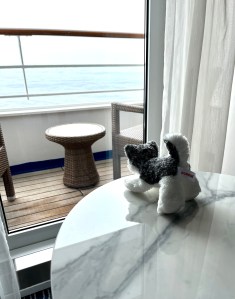
In Skagway, Alaska, I bought a small toy Husky, a beanie-bag size and shape little guy, with soft gray/white fur, big blue eyes, and the name MUSH printed on the tag. I loved the little guy from the first glimpse and perched him on my pillow in the stateroom when we got back to the ship. Joel, our cabin steward aboard the Oceania Regatta ship, loved Mush too.

When we left for dinner in the evenings the steward would come in to straighten up and turn down our beds. When we returned later, we found the usual chocolate candy on our pillows, AND…..Mush, posed in a series of so cute antics. The first time, he was propped on a pillow with the TV remote, watching a football game on the screen.

Another time he was standing on an open book (that I’d been reading), as if he were reading too.

Once when we came back from an excursion ashore and after we’d had lunch at the buffet, we found him on our small room table with the curtains draw slightly, looking out at sea.

And then, every evening HE started getting chocolate candy too, an additional piece placed between his paws. We were absolutely delighted.

Of course “I” started posing Mush for Joel too when we went out for the day, hiding him where the pitcher of ice water was kept, or behind the desk alarm clock, or sometimes just lying on the bed, his head tucked in and front feet up, waiting for a belly rub.

We had such fun with Mush and our very good and so kind cabin steward.  Another sweet memory.  And now, Mush resides on my dresser at night, guarding my glasses, and sometimes on my pillow during the daytime.  (But he’s on a diet now – no chocolate.)

##

Maybe I could write a cute kid’s story starring Mush on an ocean cruise. He could meet friends, find a missing object, solve a mystery, or rescue someone in danger.  Now that’s an idea!! Mush and I might have to put our heads together and come up with a plan!

Character Flaws

by Gayle Bartos-Pool

gayle-at-bills-house-sept-2022

Through the centuries man has written novels and other stories using that plan old Aristotle, born in 384BC, came up with and documented in The Poetics. He said there are 5 Basic Elements used in writing a story: Plot, Character, Dialogue, Setting, and the Meaning of the story. He was so right. As for the people who populate said story, many authors utilize the “Character Flaw” idea to give their main character some quirk that might trip them up while pursuing their goal.

Whether it’s a private detective with a drug problem (Sherlock Holmes), a gal who drinks too much (the woman in The Days of Wine and Roses), or even the kid who can’t tell the truth (The Boy Who Cried Wolf.), when the reader learns the character has this flaw and also learns what the goal is in the story and what the roadblocks are in trying to achieve that goal, there will be anxiety on the part of the reader to see if the hero can overcome his or her problem and succeed.

This method has been used for centuries and works, but there have been other ways to toss a curve to the hero just to see how he or she handles it. A blind main character (in the movie: Wait Until Dark) or a blind detective (the movie and book called exactly that: The Blind Detective) or a hero in a wheelchair (the TV show: Ironside) worked just fine in catching the bad guys.

Rob a Bank

A physical handicap can actually make the hero stronger. I’ve known real people who had severe health problems turn into some of the strongest people I have ever seen in my life. But a drug addict or an alcoholic isn’t exactly wearing a badge of courage. I’ve also known people who had those issues as a part of their character and who had no intention of getting rid of them. I probably wouldn’t turn to them in a crisis. In a story they might be the main character with what is known as a “fatal flaw” who solves the problem or reaches the final goal as he dies on the last page. That’s been done, but it’s a bit of a downer.

But there can be other ways to give the main character something to deal with besides thrusting negative points on him. In fact, some TV characters don’t really have major flaws, but some of their friends do. The main character in the series Magnum, P.I., and Jessica Fletcher in the TV show Murder, She Wrote were basically good people, but some of their acquaintances had problems. Usually those problems were thrust upon them by someone else, otherwise known as the villain, and the hero has to solve the case before the jail cell closes on their friend.

So, are we supposed to make our main characters flawed? I’ve read some best-selling books where the hero had flaws that were rather unpleasant and I only read one of their books. I didn’t find that trait a selling point. I often say that I want my main characters to be people I would invite to my house. They don’t have to be sickeningly sweet or holier-than-thou, but I would like to respect them.

But these heroes might have a friend with a major flaw and part of the story is to get the friend on the right track so they don’t die or end up in prison. You can even have the hero mention that he almost went down that same path until somebody straightened him out. My Johnny Casino character used drugs when he was a kid while he was growing up in the Mob. They were importing and selling those drugs until a local priest challenged him to a boxing match and whooped his little butt. Johnny never touched a drug again. This revelation in one of the stories let Johnny use himself as an example to help somebody else shake their dependency.

people-4

I’ve wrestled with the notion that the main character should have something wrong with him since that theme is prevalent in many books and movies, but I prefer my main character to have either overcome some minor flaw or never really had one in the first place. Most people I know aren’t one step away from the slammer or psycho ward, so I’m not stuffing my character in that camp. He can have doubts and reservations, but in the end his upbringing and persona got him where he is, so I’m not going to let him fall into a pit. And anyway, that’s what heroes are…heroes.

People with problems don’t usually go to people with their own troubles. They go to the guy or gal who made it through the gauntlet and survived. We learn from characters like that, so my heroes fight to keep on an even keel and get us all to shore.

Coast Lighthouse