Once upon a time…

by Jackie Houchin

Once upon a time, in a WAY long time ago, before I had a smartphone, a computer, an online presence, or even a typewriter, I wrote with a pencil, on lined school paper.  I wrote letters (to pen pals and cousins), stories (mostly tragically romantic vignettes in far-off places), and I wrote in small daily diaries.

You know those little books, about four by five inches, with a strap that wrapped across the pages and fit into a lock on the front, and had a half-inch, flat key to secure it. I mean, even a fork or a good slap could open them! 

The pages were dated, but you had to fill in the year. And you had to write quite small if you had a lot to say, like I did.  Wow, did they hold secrets!  And souvenirs – another good reason for that little strap and key. I wrote about feelings, events, boys, teachers, embarrassments, fights, dreams, disappointments, and things or people who made me mad, jealous, or envious.

One day, I found and opened a thirty-five-year-old diary like that. Oh, my goodness!  I slammed it shut and looked around me. Then I carried it to a small chair in a corner of the bedroom and opened it again.

I wrote THAT?  And that? Oh, my!

I laughed. I cringed. I even cried a little. A couple of times, I gazed off into space, seeing and reliving a sweet incident.  I’d smile and sigh.

How would my life be different if THAT had happened? Or hadn’t happened? Or if I’d said something else? Or acted quickly, nicely, or at least not selfishly? What if….?

What if? 

That’s the way fiction writers often dredge up a story idea or outline. What if such and such happened, or someone said or did THAT?  

I glanced down at the diary and thumbed through the pages, stopping now and then to read a heavily underlined passage.  WHOA!

I eventually put the little book back into the cardboard box with maybe eight others like it.  I’ll read them all, I promised myself.  I’ll write a story or two.  Is there enough for a book, I wondered?  

I stretched the duct tape tightly across the flaps and penciled “diaries” on the front. Tomorrow we will take the last of these attic finds to our new house.  After all the unpacking and settling in, I will dig out these diaries and sit at my computer, and type, “What if….?”

Halfway down the busy freeway to the new house, traveling at 65 mph, our heavily packed pick-up truck hit a pothole. In the passenger side mirror, I saw a small box jump and pitch itself over the truck’s railing. When it landed, the box split apart.  Small square objects flew out and bounced into the bushes growing close along the side.

“OH!” I cried.

“What?” my hubby asked.

“My diaries!  Didn’t you tie the boxes down?”

“I did!”

“But…”

There was no place to pull over. No going around. No going back, either along the freeway… or to that youthful time long ago.

I sat stunned.  Then I laughed, imagining some homeless dude living in the bushes finding and being entertained by my teenage drama and angst. Or maybe a gang of miscreants wearing orange vests and carrying plastic bags would come by to clean up the roadside trash, and find them. 

Hey, my stories could be read in jail! Perhaps even traded among the inmates for snacks or phone calls. Juicy sections could be copied on the backs of old envelopes and reread a hundred times. Pages might be torn out and passed on to new inductees as the old timers were released. My audience would grow! I might become “a best-selling author!”  

Well, maybe not.

Anyway, that’s why I never wrote the “Great American Novel.” 

Did you ever write in diaries?  Do you keep a journal now?  If so, is what you write  “stream-of-consciousness” or does it have a specific purpose?  Have you ever reread your previous ones from a year ago, or many years past?

GROUP QUESTION #3 – Settings & Research, Where & How Much?

By WinR members & guests

  1. Where & when do you set your stories? 
  2.  How much research do you do on that time & place?

MIKO JOHNSTON: I’ve done extensive research for my historical fiction series, set primarily in and around Prague during the first half of the 20th Century, to give it authenticity. That includes using real places, people, events – even moon cycles accurate to the day – alongside my fictional characters. Some information has been unobtainable (at least in English), so when I can’t make it accurate, I aim for plausible. 

*

G. B. POOL (Gayle):  The setting I use in my novels or short stories depends on what the story is. So many of my private detective stories are set in Los Angeles because that city is known for its “high crimes and misdemeanors,” as we saw in these old black and white detective movies from the 40s and the great TV detective series from the 60s and 70s. I watched them all. I like having my contemporary private detectives walk that same turf. My spy novels are set in various countries during WWII, the Cold War, and into the later part of the last century. That might sound like a long time ago, but I lived through part of that time, so I know the later era.

As for how I write about those other times before I came on the scene, I watch a lot of old B&W movies and see what places looked like back when they filmed them and how they dressed. It’s a great way to “see” history when you didn’t live through it.

*

JACKIE HOUCHIN:  My dozen stories for 4th to 6th grade kids are set in present-day Malawi, Africa. However, many of the people in the surrounding areas still live in very primitive circumstances.  My goal in these stories was to show upper elementary kids in America how a missionary family (with 6 children) would live among and interact with less than modern circumstances, and still have fun. (And get into trouble!)

Most of the research I did was hands-on.  I visited Malawi five times, spending a couple of weeks each. I went into villages, watched kids doing chores, caring for babies and animals, and playing primitive games.  I ate the food and learned a few words. I cringed at the sight of humongous insects and scary witch doctors. I lived with a missionary family each time, seeing how they “made do.” I had lots of fun, asked questions, and took copious notes!  I also never caught malaria, meningitis, typhoid, or HIV. Whew!

*

DIANE ASCROFT (Guest): My Century Cottage Cozy Mysteries are set in Fenwater, a fictional small town in Canada, during the 1980s. The place is far from where I now live in Northern Ireland, but I grew up in Toronto, Canada, and often visited the real town of Fergus that Fenwater is inspired by. I loved the place and thought it would be a great setting for my stories.

For my series, I wanted to create a place that beckons readers to step in and stay a while, so a fictional version of Fergus was perfect. Setting my books in Canada during the 1980s is also a nostalgic journey back to my homeland. It was forty years ago when I was a young woman, so it’s a pleasure to spend time writing about the place.

*

JILL AMADIO:  I set my contemporary mystery series on Balboa Island, Newport Beach, CA. My amateur sleuth is a British gossip columnist banished for a year at the request of the royal family, tired of her perceptive comments. She is from the fishing village of St. Ives, Cornwall, my own hometown, which allows me to recall its pub built in 1310, my school, the beaches, my father’s pharmacy, my mother’s dance academy, and the pantomimes she produced every Christmas.

My research to jog my memory is a delight as I have several travel books on the British Isles, reminding me, too, of London, where I was a newspaper reporter. I also keep up with the news in Cornwall.

*

ROSEMARY LORD:  I have been writing mostly about Hollywood in the 1920s and 1930s.  I’ve always been fascinated with this era, and learned a lot more when researching my non-fiction books, Hollywood Then and Now and Los Angeles Then and Now.

I do a lot of research, which I find fascinating, and sometimes get far too carried away with that!  I love to show how either simple or how difficult life was one hundred years ago,  compared with today’s world.

I must confess that writing mysteries set today, when crimes may be solved using cell phones and today’s technology rather than old-fashioned “gum-shoe” sleuthing, leaves me cold!

*

MAGGIE KING:  My stories are set in Virginia in the present day. Most take place in Richmond, the state capital. It’s a city rich in history and culture, and it boasts two major universities. Many of the residents, myself included, moved here from other parts of the country and the world.

Charlottesville and Fredericksburg are also Virginia cities featured in my work. A few months ago, I posted here about a research trip I took to Charlottesville. It’s important to get the details right!

To date, I’ve been content to set my stories in contemporary times. But contemporary times are distressing, so I’m tempted to try my hand at something historical that will involve significant research.

*

LINDA JOHNSTON:  These days, I set all my stories in the present, although I used to also write time travel romances. But these days. my romances, romantic suspense, and mystery stories are set today, since I now enjoy the present more than the past. 

I’m currently writing mostly romantic suspense stories, in my own successive miniseries for Harlequin Romantic Suspense. They’re all set primarily in fictional towns, so my characters can get into different kinds of trouble with the law and get out of it without my stepping on real law enforcement toes. My recent mysteries, though, were set in real areas in Alaska, for fun. And of course, I’d visited Alaska.

*

Thank you, ladies! 

LIFE IS RESEARCH


by Linda O. Johnston

At the moment, I’m continuing to write enjoyable stories in my new series for Harlequin Romantic Suspense, about K-9s and PIs. Have I had to do research? Of course,  even more than I’ve done before about K-9s and their commands. 

But my entire life tends to be research. I love to read and write about animals, especially dogs, so whenever I can, I investigate pets and wildlife in different areas, and how they act, interact, and do their means of communication. I read books, newspaper articles, and more. 

And then I look out my front and back doors and windows. I see murders of crows, individual mockingbirds and other birds, lots of squirrels getting into trouble with my husband since they like to eat the fruit he grows, people and dogs going by on walks, vehicles that turn or park in the wrong places…all could be fodder for stories. Yes, even the people who drive those vehicles. I’d never get near them or hurt them in person…but my characters in a mystery just might approach and commit murder or whatever. 

Yes, my mind is always at work. Researching…and plotting. That happens when I go shopping. When I see events at the nearby Hollywood Bowl or other fun locations in my area—and when I travel too. Flying, riding Ubers and Lyfts and otherwise. What’s around—buildings? Waterways? My mind keeps watching and waiting and plotting. Lots of photos and notes! And my dogs also keep telling me what to do and when and what to write. 

And you, if you’re a writer? Where do you get your ideas? How do you research them? What do you look for moment by moment, hour by hour, day by day, or more?

Get Those Details Right!

By Maggie King

Recently Linda Johnston posted about where writers set their stories. I commented that the next day I planned to visit Charlottesville, Virginia for a research trip. I had finished the first draft of a short story set there, and needed to verify setting details.

I live in Richmond, but lived in Charlottesville for many years, and visit occasionally. It’s a cool place to spend a day. Lots of bookstores! So I have a fair picture of the place. But how accurate was my memory? And Charlottesville is a growing, dynamic city—what had recently changed and what hadn’t?

Here are the setting details in my first draft:
The story opens at the Jefferson Madison Regional Library in the downtown area of Charlottesville. As my main character stands on the steps under a columned portico, she turns and sees the Market Street Park, scene of 2017’s Unite the Right rally. I provide some information on that rally, formed to protest the proposed removal of the Robert E. Lee statue.

Once inside the library, the character takes a wide staircase to the lower level and locates a meeting room where a writing group is meeting.

After the meeting, she and a woman she just met leave and walk to Charlottesville’s Historic Downtown Mall. As they approach the Mud House, a trendy coffee shop, they decide it would be a good place to chat.

Mud House

Later they drive to a semi-country location, the scene of the crime they cooked up while drinking expensive lattes at the Mud House.

Based on my research, some rewriting is in order.

The character standing on the steps gazing at Market Street Park: she could only see a sliver of the park from where she stood. I could have her walk through the park and see the patch of dirt left behind when the Lee statue was removed in 2021. But neither the park nor the statue are important to the story, they only serve to add color to the setting. To use film parlance, this bit is destined for the “cutting room floor.”

The library interior: for all the times I visited this library, apparently I was never in a meeting room. They are located on the top floor, not the bottom, requiring the character to take the elevator (I didn’t check out stairway access). The rooms were in use, but I got a peek of the interiors through the glass doors. As the library is a real place in my story, being accurate with descriptions is important.

Jefferson Madison Regional Library

The Mud House. It’s a very attractive space with a nice, and pricey, selection of coffee and pastries. But it’s been completely redesigned and not conducive to private conversation. And the conversation my characters have needs to be private. But I can fictionalize a coffee spot, so no problem there.

Then there was the trip to the semi-country, where I once lived. The route, which must be accurate, was pretty much unchanged. I drove past the Earlysville Oak, estimated to be 250 to 300 years old.

Earlysville Oak

My old neighborhood was also unchanged—except for the owners of my previous home not keeping up the grounds. But I digress. I’ll make up the neighborhood based on this one. After all, it’s where the crime takes place, and I don’t want to rile my former neighbors!

I’m grateful I took this trip. It pays to verify aspects of the setting, especially if using real locations. I also took lots of photos, noted sights, sounds, and traffic patterns (lots of traffic!) and made time for those bookstores.

See Linda’s post, “LOCATION, LOCATION, LOCATION!”

Research Can Be Dangerous: A Cautionary Tale

By Maggie King

The Confederate statues on Monument Avenue in Richmond, Virginia came tumbling down. For this author, that meant a scene rewrite and a research trip. I didn’t expect the trip to end in the ER.

In my recently released story, Laughing Can Kill You, Hazel Rose investigates the murder of an obnoxious writer given to laughing at others’ expense. In one scene, Hazel and her cousin Lucy attend the victim’s memorial service, hoping to ferret out who killed the man. The service is held in one of the stately homes on Richmond’s Monument Avenue.

Here’s my thumbnail description of the area:

Statues memorializing notable players in the Confederacy punctuated Richmonds Monument Avenue. The statue paying homage to African-American tennis star Arthur Ashe lent an incongruous note to the lineup of Civil War monuments. Various groups clamored for the removal of the monuments that they considered reminders of slavery and racism; other groups believed removing them was tantamount to erasing history. A grassy mall divided the wide avenue, lined with trees and architecturally-significant houses.

If you’ve kept up with events of recent years, you know that the statues (except for the Arthur Ashe one) were taken down in 2020 and 2021, amid a flurry of protests, acts of vandalism, and government orders. But Laughing Can Kill You is set in 2018, when the statues were still in place. So I was okay? Right?

Maybe not. Would my readers be aware it was 2018? While it was clear to me, it may not be to them. Plus, the statues were still a hot-button topic, regardless of one’s position. I’m not looking to get readers riled, I simply want to give them an enjoyable story.

Monument Avenue was not important to the plot, but I could hardly feature it in a scene without mentioning the famous statues that give it its name. Talk about the proverbial elephant in the room. Street, rather. So I needed a different, but similar, location. It didn’t take long to come up with a Plan B: Richmond’s Northside, just ten minutes from Monument Avenue.

Here’s the description that replaced the Monument Avenue one:

The Hermitage Road Historic District on Richmonds Northside started life as a streetcar suburb in the late 19th century. Developing the area north of the city to solve the housing problems caused by a rapidly growing city population became possible with the invention of the electric streetcar. The trolley line ran down the middle of Hermitage Road. At some point, a wide, grassy median replaced the line.

As I drove along the historic stretch lined with trees and architecturally significant houses …

It was a beautiful Saturday in May of 2021 when I drove to the Northside to scope out the area for sights, sounds, traffic patterns, etc. to add authentic detail to my story. I had a house in mind, a Colonial Revival I’d visited on a long-ago walking tour of the area. It was similar to the Monument Avenue house and I could use the same interior details.

This image has an empty alt attribute; its file name is colonial-revival-house.png

I walked down Hermitage Road and what did I see in front of the house? A “For Sale” sign!

I started to cross the street, thinking I’d get a better picture of the place from a distance. I hesitate to take pictures of people’s houses, feeling I’m invading their privacy. If challenged, I could say I knew a prospective buyer. Or I could offer a copy of Laughing Can Kill You when it came out. That should certainly appease them.

I looked around at the other houses, at the trees, flowers, taking in the scene, framing photo shots.

No photos were taken. With all my looking around, I didn’t look where I was walking. In an instant, I fell off the curb, landing splat on my shoulder.

When I picked myself up, my arm felt fairly useless. Thinking, hoping, that I’d only suffered a bruise, I decided to go home and ice my arm. But some persistent voice buzzing in my ear said “Go to the ER.” My guardian angel? Where had she been a moment before? Why hadn’t she grabbed me by the hair and pulled me back from that nasty asphalt? Oh well, God and angels work in mysterious ways.

At St. Mary’s Hospital (incidentally, it’s on Monument Avenue), I learned that I had a fractured shoulder. I went home with a spiffy sling that accessorized my wardrobe for six weeks. Luckily, it was my right shoulder and I’m left-handed.

Back to my rudely interrupted research trip. As the Colonial Revival was on the market, there were plenty of pictures of it online. The owners were asking a cool million. I bet you know what I’m going to say next—-that I purchased the place! Um, no, but I did find lots of beautiful interior and exterior pictures.

Shortly before this unfortunate incident, I’d written a scene where Hazel trips over a crack in a sidewalk and uses balance skills she didn’t know she had, avoiding a spill. Hazel is like me in some ways (except I don’t investigate murders) but apparently I’ve given her better balance and coordination skills.

My original plan was to end the research trip with a latte at Crossroads, a fun and funky coffeehouse on Richmond’s Southside. Hazel and Lucy got to enjoy that treat after the memorial service (although I named the place The Beanery in the story). They needed to compare notes on what was becoming an intriguing investigation.

By the end of a summer spent in PT, my shoulder was declared healed.

Laughing Can Kill You was published just after Thanksgiving of 2021.

There you have it: my cautionary tale on the perils of research.

Originally published in Kings River Life Magazine, January 5, 2022

SHADOWS OF THE PAST, Part Two

by Miko Johnson

We may be writers but we’re also observers, and I’ve observed that one picture can be worth a thousand words.

In my previous post, which covered my time in Prague and Poland, I promised to follow up with my trip to France, and how it influenced both my writing, and my life. It began with a trip to Paris ten years earlier, when my husband and I stumbled onto an exhibition at the Musée d’Art et d’Histoire du Judiasme, or MahJ for short. It featured political drawings and prints from Abel Pann, an artist who executed a series of drawings based on the pogroms carried out by soldiers on the Eastern Front during the First World War. His work covered the early 20th century.

Most broke my heart. They showed mothers and little children hiding behind barns, or cowering inside their homes, with captions like Quick, run and hide! One of his later drawings showed an elderly Jewish man hanging from the gallows while Nazi soldiers watch with amusement. The caption: Honoring the brave WWI veteran. It made me think of my grandfather, whom I never met. A German soldier wounded in the Great War, he was taken to Auschwitz and never seen again. That’s when I decided to dedicate my fourth book to him.

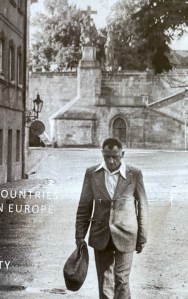
I mentioned in my earlier post the dejection I saw in the people of Bytom, Poland, a former mining town largely ignored by the EU. Images of An Other Europe, another photographic exhibit Allan and I saw in Prague, influenced that observation.

Photographer Constantin Pittas traveled to seventeen countries throughout Europe in the mid- to late-1980s, capturing people in the streets of cities. His stated goal was to “prove that Europe is one entity”.

I believe he failed. Not that his work wasn’t fascinating, but I could tell which side of the Iron Curtain he’d taken photographs by the faces and body language of the people. As in Bytom, I saw desolation throughout the Communist bloc images. In one photo, used for the brochure cover, a middle-aged man walks along a street alone toward the camera at twilight. Bag in hand, his head is tilted down to watch his step, figuratively and literally.

   I don’t see joy, or serenity, or even concern in his face. Only resignation. I’d recognized the Charles Bridge in the background so I knew this had been taken in Prague, but based on the other photographs, I had no doubt the location fell behind the Iron Curtain.

Many more showed similar images of people, their emotions constrained. Women standing on line at the market, an elderly woman sitting on a bench. Don’t ask, don’t tell, at least in places like Romania, Hungary, Armenia. People looked so different in Western Europe, where their faces bore the full range of emotions, whether young folks sunbathing on a Mediterranean beach or an elderly Portuguese woman gazing at a drunk lying in the street with a mixture of pity and disgust.

I kept returning to two images, each showing a different young woman with a little smile playing on her lips. In one, the woman sits at the counter of a Parisian café, enjoying a coffee. In the other, the woman turns to glance at a man she’s with. The pure pleasure behind the smile of the coffee drinker, compared to the sadness in the eyes of the woman presumably in love, was strikingly evident.

A series of photos the photographer had taken at the end of his journey, in Berlin, were especially moving. Pittas fortuitously found himself there in 1989, when the wall fell.

There, past and present collided, and  confusion mixed with elation as people tried to grasp what had happened.

However, the photographic image that has stayed with me the longest came from a different time.

Photograph by Constantine Pittas, from exhibition at Clam Gallasův Palác, Prague

After Eastern Europe we continued to Toulouse, France. One of my goals was to visit the Musee de la Resistance & de la Deportation, where I’d hoped to find background information for my current WIP, which covers the years around the second World War. The museum’s focus should be obvious even if you don’t understand French. Despite going through the museum with the objective eye of a researcher, I found it dark and disturbing, until I found this photograph:

Need I say more?

Photograph from the collection of Musee de la Resistance & de la Deportation, Toulouse, France

After Toulouse we spent the final days of our trip in Paris. We’d last stayed there six months before Notre Dame caught fire, and caught a heartbreaking glimpse of the ruined cathedral in 2022. While meandering through the city we once again found a photographic exposition of the decimation of one neighborhood during the Nazi occupation. Heartbreaking, we thought as we approached the cathedral. What other sad sight awaited us.  We turned the corner and saw this:

Photograph by Miriam Johnston

Progress. And hope. A balm for the soul.

Miko Johnston, a founding member of The Writers in Residence, is the author of the historical fiction series, “A Petal in the Wind”, as well as a contributor to several anthologies including the about-t0-be-released “Whidbey Island: An Insider’s Guide”. Miko lives in Washington (the big one) with her rocket scientist husband. Contact her at mikojohnstonauthor@gmail.com

.This article by M. Johnston was posted by Jackie Houchin

It’s Never Too Late

A Guest post by P.A. De Voe

(posted by Jackie Houchin)

A few years after my retirement, my first novel, A Tangled Yarn, was published as part of a cozy mystery book-of-the-month series. I had found the opportunity to write for the series through a regional writer’s conference where I met a representative from the publishing company.

I tell you this for two reasons. First, it’s never too late to begin anew and reach for your dream. Second, dreams can come true if you’re proactive. I would never have published that first novel if I had stayed home and just dreamt about becoming a “real” author. I met the publisher’s representative because I had started attending conferences to learn more about the how and what of writing, and to meet agents and publishing companies’ representatives. Even though I am an introvert (a good many authors are), I really believe that joining writers’ groups and attending conferences are invaluable for building our skills, for learning about our business, and for networking.

Since that first book after “retiring,” I have gone on to publish a second cozy mystery, five historical mysteries, and a collection of historical short stories—with a sixth historical novel to be published this summer.

My historical stories are all set in Imperial China, specifically (at this point) in the late 1300s, the beginning of the Ming Dynasty. The first three—Hidden, Warned, and Trapped—is a young adult trilogy that I had been thinking about and working on for many years. My educational background is anthropology with an interest in Chinese culture and traditions. Of course, that was long before I retired from jobs that did not specifically involve much of this training.

So, when I decided to write historical Chinese mysteries, I needed—and still need—to do a lot of research on the time period. I read Chinese literature and whatever scholarly papers or books I can find dealing with Imperial China. I look at materials on the law, economics, religion, art, education, geography, medicine, local and family histories, and more. My research is broad because I never know what’s going to be useful for a story. Criminal case reports are, of course, important because they not only tell me about the why and how a case was handled, they also expose the tensions/stresses in the society at that time. Other areas also provide windows into the social, intellectual, and religious realities for people at that time in history, which are critical for forming believable, historically grounded characters and motivations.

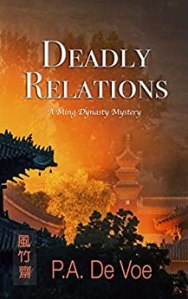
  Also, research is needed to get a realistic picture of what’s happening at the local level, beyond the Emperor’s court. In my newest series, A Ming Dynasty Mystery (Deadly Relations and No Way to Die), I wanted to show life from both a male and female perspective. The male character, Shu-chang, was easy to develop. He’s an amalgamation of striving young men struggling to achieve social and economic success through the long-standing Chinese merit system which was based on an examination process. There are many, many examples of such young men.

The female character, however, was more difficult because I wanted her to be educated and to have freedom to act outside of her home. At the same time, she had to be realistic. I couldn’t simply give her a contemporary mindset in order to create an interesting story. After all, she lived in a period and culture with a different set of expectations for men and women. Fortunately, while reading broadly, I ran across an account of a learned woman who had trained as a professional women’s doctor under her own grandmother. I was able to use her as a model on which to build my character Xiang-hua. I now had a strong female protagonist that I felt was also true to her time and place.

Fortunately for me, I enjoy research, sifting through and collecting historical tidbits. I can easily get lost in the details. However, only a small fraction of what I find interesting can or should go into a story.

As we know, an author has to be judicious in what and how information is used. It has to support what is happening without overwhelming the reader. A story is not the place for an information dump! This is true whatever the genre, but in historical fiction it is particularly important to get the balance right.

The trick is to provide enough detail that readers can easily envision the characters and environment—which may be alien or exotic to them—without being boring or bringing the story to a standstill. Consistently meeting this challenge is a skill that takes practice, and a good reader or editor can be invaluable in helping to correct the balance if and when it goes astray.

Finally, let me add one more thing on beginning to write fiction later in life. I have heard authors say they are compelled to write their stories. That’s not me. I don’t feel compelled. After all, until I retired, I wrote only a little poetry and few short stories or novels. Mostly, I immersed myself in whatever current job I had and in my family life. Once retired, however, I went back to dreams largely laid aside and dusted them off. Writing cozies and, especially, historical mysteries provides constant new challenges for me. Each story gives me a goal to work toward. A new world to share with others. And that brings me true enjoyment.

###

P.A. De Voe, an anthropologist and China specialist, writes contemporary mysteries and historical crime stories set in Ming Dynasty China. She’s a Silver Falchion award winner and twice a Silver Falchion award and an Agatha award finalist. Her short story, The Immortality Mushroom, was in the Anthony Award winning anthology Murder Under the Oaks edited by Art Taylor. She is a member of Sisters in Crime National, Tucson Sisters in Crime, the SinC Guppy Chapter, the Short Mystery Fiction Society, St. Louis Writer’s Guild, Saturday Writers, the Historical Novel Society, and Mystery Writers of America/MWA Midwest. Find her at padevoe.com. Her books can be found on Amazon.

How I Use Nonfiction and Fiction for Research and Inspiration

By Guest Author,  Sara Rosett

Some writers can sit down at their computer with no idea of what they will write about and launch into the first draft of their book. They find the blank screen and the infinite possibilities exciting and inspiring. I’m not one of those writers. I must have an idea of where the story is going before I begin writing. Otherwise, the blank screen paralyzes me. Before I begin a book, I spend a lot of time researching and thinking about the story. I’ve discovered that both nonfiction and fiction inspire different aspects of the story for me.

Nonfiction

I like to dig into nonfiction as I brainstorm my historical mystery plots. Here are a few of the resources I’ve found most helpful:

Newspaper Archives—My historical series is set in early 1920s England, so the online British Newspaper Archive has been an invaluable resource. I scoured the Positions Available section, what we’d call the Help Wanted section today, which gave me an insight into the jobs were available, the qualifications required, and the salaries that were paid. The British Newspaper Archive has magazines in addition to newspapers, and those are wonderful for getting a feel for what people read in their leisure time. One delightful surprise came as I flipped through an issue of the Sketch. I came across the first publication of Agatha Christie’s short story, The Adventure of the Egyptian Tomb with Poirot and Hastings.

Magazine and newspaper advertisements are also helpful for researching clothing and fashion as well as helping me keep in mind the attitudes of the time. Ads for fur coats and smoking tobacco seem a bit jarring to me as a modern reader, but browsing the ads helps me keep in mind the typical mindset of someone who lived in the early 1920s.

Nonfiction books—Once I have a general idea of the direction of the story, I search out nonfiction books related to the theme of the novel. I’ve read all sorts of books—everything from books on the English country house to code breaking during World War I. I find nonfiction is an excellent source for clues and red herrings. Nonfiction books have even inspired a complete plot. The second book in my historical series is about an author who keeps her gender secret from everyone—including her publisher. A real-life author who did the same thing inspired that story idea.

While researching the Egyptomania that gripped the world after the discovery of King Tut’s tomb, I ran across a story of a British nobleman who had been connected to the excavation and committed suicide. That incident became the jumping off point for the third book in my series, The Egyptian Antiquities Murder.

Memoirs—One of the most valuable resources I’ve found for getting inside the heads of my historical characters are memoirs and biographies. The Bright Young People of the 1920s were a prolific and literary bunch. It’s easy to find information about them, and reading about their midnight scavenger hunts and paper chases across London as well as their extravagant themed parties meant that I had plenty of ideas for a book set in London among the high society set when it came time to write An Old Money Murder in Mayfair. In addition to story ideas, I also cull clues in red herrings from memoirs. I note down the things that people hid from their families or feared would become public knowledge.

Video clips—I didn’t realize how much video is available from the early 1920s. YouTube and stock image sites have quite a bit from that time. I’ve watched videos of people strolling in Trafalgar Square, dancing in nightclubs, as well as an informational video from the 1920s on how the brakes work on an early motorcar, which was critical when plotting how a certain murder was committed.

Vintage clothing auction sites—My readers want to imagine the characters wearing flapper dresses and elegant evening gowns. I need to know about the fabric, cut, and embellishments of the dresses. With multiple images of individual clothing items, auction listings of vintage clothes are a good source of detailed information about the materials and construction of the clothes of the era. Another great source for clothing details and inspiration is the Metropolitan Museum of Art’s Costume Institute with its extensive online collection.

Fiction

I was a fan of Golden Age mysteries, but I’d always read them for pleasure, not research. When I decided to write a historical mystery, I began reading and rereading my old favorites as well as seeking out new authors from the era. I read the books in a different way and found that they gave me a first-hand view of day-to-day life in the time. I used my fiction-reading to glean small details that gave my stories the feel of the time.

Dialogue—Writing dialogue is one of my favorite parts of writing a High Society Lady Detective series. Much of the verbiage is inspired by my reading of Golden age fiction. Terms like old bean, old thing, topping, and that’s not cricket are common in Golden Age mysteries. The posh set was fond of their adjectives and adverbs, so I use those types of words in conversation in my historical books in a way that I wouldn’t do in a contemporary novel. Everything was ghastly, frightful or screamingly. I sprinkle those terms throughout conversation to give it a feel of the 1920s.

Culture—As I read Golden Age fiction, I made mental notes of how the characters’ lifestyles: the size of their houses, whether or not they had telephones, what they ate for meals, as well as what types of cars they drove—even if they had a car. Another thing I noticed was the formality of conversation and address. People rarely used their first names when they spoke to each other unless they were well acquainted. I fold all those details into my stories.

I’ve learned to allow some time to delve into research before I begin a book. I gather these all these details and ideas, then let them brew in my mind for a while. By the time I sit down to actually begin writing, I have a pretty good idea of the direction I want to go and some of the clues and red herrings I’ll use. If I take the time to absorb ideas from both nonfiction and fiction that blank screen isn’t as intimating and my writing goes much faster.


###

Sara Rosett Author Photo 2016 Headshot 1500 copyUSA Today bestselling author Sara Rosett writes lighthearted mysteries for readers who enjoy atmospheric settings, fun characters, and puzzling whodunits. She loves reading Golden Age mysteries, watching Jane Austen adaptions, and travel. Publishers Weekly called Sara’s books “enchanting,” “well-executed,” and “sparkling.”

She is the author of the High Society Lady Detective historical mystery series as well as three contemporary cozy series: the Murder on Location series, the On the Run series, and the Ellie Avery series. Sara also teaches an online course, How to Outline A Cozy Mystery, and is the author of How to Write a Series. Sara’s latest release is An Old Money Murder in Mayfair. Find out more at SaraRosett.com.

Social Media Links:


###


This article was posted for Sara Rosett by Jackie Houchin (Photojaq)

Oh, The Places My Mind Has Been

 by Paty Jager

I’ve been writing since I was a child. I started writing plays for our stuffed animals, then an ongoing story with two friends. When I had small children, I discovered I could make money writing freelance human interest stories for the two local newspapers.

My mind has always been filled with stories. It was several years after I started writing on a regular basis, that I realized I didn’t daydream about family members coming to harm anymore. My husband drove a semi-truck for thirty years of our marriage. Before I started writing, my mind would dredge up all these horrible things that happened to him each time he was out on the road. Once I started writing every day, those went away. I had put my imagination to better use.

My first book, let me rephrase that. The seventh book I wrote, was contracted by a small press. Yes, I didn’t sell my first attempt at writing a book. It took me 7 manuscripts before I had crafted a book that a publisher wanted.

Even though the first two books I wrote were mysteries, it was a historical western romance that was contracted. The book hadn’t started out as a series, but the hero had four brothers and once readers started asking for the other brothers’ stories, well, what could I do! The first book, Marshal in Petticoats, started the series titles: Outlaw in Petticoats, Miner in Petticoats, Doctor in Petticoats and Logger in Petticoats. Then I wrote three standalone historical western romance books. Improper Pinkerton, I had hoped to make into a series about the Pinkerton’s, but it didn’t fly off the shelves or onto ereaders.

I have always been interested in the Wallowa Nez Perce, the band of American Indian that summered and wintered in the county where I grew up. We had a rodeo each summer named after Chief Joseph, but that was the only time I ever saw a Native American in the county. Other than the ghost of a warrior I saw one day while riding my horse on the mountain behind our house.

Spirit-Box-Set1-3500x3420-1000x977My inquisitiveness started me digging into their history when agents at a writer’s conference said they were looking for historical paranormal. I came up with my Spirit Trilogy. Three siblings of a northern band of Nez Perce with blonde hair and blue eyes that turned red with their emotions (my research discovered this northern band), who had become spirits. They are shapeshifters. Through them, I showed the history of the Wallowa Nimiipuu, as they call themselves.

Historical Western Romance seemed to be taking a hit and not selling well. I was complaining about it at a Romance Writers of America meeting and one of the other authors said, then write contemporary western. I said I didn’t think I could. Lo and behold, on the two hour drive home from the meeting, a radio show host talked about how kids had used their parents’ credit card to order items on the internet. And Poof! I had an idea for a book. That was Perfectly Good Nanny which won an EPPIE award for Best Contemporary Romance in 2008. I wrote another contemporary western romance, Bridled Heart. They are both stand alone romances.

Then readers were asking for more Halsey Brothers. I decided to move forward in time and wrote stories for three male secondary characters who had been brought into the Halsey family. This is the Halsey Homecoming series. Each character is finding their way back home to Sumpter and the Halsey family. There is also a novella, A Husband for Christmas. This is a female secondary character’s story.

MayanWanting to write Action Adventure, I wrote the Isabella Mumphrey Adventures. She is a cross between Indiana Jones and MacGyver. The first book, Secrets of a Mayan Moon, she is in the Guatemalan Jungle. I became friends with a Guatemalan blogger who helped me make sure the book sounded authentic. I LOVED writing this character. She had three books. Then, again, even though the first book won the Reader’s Crown in 2013, the books are slow selling.

Mail Order Bride books became popular, but I thought they had been done over and over, so I came up with a sort of mail order husband series. Letters of Fate. In these historical western romance books, the hero receives a letter that changes his path and leads him to the woman he marries.

Ditto my Silver Dollar Saloon series. These are historical western romance, where the heroines are women who are taken in by the saloon owner when they are found starving, sick, or beaten. As they heal both in body and in mind, they find they can love and be loved again. They are redemption stories.

I finally felt confident enough to go back to writing mystery books in 2014. I wrote the first three Shandra Higheagle Mystery books and released them three months in a row in 2015. I love writing what I had always wanted to write, and I love that readers are enjoying the books. Shandra is a Native American potter. She is only half Nez Perce and wasn’t raised knowing her father’s heritage. This aspect made me feel confident I could write her because I could discover more about her family right alongside of her as I wrote her books. I have a friend who lives on the Colville Reservation where Shandra’s family lives. Number 14 in this series just released. It is set in Kaua’i Hawaii. I vacationed there last year and used it as a setting.

Murder of Ravens  The other mystery series, is the Gabriel Hawke Novels. Hawke is from the Umatilla Reservation in Oregon. He joined the military, came home, and became an Oregon State Trooper. Fifteen years ago, he became a fish and wildlife officer with the Oregon State Police in Wallowa County. Remember that place from earlier in my post? I grew up in Wallowa County, I love the rugged, ruralness of it for a mystery series. And what better character to solve mysteries than a master tracker, with roots in the area. His forefathers summered and wintered in the valleys and the mountains.  He is not only protecting the animals and land for the law but for his ancestors. To be sure I had this character’s occupation written correctly, I rode with a Fish and Wildlife State Trooper in the county for a day. He gave me a notebook full of information and ideas for stories. I’m currently writing book 5 in this series. It is set in Iceland, a place I visited last year. When I discovered they held a large SAR (Search and Rescue) conference every other year, I knew I had to bring Hawke to Iceland.

As you can see, I tend to write what is strongest in my mind. And if they don’t sell, well, then I move on to something else. Right now, the mysteries are doing much better than the romance. My calendar for 2020 is to write only mysteries.

What genre(s) do you like to read? Why?

My latest release:
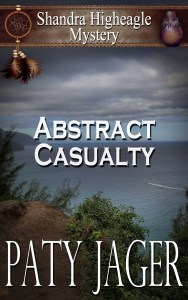
Abstract Casualty 5x8Abstract Casualty

Hawaiian adventure, Deceit, Murder

Shandra Higheagle is asked to juror an art exhibition on the island of Kauai, Hawaii.

After an altercation at the exhibition, the chairwoman of the event, Shandra’s friend, arrives home with torn clothes, scratches, and stating she tried to save an angry artist who fell over a cliff. Shandra and Ryan begin piecing together information to figure out if the friend did try to save the artist or helped him over the edge.

During the investigation, Shandra comes across a person who reminds her of an unhealthy time in her past. Knowing this man and the one from her past, she is determined to find his connection to the dead artist.  When her grandmother doesn’t come to her in dreams, Shandra wonders if her past is blinding her from the truth.

https://books2read.com/u/4XXLke

Author Paty Jager (2)Paty Jager is an award-winning author of 43 novels, 8 novellas, and numerous anthologies of murder mystery and western romance. All her work has Western or Native American elements in them along with hints of humor and engaging characters. Paty and her husband raise alfalfa hay in rural eastern Oregon. Riding horses and battling rattlesnakes, she not only writes the western lifestyle, she lives it.

blog / websiteFacebook / Paty’s Posse / Goodreads / Twitter / Pinterest   / Bookbub


Jackie: To read my review of the first Gabriel Hawke mystery, see – Murder of Ravens


This article was posted for Pati Jager by Jackie Houchin (Photojaq)

Keeping It Real: Developing Characters, Part II

by Miko Johnston

Frequent readers of this blog may recall me referring over time to the fourth novel in my A Petal In The Wind series, which I’ve been writing for more than a year. I got stuck. My plot points kept stalling out, but I had a breakthrough after my last post. Whew! Until then I worked on revising earlier chapters. In one I found something I not only rarely do, but scold other writers for doing – I repeated myself in consecutive scenes. The actual scene played out first, and on the next page my protagonist Lala told another character what happened.

Then it occurred to me – maybe I didn’t repeat myself; maybe instead, I wrote the scene in two different perspectives. I didn’t need both, but I could compare them and keep the better of the two. Out went the full scene; the gist from her dialog worked better. Lala had to have her say about the incident, and that clarified why I got stuck finishing the novel. Lala found my direction for her ‘wanting’. I realized I kept forcing the plot in a way that wasn’t true to the character, so I ‘asked’ Lala to explain, in a few sentences, what she sought for herself. That solved the mystery. I feel confident she – and my readers – will agree this new direction sounds like the Lala we’ve watched grow up.

*          *          *

Our characters must be real to us, for if we can’t envision them, body and soul, no one else will. It’s why I always write: characters ‘who’, rather than ‘that’, and say they’re created, not invented. KEEPING IT REAL: PART I focused on writing series, where you have more time and pages for character development. When creating and developing characters for a short story or stand-alone novel, how do we keep them ‘real’?

  1. Give them a background

Begin with a basic police description of gender, age, and physical size: Asian male, mid- thirties, five foot ten, 170 pounds. Ask them what you’d ask any person you’ve just met – what’s your name, where are you from, what do you do? Delve further and observe. How are they groomed and dressed? What do they sound like? Are they eloquent, plain-spoken or inarticulate? Adventurous or timid, gregarious or shy? Many writers, including our own GB Pool, recommend writing biographies for your primary and secondary characters. It’s helpful in writing a short story but vital in a novel.

  1. Find inspiration in real life

Often we base characters on actual people we know. We observe strangers in public places, listen in to their conversations. We play-act, or fantasize about what a celebrity might be like.  That may make them real to us, but it doesn’t always translate onto paper. If you write fiction, you don’t have to recreate an exact duplicate. Instead, borrow traits from the person, like appearance, personality, or history. Use those elements as a foundation to write a unique character who reminds you of what you love, or hate, about their real counterpart.  I based one character on a dear departed friend who suffered more than she deserved, and gave her a better life. I’ve also created some who resemble people I know and have one trait in common – their taste in clothes, or their bluntness. The rest I fictionalize, but with qualities I’ve found in real people.

  1. Get to know them

We must become familiar enough with a character to understand what they will say and do. Talking to your characters, questioning or interrogating them will flesh out little details. Are they outgoing or shy, active or couch potatoes? Do they like to travel, or are they homebodies? Do they eat to live or live to eat? If they could change any aspect of their life, what would it be? What flaws does your hero possess, and in contrast, what are your villain’s fine points? The more you know the better you’ll know them. To grow interrelationships, try free-form dialog, where you write a conversation between two of your characters. Sit down and begin to write without pausing, without dialog tags or punctuation. Just write, and after a few minutes your logical left brain will switch over to your more creative right brain. Try this for at least ten minutes and see what your characters have to say about each other, and by insinuation, themselves.

  1. Go beyond words and actions to thoughts and motivations

To really understand someone, we need to know more than what they say or do, but why they say or do it. Your biography will help with this, but like the exception proves the rule, contradictions in characters prove their ‘realness’. Look for contradictory traits, for everyone has a touch of hypocrisy within them. Even if your characters don’t know why they say or do something, as often happens in real life, you – their creator – must know and present it in a way the reader can deduce it without being told.

  1. Set them apart

To create characters who are not cardboard cutouts, begin by avoiding clichés and stereotypes. Not everyone from Mexico is named José (or Maria) Gomez, and you can’t always tell by appearance or mannerisms if someone is gay. Real folks are a mixture of commonality and individuality. What we share in common makes us recognizable, but our uniqueness sets us apart. Think of anyone you know and list five traits that they share with many people. Then list two or three that are different. My five shared traits would include compassionate, sensible, impatient, analytical, and curious. What sets me apart? Despite being a mature adult, put me in an environment with animals and I turn into a giddy three-year-old, as I recently demonstrated in the Monterey Bay Aquarium.

  1. Let them be

Once you’ve created your characters, allow them their voice. Let them tell you what they want and don’t want, and listen to them. It could save you hours, weeks, even months of writers block. You don’t always have to obey, but trust and respect them enough to hear them out. Also allow them some privacy. Instead of writing in every detail, give enough to flesh out the character and let readers have the pleasure of filling in the rest.

All this may seem like a lot to compact into a story or book, but the sum of big picture and little details about characters humanizes them. It also makes them vivid in our minds, which enriches the story, for even above plots, great stories revolve around the people who occupy them.

To find more writing on the subject throughout this blog – just put CHARACTERS in the search line. For an in-depth look at how to create villains, see my earlier post:  https://thewritersinresidence.com/2015/07/15/building-a-better-villian-by-miko-johnston/ If you have any advice you’d like to share, we’d love to hear from you.

mikoj-photo1

Miko Johnston is the author of the A Petal In The Wind Series, available through Amazon and Barnes and Noble. Miko lives on Whidbey Island in Washington. Contact her at mikojohnstonauthor@gmail.com


This article was posted for Miko Johnston by Jackie Houchin (Photojaq)