by Jill Amadio
Few mystery writers pour their personal passion into their fiction to get their message across as successfully and as brilliantly as multi-book author Jessica Speart. Published traditionally by such as Severn House, William Morrow, and others as one of the most addictive thriller series, the acclaimed American author’s plots are based on true, wildlife issues.
Elephants slaughtered for their tusks, sharks for their fins, rhinos for their horns, and other species for their rarity, many endangered, form the focus of Rachel Porter’s action-packed sleuthing. An agent for the U.S. Fish and Wildlife Service, (USFWS), the fictional character is a composite based on real agents who investigate smuggling, murders, and criminals who break the laws that cover illegal species trading.
Casting a worldwide net, Speart sets her mysteries in several American states, and peoples them with characters in Mexico, Russia and other countries where illegal hunting is at its most prevalent such as Hawaii for its rare reptiles and exotic birds in Florida, but what stands out the most is the remarkably meticulous and detailed research that Speart brings to her books. The reader learns a wealth of fascinating facts told in an often-humorous style while at the same time learning how poachers work, the tools needed to trap tortoises, and the clever ruses criminals use that include the rich and famous with their collecting obsessions.
“Doing research is essential to my writing,” she said. ”The idea is not to just make things up [but] to provide facts in a compelling way.”
An investigative freelance journalist for several years after studying theater at the Boston University College of Fine Arts, and stints as an actress off-Broadway, in commercials, and soap operas, Speart switched from acting to writing.
“I needed to get away for a while and ended up going to Africa. It was there that I witnessed the poaching of elephants for their ivory and rhino for their horns. I came home determined to do something to try and help.”
Speart took a direct approach and began her magazine career writing stories about the USFWS special agents and their investigations. She became fascinated with their work. Many of her articles involved wildlife and drug-trafficking crimes and were published in the New York Times, Mother Jones, and many other outlets.
But the subject matter, she discovered, wasn’t high on the list of law enforcement agencies. An animal lover, she decided to take justice into her own hands by starting a crime series, knowing the popularity of mysteries and thrillers could give her topic a voice.
“My first ten books are the fictional Rachel Porter mystery series,” she said, “which sprang from my magazine work. I became frustrated with the outcome of many wildlife cases. The illegal trade in endangered species is worth between $15-20 billion a year and yet the fines and punishment remain low.”
In the process Speart became an expert in demand at endangered species conferences, a keynote speaker at a wide range of distinguished forums including the American Museum of Natural History, John Jay College of Criminal Justice, chapters of the Audubon Society, and others, and a frequent guest on television shows and documentaries..
“The transition from non-fiction journalism to fiction wasn’t difficult, given the reality of the issues,” she said, having covered cases from initial suspicious behavior to arrest and conviction.
The fast-paced Rachel Porter series begins with what could be considered fragments of the author’s own life. Titled GATOR AIDE, it takes place in the steamy bayous of Louisiana and the New Orleans French Quarter, featuring an alligator chained to a bathtub with a dead stripper nearby. The book’s characters include cops, killers, drag queens, and corrupt politicians.
Speart’s second book, TORTOISE SOUP, crosses the country to a new assignment in Nevada where endangered tortoises have disappeared, while book 3, BIRD BRAINED, sends the USFWS agent back to the southeast coast and Florida, where exotic cockatoos and parrots are smuggled out. The cast includes a wonderfully-rendered sleazy snake dealer, Cuban cigar smugglers, airboat cowboys, and Castro terrorists. The action never stops.
Primates inhabit book 4 and the locale is the Mexican border. Not too surprisingly because they exist in real life, there’s a game ranch stocked with rare antelopes, Indian deer, and African oryx for the rich to hunt down and kill for sport. Rachel Porter unwittingly joins the group on the wrong side of the party.
Caviar, anyone? BLACK DELTA NIGHT explains how Tennessee’s Mississippi River paddlefish becomes a rival to Beluga for the Russian mafia to exploit. This time Rachel goes undercover when murder is on the menu.
 While her methods eventually result in catching the criminals, her way of operating tends to irritate her bosses and, once again, she is shipped off to another state. Montana, long known as home to private militias and survivalists, also has more than its share of grizzly bears. But why are they being killed along with several Native Americans? A KILLING SEASON provides a dazzling backdrop to the puzzle.
Books 7, 8 and 9 see Rachel once again shuttled off to other states to get her out of her boss’ hair. This time she is sent to Georgia with its manatees in COASTAL DISTURBANCE, and then to northern California with BLUE TWILIGHT in which a collector is obsessed with a rare butterfly. Again, Speart’s research brings reality to the characters, locales, and plot lines. In RESTLESS WATERS Rachel is back in Hawaii to chase down those who upset the fragile ecological balance.
Book 10 winds up the series with UNSAFE HARBOR involving the importation of illegal Tibetan antelope fur clothing, before Speart turns to non-fiction for her 11th book, WINGED OBSESSION: The Pursuit of the World’s Most Notorious Butterfly Smuggler.
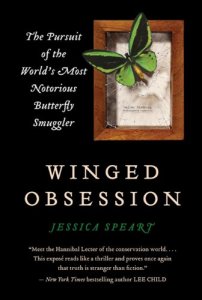 “It deals with an actual case that is so crazy no one would believe it if I wrote it as fiction,” she said. “A Japanese national began prowling around America’s national parks. One butterfly he chased was the Apache Fritillary, catching 500 of them and shipping them back to Japan to sell.”
Following up on the true case she flew to Japan and went undercover to make friends with the man. Soon, she discovered he was setting her up. A thriller, indeed.
Whether writing non-fiction or fiction Speart spends time outlining her books before giving it its freedom. “I’m a big outliner, especially when it comes to writing a mystery. Otherwise, it’s like driving your car through a tunnel without lights on a dark night. You are bound to have an accident.”
She noted that some authors spend a year-sometimes two or three – nurturing their book. “Then comes the morning when we finally have to let go and the book takes on a life of its own.”
Speart finds that releasing a published book is exciting and frightening both at the same time. “There’s the rush of having the published book hit the stores, there’s the fear that no one will like it. But what about those folks who read your book and become angry?”
 After BLUE TWILIGHT went on sale a small group of butterfly collectors felt she had attacked them, and, in turn, began attacking her.
“Apparently, I’d hit a nerve,” she said. “I’m not saying butterfly collecting is a crime but there are those who cross the line between collecting legal butterflies versus collecting protected and endangered butterflies. There are instances where even legal butterflies have been over-collected.”
The author points out that there is a class system when it comes to species being valued, and that if they were chimps, tigers and others public reaction would be one of horror. She continues the argument on her website in one of her blogs. She also discusses the difference between the two styles, saying that narrative non-fiction is fact-based storytelling employing some of the same skills that are used in fiction, setting each scene, presenting fascinating characters, and creating a strong narrative persona.
As for specific dialogue in non-fiction, Speart again brings her research to the forefront. It requires, she says, exhaustive digging which is something she enjoys. She also points out that narrative non-fiction doesn’t have to be told as purely objective journalism. Writers can bring emotion to their characters and create a sense of drama while following the story arc.
A few books that fit into the discussion are some of her favorites including In Cold Blood by Truman Capote; Into Thin Air by Jon Krakauer; The Orchard Thief by Susan Orlean; The Perfect Storm by Sebastian Junger, and Midnight in the Garden of Good and Evil by John Berendt, a book that began Speart’s love affair with the city of Savannah.
Jessica Speart teaches an advanced mystery writers workshop in Connecticut, and reminds students: “You have to believe in your work and not give up. Writing is a rough business and not for the faint of heart.”











 Before we go on to some inspiring quotes from a dozen great mystery writers, here’s a little housekeeping to help you get the most from our blog.

 For lovers, every day is Valentine’s Day. But February 14 is the official day when Cupid’s arrow strikes and big business rakes in billions spent on candy, flowers, jewelry, and fine dining.
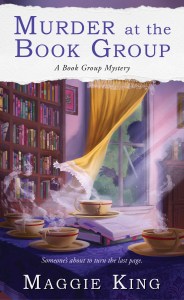 In Murder at the Book Group, the series debut, Hazel describes Vince as her on-again, off-again lover. She attributes their sporadic relationship to their inability to get along. She doesn’t offer details as to why they don’t get along but the reader can guess that the real problem is Hazel’s cold feet about committing to a permanent relationship. She’s been married four times and isn’t eager to make a fifth trip to the altar, only for the relationship to sour soon afterwards. Does she love Vince? She doesn’t want to commit to that either, but she definitely has a soft spot for him.
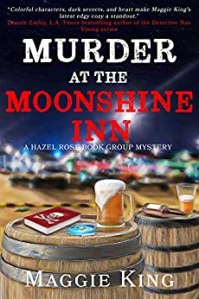 If you read #2 in the series, Murder at the Moonshine Inn, you will know the answer is “yes.” They married in beautiful Costa Rica. Hazel becomes a successful romance writer. The very name Hazel Rose conjures romance.
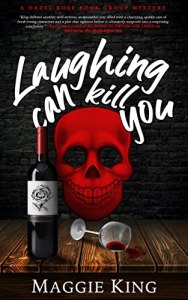 The book group members don’t fare as well as Hazel and Vince in the romance department:
 Maggie King is the author of the Hazel Rose Book Group mysteries and short stories set in Virginia. Her story, “The Last Laugh,” appears in the recently-released Virginia is for Mysteries III anthology.
 The Writers in Residence
You must be logged in to post a comment.