A New & Short Mystery!

by Guest Writer Alice Zogg

Hello friends, readers, and fellow authors,

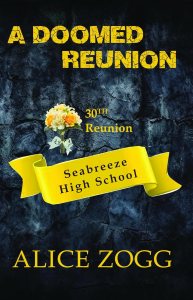
I penned another stand-alone mystery.   A DOOMED REUNION is fresh off the press and available in hardcover, paperback, and e-book editions.

This one is short (170 pages).  Either I have learned to get my point across with fewer words or have become lazy. (haha)

As to the location, I invented a fictional town called Seabreeze and placed it along the California coastline between Del Mar and La Jolla.

People with old school ties attend a 30th high school reunion and are shocked to hear one of the attendees say he knows who murdered a classmate years earlier. That knowledge gets him killed.

Can Detective Scharfkopf with the San Diego County Sheriff’s Department piece together what happened back then to catch the person who has lived with this secret all these years… before another body is added to the list?

Happy reading,

www.alicezogg.com

A Doomed Reunion on Amazon

Alice Zogg was born and raised in Switzerland. She met her husband, a fellow Swiss, in New York City, and the two made their home in the United States. The family relocated to Southern California in 1967, where they have resided. She is an avid traveler and plays racquetball and golf. She has written over 20 books. 

###

BOOK REVIEW – I read Alice Zogg’s new book. Yes, it is short, but the crime, plotting, and investigation are complete.  You don’t feel cheated at all.  The murder happens after a high school class reunion when one person blatantly claims to know the murderer of an unpopular student 30 years previously.  Does he?  Someone believes him and, in unusual circumstances “offs” the guy.  The detective is charged with solving not one but two murders.  The questioning, deduction, and final moments of revelation are well-plotted and written. I enjoyed reading it!  ~~~ Jackie Houchin


Why I Read Short and Long

by Jackie Houchin

I read a lot of print books and listen to a great many audiobooks each year. I do not read anthologies or collections of short stories unless they contain several stories by authors that have a track record I enjoy.

Recently, I have been “reading” (I will use that word whether I use my eyes or ears) a good many short prequels to book series. If the book turns out to be so-so, I haven’t wasted much time. If I like it, I’ll consider the series. Also, more authors are writing their stories as novellas, which I enjoy too.  For me “shorter is better.”

Except!

Except when I read authors that I KNOW will come through with an outstanding story. Then I will read longer. Sometimes much longer.  I’m currently reading CITY SPIES by James Ponti. It has 378 print pages and I LOVE it. I eat it up. I can’t get enough, even when my eyes are stinging. I’m already looking for the next in the series. (Okay, yes, it’s geared to 10-12 year-olds, but I’m a kid at heart, and it really IS written well.)

In general, for LONG reading, I like fascinating, immersive, tightly-written books, with unique plots and hooks and plenty of jaw-dropping moments. And the characters better resonate with me.  I enjoy relevant back-story told well and within the plot.  In mysteries, I don’t want to easily figure out who is the villain or how he did the crime. I want to follow the author step by cleverly contrived step to the WOW ending, which, on second thought, makes perfect sense. I want a story that stays with me for a while.

Charles Todd is one of those authors. His Ian Rutledge historical mysteries are top notch. Here are my reviews of two of those books. You can see why I love them and will READ LONG.

A Pale Horse

A Deadly Loyalty

Historical Novels and Mysteries need to be believable and take me right to that setting and hold me there. If they do, I’ll READ LONG.  Here are three I reviewed that did that.

The Ghost Map by Steven Johnson

The Girl in The Painting by Tea Cooper

A Brilliant Night of Stars and Ice by Rebecca Connolly

In a LONG READ novel, I want to be carried along with astonishing characters, vivid settings, and heart-wrenching but hopeful story telling. Here are two I loved.

The Bronte Plot by Katherine Reay

Light on Bone by Kathryn Lasky

Here’s one dual-time plot that is outstanding and innovative and that I gladly READ VERY LONG.

When The Day Comes by Gabrielle Meyer

And I could name more.  I totally enjoy reading Charles Martin (long & intense), Connie Berry (intricate plots), Katie Gayle (addictive), A.J. Pearce (Historical), Spencer Quinn (Humor, a dog’s POV), and my all-time favorite Mary Stewart, which I read and listen to over and over.

All these books are well written and enjoyable. If these authors keep on writing, and others like them, I think there is hope for readers. (At least in my life time.)

NOTE: I hope you don’t mind the blatant self-promoting of my Words and Reviews blog!

..

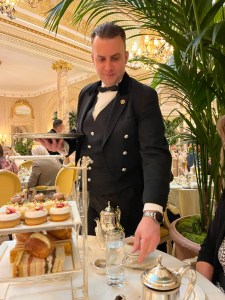
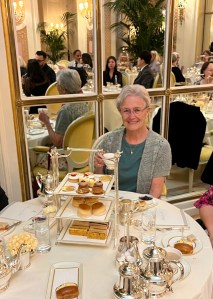
And a few fun shots of Jolly Ole England – Afternoon Tea at the Ritz with lovely piano music, 150 Picadilly, London.


Buckingham Palace and Big Ben


Words, Words, Words. Who keeps track? Writers!

By Jill Amadio

Words, words, words. More than three million of them.

That’s how many a Tamil in India wrote. Granted, the words were spread over 26 volumes but still, quite remarkable. Chinese authors wrote lengthy books, too, while contemporary writers like J.R.R. Tolkien confined himself to a mere 558,003 words to complete The Lord of the Rings.  J.K. Rowling wrote 1,084,170 words in the Harry Potter series. Carl Sandburg threw half a million words onto the pages of Remembrance Rock, while Stephen King prefers to write long, and his thriller, It, has a whopping 1,138 pages for a paperback price of around $30.  A bit heavy for reading in bed. Kurt Vonnegut’s Slaughterhouse Five is around 500 words under 50,000, and Tolstoy’s War and Peace that everyone thought to be the longest book in the world offers 587,287 of text.

I was curious last week as to word count while putting the finishing touches to my 9/11 novel. Based on a true story, I found, to my horror, that the manuscript only contained 61,000 words. I know for cozies that is acceptable but anxious to check out what the going word count was for novels these days I went online to research.

Happily, the consensus is that the majority of publishers are content with a range of 50,000 to 100,000 of an author’s polished prose. One site claimed that anything over 40,000 is acceptable. However, books by C.S. Lewis, Roald Dahl, and George Orwell among others were bestsellers with books under that number of words.

It actually depends on genre. A literary novel, one site tells me, and by the way what the heck is a literary novel as all writing is, by definition, literary, no? No. It turns out that literary fiction must be intellectual, have depth, character and style. Surely, mysteries fit right into the middle of those requirements.

Publishing industry standards can vary. Authors of romance novels typically write between 80,000 to 100,000 words, and science fiction and fantasy can exceed 140,000. Westerns are, surprisingly, shorter, between 45,000 and 75,000, and novellas can be from 18,000 to 40,000 words The Reedsy blog site points out that a too-long word count is a symptom of a major plot or pacing problem.  First drafts can usually tell us whether we’ve overstepped the yardstick, and where to cut. Most editors warn writers not to edit their manuscript until that first draft is complete, and keep an eye on bringing too many characters into your story.

It is tempting to include extraneous material when your write about a favorite hobby or pastime you love but it’s a no-no for publishers unless it’s a theme like knitting, baking, or cheese. Frankly, I enjoy learning something new and my current read, The Crossing Places by Elly Griffiths is an archaeological mystery that briefly explains many of the basics of the discipline in dialogue, the perfect place.

Thus armed, I began to edit my latest novel’s first draft and found I was right in the ballpark of acceptable word count. Of course, if you are going to self-publish with KDP, or other places, you can make up your own rules. But if readers expect a certain number of pages in your series it makes sense to adhere to that. Another point to keep in mind is that if you are adding an audiobook to your editions it could require a rather lengthy listening period that could get tiring.

A godsend to writers is the software that continually counts your words as you write and at the same time posts the page number you are currently on. A few writers I know never look at those results over periods of days or weeks in order to be wonderfully surprised when they finally do take a peek. Or not. They say that being required to produce or eliminate a certain number of words is soul destroying.

As several authors have commented when considering word count: “When it’s done, it’s done. When the tale is told, it’s told.”  End of story.