
by Miko Johnston
We can plot our stories well, describe settings vividly, and touch on all the senses, but the heart of any story is its characters, and they need more than a heart to make them come alive.
I began writing fiction, or more accurately, learning how to write fiction, while working in a library. It gave me access to numerous books and magazines for self-study. One book in the collection devoted a chapter to creating characters, complete with a checklist of traits and their opposites – outgoing vs shy; scholarly vs uneducated – from which the prospective writer could choose and assemble. I found the idea silly and worse, useless. Whether in my writing or my reading, I want characters to resemble real human beings, only more interesting than the average person. You can’t achieve that by compiling random parts. Just ask Dr. Frankenstein.
We’re told to have our characters want something and then keep it from them, make them fight for it. Good advice, crucial for plot. We must describe them with enough detail so the reader can visualize them; again, good advice. Backstories and bios, family and friends, strengths and flaws, jobs and hobbies or interests. How they dress. What and who they like or dislike. The dark secret in their past that drives them forward or holds them back. These big picture details lay a foundation for characters. However, it takes more to breathe life into them. Whether you call them quirks, idiosyncrasies or eccentricities, these subtle differences add a realistic quality to them.
Although our individual quirks may differ, we all have them, which makes this a commonality. In other words, a human trait.
Think of Robert Crais’ Elvis Cole and his affection for cartoon characters, the dry humor of Nelson DeMille’s John Corey, or the fussy Inspector Poirot and his eggs in Agatha Christie’s mystery series. Master art restorer Gabriel Allon inherited his talent, as well as trauma, from his Holocaust survivor mother. And while we naturally empathize with a blind girl like Marie-Laure in “All The Light We Cannot See”, the way she copes with it makes her mesmerizing.
There are two general types of quirks – nature and nurture. Nature includes those the character was born with, such as personality types or bio-physical traits like an intellectual disability or a club foot. A life experience, whether an acquired taste or an emotionally painful experience, would fall under the nurture category. In all cases, how the character has internalized the trait leads to the quirk.
Quirks have to be worked organically into the story. They shouldn’t be unrooted in the character’s history or biology. They should play a role in the character’s thoughts, emotions or actions. They need to be noticeable, but not too blatant; subtle, but not too vague. Readers need to discover them on their own by being shown the behaviors rather than being told about them.
A character’s quirks can be related to their physicality, the way they dress or groom themselves, their behavior or personality, or they can be completely random. Here’s one example: money. Most everyone I’ve met has a philosophy, or criteria, about what they’re willing to spend on something. They’ll be tight-fisted about some things and looser, even extravagant about others. What does it say about a character who’ll spend hundreds of dollars on tickets to the opera, a Broadway play, or the Superbowl, but won’t pay two dollars for a can of tuna in the supermarket unless they get a double-off coupon? Or worse, not buy it at all because they can remember when it cost thirty-nine cents? It says they’re “human”.
Ultimately, it’s not so much a matter of “what” a character does or doesn’t do, what they like or dislike, that makes them full-fledged humans. It’s the “why” that makes it interesting and brings them to life. Always listen to your character, for they’ll often tell you what’s right for them. For hints on this, see Gayle’s earlier post.
When treading the fine line between character and caricature, here’s what to avoid:
- Cliched or overused idiosyncrasies. If I had a dollar for every alcoholic PI, or divorced or widowed detective, I could pay my cable bill for a year. If you’ve seen it before, add a new twist. If you’ve seen it over and over again, avoid it like the plague (humor intended).
- An assemblage of unrelated quirks, as if selected from a list found in a book (jab intended). Author Rex Stout’s Nero Wolfe tends his orchids, reads voraciously, and feasts on gourmet food from the comfort of his luxurious home. The genius of his character is how all his passions connect.
- Limit the number of quirks, or else – well, just ask Dr. Frankenstein.
- Don’t overdo the ones you use. Quirks are like seasoning – you need enough to enhance the flavor without overpowering it.
If you found this post helpful, leave a comment, and feel free to contribute your suggestions for making characters come to life. Frankly, my ulterior motive in writing this comes as much from my goal to write books with believable and engrossing characters as my desire to read them.
Miko Johnston, a founding member of The Writers in Residence, is the author of the historical fiction series, “A Petal in the Wind”, as well as a contributor to several anthologies including the about-t0-be-released “Whidbey Island: An Insider’s Guide”. Miko lives in Washington (the big one) with her rocket scientist husband. Contact her at mikojohnstonauthor@gmail.com

 Among these senior students, limited to 12, were a school bus driver, a poet, an attorney, an ad saleswoman, a lady from Germany who escaped the Nazis, a couple of teachers, a financier, and an accountant. One gentleman dropped out after lesson #2 because he said now that he was about to describe his life he found it too painful to do so. Another gentleman said he doubted he would continue because as a reporter he was trained to write lean, and that was the antithesis of writing a book. I told him I’d initially experienced the same hesitation when I was first approached about ghostwriting. My editor at the magazine I wrote for said that a CEO had called asking for a referral to a writer for his business book. Before calling him back with a recommendation she sked me if I’d be interested.
 So, did I want to take up the challenge of teaching some old fogies like myself how to write their memoirs? The idea appealed to me. I had never taught anyone anything in my whole life. Well, maybe a few table manners to my kids. So, yes, I accepted the challenge to help anyone over 65 jot down their life story in presentable and publishable form.
 Among these senior students, limited to 12, were a school bus driver, a poet, an attorney, an ad saleswoman, a lady from Germany who escaped the Nazis, a couple of teachers, a financier, and an accountant. One gentleman dropped out after lesson #2 because he said now that he was about to describe his life, he found it too painful to do so. Another gentleman said he doubted he would continue because as a reporter, he was trained to write lean, and that was the antithesis of writing a book. I told him I’d initially experienced the same hesitation when I was first approached about ghostwriting. My editor at the magazine I wrote for said that a CEO had called asking for a referral to a writer for his business book. Before calling him back with a recommendation, she asked me if I’d be interested.
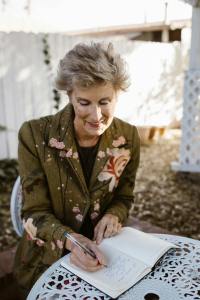 By lesson #4, we all felt comfortable with each other reading aloud the homework. One lady was writing her memoir only for her grandchildren and refused to share it with us. But everyone else was eager for everyone’s critique. The lawyer fella incorporated funny poems into his memoir, and someone else brought us to chuckles with her descriptions of working in a donut shop as a teenager. The German lady brought us to tears with her childhood memories of fleeing the Nazis
 I recently had a book published by Austin Macauley about my work as a pet detective. It is a work of ‘faction,’ as I like to call it. Some stories are true, some are fiction, and some are combined (real and made up).

 I’ve always enjoyed spring, a time of renewal, and probably more so this year after the winter we’ve been through. Thoughts turn from shoveling snow to shoveling dirt in the garden, from watching the overflowing rivers subside to marveling at the regeneration of fauna and flora.


 The Writers in Residence
You must be logged in to post a comment.