Short Stories: The Reader

by Maggie King

A while back, I had a conversation with a well-read young couple. Like me, they enjoyed mysteries, the classics, and literary fiction. When they asked what I was working on, I said I was finishing my third novel and planned to focus on short stories for a while.

“Really?” The man looked doubtful. “I know that writers like writing short stories, but do readers like reading them?”

“I’m guessing you don’t,” I said. “What is it you don’t like about them?”

“They’re too, well, short.”

The woman added, “Just when I’m getting into the characters, the story ends.”

Are their comments typical ones? I expect so.

When I asked my book group members if they read short stories, I got blank looks. One of them, a retired English teacher no less, said, “Well … we read them in school.”

My first short story was published a year before my first novel. Two people I know told me plainly that they would wait for my novel, as they had no interest in reading a short story.

I selected the following comments from reviews of anthologies published by the Sisters in Crime Central Virginia chapter:

Short stories cannot deliver a good mystery to me. There were a few short ones that were good, but on the whole, not a great book.”

I am not a huge short story person usually because I don’t feel like I get enough information. I only read this book because of a book club I belong to.”

My biggest problem is that they don’t end with a clean-cut solution. You pretty much get a ‘feel’ for what will happen and then have to use your imagination to finish the ending.”

And some good reviews:

Very much enjoyed! I’m a busy mom with not much time for fiction, so I loved that it was a collection of short stories. …. It was truly refreshing to be able to read a good short story and then move onto the next when I was ready! Interesting stories and well written.”

My first ever mystery story collection. A friend recommended it and I really enjoyed it! Glad I branched out to try something new.”

I asked award-winning short story writer Art Taylor to comment on the reviewer who wished that short stories ended with clean-cut solutions. This is his response:

Short stories don’t always tie everything up nicely at the end. They often end on an ambiguous note and the reader can draw her/his own conclusion. Sometimes readers complain, as they expect the endings that novels have.

I do try to strike some balance myself—key questions answered (no information left out) but emotional issues still up in the air a bit, if that makes sense. Maybe what happened is explained, but the fallout is still to come, and the reader can imagine some of that rolling on into the blankness of the page beyond the final word.”

Despite the criticisms, many short stories are being published in anthologies, collections, magazines (the magazines are mostly digital now). For some time, I’ve been hearing that the availability of short stories in digital format has made them attractive to readers. But based on the above in-person conversations and online comments, writers need to do more than digitize their stories–they need to make them appealing. How can we do that? How can we satisfy the reader who wants “more?”

Such a reader might like a story collection. Anthologies present stories by different authors, but the ones in collections are penned by one author.

In Shooting Hollywood: The Diana Poole Stories by Melodie Johnson Howe the mysteries are not only beautifully written, but Diana Poole, actress/amateur sleuth, appears in each one. So if you take a liking to Diana, you’ll find her in the next story. And the next. Perfect for the reader who wants continuity and character growth. Other authors feature different characters and settings in each story of their collections.

Authors with published collections include Ruth Rendell, Agatha Christie, Arthur Conan Doyle, Marcia Muller, Bill Pronzini, and our own Gayle Bartos-Pool with her outstanding Only in Hollywood. There are many more. Suggestions for non-mystery collections: Maile Meloy’s Both Ways is the Only Way I Want It, and Elizabeth Strout’s Olive Kitteridge.

An idea from M. Louisa Locke, who guest-posted for Writers in Residence in 2020: she wanted to keep readers interested while they waited for her novels, so she started publishing short stories based on her Victorian San Francisco Mystery series.

In addition to short stories serving as a marketing tool, they allowed her to develop the minor characters in the series.

Read M. Louisa Locke’s post.

As for satisfying readers who want the clean-cut solutions they find in novels–that’s a tough one. Writers certainly want to please readers, but short stories are not just short novels. In my own stories, the reader will usually know who committed the crime, but vigilante—not traditional—justice is often served. I can only think of one story where I had the villain led away in handcuffs. However, I agree that some authors end their stories on overly vague, even abrupt, notes.

Likely there will always be readers who prefer novels over short stories—and that’s okay. Perhaps the best thing we can do is keep writing, stay true to ourselves, keep improving our craft, and the readers will come.

A parting idea: writers and publishers could work together to come up with effective ways to promote their short stories, collections, and anthologies.

These are my thoughts. Yours?

Coming in September: Short Stories: The Writer.

Images courtesy of book.store.bg, abebooks.com, ElizabethStrout.com

The Future of the Written Word – Will Anybody Remember What Words Mean?

by Gayle Bartos-Pool

Writing Books

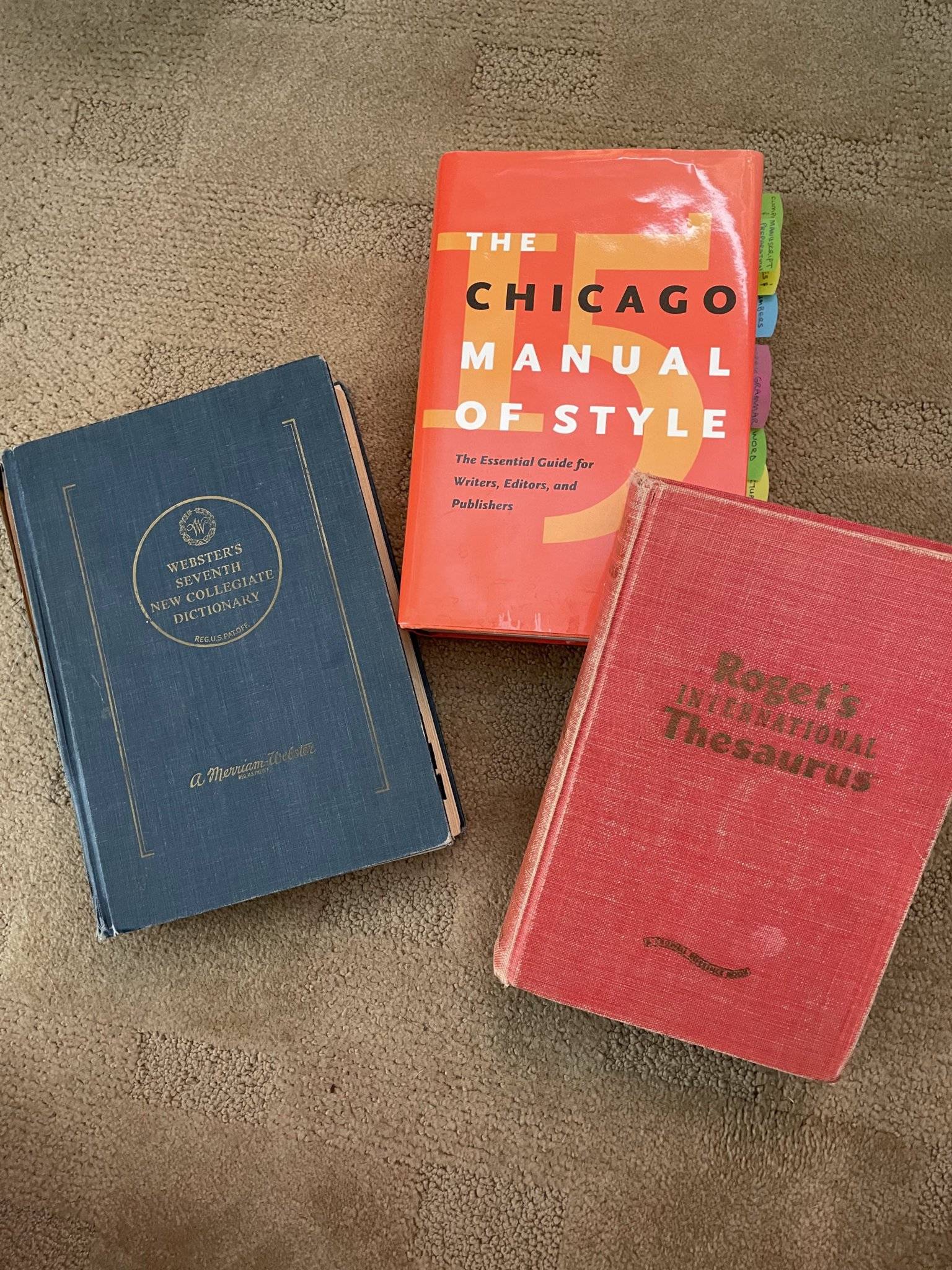
This is a Follow-Up to Jill Amadio’s post about words used by younger folk that might need a new dictionary to understand them because they aren’t in my old Webster’s Seventh New Collegiate 1965 edition. We hear slang on TV shows geared to a younger audience and from young folk in our daily life, some of which needs to be defined by the user because the listener has no clue what they mean. But what will books in the not so distant future be like? Here’s a sobering take on this subject.

I was in a writers’ group years before we formed the Writers-in-Residence blog that consisted of aspiring novelists of all ages. The majority of us were older, but the young folks wanted to be writers and this was a good way to have their work critiqued and maybe improved. Each month one person in the group would submit 30-60 pages and the others would read them and make notes and suggestions about that sample. The pages were usually part of a novel-in-progress. None of the younger people had published work, though most of us older folk did have one or two books in print or wrote for a newspaper. We still wanted our work read and have the group toss around ideas to make the WIP (Work in Progress) better.

That was basically wishful thinking on most of our parts. First, the younger folks didn’t understand sarcasm and how it was used in writing. In other words, they couldn’t understand a good joke about life in general. They also didn’t understand references to anything more than a few years older than they were. A sense of humor was foreign to them, as were the names of famous movies or actors or World History or… Anyway, much of the color and character in our work went over their “collective” heads.

As for their work, I remember reading the first few pages of one person’s novel. The lousy spelling and total lack of punctuation made the pages unreadable. I felt like a Fifth Grade teacher grading a kid’s paper who would definitely be getting an “F.” I had to tell the person why I didn’t finish reading his work. He wasn’t happy and didn’t stay in the group much longer. But every one of those younger people wrote the same way: badly.

I have heard that schools aren’t teaching little things like grammar or spelling or punctuation or math or science that you might find in a school book back in the last half of the last century. I’m not talking about the 1800s. I’m talking about 1950-1999. But remember: Gravity still exists. 2 plus 2 still equals 4… so far. A dictionary from that earlier era should still be relevant. We can add words, but not change their spelling or eliminate their original meaning. Or can we…?

If a word can mean anything you want it to mean or its spelling can be whatever you key into your handheld device with your thumbs or if World War Two was won by space aliens and not the Allied Forces, “Houston, we have a problem.”

4 Great Books

But if this Brave New World is what the future holds, the only hope we have is that the people who use these new words can’t spell them, much less understand how to use a pen and write them, so there won’t be any new books out there to read containing these odd words with nebulous meanings. But folks in the future will still have Shakespeare and Agatha Christie and a few books by some of us who still write in a readable language… but that of course does depend on a hope that kids are taught to read in school and right now that doesn’t look too promising. And of course some people are removing great books from schools and libraries or are rewriting them to suit a new generation’s feelings, so that is problematic. Ray Bradbury wrote about a dark future like this in Fahrenheit 451. Orwell saw this coming in his book, 1984. I actually made references to the books 1984 and Brave New World in this post, if you caught the sarcasm. (Look up the meaning of the word if it’s unfamiliar. Use a Webster’s…) So folks, keep copies of these great books in your home library and other books that you have in your collection so future generations can see what people wrote about a century earlier, though you might have to read the book to these younger folk if they weren’t taught in school…

Do I think this is a problem? What part of “Yes” don’t you understand? (Oh, by the way, that’s sarcasm…)

RayGayleClose

This is Ray Bradbury and me.

How I Set A Mystery In The Galapagos

By Guest Blogger, Sharon Marchisello

For as long as I can remember, I had three goals in life: become a bestselling author, meet and marry the love of my life, and travel the world together. And I always figured I’d do them in that order. Although I achieved my dream of being a published author, I’m still working on that “bestselling” part.  

When I graduated from the University of Southern California with a master’s degree in professional writing, I realized I’d have to get a “real” job. Not only was I not making a living as a writer; I wasn’t even published. Should I go for an opportunity that involved writing but might drain my talent and energy? Or should I look for something mindless that would pay the bills, so I could focus on my stories during off hours? Then a position as a reservations agent at Western Airlines fell into my lap.  

My roommate had a friend who worked there, and one day the friend called to say Western Airlines was hiring. I was the first person to listen to the message on our answering machine and begged to go to the interview too.  

The woman who interviewed me said, “You’re overqualified for this job. You just want it for the travel perks, and I know you’ll quit after a year or so. But I won’t stand in your way.” I stayed with the company for twenty-seven years; my roommate left after six months.  

But she was right about me wanting the travel benefits, and my first few years, I was on a plane every time I had a day off. I met my future husband at the Los Angeles airport, and together we’ve taken 65 cruises and visited over 100 countries on all seven continents.  

Although I kept writing fiction and even published a few travel articles, I never set a story in one of the destinations I’d traveled to. Until the Galapagos.  

If you’re looking for the Galapagos on the map, it’s a group of islands straddling the equator, approximately 600 miles off the Pacific Coast of Ecuador. I never planned to set a book there, either, but six months later, I remembered an experience from our cruise that I thought would make a great opening scene for a mystery.  

Normally, the guides were conscientious about counting heads and watching over all the passengers in their charge whenever we were away from the ship. In an archipelago comprising 97% national park containing flora and fauna found nowhere else on earth, tourists must be carefully supervised.

But one day, my husband and I left another activity to join a snorkeling excursion already in progress, and neither of the guides assumed responsibility for us.  

We were swimming along, marveling at the vast array of colorful underwater life, when I surfaced to see both Zodiac boats motoring back to the ship—without us! I can still feel the panic of being left alone in the middle of the ocean, treading water off the shore of an island populated only by sea lions and blue-footed boobies.  

I waved and screamed, bobbing up and down like a spyhopping whale, and fortunately, someone spotted me. One of the boats turned around and came back to pick me up. I didn’t see my husband right away but told the guide he was still out there. In a moment, he’d swum up and climbed aboard. All was well.  

But what if… What if my protagonist’s companion didn’t get picked up? And what if the person was left behind on purpose?  

I had a great time writing the book, reliving our trip through photos and program notes, plus doing a lot of supplemental research on the internet.  

When Secrets of the Galapagos begins, my heroine, Giovanna Rogers, is snorkeling with her new friend, tortoise researcher Laurel Pardo. The two get separated from the group, and Laurel disappears. No one on the ship will acknowledge that Laurel didn’t make it back.  

To determine a motive, I recalled a conversation I’d had with one of our guides during a visit to the Charles Darwin Research Station in Puerto Ayora, the largest town on Santa Cruz (one of only four inhabited islands in the chain). “I know a secret about Lonesome George,” he said. “But if I tell you, I’ll have to kill you.”

Lonesome George was a Galapagos giant tortoise made famous for being the sole survivor of the Pinta Island species. Unfortunately, efforts to breed George were unsuccessful, and the ancient tortoise passed away in 2012 without an heir.  

But what if someone discovered another giant tortoise from a different subspecies also thought to be extinct? And then a tortoise researcher unearthed information about the animal that the tourist industry didn’t want released?  

You’ll have to read Secrets of the Galapagos to find out what happens next.  

Blurb:  

Shattered by a broken engagement and a business venture derailed by Jerome Haddad, her unscrupulous partner, Giovanna Rogers goes on a luxury Galapagos cruise with her grandmother to decompress. At least that’s what her grandmother thinks. Giovanna is determined to make Jerome pay for what he’s done, and she has a tip he’s headed for the Galapagos.  

While snorkeling in Gardner Bay off the coast of Española Island, Giovanna and another cruise passenger, tortoise researcher Laurel Pardo, become separated from the group, and Laurel is left behind. No one on the ship will acknowledge Laurel is missing, and Giovanna suspects a cover-up.  

When the police come on board to investigate a death, Giovanna assumes the victim is Laurel. She’s anxious to give her testimony to the attractive local detective assigned to the case. Instead, she learns someone else is dead, and she’s a person of interest.  

Resolved to keep searching for Laurel and make sense of her disappearance, Giovanna learns several people on board the ship have reasons to want Laurel gone. One is a scam involving Tio Armando, the famous Galapagos giant tortoise and a major tourist attraction in the archipelago. And Jerome Haddad has a hand in it. Thinking she’s the cat in this game, Giovanna gets too involved and becomes the mouse, putting her life in jeopardy. But if she doesn’t stop him, Jerome will go on to ruin others.

AMAZON 

SUNBURY PRESS

Bio:  

Sharon Marchisello is the author of two mysteries published by Sunbury Press—Going Home (2014) and Secrets of the Galapagos (2019). She has written short stories, a nonfiction book about finance, training manuals, screenplays, a blog, and book reviews. She earned a Master’s in Professional Writing from the University of Southern California and has been an active member of Sisters in Crime since 1995, currently serving as treasurer of the Atlanta chapter. Retired from a 27-year career with Delta Air Lines, she now lives in Peachtree City, Georgia, and volunteers for the Fayette Humane Society.  

Website: sharonmarchisello.com (https://smarchisello.wordpress.com/)  

##

This article was posted by member, Jackie Houchin. If you’d like to read my review of the audiobook version of  SECRETS OF THE GALAPAGOS, click here.   


Let Your Characters Take Over

by G.B. Pool

Let me repeat myself:

When your characters start talking,

get out of the way and let them talk.

Why do I say this? Because I have done just that and my characters have taken me places I didn’t know I would be going to. They have told me who they were when I thought they were somebody else. This goes for minor characters as well as major characters.

When I was writing CAVERNS about rats eating away the ground underneath the high rises along Lake Shore Drive in Chicago, I was going to kill off a cop who first discovers the rats, but as I was writing about him, I realized I liked this guy, so I had him turn into one of the three male leads in the book. I gave him a life with a not-so-great wife, a great kid, and a really nice girlfriend. He kept telling me who he was and the story grew. I even have my female lead in the story help rescue the girlfriend. Who knew there was that much more story to write? I guess my character did, because the cop character kept nudging me to write more about himself.

One of my three detective series features this guy named Johnny Casino. I figured that would be his name. I grew up reading detective novels that my mother had and watching detective shows on television. There were three famous detectives from old TV series and a movie whose name was like a playing card: Spade, Diamond and Heart. Sam Spade from the Humphrey Bogart movie The Maltese Falcon, David Janssen’s TV series “Richard Diamond, Private Detective,” and Robert Wagner who starred in “Hart to Hart.” I wanted my detective to be the fourth playing card, a club. But “Club” wasn’t right for a last name, so I thought: what name means club? How about casino? And Johnny Casino was born.

But wait: Johnny was more than just a name. He started “talking” to me about who he was. The first page of The Johnny Casino Casebook 1, Past Imperfect, the first book in the trilogy, was literally Johnny telling me about himself. I just typed out what he was saying. This is the first paragraph in that book:

My name is Johnny Casino. I’m a retired P.I. with a past. I just hope it doesn’t catch up with me. Before I went legit, I ran numbers in Jersey for Big Louie “Fingers” D’Abruzzo and then busted heads in Miami for Big Eddie “Mambo” Fontaine. But at the ripe old age of twenty-four, Little Johnny beat a hasty retreat to L.A. when somebody slipped the cops a hot tip and all of a sudden, I became the fall guy for the Mob.

That first page was typed out in one continuous effort… No re-writes. This was who the character was going to be. I couldn’t tell you where it came from, but there it was. He knew he was born in Jersey. His dad was a consiglieri to a local crime family. His mother was from another crime family in Chicago. He worked for the mob for a while until he told himself this wasn’t the life for him and eventually moves to California. But Johnny’s real name had been Cassini back in Jersey. He changed it when he made that move to Los Angeles. But in The Johnny Casino Casebook 2, Looking for Johnny Nobody, Johnny finds out he really wasn’t a Cassini. He meets his real mother and her second husband. Johnny’s father, a cop, had been killed before he was born and an unscrupulous organization basically took him from his mother and sold him to the New Jersey pair. And how did I learn all this stuff? Johnny told me when I was writing out more of his biography for the second book.

Biography? Why not? I learned to do this when I took acting lessons in the last century. Back in 1973, I took acting lessons so I could learn how to write dialogue. It was a great way to see what actors needed to do to bring their characters to life. My teachers, Rudy Solari and Guy Stockwell, were fabulous teachers. They wanted the actor to know who they were portraying before they set foot on the stage or in front of the camera, so they had the actor write a brief bio of their character. The script doesn’t tell you everything, so Rudy said create a life for these people that you are portraying. I did it then and I still do it for the characters I write. It can be a paragraph or pages long. Just enough to know where the character came from, who they are, and why they do what they do. It really does a make a difference to the actor. If the character had a rough upbringing, they will hit the stage with attitude. If they were sheltered or beaten, they will hunch over, head down, eyes averted. The actor needs to know this. So does the writer.

Sometimes the character tells me who they are when I’m writing their dialogue. They’ll start saying something that defines them. I did this recently with one of the short stories in the third Chance McCoy book, my third detective series. I wanted a television scriptwriter to write a murder mystery that has something in the plot that rings a bell with somebody who recognizes exactly what they had done in a fairly recent murder. I was going to have the gal be a mousy little writer, but as she started to appear on the page, I realized this lady was no shrinking violet. Chance McCoy might have a lady-friend from book two, but this gal gets him thinking about doing something more permanent about his relationship with that first woman. And it all came about when this new character started talking about herself in her own voice.

I really do this, and I’m not the only writer who “hears voices.” Other writers tell me the same thing. And if you ask an actor who has taken acting lessons, they will tell you about doing “improv.” That’s when an actor will be on stage “in character” and will let their imagination make up dialogue that fits the character and the scene they’re creating on the spot. The Improv Comedy Club in the Los Angeles area and The Second City Improve group in Chicago have been doing this for decades.

So, open your mind and your imagination and let some of these characters you are fashioning tell you a little more about themselves. You never know who will appear on the page to make your story terrific. Write On!

IT’S ABOUT TIME….  

BY ROSEMARY LORD

1.08RoseSignCrop (1)

We’ve recently put the clocks forward, so we’ve lost another hour. Why did that seem so important? I mean, what could we have done with that extra hour?

They say that TIME is the most precious commodity we have… And how we’ve used it in the past, determines much about our todays and our tomorrows.

I seem to have been racing time a lot recently.  Have you noticed how often time just seems to disappear?  As writers we often get engrossed with research – that’s the fun bit, losing yourself in another world, following one link that leads to another intriguing story, then another. Then we glance at the clock. Another day is almost gone. “Where did the time go…” we ask ourselves time and again. It’s so easy just to fritter time away.

“Take time to stop and smell the roses,” goes the old saying. Make time your friend, they say. How? I ask myself, as I attempt to do ten things at once. It’s a knack!

Clock flying

Think of all those ‘time’ related phrases: from ‘once upon a time,’ ‘a whale of a good time,’ ‘living on borrowed time…’  or ‘My, how time flies when you’re having fun!’ ’Time and Tide wait for no man- or woman.’ You get the idea.

One of the most famous book openings is, ‘It was the best of times. It was the worst of times,” in Charles Dickens’ A Tale of Two Cities.  Fashion icon Coco Chanel said of time, “Don’t spend time beating on a wall, hoping to transform it into a door.” Or businessman Harvey Mackay’s sage observation, “Time is free, but it’s priceless. You can’t own it, but you can use it. You can’t keep it, but you can spend it. Once you’ve lost it, you can never get it back.”

I remember, just prior to Covid, I was so busy and overwhelmed with day-job work that I would wish for ‘time to stop’…. just for 24-hours, so I could catch up. But then the Covid lockdown stopped Life for a lot longer than 24-hours. Careful what you wish for!

And when the dreaded alarm-clock shrills us awake, how often do we mumble, “Just five more minutes….”  before we throw off the duvet and embrace a new day.

You can’t stop time. It just keeps going. It’s up to us how we use and value our time.  How many of us would give anything for “Just five more minutes… with lost loved ones?”

How much time do we allow ourselves to read all those waiting books.  How much time is allotted to research, preparation and how much time do we actually sit at our desk or table and write? Publishers work to a very tight schedule or timeline and so give us writers deadlines. Do these deadlines help the writer – or stifle the creativity?

Deadline2

I like a deadline, so I know how much time I have got. Otherwise, my industrious imagination runs wild, meandering endlessly in unruly streams of thoughts this way and that, without the satisfying clicks on the keyboard signifying The End.

And how does time affect what we’re creating?

Do we write about the Now? Or do we travel back and forth in time? Do we use time to show the origins of the story generations before, then switch to today’s update on that history? Several recent books have chapters alternating between yesterday and today.

Time Travel can transport the reader forward into science fiction. Space-age tales with characters speaking in indiscernible utterings, (translated into today’s speech) and visual images of beings unlike anything we know in our world. Writers can let their imaginations soar.

As a writer and a reader, I often prefer going back in time, perhaps, to life a hundred or so years ago. Recreating a world that seems simpler, more real. Where characters discover and react to things we take for granted today. An opportunity for richly drawn characters with colorful colloquialisms.

I’ve read a lot of books set during my parents’ and grandparents’ era of WWI and WWII and learned a greater understanding of what they went through and what they gave up.  A time when ordinary people became heroes, took on enormous challenges, without seeking attention or glory. They just got on with it. The ordinary folk I knew and read about had overcome some amazing challenges.

Victoria Hislop writes superbly researched novels set during the Spanish Civil War in The Return. Sunrise is set in WWII in Greece and The Island, is about Spinalonga, Greece’s former leper colony.  Fascinating journeys back in time, that make us appreciate our freedom and life today.

Big Ben

I’ve been reading about Bletchley Park, in WWII, where ordinary girls were called in to do long hours of top-secret work with the Enigma machines, racing against time to figure out Hitler’s secret enemy codes. The girls were not academic, but chosen because could work out puzzles, crosswords, anagrams. More ordinary, unsung heroes from a time gone by.

I’m working on a ‘timeless’ novel. A mystery. Where I don’t want to specify a time, an era.  Not a hundred years ago, yet not now. I’m figuring how to write the story so that it’s timeless; no cell phones, but also no public phone-boxes, no horse-and-buggy, but no Amtrack. Timeless buses and trains – not steam engines, nor high-speed rail travel, nor Concorde, super-jets, no Southwest Air nor Pan American. Non-specific fashions. It’s a challenge, as it needs to have the right pace, conflict, intrigue, yet nothing that puts the story in a specific time.

The thing is – it’s up to us as to how we use our time. No-one else.  We have choices. That’s a scary, yet empowering thought. Charles Darwin said: “A person who dares to waste one hour of time, of life, has not discovered the value of life.”

………THE END…….file3171299616544

ANDS, NONES, and THANKS

By Miko Johnston

Happy New Year everyone. The holiday season has ended, but the memory lingers for many reasons. Because of all the activity at the end of the year, I limit my writing to holiday messages and thank you notes, but as we always say – writing is writing.

Each year I buy five dozen holiday cards with messages ranging from Merry Christmas to various generic seasonal greetings. It takes a full day to pick an appropriate card and think of something to write in each one that I send to family and friends, but the annual ritual always begins with updating the mailing list before my husband prints out labels. Although I get together, or at least correspond, with many on the list, with some this is the only time of year we’re in contact. The exchange is a way to stay in touch, see how we’re doing, and send good wishes for the holiday and upcoming year.

Revising the list has become a bittersweet part of the process. In the past, most of the changes have been addresses and the occasional addition (marriage, children) or  division (divorce). However, for the past few years, most changes have been subtraction – the painful act of deleting ANDs. Don and Jean are now Don, Bert and Ruth are now Ruth. Some former ANDs become NONEs. When Don or Ruth are no longer with us, the entire entry will have to be deleted, leaving gaps in my mailing list as well as my heart.

The joy of receiving cards offsets much of that nostalgia.  I often get to see pictures of the family and hear about their adventures over the past year.  Some of the news may not be happy, but the contact always is. I set up all my cards along the living room and dining room windows, each one like a handshake, or hug, from someone dear. When I remove them in early January I take a moment to reflect on the cards that are missing, a reminder of those I’ve lost, either in body, or in mind, or who’ve just drifted away.
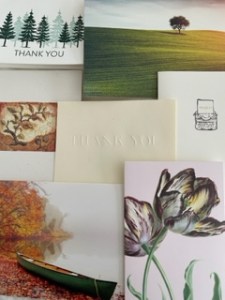
For me the best part of holiday gifts isn’t receiving them, but writing thank you cards. Like the holiday cards, it starts with finding the right card for the person to be thanked. I have an assortment of stationery with different designs, ranging from charming illustrations to an embossed THANK YOU. I favor classic white or cream notes with matching or coordinating envelopes. Then there’s the challenge of coming up with something fresh, sincere and meaningful to write, just the type of challenge I relish.
I always begin with pen and paper, and write out something I think may be suitable using the three-step method*. I play around with the wording until I’m happy with the results, then carefully copy it onto the note**. Unlike my holiday cards, I always hand write both the recipient’s address and my return address on the envelope. Only the stamp and the card’s design is pre-printed. To me that’s part of the thank you process.

Don’t get me started on how getting thank you notes has become rarer than a 1952 Mickey Mantle rookie card, especially from anyone under 60. However, when I do receive one I treasure it. After reading the note, I study how the sender constructed the message, admire the wording – heck, I admire the attempt! One of the best notes I’d received last year came from the grandson of a cousin, thanking my husband and me for a high school graduation gift. We winged the present based on what little we knew of his interests, but his note expressed such appreciation and gratitude, and so eloquently, that it didn’t matter that he emailed it to us. I’ll happily accept an emailed, phoned or texted note of thanks now. Frankly, some of my younger relatives can’t be bothered to even say thank you, let alone send a written note to us. Only my husband’s intervention kept me from giving them coal for Christmas. But that’s another story.

How was your holiday season? Did you receive any cards or notes that were especially meaningful? And what was your favorite part of holiday writing?

#

*Thank the giver, tell them why you’re thankful, then thank them again.

**I have dysgraphia – the writing equivalent of dyslexia.

###

Miko Johnston, a founding member of The Writers in Residence, is the author of the historical fiction saga A PETAL IN THE WIND, as well as a contributor to anthologies such as the newly released “Whidbey Landmarks.”

Miko lives in Washington (the big one) with her rocket scientist husband. Contact her at mikojohnstonauthor@gmail.com

Time

by Jill Amadio

Having celebrated the New Year a few days ago I am still curious about one of its major symbols, Father Time.

Appearing in books, paintings, music, film, television, and even as industry logos, Father Time is often depicted as a character with his murderous scythe and/or an hourglass. Such images have been used to remind a reader that Time is a potential murder weapon with the hours running out for a victim, or signifying an imminent arrest.

Time.

It rolls along inexorably despite any means we employ to stop it. But wait! Writers sometimes change Time not only in their fiction but even in non-fiction that one expects to be factual and pure.

How often have you read, “Within three short weeks the memoir was finished.” or “It was the longest hour she had ever spent in his company.” What do these Time phrases mean? What is a short hour, 44 minutes? Or a long year, 15 months? How about this recently published mystery wherein the author blithely bent the passage of Time with: “She knew the hours would pass more quickly if she went to a movie…” How could this be? Obviously, it was her perception in play but seconds, minutes, weeks, months, years, and decades pass at their own pace despite anything we can do to speed it up or slow it down.

In his Rubaiyat, Omar Khayyam wrote one of the most dire warnings about Time: “The moving finger writes, and having writ, moves on. Nor all the piety nor wit can lure it back to cancel half a line, nor all they tears wash out a word of it.”   However, a clever writer can give the reader an impression of a faster or slower passage of Time through tension, the building of a scene, or a change in writing style with short sentences, even a single word.

In my favorite, faithful much-thumbed 1,350-page Roget’s International Thesaurus, of which I receive the latest edition every five years as a Christmas gift, there are pages and pages devoted to definitions for Time including Duration, Instantaneousness, Perpetuity, Interim, Anachronism, Infinity, Transience, and, rather oddly, Regularity of Recurrences, and a section devoted to for Previousness (Roget’s heading, not mine, which my Spellcheck rejects), plus many more. In fact, a cornucopia of ways to express how Time moves along at its prescribed pace in any situation and circumstance.

How do we live in borrowed Time – what does that mean? We cannot borrow, stretch, shorten, nor cut Time in its literal sense yet we bandy about this commodity as if it were taffy.

Shakespeare took liberties with Time in dozens of plays and called it a “common arbitrator” and, “a bald cheater’ which I prefer to read in its literal sense although he didn’t intend it that way. The Bard was also the first, I believe, to coin the phrase that Britain’s prime minister, Neville Chamberlain borrowed centuries later when he intoned in 1938 there would be “peace for our time.”

How about this one: ‘Time is of the essence.’ Taken verbatim causes one to wonder, which essence? Frankincense, rose water, or perhaps orange peel?  Or do we wish to convey that Time is urgent? If so, why not say so with description to match the action.

Metaphors are wonderful but sometimes they can convey a meaning that the author did not intend, or missed an opportunity to raise the stakes. How often have you read, “Time and again she pulled on the chain/rope/handcuffs.…”  Would the reader enter into a precise Time frame more personally and feel the victim’s agony and persistence more clearly if the sentence read “after six desperate attempts pulling on the chain, she…

All of which reminds us to remain disciplined because – Time is honestly and truly running out! Do you have a secret method for trying to cheat Time?

Happy New Year, everyone! Do not waste a minute of this brand new year. Write!

#

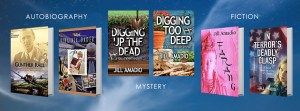
Jill Amadio is a mystery writer, novelist, journalist, and ghostwriter. She writes a column for the UK-based Mystery People magazine. Her standalone thriller, “In Terror’s Deadly Clasp,” is based on a true 9/11 story, and her memoir of Virginia Bader chronicles the pioneering of the aviation art movement in America. Amadio co-authored a posthumous biography of the singer Rudy Vallee, and ghostwrote a crime novel. She was a reporter for the Bangkok Post, Gannett Newspapers in New York, and the L.A. Daily News, and has written for Conde Nast, Newsweek, the Los Angeles Times Sunday Magazine, Motor Trend, Air Classics, and other publications. Her award-winning mystery series features an amateur sleuth from Cornwall, UK, Amadio’s former residence before relocating to California and Connecticut. She is a member of Sisters in Crime, Mystery Writers of America, and the Authors Guild. Visit Jill’s Website 

Welcome to Mystery Writer Maggie King

Hello everyone!  I’m using my normal posting date to introduce the second of our two new The Writers in Residence bloggers.  Maggie King will tell her story in her own words.  Happy reading!

My Writing Journey: Condensed Version, by Maggie King

Like many young girls I was a huge fan of Nancy Drew and the Dana Girls. I’ll never forget the day my mother brought home The Hidden Staircase after a trip to the P.M. Bookshop in Plainfield, New Jersey.

In sixth grade I started writing my own girl detective mystery and would read the latest chapter to my friends while walking home from school. They enjoyed my creative efforts (they would have told me otherwise; I have no doubt). I wish I still had those stories, for posterity.

(WOW! We wish you’d saved those early mysteries too! A middle grade treasure!)

Alas, I drifted away from writing, and it took a few decades to get back to it. I joined my first mystery book group in Santa Clarita, California in 1993. Aside from Nancy Drew and Agatha Christie, I’d read few works by other mystery authors, and I was ready to discover them. Sue Grafton, Marcia Muller, Jill Churchill, Robert Crais are just of the few who became my favorites.

The women in the book group were lovely—almost too lovely. I hadn’t yet started my writing career, but I knew I was on my way when the what-if scenarios came to me unbidden—

What if these women weren’t really so nice?

What if this was all for show and they harbored secrets, agendas, hatreds?

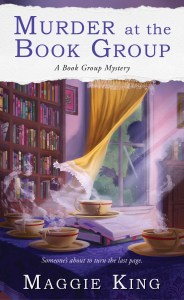
But it wasn’t until 1996 when I moved to Virginia and took a creative writing course at the University of Virginia that I started writing in earnest. I didn’t forget those nice women—or were they?—from the Santa Clarita book group. I gave them backstories and they became the story prototypes for Murder at the Book Group, my debut mystery featuring Hazel Rose.

Two more mysteries in the Hazel Rose Book Group series followed, along with seven short stories. So far, all are set in Virginia.

Like many mystery writers, I have a strong need to see justice done and set the world right. Mysteries are the perfect vehicle for that. I serve conventional justice in my novels, but my short stories tend to be morally ambiguous, and the justice may be of the vigilante variety. I’m a law-abiding citizen, but sometimes I wonder if justice is better served outside the boundaries of the law. That’s why I write. It keeps me out of prison and my victim(s) safe. And I can create interesting characters I’d never want to know off the page.

It’s unlikely that I’ll ever solve a mystery—and I have no desire to—but my sleuths can do anything. Just like Nancy Drew.

When I’m not writing, I take courses (including writing) at Lifelong Learning, work out at the gym, walk, cook, indulge my overly indulged cats, and come up with ways to save money.

(Please share some of those ways to save money in the comments, Maggie!)

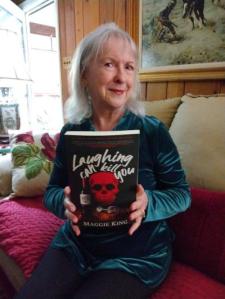
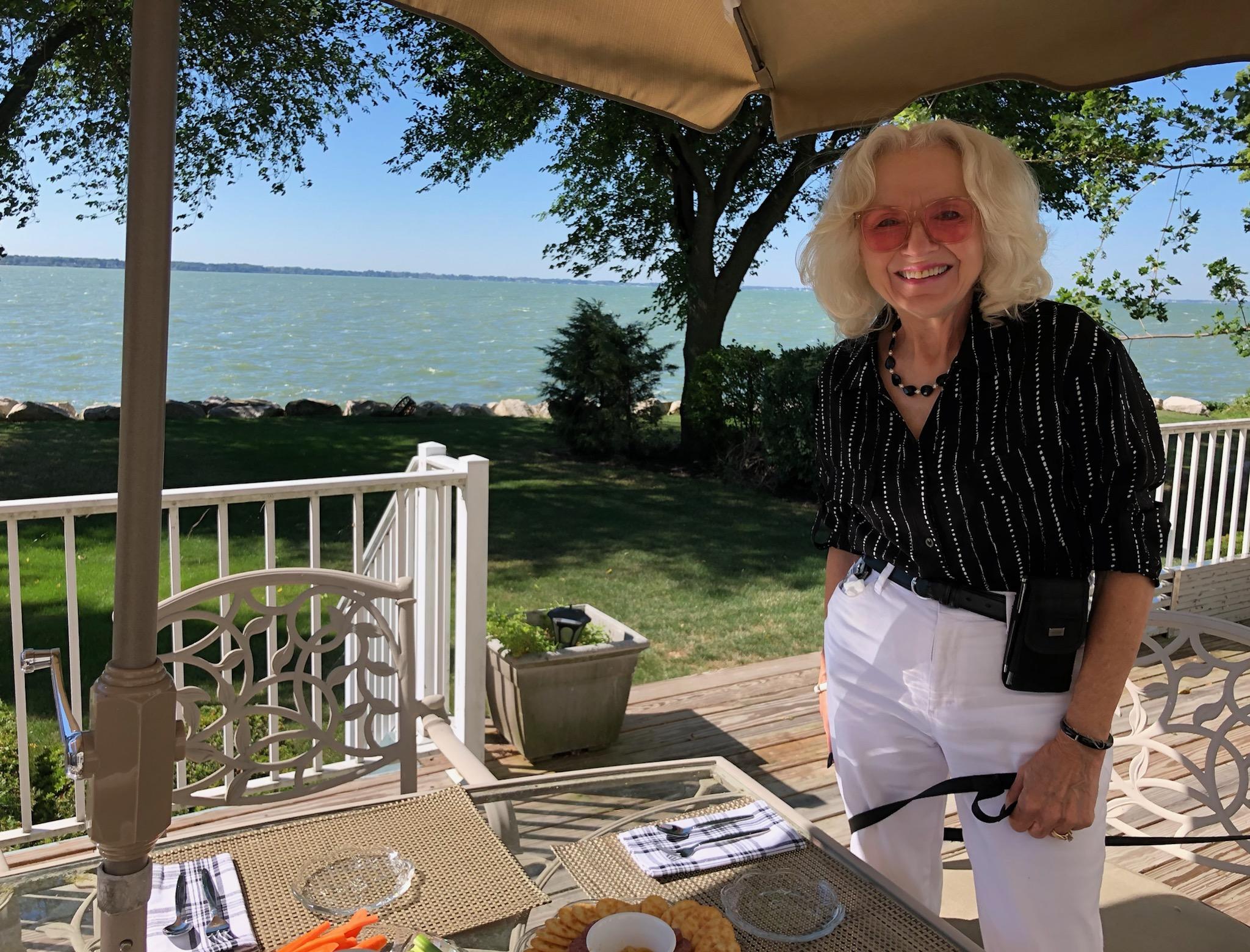
Photo: Maggie with Morris

See Maggie’s newest book, Laughing Can Kill You, at Bookshop.org

For this book as well as all her others, see her Amazon Author Page: https://www.amazon.com/Maggie-King/e/B00HR6MPOO

Thanks Maggie!  We can’t wait to read your first posting, February 15, 2023! Meanwhile, readers can check out Maggie’s BIO under the “ABOUT” button at the top of the page.

###

What to Cut Out of Your Story

by Gayle Bartos-Pool

Gayle at Bill's House Sept 2022

Hopefully, writers are also readers. We really need to see what others are doing, not to copy their story, but to learn what works and what doesn’t quite get the job done. Thankfully, many writers have their own unique style, though I have read many books that were a tad too much like twenty other authors’ work. Even movies and television shows fall into that category of being like every other show or movie out there. Unfortunately, many current publishers and producers prefer to stick with whatever worked before and won’t venture into a Brave New World. Their loss.

But what if you stick with your original story and don’t want it changed? (1) You don’t sell it to a major publisher/producer. (2) You find a small publisher or studio that doesn’t ask for too many changes. (3) You find a vanity press that lets you do what you want but you don’t make all that much money on the deal, or (4) You self-publish and make even less money unless the winds are favorable and you actually get the recognition you were hoping for. People like Mark Twain, Beatrix Potter, Steven King, Charles Dickens, and even Benjamin Franklin self-published. Their books found fame after the initial publication, but they did start out doing the job themselves.

WIR. dollar-1294424_640

I have heard many stories about those who sold their work to Hollywood and ended up basically selling their soul in the deal when the entire story was rewritten into something the author wouldn’t recognize. That’s the name of the game. You sell the movie rights to a production company and just walk away with the check in your hand and don’t look back. Really big name writers can negotiate a contract that keeps most of their work intact. Good for them. Some writers might sell the first script/novel/story to Hollywood and if it is a huge success, even if it was gutted and rewritten, their agent negotiates the next deal and the writer keeps his next story intact. Sylvester Stallone didn’t give up his rights on the Rocky movies and it worked out for him. But that isn’t the norm.

switch3

So what does a writer do to keep her story close to what she envisions? If the writer reads a lot of books and watches a lot of current movies and takes note of what type of story any given publisher or producer seems to like, she might gear her story toward that type of writing. That doesn’t mean turning out a carbon copy of the previously published or produced story, but the writer probably should stay within those known parameters. And as I said before, lots of work out there kind of looks the same as everything else you see or read.

Now if you are as frustrated as I am with this nonsense, you will just write your book the way you want, try to find an agent and/or a publisher that likes your work as is. You might be willing to change something on the surface, but if it is a slash and burn request that totally guts your work, you might want to go to another agent and/or publisher, or self-publish.

So what are you willing to cut out of your work? Its heart? Its soul? It’s a tough question to ponder and even harder to answer. Think about it. Write On!

Typewriter and desk

The Most Fun Thing About Writing

By Linda O. Johnson

Hey, our blog is still here, and I couldn’t be more delighted. I was pondering what to write about now, and came up with what I hope is a fun topic: my thoughts about the most fun thing about writing.

Do I know yet? No! But I’ve gotten a lot of ideas. And I’ve been writing for a long time.

My thoughts? First, even if I set a story somewhere real, near me, the fun thing about it is figuring out what can be different, and what my protagonist can learn about it—and tell me! For one thing, since most of what I write are mysteries and romantic suspense, people can get hurt or even killed in those environments I find fairly safe in real life. So where’s a good place to murder someone where the mystery can be resolved well and quickly enough in a story? A real place? A fictional place?

Even more important is those characters, especially my protagonists. They’re not me, but they contain some of my characteristics. The character closest to me was in my first mystery series, the Kendra Ballantyne, Pet-Sitter Mysteries. Kendra was a lawyer who lived in the Hollywood Hills with her Cavalier King Charles Spaniel Lexie. At the time I was writing about her, I was a practicing lawyer, and one of my Cavaliers was named Lexie. And yes, I live in the Hollywood Hills.

Other protagonists aren’t quite as close, but still had characteristics I like and admire. The spinoff series from Kendra was the Pet Rescue Mysteries, which of course contained dogs and other animals—and I was volunteering a lot at local rescue organizations when I wrote it. In my Barkery & Biscuits Mysteries, my protagonist owned a bakery for dog treats—and was owned by a dog named Biscuit. In my Superstition Mysteries, my protagonist owned a dog named Pluckie. And currently, in my Alaska Untamed Mysteries under my first pseudonym, Lark O. Jensen, the protagonist, a naturalist, introduces tourists to all sorts of wonderful Alaskan wildlife, including seals and bears and wolves—and yes, she brings her own dog Sasha along on her tour boats.

And in the Harlequin Romantic Suspense stories in the various series I create, yes, dogs are involved. All my stories do contain suspense, whether they’re mysteries or not, and even those I’m asked to write when I can’t always include dogs. And they contain at least a touch of romance, often more.

So… setting is fun. Characters are fun. Killing people vicariously, and not for real, of course,  can be fun. And creating romances can be fun.

Plus, various animals are fun. Dogs are fun.

Hey, for me, maybe the most fun thing about writing involves one of the most fun things in my life: dogs.

So what’s the most fun thing about writing for you?

Photo by Austin Kirk on Unsplash