
by Miko Johnston
That’s not a typo, it’s a play on words, inspired by a stream of advice I’ve gotten from many writing experts on a touchy subject. We’re told, write what you know. Does that include exploiting who we know?

How far are you willing to go to write a tantalizing mystery, an emotionally powerful drama, or a deeply moving character study? Would you base it on an actual incident or situation in someone’s life and its effect on them? I’m not talking about libel, but morality.
A piece in your news source of choice might inspire you to write a “ripped from the headlines” novel. Legitimate public information is fair play for adaptation, such as a criminal case or someone’s media appeal to raise attention to an issue. For example, some couples have had children in hopes of providing bone marrow or other vital tissue to save a stricken older child. In addition to non-fictional accounts and memoirs written by family members, many authors, including Jodi Picoult, opted that storyline for novels. Dramatic, yes. Is it exploitive?
What if something noteworthy happened in your own life? You might write a memoir detailing the experience and how it changed you. Or you could draw on the event to fashion a scene, and more importantly, for the emotions it evoked, whether it’s the pain of loss, the thrill of first love, the shock of violence or post-traumatic stress inflicted by a drastic incident. When I write about grieving or passion, feeling afraid or distraught, it comes from my own experience, but I do so voluntarily.
We base our characters, at least in part, on people we’ve known. We imbue them with that person’s physical characteristics or personality traits. Say you’ve given your sleuth, a Vietnam vet, the same war wound as your brother, and his nemesis flashes the pasty-faced smirk of your loathsome ex-boss. Those qualities illustrate the characters, but don’t define them.
Great writers incorporate their lives into their stories. They tend to base some characters on family members and people closest to them, portraits which are often unflattering and unkind. Writers also mine tales from family and friends for source material. My own series of historical fiction novels began with a rumor about my grandmother. Stories about transformation, triumph over tragedy, and overcoming loss are rich with potential. As an example, a brilliant, successful woman marries a man who never divorced his first wife – and his family knows that when he walks down the aisle – makes a great storyline. What if she was your best friend? Or if a couple in your family, grappling with an intellectually disabled son who’s growing stronger and more aggressive, are agonizing over whether to institutionalize him?
In Betsy Lerner‘s excellent book, “A Forest For The Trees”, she urges writers to use whatever they can in their own lives to enrich their story, including incidents in the lives of the people closest to them. “If you are going to be honest and write about all the untidy emotions, the hideous envy, and disturbing fantasies that make us human, how can you not offend your loved ones, your neighbors and community?” A New York Times piece by James Parker, contributing editor at The Atlantic, endorses the practice of “invading” other people’s lives, but only if you can elevate it above exploitation; the purpose must be empathy.
For me the issue goes deeper than adapting an external experience. We can take plotlines from personal sources and show how one might feel in that situation, but what about someone far removed from ourselves? Each day I’m exposed to people whose experiences, based on their race, religion, ethnicity or sexuality, shape their world view, which differs vastly from mine. Are there places within a person that are too intimate to go, too unreachable to know?

In 1990 I worked on a conference sponsored by an organization of scientists who explore the repercussions of technological advancement. They chose as their conference theme: Can We Do It? How Do We Do It? Ought We Do It? As a writer, I ask myself the same questions in understanding the social implications of storytelling, crafting diverse, authentic characters and emotionally compelling plots. Characters and plots that ring true to those outside the world I create as well as to those within.
A fiction writer’s goal is to produce a logical and believable manuscript, populated with characters, many who’ll be familiar to us and a few who thankfully bear no resemblance to anyone we know. We can borrow from their histories or instead, as Parker says, “invade” other people’s lives; strive for realistic portrayals or take Lerner’s advice to “be honest” enough to “offend”. That leaves me wondering: Is it proper to take the experiences of those we know best for the sake of a good plot? Is it possible to mine the depths of emotions, or the most intimate thoughts, of someone so dissimilar from us?
Can we? How? Ought we?
###
Miko Johnston, a founding member of The Writers in Residence, is the author of three novels in the A Petal In The Wind saga, as well as a contributor to anthologies including LAst Exit to Murder. She is currently pages from competing her fourth novel in the series. Miko lives on Whidbey Island in Washington (the big one) with her rocket scientist husband, who graciously helped her revise this post. Contact her at mikojohnstonauthor@gmail.com
Photo by Keira Burton from Pexels
Photo by Anna Shvets from Pexels





 After ordering restaurant take-out, my husband drove there to pick up dinner. It would take him almost an hour, leaving me time to explore a newly bloomed section of our garden, planted with rhododendrons. If you’re not familiar with the plant, they’re like azaleas on steroids, with flower clusters, some as big as your face, nestled against dark green leaves. Some grow as tall as trees; others have been pruned knee- or chest-high, their blossoms a riot of pinks, fuchsias, purples and reds.
 In the shelter of the garden, hidden beneath a canopy of lavender and laurel trees, I sauntered the path that wends through the rhododendrons. As I neared the end of the path, where it rejoins the lawn, I spotted something crescent-shaped sparkling on a branch. A closer look revealed a young bird, judging by its downy feathers of gray, which blended in with the bark. She (as I later discovered) had a curved beak, bright yellow, which stood out like a slice of sunlight in the darkness of the overgrowth.
 I so wanted to hear her sing, but she didn’t. Silently she sat there, occasionally darting her head, watching everything around her as I watched her, delighting in her curiosity, her seeming amazement with the world she’d recently entered. She hadn’t mastered flying yet. Her wings fluttered to help her balance on the branches as she hopped along, taking in the sights and sounds all around her. I’d been feeling blue awhile, in a rut. All that changed with my encounter with this fledgling. I found myself transfixed by her utter joy, and that joy flowed through me for the first time in months.


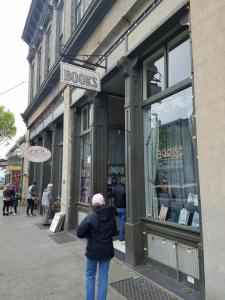 I frequent a bookshop in a neighboring town that sells books for and about writers, along with writing-related merchandise (if you’ve been to Port Townsend Washington you know which store I mean). They carry postcards and T-shirts with writing slogans like “Avoid Clichés like the Plague”. Cute. Unfortunately, it denigrates clichés. The meaning of the word has been ‘adjusted’, and unfairly so, IMHO.
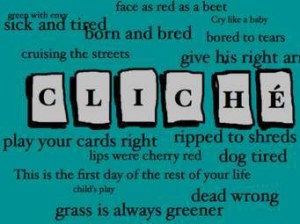 When selectively used, a good cliché expresses wisdom through metaphor. A stitch in time figuratively saves nine. Actions often do speak louder than words. Sometimes it is a dark and stormy night, but since that opening line shows up more in humorous writing nowadays, we expect it to be funny, not dark. Like cliché, the expression’s meaning has been ‘adjusted’.
 Soon waitstaff brought out steaming five-gallon pots filled with briny shellfish, loaves of French bread and bottles of chilled wine – a white Beaujolais, which I’d never heard of before. I took one sip and delighted in its light freshness, its unpretentiousness, like young girls in summer dresses.
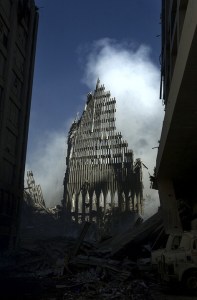 Not wanting to be alone, I found my husband and we gathered with other Americans in the lobby, where we watched the horror continue to unfold on a big screen. We gathered in small groups to commiserate. One friend had a brother who worked in the first tower (miraculously, he wasn’t there that day). Another recognized a name from the passenger list of one of the planes that hit the tower – his former boss. All of us were too shocked to respond until he said, “If anyone deserved to go like that, it was that SOB.”


 The Writers in Residence
You must be logged in to post a comment.