
by Miko Johnston
When I think back to the dark days of the Covid pandemic, I don’t focus on the panic or the shortages. I remember the isolation. Although I had the good fortune of my husband at home and kinship through technology, I found conversations very limited. I began contacting people in my life whom I rarely saw but stayed in touch with, usually with a Christmas card, but many of my friends from the past were mired in their own woes or didn’t respond. Worse, despite having ample time to finish my novel in progress the distress kept me from writing anything…for eighteen months.
I still recall an evening at least six months into the lockdown. My husband, exhausted from yard work, went to be early. His older son called that night. In the past, I’d speak to him briefly before passing the phone to his father, but neither of us wanted to wake him. As I spoke to my stepson I began to realize how much I craved company, even if only over the phone, so what would have normally been a five-minute call stretched into over an hour. I think he, too, longed to talk, and for the same reason.
Our conversation was stilted at first, but not because of any personal reason. He and I were merely out of practice. We’d pause to think of the right word or string more than a few words together in a sentence. It took about five minutes to verbally limber up before we could chat ‘normally.’
 That served as a wake-up call. From that day on, I began playing word games. It kept me entertained and, more importantly, prodded me to keep my vocabulary alive and active. Anything that forced me to plumb my memory for words (and spelling). I know many writers use writing prompts, but I wasn’t yearning to write better as much as speak better. I needed something deeper than that.
I began with Spelling Bee, a New York Times creation that gives you a ring of six letters with a seventh letter in the middle. You form words, four letters or more, that must include the center letter. I even got my husband hooked on the game; we still play it almost daily and compare our lists. Later, I added Wordle to my daily routine. You get six chances to find the five-letter word of the day – if you’re not familiar with it, you can read the instructions on the NYT website.
In both cases, trying to figure out the words stimulated my brain. Sometimes, words would pop into my head, even if they didn’t fit the puzzle. That’s when I decided I needed more stimulation and started inventing my own puzzles.
Wordle inspired a new way to challenge myself. I’d pick the first two letters of potential words and list as many as I could. I’d start with my “prompt” letters and work my way through the alphabet with the goal of reaching at least fifty words. As with my conversation with my stepson and my daily dose of word games, the more I challenged myself, the more words I could recall, and the faster they came to me.
Here’s an example:
HOW MANY WORDS CAN YOU MAKE THAT BEGIN WITH THE LETTERS:
BR——-
RULES:
- Words must be at least five letters
- No adding prefixes like S; ED; ING; LY; NESS to a root word of four or less letters
- Only one version of the same word is allowed (ex: float OR floated OR floating)
- Homographs are allowed with variations in the spelling to reflect their different meanings
(ex: score [to make shallow cuts]; score [to earn a point] becomes scoreboard)
- No abbreviations
- No foreign words unless they’re in common English usage (ex: pasta; rondo; bidet; pashmina)
- No proper nouns
- No acronyms (ex: AWOL)
- No hyphenated words or contractions
GOOD LUCK!


 I’ve always enjoyed spring, a time of renewal, and probably more so this year after the winter we’ve been through. Thoughts turn from shoveling snow to shoveling dirt in the garden, from watching the overflowing rivers subside to marveling at the regeneration of fauna and flora.
 I can still recall presenting Chapters 1 – 5 of what is now my first novel, A Petal in the Wind. I’d compressed what eventually became my entire novel into fifty pages. I also recall the group’s unanimous opinion: to put it kindly, not good, but they explained WHY. No character development, hardly any scene setting or sensory details, and worst of all, an unrealistic reaction by my protagonist, thereby committing the worst crime in fiction by presenting a totally unbelievable situation. Their comments were tough to hear, but I listened and took them to heart. The next time I presented pages for critique, I received a very different response.
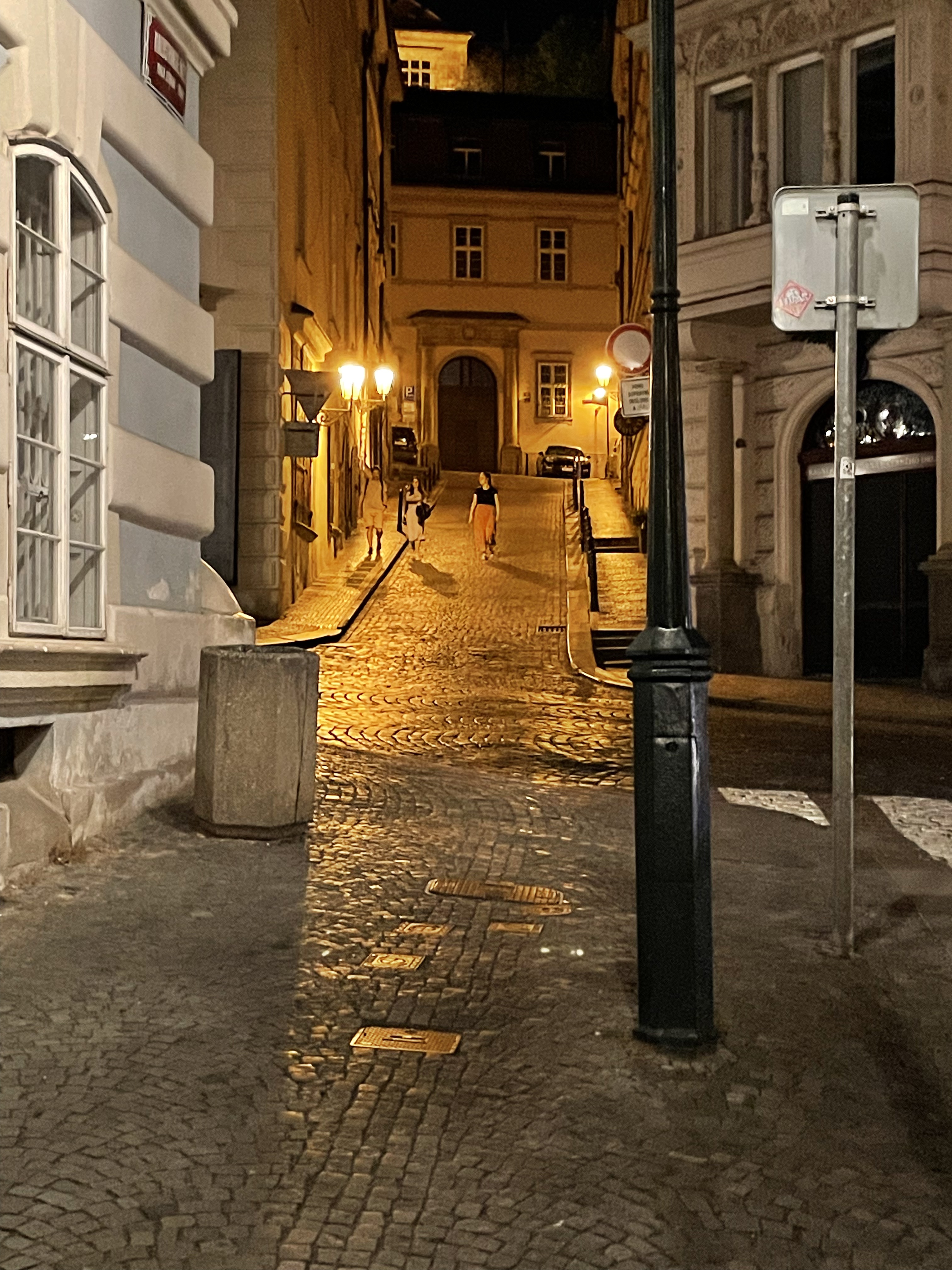
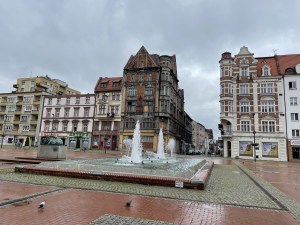 Three days later Allan and I bid ahoj to Prague and boarded a train bound for Poland. After an overnight stop in Katowice, the largest city in the region known as Upper Silesia, we took a cab to the nearby city of Bytom, the hometown of my father and his entire family. Back then Upper Silesia was part of Germany, the city known as Beuthen. As I walked along the streets, I tried to picture what his life must have been like. I gazed at the people who passed, wondering if I’d see any signs of familiarity in their faces.
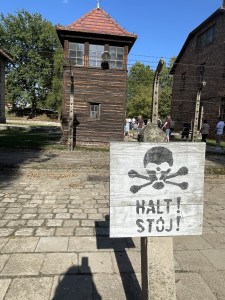 Entering into the first camp, with its ARBEIT MACHT FREI (“Work sets you free”) sign over the entrance gate, I wondered how I would react, or feel. I’m still not sure, to be honest, other than the eerie familiarity of what I heard and saw – from decades of studying photographs accompanied by written accounts, of documentaries and movies filmed on location, and stories I’d heard from survivors, including my father. For many, the trip was a history lesson. For me, it was akin to visiting the cemetery; I lost an estimated ninety members of my family there.
 After a brief break, the tour continued to nearby Birkenau. Unlike Auschwitz, which to me felt small and claustrophobic, Birkenau is huge. You’ve seen it in many movies: a long low building with railroad tracks leading to a central tower, open at the bottom to allow trains to enter with their human cargo, like a gaping maw ready to devour all who arrive. Alongside and beyond the entrance, what seems like miles and miles of barbed wire fencing surrounds a huge open area interspersed with low barracks and guard towers. In the distance I could see different tour groups traversing the grounds, and for one brief moment I pictured them in the striped uniforms and hats of prisoners.
  Prior to abandoning the camp in January 1945, days ahead of the advancing Russian forces, the Nazis burned the meticulous records they’d kept of all who were brought to the camps and blew up the gas chambers. Only piles of rubble remain. Many, many piles. They left behind the prisoners too weak to continue; the rest (including my father) went on a forced march from one concentration camp to the next, always trying to stay ahead of the Russians, whom they rightfully feared more than the other Allies. It took several more months until my father was liberated, but at least the Americans freed him. Had he stayed behind in Auschwitz, he would have lived the rest of his life under the thumb of the Soviets. After what I saw in Bytom, I’m grateful he had the strength to wait.


 Petal in the Wind Book IV: Lala Smetana


You must be logged in to post a comment.