Where Fact and Fiction Meet…or Collide

by Gayle Bartos-Pool

Gayle at Bill's House Sept 2022 cropped

There was a saying once upon a time that newspapers were only good to wrap fish or garbage in or perhaps line a bird cage. Now that we have TV News and the Internet, most people don’t even get a newspaper, so the acquiring of news today is a different animal. The quality of that news remains the same: Questionable.

But ripping a story from the headlines in order to write something comes with baggage. The baggage is the “truth” of that story. Is it true? Is it hype? Is it garbage? As for me, I prefer stories that create their own world. Maybe a dollop of flavor from the headlines, but I want my stories to have a life of their own. I want the reader to see something new, not something they are bombarded with on TV, Facebook, Instagram or X.

The old movie The Three Faces of Eve was supposed to be a true story about a gal with multiple personalities. Years later it turned out the patient lied. I wonder what else I read or hear is a lie.

If I take a story from the headlines, I use the “What If?” approach and see what would happen IF that headline was turned inside out and upside down and I created something totally new. I might follow a paved road for a while, but before long I take that detour to something entirely different.

A fellow writer, friend, and someone we lost several years ago, Paul D. Marks, wrote an article on this topic on a website called Criminal Element back on October 19, 2018.  The title of his article was Fiction Is The Lie Through Which We Tell The Truth. The title itself has been attributed to Albert Camus, but if you look it up, people aren’t sure Camus even wrote it. Fact or fiction strikes again.

My comments at the beginning of this blog are more or less what I wrote in response to Paul’s very good article. The pull quote from Paul’s piece was this:

The best writing makes you think, but it doesn’t tell you what to think. A crime writer can illuminate aspects of society, good and bad, without being preachy or moralistic.” Paul D. Marks

I responded to a comment Paul made on his post by pointing out: “Your White Heat novel did just that, Paul. You took a real time in history, but wrote totally your own story around it. It’s that world I like to read about, not one that’s on TV 24/7. Truth might be stranger than fiction, but fiction, if it’s done right, is far more entertaining. And it doesn’t leave a bad taste in your mouth. It is exactly what you said about Sullivan’s Travels. Sometimes people just want to be entertained.”

After re-reading Paul’s post recently, I wondered had anything changed. After all, that was over five years ago. What has changed? The news on all the available media sources have gotten stranger, more dire, sometimes just plain scary. In fact, some are so odd I have to laugh. Then there are those news stories that change from day to day. Not a different subject, just the “facts” in the first version we heard wasn’t exactly accurate, so they had to retell the story. You could conceivably call the first story a lie, so maybe we can just call it “fiction,” even if it was on a news channel. We all know when something earth-shattering happens the facts aren’t really known right away, and the story has to be verified by several sources until the actual facts are known. We just hope those “facts” are really true.

That’s why I prefer a good book or an old movie. That’s also why I write fiction to tell a story with a point and good characters to entertain the reader, not indoctrinate the reading public with something I saw on the Internet or heard on the news that might turn out to be even stranger fiction than Abbott and Costello Go To Mars. That’s a movie about a couple of guys who accidentally launch a spaceship and think they are heading to Mars, only to land in New Orleans during Mardi Gras. They think they are really on Mars since everybody is in costume. Two bad guys chase them back to the spaceship and they head off again only to land on Venus that’s populated entirely by women who hate men. (That sounds as goofy as news reports today, doesn’t it?) Well, the guys are sent back to earth, but frankly, the 1953 movie isn’t any odder than some reports saying American astronauts didn’t really land on the moon. (Scotty, Beam me up!) Or how about the one about life on earth will end in ten years? They’ve been saying that for fifty years. Can anybody trust the news?

Fiction is more fun, and I can write my own ending. I like my characters better than some of the real people I see on the news, and I can render a fitting end to the bad guys I write into my stories. So what if I live in a fictional world… Wouldn’t it be nice if the real world was like some of the books we read?

And remember, some people are rewriting the actual history we have lived through…Sound familiar? George Orwell wrote that story in his book, 1984 back in 1948. His book was fiction…or was it a blueprint for what lies ahead in today’s world? Brave New World, Fahrenheit 451, and Animal Farm have some thought-provoking themes as well. Maybe we should write books that show how we want the world to be in the future…Hope they have a happy ending. At least my books have the main characters fighting for that better world. How about you?

Write On!

Choosing a Theme

by Linda O Johnston

Every writer writes what they know and what they love—at least, hopefully. Sometimes, it’s also a specific genre or genres.

Of course we can go all sorts of directions in our writing as well as in our lives.

But me? It’ll come as no surprise to those of you who know me or read my stuff that I love dogs. And they’re not only important in my life. They’re important in my writing. And they’re the general theme of my writing.

I have had sixty-two novels published so far, with the sixty-second, my fourth Shelter of Secrets story for Harlequin Romantic Suspense, available starting now. It’s CANINE PROTECTION. Yes, canine. And number sixty-three, the fifth in my Shelter of Secrets series, CANINE REFUGE, will be published next year. I can’t tell you offhand how many of my books have featured dogs, but the great majority of them have.

Why? Well, they always say to write what you know, and I know dogs, and yes, I love them. My first mystery series, the Kendra Ballantyne, Pet-Sitter Mysteries, featured a tricolor Cavalier King Charles Spaniel named Lexie—the same name as one of the Cavaliers I owned when I wrote those stories. And Kendra was a lawyer who lived in the Hollywood Hills with Lexie. Yes, I was a practicing lawyer then, living in the Hollywood Hills, writing what I knew, kind of.

And right now, my first ruby Cavalier, Roxie, is staring at me as I write this. Her tricolor sister Cari is sleeping somewhere else, but she very often snoozes under my computer desk as I write.

 Yes, I’m hooked on Cavaliers, but I don’t write much about them since I don’t want to overdo it with my readers. But other dogs, including service dogs, K-9s, and even pets—yes!

And including shelter dogs, like those in my Shelter of Secrets series which is ending next year. I’ve started writing the first book in a new series. And surprise, it also features dogs!

I’m always fascinated to learn why other writers write what they do—and if they also have ongoing themes in what they write.

So please comment here, you writers who are reading this. Do your stories contain any ongoing themes, and if so, what—and how did you decide to feature them?

.

.

Image by Ermir Kolonja from Pixabay

DANCING IN THE RAIN….   

By ROSEMARY LORD

1.08RoseSignCrop (1)

“Life is not about waiting for the storm to pass, but learning to dance in the rain…” Vivian Greene’s quote has been oft repeated.

Well, I think I’ve been waiting for the storm to pass for a long time now. Too long.

And the storms kept coming. It seems the clouds would part briefly and the sun shone brilliantly again. But then those dreaded clouds crept back across my horizon…

I’m poised in the wings of Life. Waiting. Now? I ask. Is it my turn NOW?

Oops. No. Someone else’s drama needs attention. And I step back into the shadows, ready to help.

I’d been writing articles about Hollywood for all my adult life. I came to Hollywood and met and interviewed the real movie stars. I’d been a Senior Unit Publicist at Columbia Studios. Then I was asked to write two books on Hollywood history, complete with authentic archive photos. After the success of those two non-fiction books, Hollywood Then and Now and Los Angeles Then and Now I ventured into the world of fiction. Mystery fiction. 

I had met Maisie Dobbs author Jacquie Winspear when we were both honored by the Southern California Independent Book Sellers. We would meet up in Westwood where she was doing a writers’ course at UCLA, encouraging me to do the same. I did. As I waxed lyrical about Hollywood’s rich history, Jacquie encouraged me to write a mystery story set in Old Hollywood. Maisie Dobbs was her first mystery novel. She said that if she can do it, so can I!

I was scared. Me, a mystery writer – you mean like Aggie Christie? Me? But after completing novel and mystery writing courses at UCLA, I was invited to join Mystery Writers of America and Sisters in Crime and attended their workshops and conferences. I LOVED this new world of mystery writers. They’re the best! I thoroughly enjoyed the gruesome forensic workshops and was enthralled listening to the successful novelists share their wisdom and encouragement.

And so I learned – and I wrote. 

I met Gayle Bartos-Pool, Jackie Houchin and Miko Johnson at those conferences. Now lifelong friends, we started our own writers’ group, Writers-In-Residence and met at the Burbank library to share pages of our writing projects, critiquing, discussing and encouraging each other. This Blog came later.

In the midst of all this, I was taking care of my ailing mother-in-law until she passed, and a domestically-hopeless-but-wonderful, hard-working husband, Rick.

I had completed my first mystery novel and was gathering notes for the second and third in the series “Lottie Topaz Hollywood Mysteries.” I had my list of potential literary agents ready. I started sending my submissions out to the most obvious agents, then was working my way down the list. I had sort of designed my new website for the launch of my first mystery novel. I had mock-ups of cover designs. My new brief bio was written. I was ready.

But then, without warning, my darling husband Rick died of a heart attack. I was at my desk, sending another ten pages to an agent when he cried out and collapsed.

Obviously, my world stopped. I was shattered. I had no idea who I was any longer. I loved being Rick’s wife. Now I wasn’t. What was I? Who was I?

That storm lingered a lot longer than I ever could have imagined.

It was shortly after that that the Woman’s Club of Hollywood asked for my help. Numb, I said yes. I buried myself in saving that historic club as I worked through my grief. And, boy, was that a never-ending can of worms at the Woman’s Club! There’s a whole book in all the shenanigans that can go on in those historic buildings. Don’t get me started on the ghosts that linger from the days when Jean Harlow (as Harlean Carpenter) attended school there with Douglas Fairbanks Junior. Although, having grown up in England, lots of places have ghosts, so I’m used to them. But that’s a whole other tale…

For the longest time I could not even look at my Lottie Topaz manuscript. It’s what I was doing when Rick died. I made every excuse under the sun. But, like the mustard seed that needs watering in order to grow into a huge tree, we have to feed our writer’s mind, that writer’s soul.

I neglected my writing brain for too long. But this Writers’ Blog helped me work my way back as a writer. Word by word, blog by blog.

The encouragement from Gayle, Jackie, Miko and all of you really helped me tiptoe out from under that dark storm cloud. I began working on another story I had started ages ago.

Step by step, I got my writing legs back. I found the music in my life again.

And now I am on Lottie’s case once more. Her Book Two is under way. And Book Three is forming in my head. I have copious notes and old news clippings to peruse. I will find a home for Lottie’s debut novel. It took longer than I thought, but – hey – I’m not afraid of those storms. I’ve learned to dance in the rain and love it!

………………………….

A New & Short Mystery!

by Guest Writer Alice Zogg

Hello friends, readers, and fellow authors,

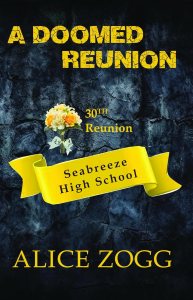
I penned another stand-alone mystery.   A DOOMED REUNION is fresh off the press and available in hardcover, paperback, and e-book editions.

This one is short (170 pages).  Either I have learned to get my point across with fewer words or have become lazy. (haha)

As to the location, I invented a fictional town called Seabreeze and placed it along the California coastline between Del Mar and La Jolla.

People with old school ties attend a 30th high school reunion and are shocked to hear one of the attendees say he knows who murdered a classmate years earlier. That knowledge gets him killed.

Can Detective Scharfkopf with the San Diego County Sheriff’s Department piece together what happened back then to catch the person who has lived with this secret all these years… before another body is added to the list?

Happy reading,

www.alicezogg.com

A Doomed Reunion on Amazon

Alice Zogg was born and raised in Switzerland. She met her husband, a fellow Swiss, in New York City, and the two made their home in the United States. The family relocated to Southern California in 1967, where they have resided. She is an avid traveler and plays racquetball and golf. She has written over 20 books. 

###

BOOK REVIEW – I read Alice Zogg’s new book. Yes, it is short, but the crime, plotting, and investigation are complete.  You don’t feel cheated at all.  The murder happens after a high school class reunion when one person blatantly claims to know the murderer of an unpopular student 30 years previously.  Does he?  Someone believes him and, in unusual circumstances “offs” the guy.  The detective is charged with solving not one but two murders.  The questioning, deduction, and final moments of revelation are well-plotted and written. I enjoyed reading it!  ~~~ Jackie Houchin


A TRIBUTE TO WORDS AND WRITING

By Miko Johnston

My late father co-founded a non-profit organization dedicated to Scandinavian philately. In addition to translating and publishing educational books on the subject, the group held monthly meetings as well as annual exhibitions where members could present their best work. Dad served as their president for many years; his name and phone number appeared on all contact sources.

He wasn’t home the day a young man called for more information about the organization. I offered to answer as much as I could. His first question: “Can you join if you’re under eighteen?” Yes, I told him, there is no age limit. “Can I bring another guy to the meetings?” Sure, I said, but something told me he had something, um, different in mind. I then said, “You do realize that philately is stamp collecting.”

“Oh.” He promptly hung up.

We spend a great deal of time writing about words on this blog. If you hunt through our archives, you’ll find many posts on the topic, which should come as no surprise. Words are the most important tool in a writer’s toolbox. We think about them, which one to use in any situation, whether a particular word or one of its cousins (aka synonyms) would be more precise, more distinctive. Can we convert that verb/adverb pairing into one verb? How many descriptives can we edit out without losing the image, the rhythm, or the voice of a character?

Words convey and put into context images, thoughts and ideas, especially when they’re carefully selected. We have non-verbal ways of communicating as well, but unless there’s some established pattern to it, such as sign language or Morse code, their subtlety makes them less effective for interpretation – is she slouching because she’s humiliated, or her back hurts?

Whether spoken or written, signed or signaled, we rely on words as the basis of communication. Misinterpretations may cause embarrassment, as my earlier story shows, but in the right hands they surprise in an entertaining way. Writers can inform the reader without the character’s knowledge, a technique I relied upon in my first novel, when my protagonist was a child. Or they can make the reader wait – ideally with keen anticipation – for information the character already knows.

We can use words to assure clarity of thought, or to deliberately deceive. Red herrings in mysteries fall into the latter category, as do ambiguous phrases meant to mislead the reader into thinking something the author intends to prove wrong later. I’ve done this so often in my writing it might be a hallmark of my style.

Words have the power to calm and reassure, to encourage and inspire, or to agitate and inflame. Think of all the influential speeches you’ve heard or read, or the memorable phrases culled from them. Whether by actors reading from a script, politicians addressing their constituents, or activists crusading for their cause, their words, carefully chosen with deliberation, hold the power to move people. To bolster their spirits, or shock them. Convince them they’re right, or maybe, just maybe, they’re not.

All have one thing in common: Someone, or some ones, wrote those words.

Not to equate a frothy page-turner with The Gettysburg Address, but I celebrate writers who celebrate the written word. I commiserate with writers who agonize over the best way to express their or their characters’, thoughts. I respect writers for what they try to accomplish whenever they put pen to paper or fingers on the keyboard.

That’s why we deserve a formal representation for what we do.

The practice of medicine has a symbol – a caduceus with two snakes coiled around it. The symbol of law is the scales of justice. No formal symbol of writing exists, although if you Google it you’ll find cartoons of a hand holding a pencil or pen.

What do you think would make an apt symbol for writers?

Miko Johnston, a founding member of The Writers in Residence, is the author of the historical fiction series, “A Petal in the Wind”, as well as a contributor to several anthologies including the recently released “Whidbey Island: An Insider’s Guide”. Miko lives in Washington (the big one) with her rocket scientist husband. Contact her at mikojohnstonauthor@gmail.com

The Case of The Runaway Bride

By Jill Amadio

Outraged at my character deciding to get herself murdered far too early in my mystery, I was also furious that she had the temerity to go out on her own and run off with my carefully organized plot. She wasn’t actually a bride, but she sure was a runaway. And a female.

How dare she!  I had barely sorted out a new setting and spent time researching a lonely location in the UK when this forward young woman opted out of my book. Not only had she escaped from my timeline, but she was also in the wrong place.

Her impulsive decision and demise threw two other characters, one the murderer, into complete confusion. I almost felt them turning to me and saying, “Now what?”

Keeping control of one’s fictional characters is usually a given. Like chess pieces, the author can move them here and there with impunity. We can, and often do, change people and places around but the decision has to be the writer’s.

Something similar happened to me once before. In my second mystery, I knew who the killer was, and I looked forward to her denouement. However, the more I wrote her, the more I came to like her. The upshot was I had to choose a different character as the murderer and thus change his gender and personality, to say nothing of his traits and habits.

However, my runaway person really put me over a barrel with her unexpected death. Should I write her out completely? Force her to stay alive a little longer? What did her early, unplanned demise mean to the rest of the storyline, the remaining characters, and my peace of mind?

It seemed that the best thing to do was to move the chapter in which she wrote herself gone forever to the end of my Word document so that I wouldn’t have to look at that chapter until l I decided where to fit it in, given the new circumstances.

Actually, I knew exactly where and when I wanted her to meet her end, but her decision to die on her own terms threw me into disarray. To say nothing of writer’s block.

I perused my synopsis, wondering if I should wedge her in where she wanted to be, but again, it was clear that her interference meant a lot more work. I would have to rearrange people and places, maybe add a new character and perhaps an extra victim, if any of her shenanigans were to make sense.

Another thought – must I re-think my POV? In order to get her back in line, would she be satisfied with being re-written in first? Her dramatic demise certainly was a plea for help. On the other hand, I had envisioned and written her with poor eyesight and she wore glasses. How did that affect the decision to off herself?  Was she too vain to wish to continue as one of my characters? I saw my authority begin to dissolve.

So, in a heroic effort to re-establish and re-claim my jurisdiction – after all, she was supposedly my creation – I finally decided I needed to be very firm with her. She could not just go around deciding how, when, and where to become the center of the action. What if others followed her lead?

Ah! Maybe that was her problem. She felt like a minor character rather than a major one. She wanted more attention. Still, offing herself hardly seemed the way to go about it since, once she was dead, she had no way to enjoy the fruits of her action. I’d not planned for her to play a prominent part. I guess she realized she was definitely not the important character she thought she deserved to be.

Again, I had a lightbulb moment. Therein lay the danger of a runaway character. They imagine they have a more significant role in the plot or a different personality than the author provides. Writers know that characters make a story. When your fictional book people populate your imagination and come alive their actions determine the story.

Readers want to be swept away into the life of a character. This silly woman ruined that purpose. I was sorely tempted to discard any reference to her and replace her with a male.

As I continued to figure out what to do, I began to question my understanding of human nature. Then I remembered that this runaway lady was not human but a creation—an AI. Perhaps my fellow Residence writers can suggest a solution. Am I being a Pollyanna?

Finding Time to Write: a “Flashback” Post from 15 years ago. Still True?

by Jacqueline Vick

Some writers snatch a few moments of time wherever they find it. Others adhere to strict schedules. Walter Mosley tells us to write every day. Peter Brett wrote his first novel on his smartphone during his daily travels on the F train. Do you follow a set writing schedule? Write every day? Have a favorite writing spot? Do you put ‘butt to chair’ until you’ve finished a specific word count? Tell us about your writing schedule.

***********

Writers Write by Bonnie Schroeder

I try (emphasis on “try”) to write every day first thing in the morning — okay, I feed the dogs and make coffee first and then retreat to my desk with one dog underfoot and one cat in my lap. On my desk, I have a kitchen timer that I set for one hour. Some days, I actually write for the full hour before the phone rings or the other cat barfs or my stomach starts growling. Some days I have to stop the timer until the aforementioned distractions are dealt with; then I try to finish the hour later on. I don’t always make my goal, but occasionally, I actually exceed it.

For me, the important thing is to try for it every day — weekends included. It keeps the circuits open and the muse engaged. When I worked at a job 50 miles away with a two-plus hour daily commute, there were times when I could only manage 15 minutes a day, so an hour is a huge luxury for me now. But even with those quarter-hour writing sessions, I finished the draft of a novel. It took a few years, but that daily contact with the pages kept them in my mind and kept me plugged into the current. And that, to me, is the secret: write something every day, even if it’s just a paragraph or even a sentence. Then I can legitimately say, “I’m a writer.”

***

Lucky by Jacqueline Vick

I’m extremely lucky. I was able to quit my day job to pursue writing full-time. (Well, writing AND homemaking full time.) That means that every morning when I rise, my day is my own and my schedule is whatever I want. Sounds great, doesn’t it? There are a few downsides.

When I’m working on a novel manuscript, there is no boss handing me deadlines, no client with a specific need to fill. I have to set all of those goals myself…and keep them. Repercussions can be a wonderful motivator; without them, it’s more difficult to stay on course.

My deadlines consist of “finish the first draft by May 1st.” I’m always happy to find a short story contest, because that gives me a specific deadline and specific criteria to meet.

Yesterday, I was talking to my brother, who is a personal coach, and he said that the difficulty most people run into is keeping promises to themselves. They don’t value their own time and their own goals as much as they value other people’s time and goals. I’m starting to get around this by setting more specific goals and deadlines and then pretending that I work for a fabulous author named Jacqueline Vick. She has high expectations, and I don’t want to disappoint her. I imagine her asking me to have the rewrites on chapter one on her desk by Friday. It’s a bit kooky, but it works.

I write every day, including weekends. My butt is in the chair for about 8 hours on weekdays, a few hours here and there on Saturday and Sunday. I write in the only place available to me–the dining room table. It’s a pain to keep cleaning off the table each night, but the thought of my husband reaching around a stack of papers for the pepper mill helps keep me organized.

***

Writing Away by Jackie Houchin

For an organized, everything-in-its-place kind of person, my writing schedule is very haphazard and irregular. I mostly write when a deadline looms, so I’m thankful I have those. I write reviews for magazines and articles for a newspaper and newsletters. If I don’t get my copy in, it doesn’t get printed, and I don’t get paid. Simple as that, and no amount of boo-hoo’ing will fix it. The next issue already looms on the horizon.

If I were to write a book, I fear I would find myself writing franticly for 23 hours every day during the last weeks before the agent/editor/publisher’s scheduled deadline. I admire my fellow Wonder Women, who persistently and faithfully write for months and even years to bring their creations into the world. Their ultimate satisfaction will far outshine my instant bursts of pride.

So which style is best? “Whatever works for you.” Yeah, you’ve heard that before, but it’s true. Whether it’s dedicating specific minutes, hours, and days to craft a novel or franticly writing and rewriting and “ripping the paper out of a typewriter” before rushing it to an editor…it doesn’t matter. If our words, opinions, ideas, and stories are read (sooner or later), well, that’s what counts.

That’s my opinion, and I’m sticking to it. Now, let’s see… when’s my next deadline?

PS: Where do I write? Either at my dinosaur desktop PC in my office until the “backside” can’t stand sitting anymore, or more recently, standing at the breakfast bar in the corner of my kitchen with a 6-foot cat tree behind me (usually occupied by three cats lounging and looking over my shoulder, and trying to foil my thought processes with their diabolical purring and mind games) while I pound away on my laptop.

***

“Finding Time to Write,” from June 2009, was reposted by Jackie Houchin.

Photo by Andrey Grushnikov: 

“Off The Top”

by Jackie Houchin

What do I mean when I say, “off the top of my head…”?

Dictionaries say it means derived from the knowledge you have in your memory or impromptu, without previous thought or preparation.

Does it mean the same as “seat of my pants”?  Hmm. We often say we are “pantsers” when we sit down and start writing a story without a formal outline.

Although I love outlines, pages of notes, and lists of resources, I often sit down and simply start writing. Some call this ‘free writing,’ and it sometimes begins with a prompt. I did that recently with a short story I wrote using the prompt “The Convenience Store Was a Sad Place.”  That prompt made me think of our neighborhood store and gas station. I pictured myself walking into that store, looking around, dealing with a smarty-pants cashier, and away I wrote. The story came to me in a series of vivid mind pictures.

Was it seat-of-my-pants? Or something “derived from the knowledge I had in my memory.” Hmmm.

More recently, in April, to be exact, I joined a month-long Writers Digest PAD Challenge. The idea was to write a Poem-A-Day (PAD) on the daily prompt they gave. You could write any type of poem, from a limerick to a sonnet or free verse.  (I liked the shortness of this challenge.)

I did it. For nineteen days, at least. And the poems were totally “off the top of my head.”

April 1 – An optimistic poem.

There once was a gal with a lump.

When first it was found, she did jump.

“Oh, my! I shall die!”

Was her terrified cry!

But a doctor cut out that bad bump.


April 3 – A sad poem.

The rosebud is gone.

Cut from a lily-white breast.

Warm tears down the drain.


April 4 – A mistake poem, one you made or witnessed.

The mistake was mine. I’ll confess

I love whodunnits. But I digress.

I put down the fiver. I looked away

Hmm, stab or shoot? Which way to slay?

Wait! I’m not stealing a book!

Look in my bag? Really, just look!

There’re TWO books by Christie???

Well, I declare. It IS a mystery.


April 8 – A major event poem.

I gasp and stutter and lisp,

For today, I saw an eclipse.

The sun was gone

But not for long

It returned; its edges all crisp.


Off the top of my head – derived from knowledge I have in my memory.

It was fun for those nineteen days last April. There were longer poems, too, and some more serious.  I’ve often said I’m a short writer. I don’t think I could actually write a book, although I’ve tried.  I admire the Writers In Residence here on this blog for doing just that!

Do you write short or long?  Off the top of your head or from detailed outlines?

..

If you want to see more of my PAD poems, go to my blog, Words and Reviews, and scroll down the right-hand side column to April 2024. 

In the week before June ended, there was a 7-day challenge by Writers’ Digest for personal essays. Again, you have a topic, and you write about it.  My first one was about “a job experience,” and I titled it “Knick-knack, Paddywhack, Give A Dog a Bone.”  You can find that one on my blog site at: Words and Reviews Essays