We are a group of published writers who come here weekly to entertain, inform, and encourage you in your writing and your reading journey. Grab a cup of coffee, get comfortable, and join us.
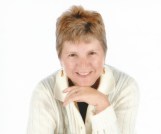
Jacqueline Vick is the author of over twenty published short stories, novelettes and mystery novels. Her April 2010 article for Fido Friendly Magazine, “Calling Canine Clairvoyants”, led to the first Frankie Chandler Pet Psychic mystery, Barking Mad About Murder. To find out more, visit her website at http://www.jacquelinevick.com.
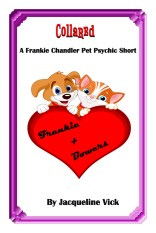
I was writing a Pet Psychic short story for St. Valentine’s Day. It seemed like the perfect time to have Bowers propose to Frankie, but I wondered if that would be fair to readers of the series. On one hand, it would encourage people to keep up with the shorts. On the other hand, not everyone enjoys shorter fiction, so they might be confused when they picked up the next novel.
I’d run into this problem before with a Harlow Brothers short mystery, also involving a romantic situation.
In both cases, I took out the big changes and will use them in future novels. Did I do right? Should I have gone with what felt natural? In the Pet Psychic instance, I’ve thought of ways to incorporate the proposal in a more creative environment, so maybe my concerns about including a marriage proposal in a St. Valentine’s story came from my creative muse.
So, I am curious. Do you think the short stories in between novels should include major changes to the character’s life? Or should those only appear in the novels?
Madeline (M.M.) Gornell is the author of seven award-winning mystery novels. Her current literary focus is Route 66 as it traverses California’s Mojave Desert. Madeline is a lifetime lover of mysteries. She lives with her husband and assorted canines in the High Desert. Visit her website and Amazon Author Page.
Several events/ideas have brought me to this post. My continuing interest in the importance of setting in conjunction with “taking me there,” G.B. Pool’s recent post on Openings, and my enjoyment-of and fascination-with audio books. I’ve mentioned in past posts how much I enjoy audio books—and now I’m asking myself why, in that there might be a couple writing-nuggets there worth paying attention to.
Being taken (dropped) into a protagonist’s world is what reading is all about for me, and has also been mentioned by other readers to me. In that line of thought, I’m currently listening to an audio series called Cherringham Mystery Shorts[i], and though the blurb for these audio book offerings didn’t immediately grab me, the narrator did. Neil Dudgeon[ii] I’ve liked his acting and “aura” from first seeing him in Mrs. Bradley Murder Mysteries—and I’m now realizing a lot of the like is the sound of his voice. When listening to Neil read these stories, it feels like I’m actually in Cherringham, UK. I can visualize the dual female and male protagonists, see their world. Part is the writing of course, but a large part is the immediate involvement that comes with hearing a spoken word, versus reading a sentence. Indeed, I think if the narrator reads well, the reader can so easily be “taken there.” Dropped into the character’s lives.
How can a writer do that without having Neil read their book (smile)? I suggest the knack/art/skill, is to take the reader into your protagonist’s head with your writing POV. Then once inside, see the world through their eyes. A Big deal I think, and not that easy without simultaneously stagnating the story or “dragging” the action and dialogue. But once a reader is with your character, so much easier to go into their world. There is a downside though with character identification, and one that has caused me to not finish reading more than one book. Once engaged with a character, and/or their environment, if you don’t like the character-person, interest is gone. Most recently, I didn’t finish such a book because even though the author quite successfully took me into their world, and was indeed a very good writer, I didn’t like the character or the character’s world. A future post maybe on what makes a likeable character—a protagonist you want to root for?
I’m throwing-out in this post, that a narrator, if good, does that “taking you there” easily and quickly—including setting, events, and personalities. Would very much like to hear from readers and writers reading this post on your experiences and thoughts about audio books in the comments below.
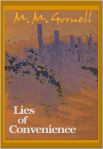
On a personal note, I would love to have all my books as audio, but don’t sell enough (not yet! Smile) for many narrators to take a commission-split chance on me, and can’t afford the narrator I want with a hefty flat out payment! (I’m talking about someone famous of course like Neil Dudgeon or Hugh Frasier) The talented Mei-Ling Downey, did take a chance on me and narrated Lies of Convenience, on Audible. What a joy to my writing-heart that is!
On the flip-side, a few comments from other writers have pointed out not everyone is as fond of audio books as I am! Nonetheless, the key point I’m aiming for is–paying attention to bringing your reader into your character’s world is crucial to reader enjoyment and writer success—whatever the format. Paper, eBook, or the spoken word.
Happy 2018 writing trails!
[i]Written by Matthew Costello and Neil Richards about a retired NYC policeman who moves to England and lives on a houseboat solving crimes with a divorced lady co-protagonist and her two teen aged children.
[ii] Of Mrs. Bradley mysteries way back when, and currently Barnaby in Midsomer Mysteries.
Mention “Valentine’s Day,” and instantly visions of cute or sentimental greeting cards, heart-shaped boxes of chocolates, and bouquets of red roses come to mind. You may even dream of romantic dinners or diamond bracelets.
But it was none of these things that Kristin Molloy of Mission Viejo, California, wished for last year for Valentine’s Day.
“I love books and libraries,” she said with a smile. “So do my kids. We love to go to our Mission Viejo library to check out books. Growing up, everyone in my family had a book to read around the dining room table. I wanted my own library!”
From left to right: Jenna Brown, Kaitlyn Schisler and Astha Parmar take a photo with the Little Free Library, a book kiosk at the Lake Forest Sports Park designed by the three from Cadette Girl Scout Troop 1859. Contractor Bradlee Rodecker helped in building the house-like kiosk.
Her husband, Kevin Molloy, a fireman, knew exactly what she meant. Earlier that year while visiting the Lake Forest Sports Park and Rec. Center they spotted an amazing tiny wooden library on a pole. Designed and built by three Girl Scouts with help from the Park staff, the cheery blue and white painted Little Free Library is a house-like box of books. Visible through two Plexiglas doors are perhaps 30-40 books for all ages. Anyone can take a book to read…free. After reading it, they can return it or bring back a different one. The organization’s motto is “Take a Book, Return a Book.”
Kristen thought her own Little Free Library would be great for their neighborhood.
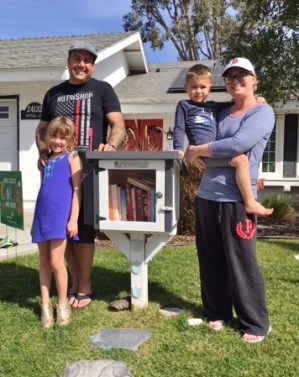
Kevin drew plans and constructed his Valentine’s Day gift, painting it to match their house. He checked with city regulations (though not all the Libraries I visited did) and sunk a post into their front lawn three feet from the side walk and about 24 inches from the ground. Three small flagstone steps invite kids to visit. He attached a mailbox flag which is extended when new books are added.
Kristin loved it!
(The height of the Libraries is a personal preference. I saw ones sitting on a base at 3 and 4 feet high.)
The family says they have quite a few kids & teens stopping to choose books on their way to/from a nearby park. The couple’s children, Georgia and Ryan, enjoy sharing their own books as well.
Check out the organization for information on buying or building your own library, and to see an amazing variety of Little Free Libraries, including some that look like a church, schoolhouse, caboose, or English telephone booth! https://littlefreelibrary.org/faqs/
Of course, right away, I had my hubby build a Little FREE Library for ME for THIS Valentine’s Day, and paint it to match our house. (I’ll let you know how it goes in a later post, if you are interested.)
Other Little Free Libraries in Mission Viejo.
Now let me tell you about some other things to LOVE and to GIVE on February 14th, and these are especially meaningful to us writers of books.
The 14th of February is also LIBRARY LOVERS DAY.
Here are some things you can do to celebrate:
Visit your local library and check out a book or film.
If you know someone who doesn’t have a library card, encourage/help them to get one.
Volunteer time at the library (shelving, tutoring, reading to kids), or donate money and/or a few of your books.
“Without the library, you have no civilization.” ― Ray Bradbury
“Libraries really are wonderful. They’re better than bookshops, even. I mean bookshops make a profit on selling you books, but libraries just sit there lending you books quietly out of the goodness of their hearts.” ― Jo Walton
“The library is like a candy store where everything is free.” ― Jamie Ford
“Libraries made me – as a reader, as a writer, and as a human being.” –Laurie R. King
The 14th of February is also INTERNATIONAL BOOK GIVING DAY.
Here are some ways to participate:
Share your favorite book with a friend.
Give books as gifts to your own children or to those of friends.
Donate books to children’s libraries, schools or charities.
Leave books in places where they’ll be found, such as doctors’ waiting rooms, train or bus stations, or airports.
“Give a Book” is a UK based charity with the sole aim of giving books where they will be of particular benefit including prisons. http://giveabook.org.uk/
“Give a Book” works with Ellie’s Friends, a charity who helps women who are recovering from Cancer. They send a monthly mixed selection of light reading to be enjoyed. Each bundle contains ten titles and is delivered to a different recipient each month. https://elliesfriends.org
“Give a Book” also works with First Story, a registered charity which places published authors in schools to hold weekly workshops on creative writing. At the end of the program, the students’ pieces are published in their own anthology. https://firststory.org.uk/
A while back I posted Part Oneof this Blog. Here’s the rest of the story…
There are a few other things to think about while you are writing that OPENING to your story. Remember, it might be the only thing an agent or editor reads. Make him or her want to read the rest of it.
How To Open a Great Short Story using the 5 Basic Elementscovered in Aristotle’s The Poetics:Plot, Character, Dialogue, Setting, and the General Theme or Point of Your Story (Man Against Nature Man Against Man; Man Against Himself; Love Conquers All, etc.)
The perfect plot is simple, not complex.Aristotle from The Poetics
1. The Plot in a Short Story especially, but most stories in general should –
a. Have a beginning, middle, and an end, but start in the middle of the beginning. This makes the reader want to see what he missed so he keeps turning those pages. EXAMPLE: “I already told you. I met the guy in a bar. We got to talking. Somehow he knew I’d been in trouble with the law before.” (Something bad has already taken place and this guy is explaining it.)
b. Get to the point with very little, if any, backstory. You can add that later. EXAMPLE: “But you’re married, Janice.” (Obviously something has elicited this reaction. Now the reader will want to know what Janice has been up to.)
c. Hook the reader with a compelling reason to continue reading; an “out-of-whack” event; something that changes the protagonist’s world profoundly and the reader just has to know what happens next. EXAMPLE: “How long has he been in the water?” I asked, knowing by the bloated, blue body it was too long. What was left of the corpse’s clothes had shredded, exposing large masses of distended flesh. – From Damning Evidence – by G.B. Pool – (Obviously our private detective will have another murder to solve.)
d. A story-worthy problem or situation is the heart and soul of your story; your annual Christmas letter doesn’t cut it, neither does just a series of bad things happening to someone; there has to be some extenuating circumstances that brought about this calamity.
e. Or have something that changes the protagonist’s world profoundly and the reader just has to know what happens next: EXAMPLE: John Smith didn’t know he was an amnesiac. He discovered that and the fact he was married to two women when one of them turned up dead.
f. Make sure the Opening Scene has some relevance to the rest of the story, whether it actually figures into the plot or echoes the theme. Opening in a beautiful flower garden better reveal a dead body in the posies. Or hearing about a long ago train wreck better foretell another “train wreck.”
2. Characters
a. Don’t introduce all your characters at once, but begin with an important one.
b. Don’t over describe your characters at first; leave some traits for later, but start with something compelling like the smoking gun in her hand.
c. And remember, actions always speak louder than words, so have your character do something or see something right away.
3. Dialogue: It gets you into the story fast and moves the story along even faster than merely telling the story.
a. Dialogue can set the stage (EXAMPLE: “The bridge is out!”), define a character’s education level or regional origin by their accent (EXAMPLE: “Honey, did y’all get another dawg?”) or get into a character’s personality (EXAMPLE:“I loathe you,” she said, grinding her cigarette into the back of his hand. “Have a nice day.”)
b.Dialogue, whether it’s an internal monologue or between two people, performs a major function. (If it doesn’t, rewrite it.)
i. Dialoguewith occasional body language enhances (describes) the character; (EXAMPLE:“Go ahead. Date my ex-wife,” he said and then slammed his fist into the wall.)
ii. Dialogue advances the plot (EXAMPLE:My name is Johnny Casino. I’m a retired P.I. with a past. I just hope it doesn’t catch up with me. Before I went legit, I ran numbers in Jersey for Big Louie “Fingers” D’Abruzzo and then busted heads in Miami for Big Eddie “Mambo” Fontaine. But at the ripe old age of twenty-four, Little Johnny beat a hasty retreat to L.A. when somebody slipped the cops a hot tip and all of a sudden, I became the fall guy for the Mob.) FROM THE JOHNNY CASINO CASEBOOK 1 – PAST IMPERFECT BY G.B. POOL
iii. And Dialoguegets you up close and personal as if you were eavesdropping on the conversation; EXAMPLE: Before Donald got out of his chair to greet me, I launched. “Are you out of your freaking mind? Marrying somebody before you even buried your wife! Do you want me to save your butt or direct traffic to your hanging?” I was speaking in a crescendo, starting around contralto, and ending somewhere in the soprano range.
“I never loved my wife!” he declared in clear basso profundo.
“Did you kill her?” I yelled.
“No!” he shot back. Note: As the dialogue gets more intense, the fewer words are used.)
4. Have a terrific Settingor Sense of Place.
You want to set the stage whether it’s an attic room or a ballroom, a secluded path or a desert vista. Paint that background and then get out of the way and let your characters experience it. EXAMPLE: It was going to be the hottest damn day of the year. Those Santa Anas were kicking up, turning the L.A. basin into a blast furnace. If it didn’t cool off, half the state would catch fire. From “Heat” G.B. Pool
5. The Point of the Story
Reread your story and ask yourself: Does this make sense? Does your opening tie in with the ending? Does the Title fit the story? The Opening:I couldn’t believe they found Brad’s body. I thought I buried him deeper. FROM “A ROLE TO DIE FOR” BY G.B.POOL
The Closing: “They think an animal killed him, dug a shallow trench to hide his kill for later, and must have forgotten where it was buried.” He walked closer and put his warm hand on my arm. “It was ruled…death by cougar.”
Aaron smashed the plastic bag containing the vodka bottle against the fireplace and the glass shattered. Then he took my hand and led me upstairs. I’ll always wonder if he ever read that “cougar” book, but I’ll never ask. Lovers have to have some secrets. FROM “A ROLE TO DIE FOR” BY G.B.POOL
(FROM THE OPENING, Our protagonist obviously had something to do with Brad’s death. At the CLOSING, her boyfriend must know it, too, but they will both postpone the inevitable until later.)
As for the TITLE, “A Role to Die For,” several people died while she was securing those roles. That’s showbiz…
In Conclusion: This might be a lot to think about, but opening your story well will have readers follow it to the end… and maybe read your next story. Write On…
A while back I posted Part One of this Blog. Here’s the rest of the story…
There are a few other things to think about while you are writing that OPENING to your story. Remember, it might be the only thing an agent or editor reads. Make him or her want to read the rest of it.
How To Open a Great Short Story using the 5 Basic Elementscovered in Aristotle’s The Poetics: Plot, Character, Dialogue, Setting, and the General Theme or Point of Your Story (Man Against Nature Man Against Man; Man Against Himself; Love Conquers All, etc.)
The perfect plot is simple, not complex. Aristotle from The Poetics
1. The Plotin a Short Story especially, but most stories in general should –
a. Have a beginning, middle, and an end, but start in the middle of the beginning. This makes the reader want to see what he missed so he keeps turning those pages. EXAMPLE:“I already told you. I met the guy in a bar. We got to talking. Somehow he knew I’d been in trouble with the law before.” (Something bad has already taken place and this guy is explaining it.)
b. Get to the point with very little, if any, backstory. You can add that later. EXAMPLE:“But you’re married, Janice.” (Obviously something has elicited this reaction. Now the reader will want to know what Janice has been up to.)
c. Hook the reader with a compelling reason to continue reading; an “out-of-whack” event; something that changes the protagonist’s world profoundly and the reader just has to know what happens next. EXAMPLE: “How long has he been in the water?” I asked, knowing by the bloated, blue body it was too long. What was left of the corpse’s clothes had shredded, exposing large masses of distended flesh. – From Damning Evidence – by G.B. Pool – (Obviously our private detective will have another murder to solve.)
d. A story-worthy problem or situation is the heart and soul of your story; your annual Christmas letter doesn’t cut it, neither does just a series of bad things happening to someone; there has to be some extenuating circumstances that brought about this calamity.
e. Or have something that changes the protagonist’s world profoundly and the reader just has to know what happens next: EXAMPLE:John Smith didn’t know he was an amnesiac. He discovered that and the fact he was married to two women when one of them turned up dead.
f. Make sure the Opening Scene has some relevance to the rest of the story, whether it actually figures into the plot or echoes the theme. Opening in a beautiful flower garden better reveal a dead body in the posies. Or hearing about a long ago train wreck better foretell another “train wreck.”
2. Characters
a. Don’t introduce all your characters at once, but begin with an important one.
b. Don’t over describe your characters at first; leave some traits for later, but start with something compelling like the smoking gun in her hand.
c.. And remember, actions always speak louder than words, so have your character do something or see something right away.
3. Dialogue: It gets you into the story fast and moves the story along even faster than merely telling the story.
a. Dialogue can set the stage (EXAMPLE: “The bridge is out!”), define a character’s education level or regional origin by their accent (EXAMPLE: “Honey, did y’all get another dawg?”) or get into a character’s personality (EXAMPLE: “I loathe you,” she said, grinding her cigarette into the back of his hand. “Have a nice day.”)
b. Dialogue, whether it’s an internal monologue or between two people, performs a major function. (If it doesn’t, rewrite it.)
i. Dialogue with occasional body language enhances (describes) the character; (EXAMPLE: ““Go ahead. Date my ex-wife,” he said and then slammed his fist into the wall.)
ii. Dialogue advances the plot (EXAMPLE: My name is Johnny Casino. I’m a retired P.I. with a past. I just hope it doesn’t catch up with me. Before I went legit, I ran numbers in Jersey for Big Louie “Fingers” D’Abruzzo and then busted heads in Miami for Big Eddie “Mambo” Fontaine. But at the ripe old age of twenty-four, Little Johnny beat a hasty retreat to L.A. when somebody slipped the cops a hot tip and all of a sudden, I became the fall guy for the Mob.) FROM THE JOHNNY CASINO CASEBOOK 1 – PAST IMPERFECT BY G.B. POOL
iii. And dialogue gets you up close and personal as if you were eavesdropping on the conversation; EXAMPLE: Before Donald got out of his chair to greet me, I launched. “Are you out of your freaking mind? Marrying somebody before you even buried your wife! Do you want me to save your butt or direct traffic to your hanging?” I was speaking in a crescendo, starting around contralto, and ending somewhere in the soprano range.
“I never loved my wife!” he declared in clear basso profundo.
“Did you kill her?” I yelled.
“No!” he shot back.
Note: As the dialogue gets more intense, the fewer words are used.)
4. Have a terrific Setting or Sense of Place.
You want to set the stage whether it’s an attic room or a ballroom, a secluded path or a desert vista. Paint that background and then get out of the way and let your characters experience it. EXAMPLE: It was going to be the hottest damn day of the year. Those Santa Anas were kicking up, turning the L.A. basin into a blast furnace. If it didn’t cool off, half the state would catch fire. From “Heat” G.B. Pool
5. The Point of the Story
Reread your story and ask yourself: Does this make sense? Does your opening tie in with the ending? Does the Title fit the story? The Opening: I couldn’t believe they found Brad’s body. I thought I buried him deeper. FROM “A ROLE TO DIE FOR” BY G.B.POOL
The Closing: “They think an animal killed him, dug a shallow trench to hide his kill for later, and must have forgotten where it was buried.” He walked closer and put his warm hand on my arm. “It was ruled…death by cougar.”
Aaron smashed the plastic bag containing the vodka bottle against the fireplace and the glass shattered. Then he took my hand and led me upstairs.
I’ll always wonder if he ever read that “cougar” book, but I’ll never ask. Lovers have to have some secrets. FROM “A ROLE TO DIE FOR” BY G.B.POOL
(FROM THE OPENING, Our protagonist obviously had something to do with Brad’s death. At the Closing, her boyfriend must know it, too, but they will both postpone the inevitable until later.)
As for the TITLE, “A Role to Die For,” several people died while she was securing those roles. That’s showbiz…
In Conclusion: This might be a lot to think about, but opening your story well will have readers follow it to the end… and maybe read your next story. Write On…
Bonnie Schroeder started telling stories in the Fifth Grade and never stopped. After escaping from the business world, she began writing full-time and has authored novels, short stories and screenplays, as well as non-fiction articles and a newsletter for an American Red Cross chapter.
As I get older, I seem to be experiencing an odd form of dyslexia (I think) where my brain transposes letters in words so that I read something that’s not there. Only on second glance do the letters rearrange into what they’re supposed to be.
This has been a boon for me in one way: character names. For example, I came across the surname “Murdock,” but my eyes thought they saw “Mudrock,” and after my initial annoyance at myself, I thought, what a great name for a character.
I collect names because few things are as frustrating to a writer as creating a new character and not being able to name them, right? First names are easier to come by; I pop open 1001 Names for Baby and can usually find one that works. But surnames? The tone must be just right.
In my novel MendingDreams, the main character’s last name is Krajewski [yeah, even now I have to look it up in the book to spell it correctly], and that was intentional. I knew a fellow with that last name, and he used to joke about how people mispronounced it. I wanted the character, Susan, to have willingly kept the name even after she and her husband divorced. Her maiden name was Stafford, and it says volumes about her and her feelings about her ex-husband that she kept his name despite the difficulties it could cause.
My list of unusual surnames fills several pages in my notebook. One I’m trying to find a story for is “Evilsizer.” Meaning no disrespect to real people with this name—and I found several via Google—I think it would be perfect for a scheming couturier. Or maybe someone who is really nice. . .
Strong first and last names are essential to me so I can paint a picture in my own mind of the character before I start writing. Names help me visualize characters—sometimes even more than physical descriptions. Names bring with them associations for me personally that color a character’s nature and behavior.
Take the name “Joan,” for example. What does this name conjure up for you? Joan of Arc? Joan Crawford? Joan Baez? For me, it brings back the memory of a woman named “Joanie,” the utterly helpless wife of a fellow I worked for. This woman would call my boss with every little challenge life presented her. If she locked her keys in the car, her first call wasn’t to Auto Club; it was to her husband. I haven’t found a role for Joan or Joanie in my stories yet, but some day I will.
Names and the way they are used in a story also reveal behavior and sometimes emotion. The main character in my novel Write My Name on the Sky goes by “Kate,” but when she exasperates her mother, she becomes “Kathryn Ann.” How many of you remember hearing the sound of your first and middle name as a cue that you were in big trouble with a parent? And if they added your last name—run for cover!
Sometimes the way a name is mis-used in a story can affect the outcome, too. For example, my flash fiction piece “What’s in a Name?” answers that question with one word at the end of the narrator’s date with the man of her dreams. If you want to check it out (it’s only 532 words), follow the link on my website: http://bit.ly/2En7TJw
Yes, names are important to writers, and to readers. And not just the human characters. The animals in our stories need particular names, too. After all, none other than the masterful poet T.S. Eliot admonishes us to give thought to the naming of cats: http://bit.ly/2mZ47xQ
How about you writers: do you struggle as much as I do to come up with suitable character names? And, readers: any favorites among your literary heroes and heroines? Any tips for good name sources?
Linda O. Johnston, a former lawyer who is now a full-time writer, writes the Barkery and Biscuits Mysteries for Midnight Ink. She has also written the Pet Rescue Mystery Series, a spinoff from her Kendra Ballantyne, Pet-Sitter mysteries for Berkley Prime Crime. She additionally currently writes the K-9 Ranch Rescue miniseries for Harlequin Romantic Suspense about a ranch where dogs are trained, as well as the Alpha Force paranormal romance miniseries about shapeshifters for Harlequin Nocturne. And yes, they all involve dogs. Her most recent release is her 46th published novel, with more to come…soon.
* * *
I’m thrilled that I’m having four novels traditionally published this year. I love being busy.
But can you be too busy doing what you love? Oh, yes!
I’m used to having deadlines, of course, with my fourth book this year to be my 50th published novel, as I mentioned before. And I’ve always been able to negotiate deadlines that work for me.
This past week, though, was a bit nuts. I already had a February 1 deadline for the fourth book of the year, which will be my last paranormal romance for Harlequin Nocturne. I then received some detailed copy edits for my fourth Barkery & Biscuits Mystery, which will be published in May by Midnight Ink–and the revisions also had a February 1 deadline. And in the middle of this, I had to take time out to come up with some additional title ideas for the second of my K-9 Ranch Rescue romantic suspense novels to be published this year by Harlequin Romantic Suspense.
I also had family things to do, including responding often to my dogs’ requests to go outside while I’m sitting at my computer working. Obviously that can’t be ignored. Neither can demands to be snuggled. Plus, I’m taking my younger dog to her second round of obedience classes and need to practice what she learns with her. We also had family in town whom we got together with a lot for meals and more. And then there’s the normal stuff: sleeping, eating, shopping and more.
So how do I deal with it–and how should you, whether or not you’re a writer, handle it all? For whoever you are, and whatever you’re doing, we all face times when there’s more to do than we hope or expect.
The answer? Just dig in and do it! And yes, I recognize that we all have lives in addition to our writing. Some of us have full time jobs, young families who aren’t only pets, and other responsibilities as well.
So… expect it. Plan for it. Think about it, don’t obsess–but do it. Schedule things the best way you can, and recognize that those things may change as you go along. You’ll adapt. You have to.
So where am I? Well, I sent in my title ideas and received word that they chose something similar to, but not identical with, one of my suggestions. I finished and sent in my Barkery edit comments first, and I’m currently finishing the manuscript for my last Nocturne. I feel pretty good about how I’d been able to work it all out, although all I had to do meant I haven’t had much time to work on two ideas I’ve had in the meantime for some additional stories. But that’s okay. February 2 is on its way, and then I’ll only be under a June 1 deadline for my next book.
Rosemary wrote her first book when she was ten years old – for her little brother. She also illustrated it herself. It was later rejected by Random House!
She has been writing ever since.
The author of Best Sellers Hollywood Then and Now and Los Angeles Then and Now, English born Rosemary Lord has lived in Hollywood for over 25 years. An actress, a former journalist (interviewing Cary Grant, James Stewart, Tony Hopkins, John Huston amongst others) and a Senior Publicist at Columbia Pictures, she lectures on Hollywood history. Rosemary is currently writing the second in a series of murder mysteries set in the 1920s Jazz Age Hollywood featuring Lottie Topaz, an extra in silent movies.
* * *
Don’t know about you, but I am still easing myself into this New Year. We relaxed through Madeline’s ‘betwixt and between’ week and suddenly there it is: a New Year. And, as if running down hill, you gather speed as life takes over once again.
But to get back to the beginning, less than three weeks ago:
At the start of each year, I look forward to the blank page.
Firstly, the clean, empty blank page of a new diary – or appointment book – as I anticipate writing that first entry. The first appointment. What’s it going to be? Something dire or something fun?
This year, it was the dentist, hairdresser, doctor check-ups. Finally taking care of me – so that was a good, healthy start. Then I set meetings about work, about writing: what new people will I meet? What adventures will I start this year? And in the margins of the new diary page I start to note new ideas, new goals for the year as ‘A Plan’ begins to emerge. “This year, it really will be different, better,” is my theme song.
I determined to get a control of my pathway for the year, before life’s little jokes and challenges intercede.
My favorite blank pages are in my writing books. I have a series of brightly-colored leather-bound note books – a big clue I used in the first Lottie Topaz Hollywood Mystery, by the way… The different colors are for different stories I am working on.
I’ve not been one to dread the empty page, or the stuck-ness (did I just make up a word?!) of no ideas. Quite the reverse. Instead of a frozen, blank mind, my fingers can’t write fast enough. I have an annoying habit of starting a word in such a rush that I finish the next word on top of it, jamming two half words together, missing the middle letters, in my haste to finish the sentence. Then later I attempt to figure out what I was saying! I am trying to slow my thoughts down as they tumble onto the blank page, not always making sense, in speedy disarray. Fortunately, this first draft is always in pencil – there is a lot of erasing later on.
And so I fill up page after page, stopping only to sharpen pencils and grab a fresh cuppa (cup of tea) with no time to eat – just back to convert blank pages into the start of an amazing story.
I also have a collection of tiny, pocket-size notebooks that I carry with me. On those blank pages I make lists of names, lines of dialogue, clues, storyline notes that come to me as I wait in the check-out line, parking the car or waiting at appointments. Mind you, it’s not always neat blank pages of note-books that I scribble thoughts on. How often can you NOT find the note-pad when you need it? So backs of envelopes, register- receipts, shopping lists, coupons suffice. Whatever is handy. The trick is not to lose that scrap of paper! Later that day those bits get transferred to a proper blank page.
So these are part of my arsenal for the start of a new year. First, I have to remember to breathe. Slow my racing mind down. Then take it step by step into my writing world so that I finally finish another book.
Last year, amidst the very productive chaos, I did manage to write the revised, updated version of my first published book: Los Angeles Then and Now. Sadly, so much of historic Los Angeles has disappeared since I wrote the original book. The landscape is so very changed, the sky-line filled with towering apartment and luxury condominium blocks, many still empty.
I updated those original sites that are still standing, and discovered future plans, new focuses in the city. I researched all the new sites I have added, explored fresh archive photographs to mirror the new ‘now’ images. It was a fun challenge.
I also wrote a piece on the Hollywood School for Girls and the Woman’s Club of Hollywood for the Fall issue of Discover Hollywood magazine along the way.
And now my new Los Angeles Then and Now is coming out next month, so I will get busy promoting that. And guess what? A new notebook and new blank pages to fill as I travel that road.
Life is full of blank pages for us all to fill. What would you fill yours with?
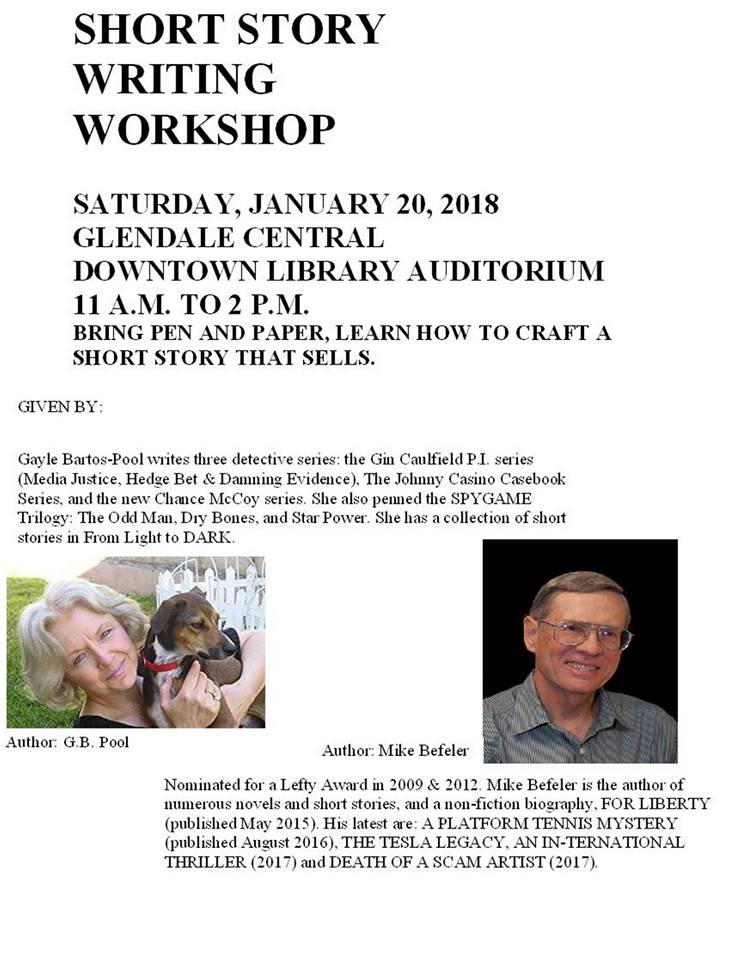
Join Mike Befeler and G.B. Pool (Gayle Bartos-Pool) at the Glendale Central Downtown Library (222 E. Harvard Street, Glendale, CA) this coming Saturday, January 20, from 11 a.m. until 2 p.m. when they teach a short story workshop for all you writers out there.
If you aren’t in the area, you can find Gayle’s book, Anatomy of a Short Story Workbook, on Amazon. It covers even more than the class and has oodles of examples.
Miko first contemplated a writing career as a poet at age six. That notion ended four years later when she found no ‘help wanted’ ads for poets in the classified section, but her desire to write persisted. After graduating from New York University, she headed west to pursue a career as a journalist before switching to fiction. She is the author of the A Petal In The Wind Series;Book III – The Great Warhas just been released and is available through Amazon and Barnes and Noble. Miko lives on Whidbey Island in Washington.
Happy New Year, everyone. A fresh year, a fresh beginning. Time to dig out that half-finished novel, or start a new one. There’s nothing better than curling up on a winter’s day and writing, which made me think….
Where do you write? For the past year my preferred spot has been a comfy chair in my bedroom, but I have a number of places that suit me, both at home and elsewhere. The reason is simple – I own a laptop computer. This has changed not only where I write, but how I write.
Like many of us in the craft, I began writing when I learned how to in first grade. I’d sharpen my yellow pencil and print words in my composition book – the ones with the black and white ‘marble’ cover – eventually switching to ballpoint pen and spiral bound notebook after I’d mastered cursive and good penmanship. That allowed me to write at home, the library, school cafeteria or a friend’s house, as long as I had a good light source. It worked well, except when story ideas erupted; I couldn’t write as fast as I thought.
I learned to type in high school and purchased a used manual typewriter when I began college. It sat on my desk, set near a window, with a swing arm desk lamp for writing at night. My typewritten work looked more professional, but the carbon copies were awful and my creative spurts still outpaced my typing. I hated making mistakes, a nightmare to fix until I discovered correction fluid in the eighties. However, typing forced me to think about my work since it was tedious to redo significant portions. I usually began with a hand-written copy and transcribed it to typing paper.
The electric typewriter worked much better; I could type faster, which allowed me to keep up with my thoughts. Mistakes were easier to correct, though major changes still required major retyping. Being electric it required a nearby outlet, and it wasn’t portable, so I had to resign myself to type at my desk. I sat with my back to the window for natural light and kept my desk lamp. Pad and pen filled in for other locations.
In the early nineties I worked in a windowless cubbyhole. That’s when I began to use my desktop computer at work for writing. The ability to not only make corrections, but to cut and paste, became a game changer for me. I could let my thoughts pour out, then go back and rearrange them, condense them, or flesh them out with ease. For the first time, I could write faster than I could think. I still had to work in one spot, but pen and pad filled in when I was away from work.
My first personal computer was ‘totable’, about seven pounds that could be moved and operate on battery power for a few hours. Suddenly I could work anywhere, with the portability of a pen and pad and the advantages of a word processor. Lighting wasn’t an issue; in fact, rather than sitting with my back to the window, I could now face it and have something other than a blank wall to stare at while waiting for inspiration to strike. Email allowed me to electronically transfer my work between home and office.
I currently write on a compact laptop that weighs about three pounds and has a battery life of at least six hours, longer if I turn off the wifi. It has its own black ‘jammies’, a padded slipover case to protect it when I travel. The portable computer fits in my larger purses, tote bags and suitcases. I can write anywhere. And I have. In just about every room in my house. On my deck. In hotel rooms, airport lounges, airplanes, boats, coffee shops and friends’ houses. I no longer have to plan out what I’m going to write before I commit it to the page – the ease of changing words, paragraphs and whole chapters means I can work freeform. Get my thoughts down and clean it up later. Of course, it’s also made it easier to constantly tinker with my pages, tweak a word, delete a comma, or cut that wonderful line that doesn’t serve the story.
Technology has changed the way I write in other ways as well. I presently do not have a desk. My handwriting, which used to be neat and easy to read, is neither without great concentration. I’m not as disciplined about organizing my thoughts as I was in the typewriter era, when changes or corrections required a major effort. I must always write a draft version of any notes or letters before committing my words to stationery. Then again, I’m also not obsessed with getting it ‘right’ on the first draft. Storing earlier drafts and critiques of my work in progress no longer requires multiple shelves of loose leaf binders and cartons filled with copies of printed pages covered with hard-to-read scribbled notes. I also love the idea of sending e-copies of my manuscripts to my publisher instead of mailing hard copies.
What about your writing journey? How has technology changed the way you write?

 Jacqueline Vick is the author of over twenty published short stories, novelettes and mystery novels. Her April 2010 article for Fido Friendly Magazine, “Calling Canine Clairvoyants”, led to the first Frankie Chandler Pet Psychic mystery, Barking Mad About Murder. To find out more, visit her website at http://www.jacquelinevick.com.
 I was writing a Pet Psychic short story for St. Valentine’s Day. It seemed like the perfect time to have Bowers propose to Frankie, but I wondered if that would be fair to readers of the series. On one hand, it would encourage people to keep up with the shorts. On the other hand, not everyone enjoys shorter fiction, so they might be confused when they picked up the next novel.
 .M.) Gornell is the author of seven award-winning mystery novels. Her current literary focus is Route 66 as it traverses California’s Mojave Desert. Madeline is a lifetime lover of mysteries. She lives with her husband and assorted canines in the High Desert. Visit her
  Several events/ideas have brought me to this post. My continuing interest in the importance of setting in conjunction with “taking me there,” G.B. Pool’s recent post on Openings, and my enjoyment-of and fascination-with audio books. I’ve mentioned in past posts how much I enjoy audio books—and now I’m asking myself why, in that there might be a couple writing-nuggets there worth paying attention to.
 On a personal note, I would love to have all my books as audio, but don’t sell enough (not yet! Smile) for many narrators to take a commission-split chance on me, and can’t afford the narrator I want with a hefty flat out payment! (I’m talking about someone famous of course like Neil Dudgeon or Hugh Frasier) The talented Mei-Ling Downey, did take a chance on me and narrated Lies of Convenience, on Audible. What a joy to my writing-heart that is!


 Kevin drew plans and constructed his Valentine’s Day gift, painting it to match their house. He checked with city regulations (though not all the Libraries I visited did) and sunk a post into their front lawn three feet from the side walk and about 24 inches from the ground. Three small flagstone steps invite kids to visit. He attached a mailbox flag which is extended when new books are added.

 The 14th of February is also LIBRARY LOVERS DAY.
 The 14th of February is also INTERNATIONAL BOOK GIVING DAY.

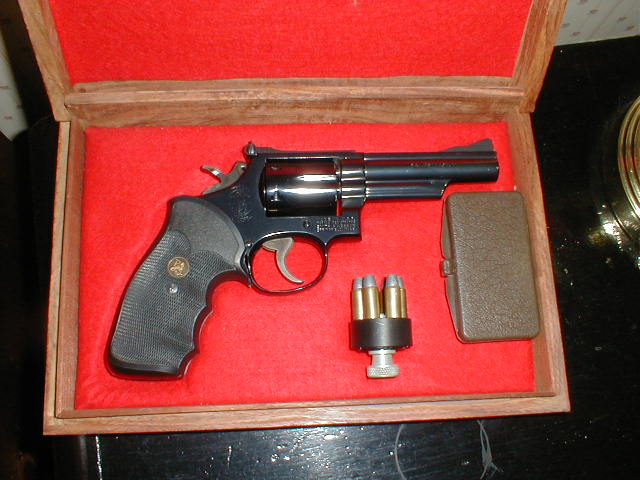


 How To Open a Great Short Story using the


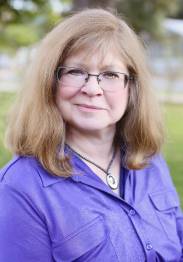 Linda O. Johnston, a former lawyer who is now a full-time writer, writes the Barkery and Biscuits Mysteries for Midnight Ink. She has also written the Pet Rescue Mystery Series, a spinoff from her Kendra Ballantyne, Pet-Sitter mysteries for Berkley Prime Crime. She additionally currently writes the K-9 Ranch Rescue miniseries for Harlequin Romantic Suspense about a ranch where dogs are trained, as well as the Alpha Force paranormal romance miniseries about shapeshifters for Harlequin Nocturne. And yes, they all involve dogs. Her most recent release is her 46th published novel, with more to come…soon.

 Rosemary wrote her first book when she was ten years old – for her little brother. She also illustrated it herself. It was later rejected by Random House!



 The Writers in Residence
You must be logged in to post a comment.