SHOW DON’T TELL: A PERSONAL DEMONSTRATION by Miko Johnston

One of the first rules of writing I learned was the mantra “Show, don’t Tell”. I’ve lost count of how many times I heard this advice “told”, but ironically, I’ve never been “shown” how to do it. If you agree, read on, for I will “show” you my version of Show, don’t Tell with a demonstration of what I call forensic editing – a way to improve writing line by line, paragraph by paragraph, page by page. And I’m going to use a sample of my own work to illustrate how it’s done.

I’ve never shown a rough draft of my writing to anyone before, but I want to give you real “before and after” examples. Below you’ll find the original version of Page one from my novel, A Petal in the Wind III: The Great War. I’ll guide you through an analysis of its many flaws and correct them using forensic editing. Let’s begin:

Lala Hafstein stepped out of the taxi in front of her house. Still a charming two story stone cottage, she observed, surrounded by blooming rose bushes and bathed in mid-afternoon sunshine. The cherry tree was bare of fruit, but the walnut tree was laden, the plums needed harvesting, and apples and pears would soon ripen on their respective trees. A typical early August day in Bohemia, she thought, even if absolutely nothing else was remotely so.

A sense of déjà vu enveloped her as she clutched her travel satchel to her chest and stepped aside. Her parents entered the house, followed by the driver who assisted in bringing in their travel trunks. Lala went inside as well and looked around. The gilt-framed mirror still hung in the entryway above the walnut cabinet her father had constructed decades ago in his carpentry shop in Prague. The parlor, filled with a mix of old and recent pieces acquired through inheritance and her father’s masterful woodworking skills, was as they’d left it save for a trace of dust. She wondered if Hilde, their maid, had been in for over a week. Her life, like everyone else’s, was interrupted nine days earlier, when Emperor Franz Josef directed the bombing of Belgrade in retaliation for the assassination of his nephew by Serbian nationalists.  #

Yikes!

Consider an ideal page one. The opening sentence functions as the “hello” to the story, grabbing the reader’s attention. The first page must coax you into the first chapter and hold your interest. It should give readers a sense of the who, what, wherewhen, why and how of the story. Usually the who – your protagonist – is foremost. Page one lays the path to the when and where (is this taking place) and the what (is going on), which eventually leads to the how (the story will play out) and why (it’s important).  This version fails on most accounts.


Let’s review the first sentence:

Lala Hafstein stepped out of the taxi in front of her house.


The who is clear, the where not so much. We know she’s home, but where is home? What is significant about her coming home? How does that intrigue the reader?


This opening line is neither dramatic nor engaging.


The rest of the first paragraph provides some setting details with imagery. We learn where, in Bohemia, and when this takes place, August. But with summer fruit at its peak and fall fruit soon to harvest, readers might figure out this must be late summer anyway. Not until the end of the paragraph’s final line, …even if absolutely nothing else was remotely so, do we get a hint that all is not what it appears to be. This may be too subtle or cryptic to hook readers.  


A dissection of the paragraph shows it’s moving in the right direction, but fails to engage readers. It conveys very little for the valuable real estate it occupies.  


The next paragraph shows Lala’s been traveling with her parents. The déjà vu reference harkens back to something that occurred in the first Petal novel. As this is Book III, many readers might not recall this and make the connection. The rest frontloads the page with backstory. The implication, that on the surface things look the same but really aren’t, repeats what was in the first paragraph. And we still don’t know why that is until the end of the page. I knew the bombing of Belgrade marked the actual launch of the first World War, but to readers that reference might be vague; not everyone spent months researching the subject like I did. Worse, I reveal WWI’s onset in an undramatic way, telling rather than showing. Not much of a pay-off for the “things are different now” scenario I imply, nor an irresistible way to end page one.

The opening also falls into a classic trap by limiting Showing to visuals – no scents, no sounds.


Now let’s examine how to fix these weaknesses:


1- Write an opening line that entices the reader and alludes to what will transpire.


Lala Hafstein stepped out of the taxi in front of her house does not accomplish this. My first revision:


Lala Hafstein stepped out of the taxi laden with trunks and valises in front of her house.


A little better. We surmise she’s been traveling, but we don’t know how she feels upon returning or what her return means, so back to work. My final version of the opening sentence:


Relief washed over Lala Hafstein as the taxi laden with trunks and valises came to a stop in front of her family’s house.


Relief. That exposes her state of mind. We know what that looks like and feels like. The word captures our interest, puts the rest of the paragraph in perspective, and also mirrors the ending. Woo-hoo, triple points.


2- Shore up the sensory details that lead to the teaser at the end of the opening paragraph.


I amended it so her parents now exit the taxi with Lala, but I got rid of the procession entering the house. Lala remains outside while the driver unloads the luggage, so I focused on better illustrating the where instead of the home’s interior. What began as a purely visual description:


Still a charming two story stone cottage, she observed, surrounded by blooming rose bushes and bathed in mid-afternoon sunshine….  became:    


As she inhaled the scent of roses warmed by the afternoon sun, Lala looked over the property. The two-story stone cottage perched on a hill, overlooking rolling plains sectioned by thickets of forest….


Adding relatable sensory details beyond visuals, and broadening the setting, vivifies the where.


3- Eliminate the repetition and make the reveal about the war’s onset more impactful.


Having Lala wonder what the maid experienced, which is third hand information, dulled the impact. The most visceral reveal would be through her first-hand perspective, but Lala wasn’t there. I went with the next best thing, a creative solution based on logic. Curious to know, she would ask, “What was it like here when it began? How did you know?” to someone who was there – the taxi driver. In the final version, Lala does that:


The driver understood, for he answered without hesitation. “Church bells, Miss. The church bells rang out.” He stood up and with head bent, took off his cap and held it against his heart as if facing a coffin. “Not just our church bells, but you could hear them ringing off in the distance, from every town and hamlet in the region, ringing for a long, long time. We knew then our empire was at war.”

As he described that moment, Lala could almost hear church bells clanging from near and far.


Now we not only understand what has happened, we feel it through the taxi driver’s firsthand account of the moment the war began. By establishing it with sensory detail – in this case, sound – readers, like Lala, can virtually hear the church bells clanging as we listen to the man’s response and see his physical reaction. I can also see readers turning the page to find out what happens next.  


If you would like to see the first page as published, click on  this link:

Click on “LOOK INSIDE” and scroll to Chapter One. The entire first chapter is available.

CLOSER by G.B. Pool

Launch Date is Here….


The old adage says to keep your friends close and your enemies closer, but what if you don’t know who your friends are?

When the wife of an LAPD captain turns up dead on the pier in Santa Isabel, a relatively peaceful town along the coast in Central California, Police Lieutenant Shelby Ann Webb figures there’s a story there somewhere. She doesn’t realize the backstory will involve not only the captain, but also a big-time operator in illegal drug trafficking, a handful of characters you wouldn’t want to meet in a dark alley, and some people very close to Shelby herself.

Shelby had her own troubles in L.A. before she was basically forced to leave the LAPD. Will her past hold her back in trying to solve this murder? Someone asked her what she would do if someone she cared about did something very wrong. Now she has to answer that question.

Don’t turn your back… It’s getting closer…


NOW on Amazon.com

Book is available on Amazon.Closer Cover with Title

Promoting Pointers

     by Jill Amadio


MegaphoneDo you spend time each week promoting your books? Many of us loathe having to leave our fascinating work-in-progress and slog through the various social and publicity sites. While there are tons of how-to books out there to provide guidelines, there’s nothing like hearing expertise straight from the horse’s mouth, so to speak.

 

One of the hardest working U.S. publicists with a long list of international fiction and non-fiction clients is Penny Sansevieri. She’s a whiz on how to grab publicity, and writes a free tips blog on her web site, www.amarketingexpert.com.


She has written several books on marketing including her latest, “50 Ways to Sell a Sleigh-Load of Books,” and “How to Revise and Re-Release Your Book.”  I wish I had read the latter after my traditional publisher went belly-up and I re-released my mysteries with KDP on amazon. I missed several ways to promote them including asking for reviews from new readers and new Facebook friends. Here are some tips Penny recently revealed:


  1. Create an eBook. More and more readers buy kindles and iPads.


  1. Write for popular blogs like The Writers in Residence (sorry, I added that myself!) Social media, said Penny, can be a black hole in effectiveness so choose wisely. Build a fan base by writing a newsletter and/or a blog for your web site. Knowing your core reader through your fan list is a must. You might divide the list into general mailings, fan reviewers, and a super-fan group. If your readers are on Twitter then there is no need to be on Facebook. Time is limited so spend the time and investment finding where your readers are. If social media is part of your overall campaign, don’t spend more than ten percent of your time there. For a quick and easy way to find out where your readers are, follow the big authors in your genre and watch where those authors are investing their social media efforts. This will tell you a lot, especially if they have much engagement on particular sites that you may not have considered using.
  • Add content to your amazon.com author page periodically.
  1. Assess the market. An important part of that is your book cover. If your publisher produces one you don’t like, complain.
  2. Give yourself time for your book to get some traction. Allow at least 90 days to get reviews and gain exposure.
  3. If your settings are real places, set up library and bookstore events there. Or find a similar setting and compare them, and target their local media.
  4. Call radio stations weeks ahead to set up phone interviews.
  5. Set up virtual events. For instance, if you have a book, say a YA that resonates with schools, you could do Skype events, which are very popular with schools, or Skype events for book clubs.
  6. For indie authors in general the best way to maximize exposure is to take a hard and realistic look at who your core readership is.
  7. Personal recommendations are 95 percent of books sold and are the best and most powerful marketing you can have. However, only three percent of readers will review your book without any prompting. Solution? Include back matter asking for a book review, or to contact you directly, plus a reader letter that asks for sign-ups.
  8. Send out ARCs. Amazon will be doing them soon so authors can order copies. Or send out review copies of your manuscript nicely set up like book pages when your book is 90 percent complete. Include high-profile bloggers and media.
  9. Following other authors is a terrific way to share your recommendations and network. Help big authors with launches by sharing their newest titles in your social feed. Share content, and, guess what, when it comes time for you to promote the book, they’ll be sharing your stuff too.


Penny told me that she loves giveaways whether you’re doing a Goodreads giveaway or an eBook promotion. As an indie author you have full control of your book’s success. How about discounts on your books? This is called ‘stacking’ and quite literally refers to the piling up of multiple promotional opportunities that are important to an indie author. Once your discount eBook price and dates are set, it doesn’t stop there. Research all the opportunities available to ensure the discount dates are seen by as many readers (and potential fans) as possible. Keep it varied and have a mix of both free and paid opportunities.

Climbing Books

‘Free’ is a bonus if you don’t have much of a marketing budget. Submit your promo to all of the free sites you can find since placement isn’t guaranteed. Remember, it’s easy on the bank account, so embrace the legwork. Paid opportunities vary in pricing but no matter what, if they charge you, you get what you pay for, so you can count on that exposure. Have a budget for every discount eBook promotion you can do, however small. For the amount of quality exposure to real readers, Penny suggests a budget of between $50-$100 if you’re doing book promotions once a quarter. As for a discount price for your book, aim for no more than $1.99 if you can’t offer it for free, Keep it at that price for five days.

sign

Marketing sites online include many to which you can submit discounted books. They include BookBub which is the Holy Grail. They are tough to get into so submit every month no matter what, because the time you do get up on that site is a different level of book marketing. Also, Free Kindle Books & Tips has a free author newsletter; other sites include Frugal Freebies; Indie Book of the Day, and StoryFinds. Paid sites include Awesome Gang that also has an interview option; Book Bassett that includes an indie author guest post; Bargain Booksy; BookGorilla; eBooksHabit for paid and free options; Digital Book Today, paid and free, and two other paid sites, Booklemur, and BookGoodies.


That’s an awful lot of advice from a real pro, so I shall end this blog, fellow authors, and get myself in gear to follow as much as I can. Still, I would much rather be writing my next mystery!


(Posted by G.B. Pool for Jill Amadio.)

Some Thoughts on Sex…

by M.M. Gornell

My post’s title[i] was intended to garner interest, and if it did get your interest—hope it’s not too much of a disappointment that I’m referring to having a protagonist with a different gender than one’s self.

I recently had a “writing surprise” on my winding writing-trail-adventure. Which in turn led to my gender thoughts… And here’s the path of how I got here:

  • I’ve been working over a year on a third Rhodes novel, finally finished it, but during rewriting/editing several weeks ago, decided I didn’t like it. This is a completely new writing-happening for me. Especially at this point in a work. Why didn’t I dump it a long time ago? What was this new perspective that turned me off? Most probably, I will revisit one day with these very questions, but for now, Rhodes – The Caretakers is now a lonely file on my backup drive—maybe never to be seen again.

It’s a strange feeling, having really enjoyed writing the story for so long—then dumping it out of the blue. Nonetheless, I’ve moved on to a new novel.

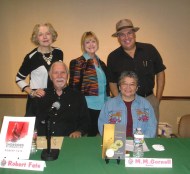
  • Rosemary Lord’s post on de-cluttering a month ago really hit home when I tried to open a file cabinet drawer, and it got stuck on the hinges because the drawer was too full with to-be-filed “important stuff” jammed into it. Then an hour (exaggeration) down the road later of wrestling with it, accompanied with a few choice words, I finally got it open. As it turned out, the offending paper contained notes from a panel G.B. Pool invited me to participate on back in 2012[ii] (I think at the Burbank Library).

The notes I found sounded good, but I can’t remember what I actually rambled on about (get nervous and have a hard time trying to speak and think at the same time—and can’t rewrite and edit like with writing) I do remember having great panel compatriots who were very kind, gracious, and carried the panel through quite well.

  • Here’s the convergence back to sex on this particular winding road. The novel I’m working on—after abandoning The Caretakers—has a female protagonist. And, the novel is written by a fictitious male ghostwriter (who has promised his client to write from the female protagonist’s POV since she is supplying him with the novel’s material.) POV shifts are rather tricky, but it’s fun-so far…

The overall writing impact—some of my favorite male protagonists written by women(outside of my Writers in Residence female writing friend’s wonderful male protagonists), are Adam Dalgliesh, Hercule Poirot, Tom Barnaby, and Roderick Alleyn. So what is the key to P.D. James, Agatha Christie, Caroline Graham, and Ngaio Marsh’s successful portrayal of the opposite sex?

Talent, artistic writing ability, or learned craft? [iii]. Right now, I’m thinking it’s the ability to get inside a character’s head, then convey how they’re seeing the world to a reader—no matter their sex. Seeing the world and experiencing your story from inside, looking out…rather than the perspective of looking from the outside at the events occurring around them.

Said in another and hands-on way, I wrote a sentence recently in this new novel, reread it, then said to myself—wow, that sounds like Leiv (former male protagonist), not like my new protagonist, LydiaRose. So what was wrong with it? I ended up deciding nothing. For in this particular scene it was a typical windblown desert day—and looking out—it would be the same, no matter the character’s gender. I’m thinking writing this book is going to push me as a writer, and getting it right isn’t something I can get from reading a writing book—rather, from writing experience.
I guess, my bottom line here is, trying something new is an excellent way to further hone your craft. And writing from opposite sex perspectives might be an excellent topic to think about…

As always, would love to hear your thoughts about writing, and heading out into new writing adventures.

Happy Writing trails!


[i] Last week, G.B. Pool wrote an excellent post on titles!

[ii]It was a mystery writer panel with Robert Fate, Mike Mallory, G.B. Pool, Kate Thornton, and moi. All panel member wrote a main character of the opposite sex.

[iii] Art vs craft is a topic I’ve also often heard discussed among potters.

Titles: Do They Work or Miss the Mark? by G.B. Pool

Target 1The Title of a novel or short story might seem like the first thing a writer thinks about before launching into the actual writing. Sometimes a title pops into the writer’s head before even a plot is considered. It’s happened to me many times. I have a file called Bits and Pieces with random titles and snatches of plots in it. Sometimes they’re written on a scrap of paper and stuffed in the folder because the idea caught my fancy with nothing more than a sentence stating what I thought that title might mean or the story behind it might be about. And once in a while it’s just the title.

Orville at the Castle cover (4)Here’s an example of what I mean: After Christmas several years ago I was looking through the half-priced ornaments on sale at a local hardware store and found one in the shape of a dragon no more than three inches tall. He was rubbery, not made of glass, but he was kind of cute, and so I bought him and took him home. Then on a walk one day around the same time, I found a small, sparkly thing on the ground. It was probably for a girl’s ponytail, but I picked it up and brought it home, too. I’m into miniatures and doll houses and to me the sparkly thing looked like a Christmas wreath. Not knowing what to do with it, I spotted the dragon and slipped it around his neck. Now the dragon looked very Christmassy.

Every castle coverI took him upstairs and set him on the roof of the Christmas castle I had built years ago and even wrote a story about called Bearnard’s Christmas. Looking at the little guy there on the roof, I said to myself: “every castle needs a dragon.” The phrase stayed in my head until I wrote it down and put it in that Bits and Pieces folder. A few years later I wrote the third of my Christmas stories with that as the title and the dragon as the main character.

But a title and a main character aren’t all there is to a story. I had to come up with a plot that incorporated those two pieces, but that’s what writers do. Or at least what we try to do. In my case I had to think about what a dragon might do up at the North Pole since this was to be a Christmas story. I decided to have someone leave a large egg in Santa’s sleigh on Christmas Eve and he has to figure out what to do with it when it hatches and turns into that little dragon. Wizards, magic powders, and a big Polar bear add to the mix. But there was a dilemma: I had to give the dragon some kind of special quality.

Medium Orville with Books (1)But, hey, I am a writer. I write books. I know folks who write books. We really want people, children and adults, to READ. We really are worried that the country is forgetting the value of books, so what better thing for this little guy to do than to “light the fire of imagination” under kids to get them to read when Santa leaves books under the tree on Christmas Eve.
So now I had my story and it all came from a title that popped into my head after finding that very special little dragon.

Target MissedBut not every time do titles and the story click. You might have a great title in your head or in that folder of ideas and you start writing. As often happens, your story takes a detour to a new and exciting place. All of a sudden your story has a life of its own, but now your great title doesn’t fit. But you love the title. Do you keep it anyway?

Of course you do, but for another book or story. The title will wait until you find it a home somewhere else.

So what should a Title do? There are many possibilities.

  • StageThe Title can set the stage, in other words, suggest the Genre or Tone of the work. It can tell the prospective reader if the book is Hardboiled Noir or a Romance novel. A book with the title A Killer Among Us won’t be confused with a romance novel that would more likely have a title like Passion in the Gazebo. The book title American Caesar sitting in the History section will attract history buffs. If it were in the Children’s section, it would be totally out of place. If it landed in the Cooking section by mistake readers might think it’s a salad dressing. So a title needs to fit its genre (and its spot on the shelf at the bookstore.)
  • The Title can hint at the outcome. After all, the title Gone with the Wind certainly says something about what happened to the Old South after the Civil War. Fahrenheit 451 is an integral part of Ray Bradbury’s classic tale about a future where books are being confiscated and burned. The temperature in the title is the temperature at which books burn. Sometimes these types of titles pop into a writer’s head as he is writing. Or maybe a character says something in the heat of the moment and you realize that is what your story is about and it would make a terrific title. Your characters can sometimes have a mind of their own. So listen to what they say. (I’m quite serious here, in a literary sense, of course.)
  • Perhaps the Title will introduce the main character and the continued use of that name will help carry on the series. How many Nancy Drew books have been written that now feature her name above the title? The Chronicles of Narnia use that main title to introduce each subsequent edition. If you are planning to do a series of books utilizing the same main character, you might want to use the character’s name in each of your titles so the reader can locate them on the shelf at the bookstore or find them easily on Amazon. My Chance McCoy short stories use “Chance” in every title. For example: Second Chance (both the collection’s title and one of the stories), “Ghost of a Chance,” “Chance Encounter,” and “Chance of a Lifetime.” Those are just a few of the titles so far. I have a file full of “Chance” titles waiting for a story to go along with it.
  • Target goalThe Title can also be a Goal or Destination. When you start writing a story you should have just such an objective in mind. The main characters and/or the villain might want something. Take Dashiell Hammett’s The Maltese Falcon. Everybody was looking for that black bird. Or maybe the goal is to Kill Bill which is the title of the popular movie by Quentin Tarantino. The title was definitely the objective. And remember, other than wanting to get back to Kansas, Dorothy, with the help of the Scarecrow, Tin Man, and the Cowardly Lion, were all looking for The Wizard of Oz.
  • Of course there is always the title that tells you Something Wicked This Way Comes. Ray Bradbury used that exact title for one of his stories. You might want to have your title suggest something looming over the horizon. I utilize that strategy in the titles of a few of my darker short stories: “Shoot Me and Set Me Free,” “A Role to Die For,” “You Can Only Die Twice.”
  • Titles can also multitask. My short story “Bloodlust” obviously tells you something unpleasant is lurking within those pages. The title actually captures several points in that single word. First, the title definitely sets the Tone or Genre of the piece. This is obviously not a cozy. And a single word like that acts as a Grabber because it doesn’t need modifiers to get to the point. The title can also Hook the reader with a compelling reason to keep reading, if they are into the darker side of mysteries. But then I do follow up with a dead body at both the beginning and end of the story. That ties the entire thing up in a nice red ribbon.
  • Make sure your title pays off in the end. Somewhere in all those words that follow the title should have some relevance to the plot or the point to your story. To see if it does, write a blurb for your story. This can be no longer than the sentence or two like the write-up you see in the TV Guide that describes an upcoming movie. Check those out every time you watch a movie and see how you can boil down your story to a few well-written lines. For my Johnny Casino Series I use the general title and volume number first. Example: The Johnny Casino Casebook 1. But each of the books in the three-book series has its own defining name added. For instance, the first book is called: The Johnny Casino Casebook 1 – Past Imperfect. The short blurb for the book is: “Johnny Casino is a retired P.I. with a past. He just hopes it doesn’t catch up with him.” My Gin Caulfield mystery series doesn’t happen to use her name in the title of each book. I didn’t know it was going to be a three-book series when I started writing the first book. But take the title of the second book in the series: Hedge Bet. The blurb reads as follows: “Is it a bet on the ponies or a high stakes gamble in the stock market that leads to a death at the racetrack and the return of Ginger Caulfield to her former profession as private investigator?” Whether one is gambling in the stock market or at the racetrack, the title is about betting.
  • Other than “How To” books in the Self-Help section, loooong titles can be difficult. The movie A Funny Thing Happened on the Way to the Forum has a long title, but it also hints at being slightly funny or at least sarcastic. A long title can be ponderous, pretentious, and maybe even off-putting. Always consider what you are selling and who your audience is.
  • Dynamic and memorable titles are often short and pithy. A one word title can speak volumes if it’s the right word. Twilight by Stephenie Meyer. Bram Stoker’s Stephen King’s It. or Orwell’s 1984. I have one book called Caverns. It’s about caverns being carved out by large rats under Chicago. The skyline photo of Chicago on the cover also has a rat in the foreground. Here’s where one word and a cover to match go hand in hand.


Of course there are exceptions to rules, but it never hurts to really think about your title to make sure it fits what you are trying to say within those pages.


Now let’s think about what a Title should Not do? There are a few things in this category.

  • Don’t promise more than you can deliver. The title Everything You Ever Wanted to Know about Sex better be one heck of a comprehensive book or Book One of a twelve volume series. You might be better off calling it Sex for Dummies.
  • supermanDon’t promise something and deliver something else. If your title is Roses and Pussycats and it turns out to be a slasher story, you will probably end up with a disgruntled reader. Or if the title is Killer Bees and there are no bees, again your readers will walk away dissatisfied. You will leave them wondering if you knew what you were talking about or worse; they might think they were too dense to understand your brilliant prose. You can bet they won’t be back for a second helping.
  • Don’t be “Too Clever by Half.” That old saying means don’t try to be ultra clever in your title because your reader might not understand your joke, point, or subtle pun. Take the title: “A Dyspeptic View of Murder.” I made it up. I have no idea what it means other than you might get an upset stomach somewhere along the line. But it could also mean the reader won’t buy your book because they have no idea what it would be about.


Target 2Something you might want to do, especially if you have beta readers. Those are folks who will read your final draft before publication. These can be friends, relations, or just a bunch of readers who will give you their two cents on your book. Take their advice with a grain of salt, but do listen. Sometimes they see something or misunderstand something that the majority of your readers might also misunderstand. But while they are giving you a few comments about your book, ask them if the title works. Since they just read the book, they might have some good thoughts on that very subject.

Here is something else to ponder or at least be aware of. Often one’s publisher has other ideas about your title. You might think it’s the best title ever. And it might be. But your publisher has the last word. Suck it up and let them have their way as painful as that may be. If you ever get dropped by your publisher or leave on your own, get back your publishing rights and re-publish it yourself under the title you had originally wanted.

There was a time during the last century when ladies’ magazines and other monthly publications printed short stories. Often these stories were turned into movies. Occasionally the title would be changed when it hit the big screen. “Madman’s Holiday” changed to Crack-Up. This was done to attract a certain kind of audience. It not only fit the era, the 1940s when Noir was hitting its stride, but it looked better on the marquee. Your title should first and foremost grab your audience.

Titles can change if others get a say in the publication; that’s the biz, but as a writer you want to be the first to crown your work with a fitting identity. It also reassures you that you know what your story is about in a few brief words. And it tells the reader what’s in store for them.

Something else that goes hand-in-hand with that all important Title is the Cover. It should also say something about what’s inside. When you are strolling down those bookstore aisles, glance at the covers. What do they tell you? Puppies and cartoon characters might work well in the children’s section; dark and ominous is what crime and murder is all about. A cute and cozy cover might also be about murder and mayhem, but most, if not all of the violence, is off the page. The title can be cute and cozy, too, with maybe an axe sticking out of the knitting basket.

But again, if you have a stubborn publisher who wants another cover than what you had visualized, hopefully your title will capture the reader’s interest.

Think about your audience and what they expect from the genre writing you are doing. Wander through a bookstore, if you can still find one, and look at book covers in the area in which you want to write. What do their titles tell you about what’s inside? Read the blurb on the back of the book and see if the title fits those few very important words.

Sing

Remember this: Often the book is not facing out on the bookshelf in the bookstore, so that title should say a lot. Make it sing.

Starting a New Series

by Elise M. Stone

When I was a little girl, I dreamed of being a writer. I put that dream on hold for decades while I got married, had a family, and built a career. It was one of the many things on my “someday” list. Then 9/11 happened, and I realized that “someday” might never happen. If I wanted to write a novel, I’d better get started.

I’ve written nine cozy mysteries in two different series over the past few years. Cozies generally have a romantic subplot, and mine are no different. While writing the last book, I realized I was enjoying writing the romance more than the mystery. What if my next book was a romance novel instead of a mystery? An intriguing question, which I decided to answer.

I began 2019 by starting on a sweet historical western romance series for a change of pace. This has been coming for a long time. Years, in fact, although I didn’t realize it myself at the time.

I have trouble sleeping. In the quiet, my brain is like a hamster on one of those spinning wheels. It thinks of all kinds of things it should not be worrying about at midnight. I have to distract it in order to fall asleep.

OTRW-TotTROne of the things that helps is listening to a podcast of Old Time Radio Westerns. Before most of the classic western series of the 1950s and 1960s were on television, they were on radio. I grew up with those TV series, so the stories, while different, are very familiar. Now I fall asleep to the Lone Ranger or Gunsmoke or the less-familiar Frontier Gentleman.

I’ve been absorbing these stories in my dreams for at least two years.

I find the time between the Civil War and the beginning of the twentieth century, when cowboys and outlaws and marshals were in their heyday, fascinating. The legends in themselves are romantic.

But I’d forgotten how hard it is to start a new series in a new genre. There are new characters in a new place in a new time.  The people are like cartoon outlines with indistinguishable features. They’re not even wearing any clothes. They’re white blobs like the Pillsbury Doughboy. This is quite a change from going back to my senior citizens in the fictional town of Rainbow Ranch, Arizona, characters I love who live in places I’ve visualized dozens of times.

Another stumbling block is the historical aspect of this series. I often find myself stopped with questions like when did the railroad arrive in Tucson? (1880, which means I can’t use it because my story takes place in 1872.) Or did Philadelphia have mass transit in 1872? (It did: a horse-drawn streetcar.) Or handling issues of diversity for today’s sensitive audience.

The biggest threat to the settling of southern Arizona was Apache raiders. The attitude of most back then was that the only way to solve the problem was to exterminate the Apache. This was the opinion of not only whites, but Mexicans and the Papago, an Indian tribe now known as the Tohono O’odham. In fact, these three groups banded together and massacred a group of over ninety Apaches, mostly women and children, in a peaceful settlement outside Camp Grant in 1871. But not all Apaches were peaceful, and they were a serious problem for the ranchers and miners and homesteaders in the late nineteenth century.

And then there’s the romance plot itself. I bought several books on how to write a romance novel because—ahem—I’d only read one or two of them prior to this year. Unlike cozy mysteries, where I’d read hundreds over the years before I tried to write one, I had no gut feel about how a romance needs to work. A lot of times, I feel like I’m stumbling in the dark.

I know, eventually, the whole story will start playing itself out in my head faster than I can type. I’m looking forward to that stage because that’s when the magic happens. In fact, it happened for a time his past week as I was writing a scene and the characters started interacting in a way I’d never thought they would. I love when that happens. So I’ll keep pushing forward, stumbles and all, because I’m addicted to that magic.

And I love a happily ever after.


Elise StoneBest Photo Reduced Size Lavender Background 2Brief Bio:

Elise M. Stone was born and raised in New York, went to college in Michigan, and lived in the Boston area for eight years. Ten years ago she moved to sunny Tucson, Arizona, where she doesn’t have to shovel snow. With a fondness for cowboys and westerns, Arizona is the perfect place for her to live.

Like the sleuth in her African Violet Club mysteries, she raises African violets, although not with as much success as Lilliana, who has been known to win the occasional prize ribbon. Elise likes a bit of romance with her mysteries. And mystery with her romance. Agatha and Spenser, her two cats, keep her company while she writes.

Elise StoneAVC Series Six Books
Elise M. Stone
***
Elise M. Stone’s article was posted by The Writers In Residence member Jackie Houchin.

Keep Going by Linda O. Johnston

Climbing BooksThere probably aren’t a lot of professions that are easy.  Whatever they might be, writing isn’t one of them.

But as with everything else, things can change, moment by moment–so it’s a good thing to be prepared for everything, or at least as much as you can.

Sick LadyMe?  In addition to having a couple of pending deadlines over the past couple of weeks, I’ve also had the flu.  So what did I do?  I kept going as much as possible, at least when I wasn’t coughing or napping or visiting Urgent Care, although I did miss out on participating on a panel I’d been looking forward to as well as meet-ups with some writer friends.

I’ve mentioned before that one of my publishers, as well as a line I’d written for over a long period of time, were ending.  As a result of the latter, I assumed my last Harlequin Nocturne about Alpha Force, a covert military unit of shapeshifters, was over and done with after its publication last November.  And was I right?  Yes and no.  I just got word this week that the final one, Visionary Wolf, will soon be printed in an anthology with another Nocturne writer’s story.  So–it’s kept going, at least for now.

DeadlineI did turn in the next-to-final edits for my final Barkery & Biscuits Mystery, For a Good Paws and have one more round to completeI’m not sure yet what its publication will be like, which is scheduled for May.  Will it make it into the usual bookstores?  Will it be available at this year’s mystery conferences such as Malice Domestic?  I guess I’ll find out whether, and for how long, it’ll keep going.

BooksSo what’s next?  For one thing, I’ll be writing several more books for Harlequin Romantic Suspense, beyond my most current K-9 Ranch Rescue stories.  So yes, I’ll keep going there.  And I’ve another possibility pending, too.
Will my flu keep going?  I certainly hope not!  But in any event, I will keep going.

And you?  How do you keep going?


ON SISYPHUS AND DE-CLUTTERING.… By Rosemary Lord

Trash 2The start of the year always bring out the de-clutterer in people. Especially me.

Although I seem to manage a little clearing-out every weekend, that time between Christmas and the New Year is when I really look around and think “Why am I keeping this?” and “I’d have more room if I got rid of that …” I re-imagine my apartment with fresh new colors to paint and furniture to buy.

As I snatch a quick work-out on my Total Gym, counting repetitions of stomach-reducing exercises, I gaze at the bookshelves in front of me.  “Do I really need to keep all those books?” Hmmm. I pledge to remove those I am not desperately attached to. Someone else might really enjoy them as much as I have.

Total GymRowing back and forth with the pulleys in my pledge to become slim and svelte once more – well I was once, even if it was a long while ago – I turn to the side, to do side-stretches. Aha! What’s that pile of things under the dining table? Oh: more half-hidden things to de-clutter.

Of course, this is the current craze, thanks to a very young, slim Japanese girl called Marie Kondo and her very successful book The Life Changing Magic of Tidying Up. Even the kids are following her – clearly parents’ admonishments to “tidy up your room,” fell on deaf ears. Today’s kids think Marie Kono invented that novel idea of tidying up your room.  And if you’re as young as she is, you don’t have a life-time of treasures in your home, or decades of travel souvenirs or years of career-related things. So the task is not nearly as daunting.

IdeasUs writers tend to keep things for inspiration. Shelves of books from our favorite authors, reference books on what it’s really like to hack your way through a jungle, jump out of an airplane and, of course, different ways to murder people. We have folders of song-lyrics, poems, homilies that might be our next book-title. We have copies of every book that our far-more prolific writer friends have produced. And books that we just love to read over and over.

How often have we started to clear a bookshelf, and lost ourselves in reading a passage in a favorite book, only to find the day has gone and we’re in the same spot, eagerly getting towards the end of the story. Even though we know what happens, we relive the journey the author’s taken us on with their carefully chosen words. Bliss!

But where did our allotted de-cluttering time go? Oh, and you can’t get rid of that book.

Ms. Kono says we should ask of every object in our home, “Does it bring me joy?” Well, yes – my books bring me joy. I think that goes for most writers.

Pushing RockAlas, this does little for my de-cluttering attempts. I feel like Sisyphus pushing that boulder up the mountain, but on reaching the top, the weight of it pushes him down to the bottom so he has to start again. I keep starting again with my book culling.

I have better luck with my clothes. It’s easier getting rid of skirts or shirts I haven’t worn in ages and scarves and shoes that really are uncomfortable to wear, purses that no longer “bring me joy.”

A young girl I knew only kept things for six months then she’d replace them, including furniture. She had a very minimalist apartment. Besides, her parents were wealthy, so she just kept buying new things.

I even knew someone who de-cluttered her friends: She said that as her husband was signing a big new contract with a major studio, she would be ‘letting go’ of their less successful friends. That is those who didn’t live in the right area or drive the right cars – because their new, very wealthy, successful friends would judge her badly. She wanted to ensure being accepted into this new elite Hollywood circle. I guess keeping less successful friends might have reminded them where they came from – and it might be catching, like the measles or something. Of course Rick and I were part of that group to be ‘let go.’ We didn’t have flashy enough cars or live in the right zip-code. She told me the right zip-code was most important. We never heard from them again – not even a Christmas card! Of course, this was Hollywood! And they weren’t writers…


But back to the real world and de-cluttering. It can be a fun adventure. Long forgotten, old favorite things I come across as I open another drawer or cupboard, swiftly take me back to when and where I bought – or was given – items. That is where the writer in me thrives, as a new story starts wandering around my head.

It’s usually after a spell of decluttering that I sit back down at the typewriter – nay, computer – and get back to work, with that satisfied feeling knowing I have an empty shelf or drawer. I write away blissfully with renewed enthusiasm.

Too many booksIt seems to be true what they say: when you clear out old things, you freshen the atmosphere; your energy becomes unstuck, making room for more positive energy.

And space for more books.

Has anyone else got the de-cluttering bug? Or been de-cluttered by a supposed friend?

…………end……….

CREATE A ‘BEING THERE’ SETTING FOR YOUR STORY by Miko Johnston

I’m currently writing my fourth Petal in the Wind novel, which takes place in Prague. Having spent a week there ten years ago, it roused happy memories. I felt as if I were back in the city, if only on the page. However, I recently experienced that sensation of “being there” in another way.

In addition to my historical series, I’m also working on a contemporary mystery set in a fictionalized SoCal town. Stratford, where my heroine Iris lives, serves as a stand-in for Thousand Oaks, California.

You may recall the name – it’s where another mass shooting occurred last November in the Borderline Bar and Grill. I suspect you watched the story unfurl on television, shocked, but not surprised that another senseless slaughter had taken place. Maybe you shook your head and said, “Not again.” You felt sadness for the young victims, compassion and sorrow for their families, like every other time this has happened.

For me, this time was different. Very different.

There’s a scene in my novel where Iris abandons her car and runs when she realizes the men chasing her are not reporters, but hitmen. That spot is across the street from the Borderline.

A gut punch of foreboding struck me as I watched the coverage, wondering if I knew any of the victims or their families. I worked in Thousand Oaks for nearly twenty years. Having lived two blocks from the club, walked or driven by it countless times, I recognized every detail of the TV footage – the building where the shooting took place, the street where the ambulances parked, the gas station down the street. My mind became a camera following the action. I could envision every inch of the route as the ambulances raced to the hospital, the layout in the ER where the victims would be taken, the doors separating it from the waiting room where their families would pace, anxiously awaiting news. I can describe that room down to the pattern of the carpet.

The experience gave me a new appreciation of the importance of setting in stories. Writers may create interesting characters and provide a compelling narrative, but they neglect that third part of the trinity. Creating that “being there” sense in writing really draws you into the story.

Last year our blog published Patricia Smiley’s superb post on the importance of setting. But how does a writer create that “boots on the ground” feeling when writing about a present-day location they don’t know well? One option is traveling to the places you’re writing about. Nothing else will compare. However, if that isn’t possible, then consider the next best thing to being there.

Thanks to internet sites like Google Maps, you can take a virtual tour of any neighborhood. Practice on a place you’re familiar with, like the area where you grew up, went to college, or used to work. “Walk” the streets to see what the predominating architecture looks like, what shops line the avenues, how folks are dressed, the types and condition of cars. You might find the field where you used to play hide-and-seek is now a shopping mall, the yeasty aroma that wafted from your favorite bakery has been replaced by the perfume of exotic spices from the Indian restaurant that recently opened.

When you pick your site, visit it often until you have a feel for the neighborhood. If you’re creating a fictitious location, give it an authentic feel by basing it on an existing locale. Need a place with lots of open space and wilderness? Check out areas near national parks in Utah, Washington and Wyoming. For a once grand area that’s fallen on hard times, look at rust belt cities in Ohio, Pennsylvania, and Indiana. One caveat: note the recording date. With a world to document, some of the images may be several years old and potentially inaccurate.

Many cities and towns have travel bureaus or chambers of commerce. Their websites will give you a capsule version of the more positive aspects of the place. Contacting the police department for blotter information will help with the less positive. Local libraries can also provide statistics; reports, ads and calendars in regional newspapers will give a sense of what’s going on.

Be creative. Seek information on local vegetation from area nurseries, botanical societies or hiking groups like the Sierra Club and American Hiking Society. Contact the Wildlife Society and the Audubon Society for information about fauna. A general or special interest travel guide for your locale will provide valuable information (take advantage of your AAA membership). Do a search on a travel website like Tripadvisor. Local lodging, restaurants and activities say a lot about an area. While researching this post, I discovered niche.com, an online rank and review site that evaluates places based on criteria like schools, job prospects, housing and cost of living.

Go beyond geography. Think weather patterns and geology, their potential to add a layer of crisis or provide a much needed respite to your action. Are there any iconic structures, significant history or landmarks associated with your locale?

These tips will help you research locations, but how do you go about finding them? One way is to seek out real estate sections in newspapers or online through realtors. Investigate houses for sale and rental properties. They will give you a baseline of the character and economic health of different neighborhoods, often mentioning if the area is trendy, noted for good schools, or otherwise desirable. Another is to search the internet for legitimate articles (as opposed to paid ads) about topics related to your location. Aside from statistics, any accompanying photographs and interviews with residents will offer a more first-hand perspective.

For example, if I needed to set my story in a struggling West Coast farm community, I might base it on East Porterville, California. The Tulare County town has been seriously impacted by drought, based on a Reuters article I found. Quotes from locals interviewed for the piece would provide great insight into character development as well as plot. Of the five homes I found for sale, three are in foreclosure auctions. Satellite images of the town show modest one story homes, one market, an auto shop, older middle-class cars and pick-ups parked in driveways, and a parched landscape. Although the images are two years old, the article, Zillow and niche.com concur that life has not improved there. Worse, the community abuts Porterville, a suburban city thriving with shopping malls, parks and a medical center. With my research complete, I would weigh the information against its relevance to the plot or characters.

A compelling plot and well-drawn characters are critical to good writing, but the ability to create a realistic setting enhances the experience. Take advantage of the many tools available to help bring that sense of “being there” to your story, and if you have other sites or resources you like, please share them with us.


Miko Johnston is the author of the A Petal In The Wind Series, available through Amazon and Barnes and Noble. Miko lives on Whidbey Island in Washington. Contact her at mikojohnstonauthor@gmail.com

A New Year, A New World by Jill Amadio

Books Pop ArtWriting a novel from the perspective of a client – hardly a fictional character, luckily  – is a matter I had not considered in depth until the week of December 15-31 when everyone was between holidays. Living alone and becoming a hermit when I have a deadline, I found myself in limbo after a wonderful Christmas dinner with friends and awaiting a New Year’s Eve party. Those six days in between when families are gathering up the torn wrapping paper and ribbon and buying champagne for December 31st, are quite welcome because I figure I can use the time to write and everyone else is still baking or returning gifts. I always open my Christmas gifts as soon as I receive them which greatly irritates one of my daughters and evokes laughter from the other.  In any event I had long trashed the ripped-off sheets of Santa paper and was back in my mesh office chair to play Solitaire.


The hiatus included time spent wondering why on earth I’d wasted months without working on my third mystery during which time my small press publisher went belly up, and accepting freelance assignments instead. But of course, one must keep the wolf from the door.


Writer Lady 2During the first week in December I signed a contract to ghostwrite a book, my 15th. A book of fiction. Now, I ghostwrote a crime novel a few years ago, and in fact it catapulted me into writing my own series after that book went into bookstores, and I continued to ghost biographies.


Creating a biography is one thing; creating a make-believe world envisioned by someone else is an entirely different experience, in part because they haven’t thought it through and have no idea how necessary an outline or summary is. Memoirs practically write themselves as we use interviews with the client, relatives, friends, and colleagues. Research provides descriptive settings and one-on-one tape-recorded sessions in person allow us to observe body language and behavior. Often winkling out moments of their lives that they considered irrelevant but were actually crucial to the story as a turning point can take persistence on the part of the ghostwriter.


Coast LighthouseGrowing up in a Cornish village at the very southern tip of the UK where fishing and shipwrecks were the main topics of conversation, as well as my mother’s hats, our fictional heroines were the young Secret Seven detectives in Enid Blyton’s books (she sold 600 million!!), and adventurous children in The Dandy and The Beano comics. We had no superheroes until Marvel came to town. Steeped in moral issues, we learned all about good and evil in the written word and illustrations, but Superman and Batman were beyond my sphere. I was considered a pragmatic child, and indeed grew up with a practical, realistic attitude.  Space travel, illusions, and magic held absolutely no interest.  To me, everything was explainable instead of an unreal figment of someone’s imagination that could not possibly actually happen, unlike the action in mysteries.


Then, I was offered this gig writing a sci-fi fantasy.Space City


Could I translate her vision into a saleable book? Sometimes memoir clients simply want a few copies printed up for their families. Others go full blast for commercial sales. This client wanted a blockbuster, sure-fire book that would top the best-seller lists instantly. She had done her homework on sci-fi and had a fascinating plot and characters. So far, so good. Then we got down to brass tacks and it turned out my pragmatism threatened to ruin the deal. I asked silly questions like, “Which pharmacy dispensed Captain America’s serum?”

Superhero

I needed explanations of how and why characters did things, I wanted backstory and detail. I found it simply too difficult to enter her world and believe in it enough to write it. I’d ghosted books for a nuclear-physicist, an Olympic athlete, an arborist, and sundry others but, alas, dipping my toe into a world where I had to suspend belief took two weeks to accept and almost ruined Christmas. But, like all authors, I turned to research, picked myself up and dug into the story, and now I am enjoying exploring this new world of fantasy. Who knew? Come on down, Batman!

Robo Man