
by Gayle Bartos-Pool
 Platform: 1. a raised flooring 2. the flat area next to a railroad track 3. a set of principles
Now is the time to add another definition to your Webster’s. If you are a writer, or you would like to be a writer someday, definition #4 is essential.
Platform: 4. an accumulation of skills and accomplishments along with various methods of broadcasting that information to the publishing world and the reading public; Your goal is to drive people to you and your book.
Learn what type of tools to use to build that platform: website, Internet, writers’ groups, other social networking
Building a Platform in the 21st Century
It isn’t enough for today’s writer to merely write the novel or short story, or for that matter a non-fiction piece, newspaper article, or screenplay. Today’s writer needs to get noticed. Does that mean be a flaming exhibitionist? Yeah. Sort of.
As described in definition #4: a “platform” is an accumulation of skills along with various methods of broadcasting that information to the publishing world and the reading public. And this can be started before you have a book in print. In fact, it should have been started before you are knee deep in trying to promote a published book.
If you have visions of your future publisher footing the bill for your world-wide book tour or arranging your multi-city American book tour, wake up, sweetheart. More than likely, you will be doing this yourself.
But, if you have developed certain skills and have laid a foundation (a.k.a. platform) for getting your name out in front of the public, you are ahead of the game. But a “platform” isn’t just a website or a blog. It’s a lot of things.
If people (agents, publishers, booksellers, librarians) know they can count on you to get a job done, you build your credibility. Sometimes that means just showing up at a literary event and helping out. If you exhibit this type of capability, your agent and publisher will consider you a professional, especially if you have this part of your budding career taken care of before you drop your first manuscript in their laps. And let’s face it, when you sell your book, you won’t have time to learn these new skills. Take the time now, while you are still polishing that second or third draft, to get yourself up to speed.
Now you might say, “But, hey, I just want to be a writer.” (Boy have you got a lot to learn.) Unless you actually have the next Harry Potter book, or Twilight series stacked up around your computer, you have things you need to do now. Both Ms. Rowling and Ms. Meyer have people to handle this. Unless you have “people,” you will have to do this part yourself.
This will be a Bullet Point Presentation of many of the ways you can build your own platform. This will include creating a web presence, getting your face out there (short of on the Ten Most Wanted list), and discovering who you really are in the first place.
 Roll up your sleeves and join me as we polish the gems that we are inside.
Please note: I am primarily a mystery writer, so I will use examples based on writing mysteries. But a writer is a writer. These skills fit all shapes and sizes.
Gayle Bartos-Pool, aka: GB Pool, mystery writer

Bullet Points for Building a Successful Platform
Point #1 –
- Who are You? Before you can really start building a platform of skills to promote yourself and your work, you need to know who you are and what you do best. In other words, what is your niche? If you were a book, where would you be in the bookstore? Mystery section, Short Story collections, Mystery plays. When you meet people, do you say, “Hi, I’m Agatha Penwrite. I’m a mystery writer.” Or are you still not sure what you want to be or write? If you can’t figure out who it is you are, you won’t be the only one.
Look back over the things you have already written and take inventory. At the California Crime Writers Conference in Los Angeles (June 2009), Gayle Lynds (The Book of Spies) said that you will probably have five novels under your belt before you sell your first one.
 So, what do you primarily write?
The other half of knowing who you are is this: What other skills do you bring to the party? Were you once a cop, a private detective, a chef, a hooker? Hey, all of these are the basis of a good storytelling. What skills do you already have that will add credibility to your writing?
When I first started to write seriously, I wrote three long spy novels. The length alone said they wouldn’t be selling anytime soon. My dear husband said to me, “You were a private detective once. Why don’t you write a detective novel?” Duh. Boy, was he right.
So ask yourself, “What actual expertise am I bringing to this novel?” If you are a great cook or professional chef, you might center your stories around cooking. (Jerilynn Farmer’s Perfect Sax). If you are good at research, you might tackle an historical novel. (Jeri Westerson’s Veil of Lies) If you are a doctor, lawyer, or police officer, you have case studies by the score from which to draw stories. (Michael Crichton, John Grisham, Joseph Wambaugh.)
All the people with the above job descriptions have something to talk about when speaking to an audience besides their great new novel. They have real life experience in the subject matter. They bring credibility and great insight to their latest book. Sue Ann Jaffarian (Booby Trap) is a paralegal writing about paralegals. Sheila Lowe (Dead Write) is a real life handwriting expert. Her protagonist has the same job. Doug Lyle (Forensics for Dummies) is a heart doctor. They each write about what they know best.
Not only does Sue Ann have actual knowledge of her subject matter, but she can also go speak at a paralegal convention or a lawyer conference. Her expertise carries weight. It’s a great draw.
 So, what is your biggest asset?
Not a doctor or lawyer? You still have resources. Mari Sloan (Beaufort Falls) comes from a long line of Southern eccentrics and visionaries. Her storytelling skills made her book fascinating, but her ability to tell those stories out loud made her book events unforgettable. Did you hear some good family tales growing up? Bruce Cook (writing as Brant Randall) wrote a novel that incorporates some of his family’s stories in a knock-out book, Blood Harvest. But not only did he have the interesting stories, but Bruce is also a movie director and he knows how to stage a story for the most impact. And his eye for detail shows up on the page.
Now ask yourself again: “What am I bringing to the party? What else can I talk about that shows I just might have credibility in the subject matter of my book?”
Write a one-paragraph biography about yourself listing pertinent accomplishments and skills. You’ll need this when an agent asks: “Give me a brief bio about yourself that I can send along to the publisher when I submit your manuscript.”
Are you getting the idea what a platform is? Good. There’s more coming up the next time it’s my turn on the blog. Watch for it.

 In closing, I have a request for writers in this group.
 A Pretty Little Plot
 The Stolen Star
 A Daughter’s Doubt


 Then there’s Romance Writers of America. It’s in San Francisco this year, and I’d certainly planned to go there, only… Well, things have changed in the entire organization. It’s been rocked by a scandal involving discrimination issues. I haven’t entirely followed all the changes and nuances, but a lot of people in charge have been ousted from their positions or resigned, and even a lot of members have decided not to renew their membership, even though the discrimination issues will hopefully all be addressed–and eliminated.
 So, instead of four conferences this year, I doubt I’ll attend any.



 My writing has matured over those thirty years, as has my heroine. Granted, when introduced in my first book, she was “almost eight”, so her voice and thoughts had to reflect her age. However, the book was meant for adults, therefore it had to present the story at a more mature level. Much of the storyline and the tension springs from a child who’s unable to fully understand her situation and an adult audience who clearly can.
 Mike McNeff introduced his hero Robin Marlette in GOTU (pronounced Got-U, it’s short for Guardians of the Universe). His action/adventure series features a covert ops team that has to balance work with home life. Mike’s currently writing the fourth book in the series. When I asked him how his characters have evolved over time, he decided to let Robin speak for himself:
 What began for Heather Ames as a stand-alone novel turned into a deftly blended mystery, suspense and romance series featuring Detective Brian Swift and socialite/club owner Kaylen Roberts (due in part to encouragement from some members of this blog). Ames says, “My characters have evolved from two people who didn’t even trust each other enough to share confidences into two people who have been trying to work through various challenges. They weren’t sure they could work things out by the end of Book one, but they both wanted to try.”
 Pat Kelley Brunjes traveled a similar route with her characters as I, opening her series with a story loosely based on her family history. In her first novel, The Last Confession, her protagonist serves as a stand-in for Brunjes. “Maggie was me seeking to find the truth about my grandmother’s relationship to the Catholic Church.” Although based on her research, she fictionalized the story, which allowed her to take Maggie in a non-biographical – and more dangerous – direction. In the sequel she’s writing, her heroine gets entangled in a cold-case murder and human trafficking. “In the second novel, Maggie has evolved into her own person dealing with what fate has thrown her, and how her personal beliefs guide her decision to help others.” Having given herself the freedom to step away from semi-autobiography, Brunjes will have much flexibility in plotting future entries in the series.
 Avis Rector faces a unique challenge in writing her historical fiction series, based on the early life of her family on Whidbey Island. In her first book, Pauline, the heroine and her husband settle on the island during the Depression. “So much of the first Pauline was based on my memories of the stories I heard as a child from my father who loved to tell stories—usually real happenings, but many embellished.” However, in her sequel, the story moves into the 1940’s, a time Rector lived through. She’s having to reinterpret her childhood memories through an adult’s perspective. “Actually, I’m having a hard time writing how the adults felt about the time. Pauline has changed.”


 “Ideas had space to roll around in my head,” she said. “My thoughts were uninterrupted. It was divine. These days the life of a 21st century writer are frantic, a pressure cooker requiring one to write reviews, connect with fans and friends, and try to stay in the game. ”
 Jill Amadio is from Cornwall, UK, but unlike her amateur sleuth, Tosca Trevant, she is far less grumpy. Jill began her career as a reporter in London (UK), then Madrid (Spain), Bogota (Colombia), Bangkok (Thailand), Hong Kong, and New York. She is the ghostwriter of 14 memoirs, and wrote the Rudy Valle biography, “My Vagabond Lover,” with his wife, Ellie. Jill writes a column for a British mystery magazine, and is an audio book narrator. She is the author of the award-winning mystery, “Digging Too Deep.” The second book in the series, “Digging Up the Dead,” was released this year. The books are based in Newport
 Try the classics. Try some older writers. Try a new writer and hope they have something clever or interesting to say.



 My post today is very short, and is about “snuggling up” cozy-like under your favorite “blankey,” with a Christmas book at hand, ready for the reading.

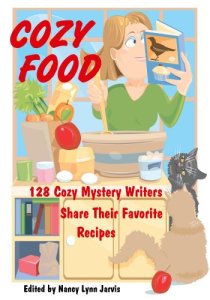 I loved “Cozy Food” edited by Nancy Lynn Jarvis! The cover says it is a compilation of 128 Cozy Mystery Writers’ Favorite Recipes, but it is so much more.
 The Writers in Residence
You must be logged in to post a comment.