Write in the New!

What are YOUR writing plans, ambitions, and hopes for 2026? 

Will you finish that book manuscript or begin a new one?  Will you submit a short story (or two) to a contest?  How about brainstorming a month’s worth of blog posts? Or will you finally write that book review for your favorite author’s new (or almost new) novel?  If you’re really stuck, go to one of those online sites that have hundreds of daily, seasonal, or holiday lists of prompts, and free write for 10 minutes several times throughout the day.

Whatever and whenever, in 2026, get to writing!  (And I’m talking to myself here too!)

Happy New Year!

Finding Time to Write: a “Flashback” Post from 15 years ago. Still True?

by Jacqueline Vick

Some writers snatch a few moments of time wherever they find it. Others adhere to strict schedules. Walter Mosley tells us to write every day. Peter Brett wrote his first novel on his smartphone during his daily travels on the F train. Do you follow a set writing schedule? Write every day? Have a favorite writing spot? Do you put ‘butt to chair’ until you’ve finished a specific word count? Tell us about your writing schedule.

***********

Writers Write by Bonnie Schroeder

I try (emphasis on “try”) to write every day first thing in the morning — okay, I feed the dogs and make coffee first and then retreat to my desk with one dog underfoot and one cat in my lap. On my desk, I have a kitchen timer that I set for one hour. Some days, I actually write for the full hour before the phone rings or the other cat barfs or my stomach starts growling. Some days I have to stop the timer until the aforementioned distractions are dealt with; then I try to finish the hour later on. I don’t always make my goal, but occasionally, I actually exceed it.

For me, the important thing is to try for it every day — weekends included. It keeps the circuits open and the muse engaged. When I worked at a job 50 miles away with a two-plus hour daily commute, there were times when I could only manage 15 minutes a day, so an hour is a huge luxury for me now. But even with those quarter-hour writing sessions, I finished the draft of a novel. It took a few years, but that daily contact with the pages kept them in my mind and kept me plugged into the current. And that, to me, is the secret: write something every day, even if it’s just a paragraph or even a sentence. Then I can legitimately say, “I’m a writer.”

***

Lucky by Jacqueline Vick

I’m extremely lucky. I was able to quit my day job to pursue writing full-time. (Well, writing AND homemaking full time.) That means that every morning when I rise, my day is my own and my schedule is whatever I want. Sounds great, doesn’t it? There are a few downsides.

When I’m working on a novel manuscript, there is no boss handing me deadlines, no client with a specific need to fill. I have to set all of those goals myself…and keep them. Repercussions can be a wonderful motivator; without them, it’s more difficult to stay on course.

My deadlines consist of “finish the first draft by May 1st.” I’m always happy to find a short story contest, because that gives me a specific deadline and specific criteria to meet.

Yesterday, I was talking to my brother, who is a personal coach, and he said that the difficulty most people run into is keeping promises to themselves. They don’t value their own time and their own goals as much as they value other people’s time and goals. I’m starting to get around this by setting more specific goals and deadlines and then pretending that I work for a fabulous author named Jacqueline Vick. She has high expectations, and I don’t want to disappoint her. I imagine her asking me to have the rewrites on chapter one on her desk by Friday. It’s a bit kooky, but it works.

I write every day, including weekends. My butt is in the chair for about 8 hours on weekdays, a few hours here and there on Saturday and Sunday. I write in the only place available to me–the dining room table. It’s a pain to keep cleaning off the table each night, but the thought of my husband reaching around a stack of papers for the pepper mill helps keep me organized.

***

Writing Away by Jackie Houchin

For an organized, everything-in-its-place kind of person, my writing schedule is very haphazard and irregular. I mostly write when a deadline looms, so I’m thankful I have those. I write reviews for magazines and articles for a newspaper and newsletters. If I don’t get my copy in, it doesn’t get printed, and I don’t get paid. Simple as that, and no amount of boo-hoo’ing will fix it. The next issue already looms on the horizon.

If I were to write a book, I fear I would find myself writing franticly for 23 hours every day during the last weeks before the agent/editor/publisher’s scheduled deadline. I admire my fellow Wonder Women, who persistently and faithfully write for months and even years to bring their creations into the world. Their ultimate satisfaction will far outshine my instant bursts of pride.

So which style is best? “Whatever works for you.” Yeah, you’ve heard that before, but it’s true. Whether it’s dedicating specific minutes, hours, and days to craft a novel or franticly writing and rewriting and “ripping the paper out of a typewriter” before rushing it to an editor…it doesn’t matter. If our words, opinions, ideas, and stories are read (sooner or later), well, that’s what counts.

That’s my opinion, and I’m sticking to it. Now, let’s see… when’s my next deadline?

PS: Where do I write? Either at my dinosaur desktop PC in my office until the “backside” can’t stand sitting anymore, or more recently, standing at the breakfast bar in the corner of my kitchen with a 6-foot cat tree behind me (usually occupied by three cats lounging and looking over my shoulder, and trying to foil my thought processes with their diabolical purring and mind games) while I pound away on my laptop.

***

“Finding Time to Write,” from June 2009, was reposted by Jackie Houchin.

Photo by Andrey Grushnikov: 

NEW IDEAS, PAST AND PRESENT

by Miko Johnston

We’re barely two months into the new year, but as I contemplate what we’ll write about in the future, and what will inspire us to keep at it, I’ve found some of my answers to those questions in our posts from the previous year.

Hannah wrote about overthinking. How many of us are guilty of getting obsessive about our writing? Characters, plots and background have to be thought out, but we also must keep it all in balance. That has become harder for me to achieve, partly because age has undermined my ability to multitask and partly because my priorities have shifted. I still enjoy writing and am committed to finishing at least two more books, but I’m reminded of Madeline’s piece on Writing Scared, and the idea of switching up the type of writing you do. I’ve done that in the past, so now I’m adding a new avocation – photography.

Years of writing has given me a sense of what works and what doesn’t, and while I still rely on critiques from fellow writers, I often can figure out problems in my manuscript on my own. Not so with my new hobby. I look at a photo and I may like it, but I don’t know why, exactly, nor can I be certain it’s any good. I’ve joined a photography club and have been invited to participate in their biannual exhibit. I’m going to need a lot of critique and advice before I select which pictures I want to use.

Linda’s piece on attending writers conferences reminded me that many more may be held this year as the risk from the recent pandemic fades from our memory, if not from our lives. Will these events be successful, or will the attendance habit, having been interrupted, be broken? Costs, from registration to travel to hotels and meals, will likely be higher than we remember. I can see where some will be very selective about which they’ll attend while others choose not to register for conferences at all.

Gayle’s piece on The Future of the Written Word really resonated with me. I’m often puzzled, even shocked, by how many words have been usurped and had their meanings altered, some with additions, some with subtractions. Regardless, these 2.0 definitions have led to divisions. A lack of clarification, or precision, makes the word’s meaning, well, meaningless. I suspect if any of the worst offenders of this phenomenon were reading this, they would have stopped at usurped (insert my sarcastic smirk here).

And speaking of the written word, Jill contributed a post on a similar, if lighter, topic – the subtle differences between American and British English. With three Brits in our WinR group and many others within our writing circle, it can be a challenge.

Rosemary’s Collecting Memories touched me. While clearing out closets and shelves in anticipation of a thorough spring cleaning, I’ve uncovered a trove of precious mementos – cards, notes and letters from family and friends, some going back to my birth. Programs from bar/bat mitzvas, funerals, and other events. Menus from private supper clubs, conference galas and corporate dinners at restaurants. Each find brought back wonderful memories of the people and places I’ve enjoyed over the years. That included a copy of the dedication that went into the L.A. Library’s copy of Rosemary’s book, “Hollywood Then and Now”, in memory of her beloved husband Rick. Her post reminded me that these keepsakes – all comprised of words – and the memories they invoke, are precious, something Maggie explained so eloquently in her post based on the “a reason, a season, or a lifetime” quote.

Jackie’s interviews with writers as well as all the fabulous guest posts she’d arranged added dimension to our blog, and her piece on naming characters had many solid tips I’ve come to rely on. And I’ll add a special shout-out for all the technical help she’s provided to us, especially a technical “muggle” like me.

There are many more posts from my co-WinRs that have and continue to inspire me. I can only hope I might have had the same effect on them, as well as our readers.

Miko Johnston, a founding member of The Writers in Residence, is the author of the historical fiction series, “A Petal in the Wind”, as well as a contributor to several anthologies including the about-t0-be-released “Whidbey Island: An Insider’s Guide”. Miko lives in Washington (the big one) with her rocket scientist husband. Contact her at mikojohnstonauthor@gmail.com

The Most Fun Thing About Writing

By Linda O. Johnson

Hey, our blog is still here, and I couldn’t be more delighted. I was pondering what to write about now, and came up with what I hope is a fun topic: my thoughts about the most fun thing about writing.

Do I know yet? No! But I’ve gotten a lot of ideas. And I’ve been writing for a long time.

My thoughts? First, even if I set a story somewhere real, near me, the fun thing about it is figuring out what can be different, and what my protagonist can learn about it—and tell me! For one thing, since most of what I write are mysteries and romantic suspense, people can get hurt or even killed in those environments I find fairly safe in real life. So where’s a good place to murder someone where the mystery can be resolved well and quickly enough in a story? A real place? A fictional place?

Even more important is those characters, especially my protagonists. They’re not me, but they contain some of my characteristics. The character closest to me was in my first mystery series, the Kendra Ballantyne, Pet-Sitter Mysteries. Kendra was a lawyer who lived in the Hollywood Hills with her Cavalier King Charles Spaniel Lexie. At the time I was writing about her, I was a practicing lawyer, and one of my Cavaliers was named Lexie. And yes, I live in the Hollywood Hills.

Other protagonists aren’t quite as close, but still had characteristics I like and admire. The spinoff series from Kendra was the Pet Rescue Mysteries, which of course contained dogs and other animals—and I was volunteering a lot at local rescue organizations when I wrote it. In my Barkery & Biscuits Mysteries, my protagonist owned a bakery for dog treats—and was owned by a dog named Biscuit. In my Superstition Mysteries, my protagonist owned a dog named Pluckie. And currently, in my Alaska Untamed Mysteries under my first pseudonym, Lark O. Jensen, the protagonist, a naturalist, introduces tourists to all sorts of wonderful Alaskan wildlife, including seals and bears and wolves—and yes, she brings her own dog Sasha along on her tour boats.

And in the Harlequin Romantic Suspense stories in the various series I create, yes, dogs are involved. All my stories do contain suspense, whether they’re mysteries or not, and even those I’m asked to write when I can’t always include dogs. And they contain at least a touch of romance, often more.

So… setting is fun. Characters are fun. Killing people vicariously, and not for real, of course,  can be fun. And creating romances can be fun.

Plus, various animals are fun. Dogs are fun.

Hey, for me, maybe the most fun thing about writing involves one of the most fun things in my life: dogs.

So what’s the most fun thing about writing for you?

Photo by Austin Kirk on Unsplash 

A Final Pass

by Miko Johnston

By the time you read this, the manuscript for my fourth A Petal In the Wind novel will be back from the editor and ready for its final draft before publication. Prior to sending it out, I made several passes through it, each time searching for ways to fix or improve the work.

In my first pass I searched for everything from formatting issues to misspelled words. In light of recent events I found parts of the story, which I’d begun writing in 2017, had become dated. I couldn’t gloss over a worldwide pandemic and the social rifts that emerged from political discord. Several new characters who were introduced in chapters written years before the book’s conclusion sounded too generic; I’d gotten to know them better as the story progressed and that needed to be reflected in their earlier dialog and mannerisms.

Other passes looked for repetition, excess verbiage, more precise word choices, missed misspellings, lapses in logic, and incorrect information. With that complete, I sent out my manuscript, anticipating a few more changes would be needed once I heard back from my editor. I took advantage of the wait time to put together all the additional material needed – logline, book blurb and synopsis.

Whenever I have to write marketing stuff, I cringe. It’s not what like to do, or do well. I view it as a necessary evil, and many authors I know feel the same way. However it must be done, and the good news: I’ve found an advantage to it beyond promoting the book.

When you have to encapsulate your x-hundred page novel into a one page summary, then a teaser for the back cover, and finally a one-sentence logline, it forces you to look at your theme in a different way. Gone are the long passages of prose, the snappy dialogue, the transitional scenes and flashbacks. You must have a laser focus on what your story is about – what you’re trying to get across to the reader in terms of theme, character, and plot. By doing so you sometimes will see aspects of the story that are important but may not have been shown in a compelling or complete way. So beyond my editor’s input, I saw that I wasn’t done with my revising.

I came to that conclusion when I encapsulated a 106,500 book into a few paragraphs with just a hint of where the story will eventually wind up. I had my external conflict and internal struggle, and pointed that out in my blurb. Then I wrote my logline:

Amidst the social and political upheaval in the aftermath of WWI, a woman who identifies as an artist marries the love of her life, but chafes at being relegated to wife and mother.

We can understand the difficulties a woman would face in giving up her career to marry and have children, especially at a time when such notions weren’t as accepted as they are today. But had I adequately shown how she feels in the book? Could I have made it not only clearer, but on a much deeper level?

The logline hints at the deeper issue. What she rails against is not being married to the man she loves, or even the challenges of motherhood. It’s losing her identity, having to see herself as only a reflection of her husband and children. When Jane marries John Doe, she becomes Mrs. John Doe. Her baby’s mama. She’d wonder—what happened to Jane?

My character Lala is a woman who’s accomplished a great deal despite her youth. She not survived the trauma and hardships of WWI and kept her family alive, but her home town as well. It’s described as a factory town north of Prague throughout the series. In America we’d call it a company town, where a single business – in this case a furniture factory – provides the economic base of the area.  Circumstances force her to take charge of the factory and oversee its conversion to wartime production. If it had closed, which it nearly did, the town would have been devastated. How can someone like this ignore all she achieved, the skills she developed, the talent that resides within her?

When the manuscript returns from the editor, I will review the comments and make some changes, including a few of my own – adding more layers of my character’s internal dilemma to the story. Then I’ll probably rework my promotional material. A writer’s work is never done…that is, until it goes to the publisher.


Miko Johnston, a founding member of The Writers In Residence, is the author of the historical fiction saga A PETAL IN THE WIND, as well as a contributor to anthologies, including “LAst Exit to Murder” and the soon-to-be-released “Whidbey Landmarks”. The fourth book in her series is scheduled to be published later this year. Miko lives in Washington (the big one) with her rocket scientist husband. Contact her at mikojohnstonauthor@gmail.com


A Life of Unfinished things…


By Rosemary Lord

Many of us get very reflective around this time of year, as we look forward to spending Thanksgiving with friends and loved ones.  I love this American tradition. As a transplanted, naturalized American, over the years, I have spent this annual celebration in so many different places, with many different people. I’ve listened to memories of childhood Thanksgivings, of different family traditions across the nation, handed downfrom great grandparents to sons and daughters and then to their offspring, in due course.

Frankly, I envy these traditions. And I just love the importance of all the special family dishes that are served. The recipes handed down through the generations have their ownstories. And the simple custom, at so many tables, of each person sharing what they are thankful for. It’s a wonderful time when everything else stops for a while, and people from different generations, different religions and all walks of life get together to simply say “Thank you.”

 After such a strange couple of years, I think many of us realize we have a lot to be thankful for. Maybe for things that we previously had taken for granted. Such as walking out in public bare-faced and exchanging smiles with strangers… an impulsive stop by your favorite family-run café – that is still in business. Or simply – hugs with friends.

As writers, we are more easily able to notice these little things that have come to mean so much. And as writers, we are especially fortunate that, whatever external restrictions the dastardly Covid plague inflicted on so many people, for us scribes, we could just keep on writing.

However, so often we get our story ideas from a chance remark in a casual conversation overheard – or eavesdropping (‘ear-wigging’ is the more colorful informal English term.) I would often make up my own version of the end of some snippet I’d heard and that would sometimes turn into a whole story.  

But during these cloistered times, we’ve missed out on overhearing strangers’ conversations.

The Covid situation affected people differently. All around us, some were having meltdowns, dramas, or ‘wobblies’ – as in “She/he’s having a wobblie” – a charming current English phrase. Others found a strength and a fortitude they hadn’t realized they possessed. They found a new purpose, as they stepped into the fray to help the home-bound, the elderly living alone, or the children without an open school to attend. They volunteered wherever they were needed. Many new friendships were created. Everyday heroes emerged, as people found innovative and creative ways to handle the situations we all found ourselves thrust into – and along the way, found ways to improve other people’s lives.

For writers, fascinating tales appeared for our writing brain to feed on. People stories.

These interminable lock-downs have given many people the chance to write that novel they always felt they had in them – but never had the time to pursue. For the uninitiated, they had their first crack at completing that novel. For us old-timers, it was the opportunity to maybe write outside our normal field. (Did I tell you I have a quarter of a noir, dark and creepy contemporary novel done? Who knew I could write that?) And for writers at every level, the burgeoning self-publishing market has been a boon and a blessing.

I have discovered so many new writers from all over the world – especially when I can get the bargain price of a used book, I don’t feel so guilty if I don’t like it. Plus, I have a whole slew of new books to read on my Kindle.

I must confess that my own, personal reading, at the end of a long day wrestling with Woman’s Club administrative ‘stuff’ is more and more escapist. Often tales of a newly widowed or newly divorced woman who decides to start a new life on the other side of the world and open a bakery or her own winery.  I’m re-reading my Rosamunde Pilcher favorites and re-discovering what a good, simple, nuanced writer she was. Her books are inspiring – usually about starting again, uncovering deep family secrets that lead to wonderful, happy endings. I like a happy ending. Especially these days. 

I think I have a life of unfinished things….  That’s what it seems like to me at the moment. Some painting and fixing things around my apartment. Some sewing bits and pieces. But mostly unfinished novels and stories, which is a good thing, because I have started some new writing projects and my busy mind keeps thinking of more. Not so good because I haven’t had time to complete them. And the characters in my stories are still whispering, nay yelling, in my head to share them with the world…

But I’m thankful for every moment when I am able to write – and plan that “next year it will be different. Promise!” Hmm, I think I’ve said that a time or two before. But I really, really mean it this time!

………………………………………………

Not Quite Cozy

by Jackie Houchin

(I’m early this month with my post, because I switched with the “other” Jackie – Jackie Vick  – who will be posting on Self Publishing on August 18th.)

I’ve recently read two books which are billed as “cozies” but have none of the more modern sewing, crafting, cooking, library/bookstore, tea shoppe/coffee house, or pet themes that we’ve grown accustomed to. (There’s nothing wrong with these if they are what you like to read!)

No, these were the “old fashioned” style mysteries, that are super-plotted, character-strong mysteries like Agatha Christie wrote. Clean, as far as no on-the-page sex, vulgarity, profanity, or excessive violence. Just good, captivating, complicated mysteries, sometimes in unique settings. 

Here are reviews of the two  books I read.

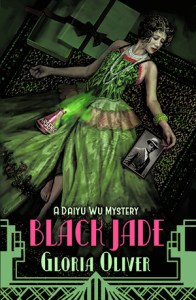
BLACK JADE, a Daiyu Wu Mystery by Gloria Oliver

What a fascinating book! It’s very different from the usual historical cozy mysteries out today. It has a main character who is unique and amazing in her disability, living in a disguised house with her once royal parents and a pair of staff who love and protect on her.
Black Jade, A Daiyu Wu Mystery by Gloria Oliver, is set in Texas in the early 1900’s, when the race issue is prominent against Asians, specifically Chinese, who are considered to be the “Yellow Menace.” Even more of a bias however in this story, is the rich vs commoner distinction. So when the second son of a British Earl comes to America and falls for a ‘common’ girl who is a waitress in a speakeasy, his hoity-toity relatives across the Pond rush to the first ship heading west to try and stop him marrying her. The means they use is macabra and horrific, but only the blind, Chinese Miss Wu, working in her family’s laundry is able to discover it.

The rest of the book takes us on a detailed and fascinating investigation to find and identify, first the victim, then the villain. (My guesses hopped from one to another of the book’s characters: all in vain.) But Miss Wu, accompanied by Jacques, her handsome companion and chauffeur (who also narrates the story), along with her new friends, a female forensic doctor and a millionaire playboy, moves along as surely as a bloodhound following an invisible scent (burnt garlic?) to the killer. She meets obstacles at every turn, but this gal is persistant and clever, and inspires those around her to not give up no matter what. The climax scene is a nail biter!  FIVE STARS

PS: I totally loved Miss Wu’s little dog, who goes everywhere with her. He has a strange name – Prince Razor. When you read this book, you’ll find out why.


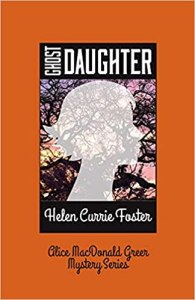
GHOST DAUGHTER, An Alice MacDonald Greer mystery by Helen Currie Foster 

This is an amazing, sometimes jaw-dropping, mystery-adventure in which the heroine, Texas lawyer Alice Greer, risks life and limb to fulfill the last wishes of her friend Ellie. In Ghost Daughter, the newly widowed Ellie has discovered her long-lost daughter, conceived at age 17 and given up for adoption decades earlier. She wants to include her somehow in her estate and asks Alice to be executor if/when she dies.

Sooner than either expected, Alice finds her friend’s bloodied body in her own ranch house, along with a rearing, kicking, squealing horse! Yes, IN her house. LOCKED in. Huh? Instantly my mind tried to come up with suitable scenarios, but failed. There was nothing to do, but keep turning the pages.

And that was just the beginning of this fast-paced story with multiple complications and misdirections.

And what was so special in Ellie’s Santa Fe vacation house that could elicit murder? Alice tries to find out, but meets with “baddies” at each attempt. There are car chases through the mountains, unexplained  assination attempts, theivery of extremely valuable art right under Alice’s nose. And, if that isn’t enough, Ellie’s warring sons threaten to drive her up the wall with their arguing about who gets what. And the police can’t find the murder weapon or any evidence at all pointing to a suspect. 

There are no giveaways in the plot. To the literal last pages I couldn’t guess how, why, and by whom the murder of Alice’s friend was done. Thankfully the author ties everything together in a grand scene at the end.  FIVE STARS

I enjoyed Ghost Daughter so much, that I purchased Ghost Cave, the first of Greer’s six  books in the series!

Oh, and by the way, there is nothing “paranormal” in her Ghost books.  

#

I hope that in the future more of these new/old style cozy mystery books will be published. Books that challenge the reader to get out of her rocking chair and trudge the mean streets with the protagonist. 

PS: I just noticed that both of these books were set in Texas. 


Busy Then and Now 

By Linda O. Johnston

I’m busy.  I’m always busy. But busy before the pandemic began is a lot different from busy now.

Is that true for you, too?

 I’ve been writing forever, and I’m fortunate to be traditionally published a lot. That means I generally have faced a lot of upcoming deadlines. That hasn’t changed, although at the moment there seem to be more than usual.

But my busy-ness before was enhanced a lot by get-togethers with other writers at meetings of local chapters of Romance Writers of America, Sisters in Crime and Mystery Writers of America, and sometimes more.  Then there were all the conferences I attended, which often included the Romance Writers of America National Conference, held annually in different locations. Then there were Malice Domestic, Left Coast Crime, Mystery Writers of America, and other mystery-related conferences. I attended at least one a year.  And in addition, there were annual conferences locally, such as the California Crime Writers Conference.

And now?  Well, some get-togethers are available virtually. I’ve attended some chapter meetings that way, but not annual conferences.  I know Malice Domestic will be virtual this year and I keep receiving emails about it—but so far I haven’t decided to go.

That’s all certainly different from before.  But things seem to be improving now, as far as the ability of people to meet in person, though in smaller groups, and the necessity of being vaccinated, and wearing masks, although that seems to be changing at least to some extent and in some locations.

So will I go back to the old ways as things open up again?  I don’t know yet. Tempting, yes, but I want to feel more secure that I won’t get sick or bring the virus home to others. And maybe I’m getting into bad, more solitary habits this way.

I’ve been delighted, though, to meet some of my fellow Writers in Residence for our usual—formerly—monthly lunch recently!

And you? Do you attend conferences now, virtually or in person? Writing events? Reading events?

Image by TaniaRose from Pixabay

Mining Your Own Business

by Miko Johnston

That’s not a typo, it’s a play on words, inspired by a stream of advice I’ve gotten from many writing experts on a touchy subject. We’re told, write what you know. Does that include exploiting who we know?

MINING. Miriam pexels-keira-burton-6147138

How far are you willing to go to write a tantalizing mystery, an emotionally powerful drama, or a deeply moving character study? Would you base it on an actual incident or situation in someone’s life and its effect on them? I’m not talking about libel, but morality.

A piece in your news source of choice might inspire you to write a “ripped from the headlines” novel. Legitimate public information is fair play for adaptation, such as a criminal case or someone’s media appeal to raise attention to an issue. For example, some couples have had children in hopes of providing bone marrow or other vital tissue to save a stricken older child. In addition to non-fictional accounts and memoirs written by family members, many authors, including Jodi Picoult, opted that storyline for novels. Dramatic, yes. Is it exploitive?

What if something noteworthy happened in your own life? You might write a memoir detailing the experience and how it changed you. Or you could draw on the event to fashion a scene, and more importantly, for the emotions it evoked, whether it’s the pain of loss, the thrill of first love, the shock of violence or post-traumatic stress inflicted by a drastic incident. When I write about grieving or passion, feeling afraid or distraught, it comes from my own experience, but I do so voluntarily.

We base our characters, at least in part, on people we’ve known. We imbue them with that person’s physical characteristics or personality traits. Say you’ve given your sleuth, a Vietnam vet, the same war wound as your brother, and his nemesis flashes the pasty-faced smirk of your loathsome ex-boss. Those qualities illustrate the characters, but don’t define them.

Great writers incorporate their lives into their stories. They tend to base some characters on family members and people closest to them, portraits which are often unflattering and unkind.  Writers also mine tales from family and friends for source material. My own series of historical fiction novels began with a rumor about my grandmother. Stories about transformation, triumph over tragedy, and overcoming loss are rich with potential. As an example, a brilliant, successful woman marries a man who never divorced his first wife – and his family knows that when he walks down the aisle – makes a great storyline. What if she was your best friend? Or if a couple in your family, grappling with an intellectually disabled son who’s growing stronger and more aggressive, are agonizing over whether to institutionalize him?

In Betsy Lerner‘s excellent book, “A Forest For The Trees”, she urges writers to use whatever they can in their own lives to enrich their story, including incidents in the lives of the people closest to them. “If you are going to be honest and write about all the untidy emotions, the hideous envy, and disturbing fantasies that make us human, how can you not offend your loved ones, your neighbors and community?” A New York Times piece by James Parker, contributing editor at The Atlantic, endorses the practice of “invading” other people’s lives, but only if you can elevate it above exploitation; the purpose must be empathy.

For me the issue goes deeper than adapting an external experience. We can take plotlines from personal sources and show how one might feel in that situation, but what about someone far removed from ourselves? Each day I’m exposed to people whose experiences, based on their race, religion, ethnicity or sexuality, shape their world view, which differs vastly from mine. Are there places within a person that are too intimate to go, too unreachable to know?

MINING. miriam pexels-anna-shvets-5325091

In 1990 I worked on a conference sponsored by an organization of scientists who explore the repercussions of technological advancement. They chose as their conference  theme: Can We Do It? How Do We Do It? Ought We Do It? As a writer, I ask myself the same questions in understanding the social implications of storytelling, crafting diverse, authentic characters and emotionally compelling plots. Characters and plots that ring true to those outside the world I create as well as to those within.

A fiction writer’s goal is to produce a logical and believable manuscript, populated with characters, many who’ll be familiar to us and a few who thankfully bear no resemblance to anyone we know. We can borrow from their histories or instead, as Parker says, “invade” other people’s lives; strive for realistic portrayals or take Lerner’s advice to “be honest” enough to “offend”. That leaves me wondering: Is it proper to take the experiences of those we know best for the sake of a good plot?  Is it possible to mine the depths of emotions, or the most intimate thoughts, of someone so dissimilar from us?

Can we? How? Ought we?

###

Miko Johnston, a founding member of The Writers in Residence, is the author of three novels in the  A Petal In The Wind  saga, as well as a contributor to anthologies including  LAst Exit to Murder. She is currently pages from competing her fourth novel in the series. Miko lives on Whidbey Island in Washington (the big one) with her rocket scientist husband, who graciously helped her revise this post. Contact her at mikojohnstonauthor@gmail.com

Photo by Keira Burton from Pexels  

Photo by Anna Shvets from Pexels

BACK TO BASICS: Writers’ Boot Camp Part III

 by Miko Johnston

Last year I began the BACK TO BASICS series with BEGINNINGS and then presented MIDDLES, so as this is my first post of 2021, I’m beginning by ending the series with ENDINGS.

*

Congratulations. You’ve grabbed the reader’s attention with your opening and kept them rapt through your middle chapters. Don’t spoil things now with a disappointing or frustrating finale – the pages that comprise the lead-up to the climax through the final sentence. 

An off-putting beginning may discourage a reader, and when asked she’ll say, “I couldn’t get into it, but you might like it”. A problematic middle will dampen her interest, but she’ll likely continue, hoping for redemption. However, a bad ending will exasperate her. She’ll fume over wasting her money buying the book and wasting her time reading through to the end, and she’ll badmouth the book to everyone she’s ever met.

Am I right?

Once you’ve convinced a reader to buy your book, you don’t want to ruin all the time they’ll invest in reading it with an ending that falls flat, doesn’t make sense, or comes out of nowhere.  

A good ending must appeal to our emotions as well as our logic; move us, make us think, but also make sense. The best ending, simply put, satisfies the reader. This is not synonymous with a happy ending, which too often can be trite. It means the story finishes in a way the reader feels is plausible, based on what happened throughout the pages. She may be pleasantly surprised it didn’t turn out as expected, but as it ought to have concluded. Or she may be left wanting the story to go further and view the end as merely a good stopping point, which it should if you’re writing a series. Genres often dictate the type of ending needed – the detective solves the murder, the cop catches the criminal, the lovers beat all odds and wind up together. 

To conclude your novel successfully, first consider what doesn’t make a good ending:

1 – A lack of any closure. The point of the story must be resolved. You don’t have to spell everything out, but too many story threads left hanging will frustrate the reader. 

2 – Too ambiguous. You can leave some details to the reader’s imagination, but not the entire plot.

3 – Too neat. The opposite problem; tying up too much or having everything work out perfectly defies credulity.

4 – Too rushed. You want to build tension as you approach your final pages. A fast pace can produce excitement, but slow it down enough to generate that tension.

5 – Too drawn out. If you slow the pace too much you won’t generate tension and worse, you’ll lose the reader’s attention.

6 – Too contrived. Also known as deux ex machina or “the Martians landed”, this ending comes out of thin air with no foreshadowing in the story.

7 – Too predictable. Even if we know how the story will probably end, we still want something satisfying before we close the book.

8 – No ending. The story just stops.

If you’re wondering what satisfies readers you have only to look at book review sites like Amazon and Goodreads, which offer (usually) genuine critique. Your own experience as a reader will inform you as well. Classic endings include:

1 – Resolved: Effective in stand-alone stories where the protagonist has a goal and achieves it. The detective solves the murder. The lovers reunite. The operation is successful. This works best if it involves some plot twist, surprise or emotional satisfaction.

2 – Unresolved: Commonly used in literary fiction, where the point is to give the reader something to consider, or evoke an emotion. It’s often seen in series, where some plot elements are left for the next book, but trickier to pull off in a stand-alone. There’s a fine line between unresolved and ambiguous, so even when done well, many readers don’t find this type of conclusion satisfying.

3 – Open-ended: This is an implied ending, which like the unresolved ending, can frustrate readers who want to know, not contemplate, what happens. It differs from the unresolved ending in that the reader gets a sense of how the story turns out through foreshadowing in earlier chapters, or it might leave the plot open to interpretation, but complete the protagonist’s arc.

4 – The twist: Also known as a surprise ending. It differs from the contrived ending because it’s been adequately set up throughout the plot by lacing the story with subtle clues. Twist endings delight readers of mysteries, but it also works in other genres.

5 – Book-ended: I mentioned this in Part I of Writer’s Boot Camp. If you begin your story with the lead-up to the climax, complete the circle by returning to that moment at the end. Or, instead of pairing an action, create a symbolic book-end by repeating the theme of your opening, very effective in stories about never-ending battles like fighting crime, spies or terrorists.

6 – Statement or summation: This can complement or a contrast a statement or explanation beginning, and like it, tends to be cerebral. A successful version will be metaphorical rather than concrete, leaving the reader with something to think about, or picturing what happened and imagining what will happen next.

*******

The one element all good ending have in common is that they’re successful only when properly set up throughout the pages.

Still struggling? If your finale lacks closure or is muddled, it might be because you didn’t resolve enough story threads. Fix that with addition and subtraction – add enough details to flesh out critical plot point and edit out non-critical bits like multiple red herrings and extraneous characters or storylines.

If the pacing is off, decide whether you’ve rushed or dragged out the climax. If it’s the former, intensify the ending by delaying the payoff enough to create tension. Emotional reactions, thoughts, reasoning out, or physical actions like running, arguing or physically fighting can slow down a rushed pace with added conflict. Trimming might be enough to fix a plodding climax. Shortening sentences to an almost staccato rhythm speeds up the pace as well.

Does your protagonist feature prominently in the resolution of the story? There’s a reason a common synonym for protagonist is hero – we want our characters to be pro-active in bringing about the conclusion of the story. Make them active participants in their quest and its success or failure.

If pacing and character aren’t the problem, then consider the tone. Have you maintained continuity throughout? Can you justify your protagonist’s arc? I’ve read books that changed genres or mood along the way. In some cases the end bears little resemblance to the beginning. Find the scene where you lost your way and let it guide you to what and how much needs revising.

What if you don’t know the ending, or aren’t sure of how to bring it about?

I introduced the idea of writing different beginnings in Part I. It also works in reverse. If you’re unsure of how the story should end, consider the different possibilities and write out a few. See which works best with what you have. For example, if you can’t think of a good twist ending to your mystery, attempt a book-ended or a resolved ending. It may yield an idea for your story’s climax. Or, if you can’t decide between several endings, consider making it open-ended by inserting clues from the potential conclusions into the plot. Then the reader can decide for herself.

If you can’t seem to get to the ending you’ve planned, try the bridge technique outlined in Part II.  Link up the ending with the last chapters you’ve completed by working backwards for a while, then move the story forward to that point.

I hope the techniques I’ve outlined in this series have been helpful. Perhaps you have other methods you employ to open, continue or close your stories. We’d love to hear them.

MIRIAMs blog. kyle-glenn-_AR74EoWdy0-unsplash

Photo by Kyle Glenn on Unsplash

Miko Johnston, a founding member of The Writers In Residence, is the author of three novels in the historical saga A Petal In The Wind, as well as several short stories in anthologies including LAst Exit to Murder. She is currently completing the fourth book in the Petal series. Miko lives on Whidbey Island in Washington (the big one). Contact her at mikojohnstonauthor@gmail.com