A Woman in Journalism – Nellie Bly

by Jackie Houchin

(Note to self: Use this article as a base – review two books written about her – “Ten Days In A Madhouse” and “Nellie Bly & Investigative Journalism for Kids.”  Fill in info from other sources, use the three photos (her in 1890 and the book jackets.) )

Eighteen-year-old Elizabeth Cochrane was living in Pittsburgh when the local newspaper published an article titled “What Girls are Good For” (having babies and keeping house was the answer, according to the article). The article displeased Elizabeth enough that she wrote an anonymous rebuttal, which in turned so impressed the paper’s editor that he ran an ad, asking the writer to identify herself.
When Elizabeth contacted him, he hired her on the spot. It was customary at the time for female reporters to use pen names, so the editor gave her one that he took from a Stephen Foster song. It was the name under which she would become famous—Nellie Bly.
Bly’s passion was investigative reporting, but the paper usually assigned her to more “feminine” subjects—such as theater and fashion. After penning a controversial series of articles uncovering the working conditions of female factory workers, and subsequently being assigned once more to cover society events and women’s pastimes, at the age of 21, Bly embarked on a hazardous and unprecedented (for a woman) mission to Mexico to report on the living conditions of the working-class individuals there.
After her reporting got her in trouble with the local authorities, she fled the country and later published her dispatches into a popular book.
At age 23, having established a reputation as a daring and provocative reporter, Bly was hired by Joseph Pulitzer’s New York World and there she began the undercover project that made her famous. In order to investigate the conditions inside New York’s “Women’s Lunatic Asylum,” Bly took on a fake identity, checked into a women’s boarding house, and faked insanity—so convincingly that she soon found herself committed to the asylum.
The report she published of her ten days there was a sensation and led to important reforms in the treatment of the mentally ill.
The following year Bly undertook her most sensational assignment yet: a solo trip around the world inspired by Jules Verne’s Around the World in 80 Days. With only two days’ notice, Bly set out on November 14, 1889, carrying a travel bag with her toiletries and a change of underwear, and her purse tied around her neck.
Pulitzer’s competitor, the New York Cosmopolitan, immediately sent out one of its reporters—Elizabeth Bisland—to race Bly, traveling in the opposite direction. As Pulitzer had hoped, the stunt was a publicity bonanza, as readers eagerly followed news on Bly’s journey and the paper sponsoring a contest for readers to guess the exact time of Bly’s return (with the correct guess winning an expense-paid trip to Europe).
Seventy-two days later, Bly made her triumphant return (four and half days ahead of Bisland), having circumnavigated the globe, traveling alone almost the entire time. It was the fastest any human had ever made the journey. Nellie Bly was an international celebrity.
At age 31 Bly married industrialist Robert Seaman, a 73-year-old millionaire, leaving behind her journalism career and her pen name. As Elizabeth Cochrane Seaman she helped run the family business. She patented two inventions during her time as an industrialist, but business was not her really in her skillset and under her leadership the company went bankrupt.
When World War I broke out, she returned to journalism, becoming one of the first women reporters to work in an active war zone.
Nellie Bly’s remarkable life ended on January 27, 1922,  when she died of pneumonia in New York at age 57.

5 Famous Quotes About MOTHERS that Should Inspire Writers

Used by permission from The Write Conversation, May 1, 2023

By Kristen Hogrefe Parnell @khogrefeparnell

May brings more than rain showers and spring flowers. It brings the reminder to celebrate and thank our mothers. Beyond a day of gratitude, Mother’s Day should challenge us to sit at the feet of the wonderful women who have taught us so much—and still have so much to teach us.
As writers, we have much to learn from our mothers.
Five Famous Quotes about Mothers that Speak to Writing Pursuits
#1: Dare all things.
Agatha Christie wrote, “A mother’s love for her child is like nothing else in the world. It knows no law, no pity. It dares all things and crushes down remorselessly all that stands in its path.”
Dares all things.
We writers can be easily intimidated or even embarrassed that our gift isn’t good enough compared to someone else’s.
Hogwash, say our mothers. Although I realize some of you reading this post did not experience the unrelenting love most mothers have for their children—and I am truly sorry for that—as a rule, our mothers would do and dare anything for us. As a mom to a now nine-month-old, I can relate to this mama bear grit that loves fiercely and defends loyally.
Let that drive and daring inspire your writing.
#2: Give something worthwhile.
I love this sweet quote by George Washington: “My mother was the most beautiful woman I ever saw. All I am I owe to my mother. I attribute my success in life to the moral, intellectual and physical education I received from her.”
What have our mothers given us? More than words can record, that is for sure.
The challenge for us writers is to give generously and purposefully as well. What will leave behind for those who read our words? Will we inspire someone else in their “moral, intellectual, and physical” endeavors?
#3: Believe the best.
This quote by Roald Dahl made me laugh, but it is oh so true. “It’s a funny thing about mothers… Even when their own child is the most disgusting little blister you could ever imagine, they still think that he or she is wonderful.”
Did my baby just have the biggest blowout? Toss his spoon of sweet potatoes on the floor? Drool all over my Sunday outfit? Yep. Yep. Yep. Is he still the most darling baby ever? Absolutely.
Should not we writers learn to view that grimace-worthy first draft with similar faith? That even in the mess, we can find something wonderful? Let’s believe the best about the projects God has given us, even though we should also be willing to make them better.
#4: Be the truest friend.
Washington Irving wrote, “A mother is the truest friend we have, when trials heavy and sudden, fall upon us; when adversity takes the place of prosperity; when friends who rejoice with us in our sunshine desert us; when trouble thickens around us, still will she cling to us, and endeavor by her kind precepts and counsels to dissipate the clouds of darkness, and cause peace to return to our hearts.”
Not only should we writers be true to ourselves and our calling, but we must also be true to our fellow writers on this journey with us. No one understands the creative life’s highs and lows, triumphs and blows like another writer does.
Celebrate your sister or brother who receives the award and recognition, even if you haven’t received yours yet. Also, be willing to encourage the fellow writer who has received yet another rejection letter or feels tempted to quit.
Be the truest friend.
#5: Dwell in hope.
“Youth fades; love droops; the leaves of friendship fall; A mother’s secret hope outlives them all.” So said Oliver Wendell Holmes, Sr.
A mother’s hope, faith, and prayers have reinvigorated us when we would otherwise quit.
I don’t know how many poorly written stories or rough drafts my mother (and father) read for me when I started writing stories as a pre-teen. They could easily have rolled their eyes at my weak attempts. Instead, they gave me the hope to keep writing, pointed out the good that others might have overlooked, and challenged me to keep writing even when I didn’t know where the journey might lead me.
Even now, I can call my mom and share about my latest writing highs and lows, and I know she will never tell me to quit. She will encourage me to keep hoping and trusting God for the right opportunities. And for that, I am very thankful.
How will you thank your mother this Mother’s Day? What lesson has she taught you that has made you a better writer?

Kristen Hogrefe Parnell writes suspenseful fiction from a faith perspective for women and young adults. Her own suspense story involved waiting on God into her thirties to meet her husband, and she desires to keep embracing God’s plan for her life when it’s not what she expects. Kristen’s books have won the Selah Award and the Grace Award, among others, and her inspirational romantic suspense novel, Take My Hand, is now available. An educator at heart, she also teaches English online, enjoys being a podcast guest, and blogs about biblical encouragement for mamas. Kristen lives in the Tampa, Florida area with her husband and baby boy. Connect with her at KristenHogrefeParnell.com.

Slipped my mind…

Oh, no!  I was so involved with my SELF this week, that I forgot my coveted place here in the rotation for The Writers in Residence. So, this is a quickie catch-up.

HOAG Cancer Center is where I’m now spending my days – like, EVERY day – after the breast cancer surgery I had back in March.  Now I’m going through 15 days of preventative Radiation, so (hopefully) that nasty cancer stuff doesn’t come back. (At least the chances are lessened.)

Meet ELEKTA.

She’s my partner for about 15 minutes every day. She circles me like a rising and setting sun four times, shooting the “anti” death ray at my left chest area. I hear a high-pitched “zinging” noise and feel a slight warmth, but nothing else.  I thought my skin would get “cooked,” but nothing yet, just a feeling of tightness.  I thought I would experience fatigue, but also not yet. (Of course, so many people are praying for me!!)

A woman who was scheduled after me yesterday, says she is on Day 12, and the fatigue has hit her.  My Radiologist talked to me today, and when I told him I was surprised at the lack of skin burning, he said. “The sunburn will come in week three. Just keep applying that radiation cream two to three times each day.”

Believe me, I do.

That funny crunched white glob under ELEKTA’s eye on the table is a molded pillow they made when I was “mapped” for radiation two weeks ago.  It holds my shoulders, head, and left arm stretched above and over my head in the exact same position. So there’s no messing around each time I come in. The molded pillow is situated. I lay back and fit my arm and shoulders in it. They expose my left breast, line up the machine over the markers on my chest, and tell me, “Don’t move.” (Yes, I have weird PLUS and MINUS signs semi-permanently pasted on me for ELEKTA to read.)

About now, you are thinking, “Wait, I thought this was a writing blog. What’s with all this medical stuff.”  Hey, have you ever heard of Robin Cook’s books? (Coma, Toxin, Fatal Cure),  Michael Palmer (Miracle Cure), Tess Gerritsen (The Surgeon), etc.  Yes, so I know I’m not an author like them, but I AM writing about my Cancer Journey, and reviewing books that pertain to it.  I’m writing my “Journey” on Substack, and on Friday, I’ll post the next weekly update, titled “RADIATION & ME.” (You guys get a mini-sneak peek here.)

If you want to read last week’s post, here is the link, VULNERABLE  & EXPOSED. 

If that doesn’t work for you, go on Substack and search for “Jackie’s Musings & Meanderings.”  I have about thirty I’ve been writing, but the last seven are on my cancer journey. You can subscribe (but no pressure), and it’s FREE. Don’t get tricked into paying. Not needed.

So, you see, I AM writing.  Each day, I quiz the technicians on something I want to know about so I can include it in next week’s Substack post.  (And maybe the following week too, as I finish up.)

Do you have any questions or comments? If you click on the title of this post—SLIPPED MY MIND—you can find the spot below to do that.

Why You Need To Start Journaling in 2024

After nearly 20 years of journaling, I realized that everyone should be doing this one thing
 
(First published in Readers Hope. Reposted by permission.)   4 min read


I have been journaling for years.

There is a box in my office full of journals I have had since 2004. That’s right, nearly 20 years of journals. They have my ideas and worries and capture the events that have gone on in my life over the years.

And I am not done yet.

I have found there to be an immense power in journaling. It has helped me find clarity and emotional stability and even solve problems. Most of all, it is like having a space to remove what bothers me and listen for what is good.

“Journaling is like whispering to one’s self and listening at the same time.”
– Mina Murray in Bram Stoker’s 
Dracula

In a world where technology is taking over and life is becoming more fast-paced, journaling remains a timeless and effective tool for self-improvement.

Whether kept in a handwritten notebook, a digital file, or even a specialized app, journaling gives people a distinct place to think, process, and learn essential life lessons.

This article examines the many advantages journaling offers to one’s mental, emotional, and even physical health and its transformational potential.

A Personal Journey

“Journal writing, when it becomes a ritual for transformation, is not only life-changing but life-expanding.” — Jen Williamson

Journaling is fundamentally a very personal process. It offers a secure space where people can freely share their ideas, emotions, and experiences without fear of rejection.

People can externalize their innermost ideas and make sense of complex emotions and life’s threads when they put pen to paper or fingers to keys.

Action Step: Set aside three to five minutes daily to journal. Let your thoughts run freely onto the pages while you write, free from self-censorship or criticism.

Emotional Release and Stress Reduction

“Journaling is like a whisper to the soul, an emotional release that heals and rejuvenates.” — Mari L. McCarthy, Heal Yourself with Journaling Power

The capacity of journaling to act as a channel for releasing emotions is among its most obvious advantages.

Writing about difficult situations, annoyances, or fears can be therapeutic and an excellent way to release bottled-up feelings. Research has indicated that this procedure can lower stress levels, elevate mood, and enhance general well-being.

Action Step: Set aside a specific area in your journal for writing about your feelings. Use this area to release tension or emotional weight, permitting oneself to let go.

Clarity and Problem Solving

“Journaling is the first step to self-discovery, and self-discovery is the key to clarity.” — Darryn Kirschner

Moreover, journaling is an effective method for problem-solving and clarity. Writing helps people arrange their ideas and consider other viewpoints when faced with tough choices or uncertainties.

Solutions frequently become more evident during this process, and people feel more empowered as they understand they can overcome obstacles.

Action StepSpend some time outlining the benefits and drawbacks of any difficult decision you are faced with. Keep a notebook to record your observations and brainstorm ideas from many perspectives.

Tracking Personal Growth

“Your journal is like a compass; it may not point north, but it will guide you to where you need to go.” — Jessica de la Davies

Maintaining a journal offers concrete documentation of one’s evolving personal development. Reviewing previous postings, people can recognize trends, reoccurring themes, and accomplishments.

This backward-looking viewpoint emphasizes the importance of continuous self-improvement by fostering a sense of continuity and development.

Action Step: Designate a particular day of the month to review your journal entries. Make a note of your progress, pinpoint your areas for growth, and decide on new objectives for the next month.

Enhanced Creativity and Self-Expression

“Journaling opens the door to your creative mind, inviting it to dance on the pages of your soul.” — Alexandra Elle

Beyond its therapeutic advantages, journaling can foster self-expression and creativity. People can freely explore ideas, express dreams, and develop a closer relationship with their inner selves by writing in journals.

Journaling’s unrestricted format fosters an abundance of creativity that can be utilized for creative projects, problem-solving, or self-exploration.

Action Step: Set aside time in your journal for artistic expression. Compose poetry, sketch, or experiment with any creative medium that speaks to you.

Final Thoughts on Journaling

Amidst the hectic pace of contemporary life, journaling remains a potent and easily attainable method for personal development.

Journaling opens people’s potential and provides a route to self-discovery, emotional release, and improved well-being through its therapeutic, contemplative, and artistic aspects.

The straightforward practice of writing continues to be a timeless companion as we traverse the complexity of our lives, leading us toward self-awareness and transformation.

###

The above article was posted by Jackie Houchin.

Let Me Entertain You!

by Jackie Houchin

Lots of medical stuff going on with me right now, so I thought I’d simply share a fun aspect of our Alaska cruise last fall. That aspect is called MUSH.  No, not yelling at sled-pulling dogs (although we DID do that), but a different kind of Mush.

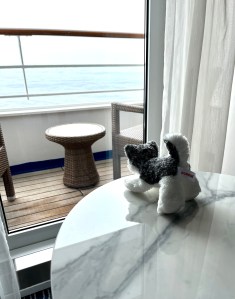
In Skagway, Alaska, I bought a small toy Husky, a beanie-bag size and shape little guy, with soft gray/white fur, big blue eyes, and the name MUSH printed on the tag. I loved the little guy from the first glimpse and perched him on my pillow in the stateroom when we got back to the ship. Joel, our cabin steward aboard the Oceania Regatta ship, loved Mush too.

When we left for dinner in the evenings the steward would come in to straighten up and turn down our beds. When we returned later, we found the usual chocolate candy on our pillows, AND…..Mush, posed in a series of so cute antics. The first time, he was propped on a pillow with the TV remote, watching a football game on the screen.

Another time he was standing on an open book (that I’d been reading), as if he were reading too.

Once when we came back from an excursion ashore and after we’d had lunch at the buffet, we found him on our small room table with the curtains draw slightly, looking out at sea.

And then, every evening HE started getting chocolate candy too, an additional piece placed between his paws. We were absolutely delighted.

Of course “I” started posing Mush for Joel too when we went out for the day, hiding him where the pitcher of ice water was kept, or behind the desk alarm clock, or sometimes just lying on the bed, his head tucked in and front feet up, waiting for a belly rub.

We had such fun with Mush and our very good and so kind cabin steward.  Another sweet memory.  And now, Mush resides on my dresser at night, guarding my glasses, and sometimes on my pillow during the daytime.  (But he’s on a diet now – no chocolate.)

##

Maybe I could write a cute kid’s story starring Mush on an ocean cruise. He could meet friends, find a missing object, solve a mystery, or rescue someone in danger.  Now that’s an idea!! Mush and I might have to put our heads together and come up with a plan!

Wishing You All a Wonderful Holiday Season!

CHRISTMAS CANDLE
a Poem by Kay Hoffman
.
Light a Christmas candle
And let it warmly glow
From out a friendly window
Across new-fallen snow.
Someone lone in passing
Will catch the strong bright beam
To cheer the rugged path ahead
And set the heart to dream.
Let the warm glad light shine
From your own candle’s ray
Glow deep within your loving heart
On each and every day.
Light a Christmas candle
To glow within your heart
And touch the life of someone dear
With blessings to impart.
.
Thank you for reading The Writers In Residence in 2023.
We will be back with new content on Wednesday, January 3, 2024.
.
Jackie
Gayle
Linda
Miko
Madeline
Jill
Hannah
Maggie
Rosemary
#
.

When A Series SPINS OFF: the Maisie Frobisher Mysteries

A Guest Post by Liz Hedgecock

I didn’t so much decide to write the Maisie Frobisher books. It was more that Maisie Frobisher decided she ought to have her own series!

Let me explain.

The Maisie Frobisher books are actually a spinoff series: the series they sprang from is the Caster and Fleet Mysteries. I co-wrote Caster and Fleet with another writer who is now a good friend, Paula Harmon.

When we began writing the books, Paula and I hadn’t actually met in real life – only via a Facebook writing group. We were already online friends, we liked each other’s writing styles, and we both wrote historical mystery (among other things). We’re not sure who first suggested writing a book together, but we’re very glad they did!

Maisie is a very minor character in the Caster and Fleet world until she has more of a starring role in book 4, The Case of the Masquerade Mob, which is a romp involving masked balls and all sorts of skulduggery. At the end of the book, poor Maisie, who has had rather a rough time, decides to travel the world and forget about men for a while. That was my jumping-off point, because I’d grown to like Maisie very much and I didn’t want to let her go.

My friend Paula also has a spinoff series of her own, set in the run-up to World War I, which follows the younger sister of one of our protagonists, Margaret Demeray.

I had many reasons to set the Maisie series abroad. Firstly, at the end of Masquerade Mob Maisie was going travelling, and I couldn’t go back on that! Secondly, in the 1890s, when the series is set, the world was opening up. Bigger and more luxurious cruise ships, faster journeys, and more capacity to travel for pleasure. I chose India because it was a well-known destination, the route was interesting, and also because of the opportunity to look at the British in India in the time of the Raj.

I try not to get too bogged down in historical research, though there are all sorts of opportunities to get lost down research rabbit holes! One advantage is that I have a Master’s degree in Victorian literature, so I’m fairly well grounded in some aspects. While I want to make the stories accurate, I don’t want to spoil a story for the sake of including every historical fact I’ve discovered. Probably a tenth of the things I’ve read about make it into the final book.

I didn’t choose the late Victorian period just because I knew a bit about it, though. It’s also fascinating because of what was going on at the time. Women were fighting for their rights, the ‘New Woman’ had arrived, and inventions like the safety bicycle meant that women’s mobility could increase.

The Maisie books are also special to me because they mark a change in the way I write. Up to that point, I had always written at my computer. With Maisie, I had the urge to try something different. In the first book in the series, All at Sea, Maisie is on a ship which is always moving, and she must solve the mystery before the ship reaches port. With that sense of urgency in mind, I tried an experiment. I took my phone for a walk and dictated the book’s opening: a letter from Maisie to her mother, followed by a rather different diary entry on the same subject. The words seemed to flow. Ever since then, I’ve dictated my fiction rather than writing it. The result needs correction and editing, of course, but it’s a really good way to get into the flow, get that first draft down, and spend time walking rather than sitting.

If you do try the first Maisie book, All at Sea, or indeed, the first in the Caster and Fleet series, The Case of the Black Tulips, I hope you enjoy them!

#

Liz Hedgecock grew up in London, England, did an English degree, and then took forever to start writing.  Now Liz travels between the nineteenth and twenty-first centuries, murdering people. To be fair, she does usually clean up after herself.

Liz lives in Cheshire with her husband and two sons, and when she’s not writing you can usually find her reading, on a walk, messing about on social media or cooing over stuff in museums and art galleries. That’s her story, anyway, and she’s sticking to it.

Website: http://lizhedgecock.wordpress.com

Facebook: http://www.facebook.com/LizHedgecockWrites

Twitter: http://twitter.com/lizhedgecock

Amazon author page (global link): http://author.to/LizH

###

Note from Jackie Houchin: I began the Maisie Frobisher series – All at Sea – while on a cruise. (I could so identify with Maisie!)  But I got so attached to her sense of adventure and fearless deeds of daring, that I bought the second one (Off The Map). Of course I had to buy that third book with the magnificent Leopard on the cover (Gone to Ground). I’m now reading the fourth one and Maisie is back in London, but still involved in mystery and intrigue. (In Plain Sight)

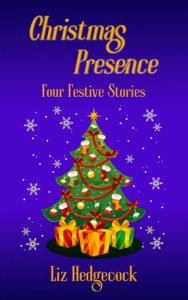
A character from the Maisie books appears in one of the four Christmas short stories in Liz Hedgecock’s Christmas Presence, Four Festive Stories. It’s a perfect way to sample Liz’s work and to gift for the Holidays!

.

This article was posted by member, Jackie Houchin

.

Writing Humor

by Jackie Houchin

How do you make a story funny?

Do you have to be a comedian? If you can’t make it laugh-out-loud-able, how do you make it chuckle-able, or at least grin-able? Or at the VERY least, smirk-able?

Our own Gayle Bartos Pool does it with punny words, double entendre, dialects, and snappy, sometimes tongue-in-cheek dialogue. And… hysterical situations!

You will grin and you will laugh aloud when you read her short story, “Only in Hollywood” in the Sisters-in-Crime collection, LAndmarked for Murder. I mean, can you picture a bunch of thugs pushing a dressed up dead body around in a wheel chair in the Bonaventure Hotel in Hollywood? No Way!

Gayle’s “Glitzville” in her own short story collection From Light to Dark has some hilarious dialogue scenes. They may not be as tangled as Abbott and Costello’s “Who’s on first?” but they sure come close. The back-and-forth conversation between Archie Wright and Sal Cohn is definitely grin-able. Your eyes will dance down the pages as you read it.

Here’s the opening paragraph so you can “taste” the style, before the funny dialogue begins.

“Archie Wright’s the name. Dishing dirt’s the game. My sandbox: Hollywood. The most glamorous and glitzy, vicious, and venomous playground in the world. If you come for a visit, bring your sunscreen and your shark repellant. If you come to stay, let me warn you, Tinsel Town eats up and spits out a hundred just like you every day. Sometimes it isn’t pretty, but it’s my job to chronicle the ebb and flow of the hopeful, the helpless, and the hapless. My best stories come from the dark side of Glitzville.”

And then the whip smart fun begins….

These are two stories in books you can try out for examples of how write comedic.  Perhaps you can recommend others?

If you are an author, how do YOU make scenes funny in your books? Is it by the characters, or some ridiculous premise, or by snappy, punny words and dialogue?  (SHARE YOUR SECRETS!)

##

Okay, as a journalist and book reviewer, I don’t have much talent with humor aside from a pun now and then. So, for the end of this post, I will try to get you to laugh, chuckle, guffaw, grin, or maybe just smirk with a few corny jokes. (from Woman’s Day magazine)

What do you call a snake wearing a hard hat?
A boa constructor.

What do you get when you cross a centipede with a parrot?
A walkie talkie.

How do you make an octopus laugh?
With ten-tickles.

How do you get a country girl’s attention?
A-tractor.

What do you call a beehive without an exit?
Unbelievable.

(You can pause here and come back later if you are grinned out.)

What do you call someone with no body and no nose?
Nobody Knows.

What do you call a blind dinosaur?
A do-you-think-he-saw-us.

Where do pirates get their hooks?
Second hand stores.

What do you call black birds that stick together?
Vel-crows.

(And a few to whet your appetite.)

What do scholars eat when they’re hungry?
Academia nuts.

Why do seagulls fly over the sea?
If they flew over the bay, they’d be called bagels.

Why should you never use “beef stew” as a password?
It’s not stroganoff.

What do you call a pig that does karate?
A pork chop.

(And for our own, Linda Johnston…)

What do lawyers wear to court?
Lawsuits.

What do you call a priest who becomes a lawyer?
A father-in-law.

What’s a lawyer’s favorite drink?
Subpoena colada.

I hope you got some ideas, or at least some laughs.

Remember the Bible verse – “A merry heart does good like medicine.” – Proverbs 17:22.

.

If you can’t find where to comment, click the title of this post at the top (Writing Humor) and you should find Likes & Comments below.

Sadly, the COMMENTS BUTTON seems to be missing. We are working on it with a PC man. Please be patient and keep reading  The Writers In Residence every Wednesday!

.

Listening for the Rhythm of What Your Characters Say: Applying Poetry Writing Techniques to Writing Dialogue

by  Guest Blogger, Tammy D. Walker

           Writing dialogue can be difficult.  First, there’s the content of what the characters say.  And then, there’s the subtext, or what the characters are trying to communicate to each other without saying something that might be too awkward or imperiling for them to say directly.  And, also, there are the actual words that need to go between those harrowing quote marks.

            As readers, we want what characters say to sound realistic, even though, as writers, we understand that the best-sounding dialogue in the context of a story might strike us as odd if we heard it in real life.

            So how do we balance all these moving parts to make them work as solid dialogue?

            One solution I’d like to offer is to use techniques from crafting poetry.

            Before I started writing mysteries, I’d had a couple collections of poetry published, and I studied the form in grad school.  And while I find writing poems and novels to be quite different in most ways, I did find that the “ear training” required for writing poems has helped me fine tune my dialogue writing process. 

            Though most of the poems we encounter are in print, poetry is still a very auditory art, meant, for the most part, to be read aloud.  So when I’m thinking about how to construct dialogue, I apply the same sound-related techniques in writing poems as I do while writing dialogue.  Though dialogue in fiction, like poems, isn’t generally read aloud, we should still consider its sound and how that sound serves the story.

            Writing poetry requires the poet to not only think about individual words but also their arrangement in syntactic units, in lines, and in juxtaposed groupings.  As fiction writers, we can apply these ideas to writing dialogue to give our characters words that make them more compelling to our readers.

Countering Some Possible Objections

            Let’s just get something out of the way, first: Poetry has a reputation among the general public for being obscure, enigmatic, and perhaps also stodgy.  Which, I think, is unfair.  The poems most of us encountered in high school are throw-backs to previous centuries, when flowery language twisted harder than barbed wire to fit the perimeter of some rigid form might well have kept all but the most diligent reader out of the green pastures of meaning. 

            Okay, maybe I took that metaphor too far.  But I think you’ll get my meaning. 

            Contemporary poetry, and that leading up to it in the last century, relies on plainer language.  Sure, there’s metaphor, simile, and all the other techniques we learned about in freshman English class, but there’s also a directness and freshness to language used now.  Victorian poems were written for Victorian audiences; poems written in the 2020s were meant to be read by, well, you and me.  In general, the language is accessible by your average reader. 

            So, for the most part, the language in this poetry-techniques-in-dialogue should be what your character would use in day-to-day life.

            Unless you don’t want them to, of course.

What the Characters Say

            So, that out of the way, let’s get to content.

            Before I write either a poem or a scene, I first think about what the content of the poem or the scene and outline what needs to take place.  For a scene, of course, that means thinking about what the characters want and how they’ll either achieve that or how I can thwart them.  For a poem (and yes, I outline my poems before I begin drafting) I think about the arc of the poem, or what argument the speaker of the poem will make.

            (A note on terms: even though many poems are autobiographical–or even confessional–many aren’t, including almost all of mine.  The “I” of the poem is the speaker, who may or may not be the poet, so it’s useful in this context to think about the poem as spoken by a character, even if that character functions more as a narrator than a in-the-scene actor.)

            Since most of my fiction these days is cozy mystery, I’ll use examples from that genre.  Let’s say we have two characters, Curtis, an art collector and one of the suspects in my novel Venus Rising, and Amy, a librarian intent on solving the mystery of a painting at the center of the book’s mystery.

            Amy joins Curtis for dinner in his suite.  She wants to know more about his art collection, but, of course, being a good amateur detective, she can’t ask her pointed questions directly.  But she’s there to gather information.  Curtis, on the other hand, just wants to impress Amy.  So this gives me both Amy’s content–she wants information–and Curtis’s–he just wants Amy.

How the Characters Say It

            So now we know what the characters want to say.  But Amy can’t tip her hand about her suspicions just yet, and Curtis can’t come on too strong.  Let’s go back to a few ideas from poetry about wording, rhythm, line length, and syntactic units. 

            Curtis wants to woo Amy, and his language is more song-like.  The rhythm of the words is more lilting.  He calls Amy “A vision in aquamarine,” and later asks “Champagne for my lovely companion?”

            To which Amy replies, “I don’t drink.”  Her words here are clipped and emphatic.  (She’s caught on to Curtis’s intentions by this point, and she has no interest in him.)

            The rhythm of the words in this short example show how differently the characters are approaching each other.  The words themselves are also worth noting, as Curtis uses Latinate language (“vision,” “aquamarine,” and “companion”) to inflate is dialogue, whereas Amy’s more Germanic retort punches back.

            Line length is also key to establishing rhythm and the perceived speed at which the dialogue is spoken by characters.  While dialogue isn’t split by line or stanza breaks in the way poems are, it can be split by tags (“she said,” for instance) or by the end of a sentence.

            Longer lines tend to quicken a reader’s pace.  Shorter lines, conversely, slow it.  Poems such as H. D.’s “We Two” cause us to stop more often at the ends of short lines: “We two are left: / I with small grace reveal / distaste and bitterness[.]”  Poems with longer lines draw us forward at a quicker pace.  W. B. Yeats’s “The Lake Isle of Innisfree” does just this: “And I shall have some peace there, for peace comes dropping slow, / Dropping from the veils of the morning to where the cricket sings[.]”

            So as I’m writing dialogue, I think about whether I want the character to speak quickly, perhaps revealing their anxiety, or slowly, to reveal their uncertainty.  And then, from there, I’ll decide whether to use longer or shorter words in longer or shorter phrases, and how I’ll either break them (or not) with tags, interruptions, or actions.

            In this example, I wanted to show Amy’s distaste for Curtis, even though she can’t reveal the fact that she does not like him just yet, since she needs to know more about his art collection.  She backtracks a bit and later says, “Sparkling water would be lovely, thank you.”  I wanted to move her more toward Curtis’s rhythm and longer lines, so that she doesn’t reveal her suspicions too soon.

Concluding Remarks Using the Best Words

            One of the concerns of poets in the early 20th century was that the language of poems had been, too often, contorted to fit forms, and that the resulting work sounded contrived and unnatural.  This carries forward through contemporary poetry, and poets do strive to make the sounds of the words, lines, and syntactic units fit with, complicate, and enrich the arguments of their poems.         

            This concern with the naturalness of language is also useful to fiction writers crafting dialogue.  We want the content of what our characters say to sound natural.  Considering the content in light of poetic sound craft can give the characters compelling things to say in a way that enriches the characters themselves and their movements through the story. 

            Which is an aim that, I hope you’ll agree, sounds good.

#

Bio: Tammy D. Walker writes mysteries, poetry, and science fiction. Her debut cozy mystery, Venus Rising, was published by The Wild Rose Press in 2023.  As T.D. Walker, she’s the author of three poetry collections, most recently Doubt & Circuitry (Southern Arizona Press, 2023).  When she’s not writing, she’s probably reading, trying to find far-away stations on her shortwave radios, or enjoying tea and scones with her family.  Find out more at her website: https://www.tammydwalker.com

#

Tammy D. Walker’s article is posted by member, Jackie Houchin  (Don’t you want to run out and buy her cozy mystery to see how she does this?  Wow!)

How Do You Name Your Characters?

by Jackie Houchin

NAMES in stories are important in that they have to “fit” the characters, the era, the country, and even class in which they live. You wouldn’t name a society woman, Buster. (Well, unless there was a right good reason for it.)  Also, a native seamstress of New Delhi probably wouldn’t be called Manuela. So how do you find those perfectly fitting monikers?

It used to be you could use telephone books, but who even has seen one of those in the last 15 years??  There are websites that offer names for babies and their meanings. Some even suggest names that were popular in different years. (See below)  Maybe you will name your heroine or villain after someone you love, or love to hate.

SUGGESTION One – A couple years ago I came up with an idea for a short story in a contest. I liked the name Autumn (the story had to be set in the fall). She would be a painter. I know how I wanted her to look – long, wavy auburn hair, green eyes. And she would be the quiet type.

Boy, did I get a shock when I asked my friends on Facebook what a character with the name Autumn Gold would look like and what she might do for a living. Nearly all of them said she would be a sexy night club dancer or even a street walker. Yikes!  I changed her name to Audrey Gould. But I titled the story, and named the fantastical woodland painting her boyfriend made with her hidden image in the colors, “Autumn Gold.”

I got honorable mention out of 400 entries.  Asking around might be a way to check out that clever name you’ve chosen.

SUGGESTION Two – I also wrote a middle grade mystery titled “The Bible Thief” set in a church much like the one we attend. For some weird reason 4 or 5 people (including myself) lost their Bibles at some church event. Some were found, others not.

Hmm. I pondered, and immediately thought of a clever gang of kids who would “investigate” and discover the remarkable solution to this mystery. Because I wanted to share the story with the kids in the 4th-6th grade class I was teaching, I minimally disguised their own names as the gang, their parents, and a few other easily recognizable people (by description) in the congregation.

That was easy!  And maybe YOU have used names of people you know but changing Sheryl to Sherry, or Garrett to Darren.

SUGGESTION Three – And lastly, I also wrote a series of related short stories for the same age children, set in Africa. There were seven kids (one set of twins, and one who passed away at a week old), and they all had names that coordinated in some way with the month they were born in.

The youngest boy, born near Christmas (and since his father was a mission pastor) got named Deacon. “Deek” for short.

There was a girl, April (yeah, I know, too easy) and the twin girls were named Melody May and Charity June. (Know why twins have two months?)

A younger boy was named August, nicknamed “Gus.”  The oldest boy was Marshall (can you guess his month?).

A sensitive girl born in July I named Julie Joy. And the little guy that didn’t make it very long was Freddie, born just after Valentine’s Day.

So, that is how I sometimes choose character names. How do YOU come up with yours?

##

Baby names from Social Security lists by popularity, the top 5 by year, by decade, state, and US Territory – https://www.ssa.gov/oact/babynames/

2023 Baby name finder and the meaning/origin – https://emma.ca/baby-names

70,000 Baby names by gender, alphabet, origin, meaning, and religion – https://www.momjunction.com/baby-names/