EXERCISING YOUR VOCABULARY

by Miko Johnston

When I think back to the dark days of the Covid pandemic, I don’t focus on the panic or the shortages. I remember the isolation. Although I had the good fortune of my husband at home and kinship through technology, I found conversations very limited. I began contacting people in my life whom I rarely saw but stayed in touch with, usually with a Christmas card, but many of my friends from the past were mired in their own woes or didn’t respond. Worse, despite having ample time to finish my novel in progress the distress kept me from writing anything…for eighteen months.

I still recall an evening at least six months into the lockdown. My husband, exhausted from yard work, went to be early. His older son called that night. In the past, I’d speak to him briefly before passing the phone to his father, but neither of us wanted to wake him. As I spoke to my stepson I began to realize how much I craved company, even if only over the phone, so what would have normally been a five-minute call stretched into over an hour. I think he, too, longed to talk, and for the same reason.

Our conversation was stilted at first, but not because of any personal reason. He and I were merely out of practice. We’d pause to think of the right word or string more than a few words together in a sentence. It took about five minutes to verbally limber up before we could chat ‘normally.’

That served as a wake-up call. From that day on, I began playing word games. It kept me entertained and, more importantly, prodded me to keep my vocabulary alive and active. Anything that forced me to plumb my memory for words (and spelling). I know many writers use writing prompts, but I wasn’t yearning to write better as much as speak better. I needed something deeper than that.

I began with Spelling Bee, a New York Times creation that gives you a ring of six letters with a seventh letter in the middle. You form words, four letters or more, that must include the center letter. I even got my husband hooked on the game; we still play it almost daily and compare our lists. Later, I added Wordle to my daily routine. You get six chances to find the five-letter word of the day – if you’re not familiar with it, you can read the instructions on the NYT website.

In both cases, trying to figure out the words stimulated my brain. Sometimes, words would pop into my head, even if they didn’t fit the puzzle. That’s when I decided I needed more stimulation and started inventing my own puzzles.

Wordle inspired a new way to challenge myself. I’d pick the first two letters of potential words and list as many as I could. I’d start with my “prompt” letters and work my way through the alphabet with the goal of reaching at least fifty words. As with my conversation with my stepson and my daily dose of word games, the more I challenged myself, the more words I could recall, and the faster they came to me.

Here’s an example:

HOW MANY WORDS CAN YOU MAKE THAT BEGIN WITH THE LETTERS:

BR——-

RULES:

  • Words must be at least five letters
  • No adding prefixes like S; ED; ING; LY; NESS to a root word of four or less letters
  • Only one version of the same word is allowed (ex: float OR floated OR floating)
  • Homographs are allowed with variations in the spelling to reflect their different meanings

(ex: score [to make shallow cuts]; score [to earn a point] becomes scoreboard)

  • No abbreviations
  • No foreign words unless they’re in common English usage (ex: pasta; rondo; bidet; pashmina)
  • No proper nouns
  • No acronyms (ex: AWOL)
  • No hyphenated words or contractions

GOOD LUCK!

A TRIBUTE TO WORDS AND WRITING

By Miko Johnston

My late father co-founded a non-profit organization dedicated to Scandinavian philately. In addition to translating and publishing educational books on the subject, the group held monthly meetings as well as annual exhibitions where members could present their best work. Dad served as their president for many years; his name and phone number appeared on all contact sources.

He wasn’t home the day a young man called for more information about the organization. I offered to answer as much as I could. His first question: “Can you join if you’re under eighteen?” Yes, I told him, there is no age limit. “Can I bring another guy to the meetings?” Sure, I said, but something told me he had something, um, different in mind. I then said, “You do realize that philately is stamp collecting.”

“Oh.” He promptly hung up.

We spend a great deal of time writing about words on this blog. If you hunt through our archives, you’ll find many posts on the topic, which should come as no surprise. Words are the most important tool in a writer’s toolbox. We think about them, which one to use in any situation, whether a particular word or one of its cousins (aka synonyms) would be more precise, more distinctive. Can we convert that verb/adverb pairing into one verb? How many descriptives can we edit out without losing the image, the rhythm, or the voice of a character?

Words convey and put into context images, thoughts and ideas, especially when they’re carefully selected. We have non-verbal ways of communicating as well, but unless there’s some established pattern to it, such as sign language or Morse code, their subtlety makes them less effective for interpretation – is she slouching because she’s humiliated, or her back hurts?

Whether spoken or written, signed or signaled, we rely on words as the basis of communication. Misinterpretations may cause embarrassment, as my earlier story shows, but in the right hands they surprise in an entertaining way. Writers can inform the reader without the character’s knowledge, a technique I relied upon in my first novel, when my protagonist was a child. Or they can make the reader wait – ideally with keen anticipation – for information the character already knows.

We can use words to assure clarity of thought, or to deliberately deceive. Red herrings in mysteries fall into the latter category, as do ambiguous phrases meant to mislead the reader into thinking something the author intends to prove wrong later. I’ve done this so often in my writing it might be a hallmark of my style.

Words have the power to calm and reassure, to encourage and inspire, or to agitate and inflame. Think of all the influential speeches you’ve heard or read, or the memorable phrases culled from them. Whether by actors reading from a script, politicians addressing their constituents, or activists crusading for their cause, their words, carefully chosen with deliberation, hold the power to move people. To bolster their spirits, or shock them. Convince them they’re right, or maybe, just maybe, they’re not.

All have one thing in common: Someone, or some ones, wrote those words.

Not to equate a frothy page-turner with The Gettysburg Address, but I celebrate writers who celebrate the written word. I commiserate with writers who agonize over the best way to express their or their characters’, thoughts. I respect writers for what they try to accomplish whenever they put pen to paper or fingers on the keyboard.

That’s why we deserve a formal representation for what we do.

The practice of medicine has a symbol – a caduceus with two snakes coiled around it. The symbol of law is the scales of justice. No formal symbol of writing exists, although if you Google it you’ll find cartoons of a hand holding a pencil or pen.

What do you think would make an apt symbol for writers?

Miko Johnston, a founding member of The Writers in Residence, is the author of the historical fiction series, “A Petal in the Wind”, as well as a contributor to several anthologies including the recently released “Whidbey Island: An Insider’s Guide”. Miko lives in Washington (the big one) with her rocket scientist husband. Contact her at mikojohnstonauthor@gmail.com

The Future of the Written Word – Will Anybody Remember What Words Mean?

by Gayle Bartos-Pool

Writing Books

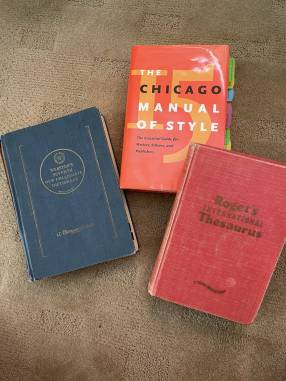
This is a Follow-Up to Jill Amadio’s post about words used by younger folk that might need a new dictionary to understand them because they aren’t in my old Webster’s Seventh New Collegiate 1965 edition. We hear slang on TV shows geared to a younger audience and from young folk in our daily life, some of which needs to be defined by the user because the listener has no clue what they mean. But what will books in the not so distant future be like? Here’s a sobering take on this subject.

I was in a writers’ group years before we formed the Writers-in-Residence blog that consisted of aspiring novelists of all ages. The majority of us were older, but the young folks wanted to be writers and this was a good way to have their work critiqued and maybe improved. Each month one person in the group would submit 30-60 pages and the others would read them and make notes and suggestions about that sample. The pages were usually part of a novel-in-progress. None of the younger people had published work, though most of us older folk did have one or two books in print or wrote for a newspaper. We still wanted our work read and have the group toss around ideas to make the WIP (Work in Progress) better.

That was basically wishful thinking on most of our parts. First, the younger folks didn’t understand sarcasm and how it was used in writing. In other words, they couldn’t understand a good joke about life in general. They also didn’t understand references to anything more than a few years older than they were. A sense of humor was foreign to them, as were the names of famous movies or actors or World History or… Anyway, much of the color and character in our work went over their “collective” heads.

As for their work, I remember reading the first few pages of one person’s novel. The lousy spelling and total lack of punctuation made the pages unreadable. I felt like a Fifth Grade teacher grading a kid’s paper who would definitely be getting an “F.” I had to tell the person why I didn’t finish reading his work. He wasn’t happy and didn’t stay in the group much longer. But every one of those younger people wrote the same way: badly.

I have heard that schools aren’t teaching little things like grammar or spelling or punctuation or math or science that you might find in a school book back in the last half of the last century. I’m not talking about the 1800s. I’m talking about 1950-1999. But remember: Gravity still exists. 2 plus 2 still equals 4… so far. A dictionary from that earlier era should still be relevant. We can add words, but not change their spelling or eliminate their original meaning. Or can we…?

If a word can mean anything you want it to mean or its spelling can be whatever you key into your handheld device with your thumbs or if World War Two was won by space aliens and not the Allied Forces, “Houston, we have a problem.”

4 Great Books

But if this Brave New World is what the future holds, the only hope we have is that the people who use these new words can’t spell them, much less understand how to use a pen and write them, so there won’t be any new books out there to read containing these odd words with nebulous meanings. But folks in the future will still have Shakespeare and Agatha Christie and a few books by some of us who still write in a readable language… but that of course does depend on a hope that kids are taught to read in school and right now that doesn’t look too promising. And of course some people are removing great books from schools and libraries or are rewriting them to suit a new generation’s feelings, so that is problematic. Ray Bradbury wrote about a dark future like this in Fahrenheit 451. Orwell saw this coming in his book, 1984. I actually made references to the books 1984 and Brave New World in this post, if you caught the sarcasm. (Look up the meaning of the word if it’s unfamiliar. Use a Webster’s…) So folks, keep copies of these great books in your home library and other books that you have in your collection so future generations can see what people wrote about a century earlier, though you might have to read the book to these younger folk if they weren’t taught in school…

Do I think this is a problem? What part of “Yes” don’t you understand? (Oh, by the way, that’s sarcasm…)

RayGayleClose

This is Ray Bradbury and me.

Words!

by Linda O. Johnston

Some of my fellow Writers in Residence inspired me to write this post by mentioning, in past weeks, their enjoyment of, and working with, words–most especially Miko Johnston, who wrote “Wordplay,” and Jill Amadio, who wrote “You Say Potatoe…” I always enjoy our posts here, but those two really jostled a lot in my mind.

Why? I love words! I always have, from the time I was a very young kid, and still do. Reading, spelling, grammar in grade school? Wonderful!

Miko described her fascination with words and their origins and imagery and sounds and more. Jill focused somewhat on the differences between the U.S. and U.K. versions of the same words and their spelling and uses in grammar.

And me, here? Well, let’s just say I do all I can with words in different schemes and environments. Yes, I write. I’ve always written, since I was a child, but I do a lot more now. My undergraduate college degree was in journalism, and I worked in advertising and public relations before becoming an attorney–and a published novelist. They all involved words!

Besides writing these days, I also do a lot with word puzzles, especially crosswords, cryptograms and acrostics. It keeps me fresh with the words I use as well as learning how others can play games with them, literally. Yes, I sometimes check the answers if I don’t otherwise figure them out, since it’s a good method to learn not only words but different and sometimes strange usages–although I’d much rather figure them out myself.

I find it interesting that I sometimes also have to figure out what recent slang and other words mean, even though many used to come to me just by hearing them and their usage. For example, I had to look up what the current usage of “woke” means. Yes, I had to become woke in its usage!

My own vocabulary was helped over the years by the fact I used to be fairly literate in the French language after studying it for over ten years as a kid. I rarely use it now, though I can often read French, but I don’t always understand when people speak it in my presence unless…they…speak…slowly. Yes, lack of usage has slowed me down, although I can always come up with a sentence in French, probably an elementary one. And if I see French words on a page, I can often translate them.

Plus, over the years I’ve learned some Spanish words, too. And after spending a significant amount of time in Germany years ago, I can sometimes recognize German words as well.

So… Yes, words and I are good friends. Buddies, chums, mates and more. Amies et amigos und Freunden. Guess I’ll keep talking and reading and listening and solving puzzles…and hope to learn even more words.

In Defense of Clichés (and Other ‘Adjusted’ Words)

 by Miko Johnston

william-james-booksellerI frequent a bookshop in a neighboring town that sells books for and about writers, along with writing-related merchandise (if you’ve been to Port Townsend Washington you know which store I mean). They carry postcards and T-shirts with writing slogans like “Avoid Clichés like the Plague”. Cute. Unfortunately, it denigrates clichés. The meaning of the word has been ‘adjusted’, and unfairly so, IMHO.

Hear me out. I’m not endorsing the constant use of ‘isms’ we now label as cliché. But the word has become synonymous with trite, and that’s unfair. While some clichés may be trite, most are merely unoriginal, though with good reason – they’re shorthand for knowledge that’s been established throughout the ages and shown to be generally true.

clicheWhen selectively used, a good cliché expresses wisdom through metaphor. A stitch in time figuratively saves nine. Actions often do speak louder than words. Sometimes it is a dark and stormy night, but since that opening line shows up more in humorous writing nowadays, we expect it to be funny, not dark. Like cliché, the expression’s meaning has been ‘adjusted’.

Not a unique situation in phrases or in words. So many words have been adjusted – either with new meanings added on, or by having their definition abridged to one exclusive meaning. In one of my older posts (see July 17, 2019) I mentioned how Clarity in writing must include weighing a word’s intended meaning against what it’s perceived to mean.

Also consider how even when the word’s meaning should be clear, many don’t understand what the word means. Take secret, for example. It’s supposed to mean confidential, not to be disclosed, but too many people seem to be unaware of that, otherwise they wouldn’t try to get you to reveal a secret. Isn’t the very meaning of that word to withhold information based on a vow?

Or take the word average. It’s a mathematical term, meant to express the value of a group of data by adding it up and dividing it by the total of their number, yet it’s taken on social connotations. We hear the expression, the average person, or man, or woman, and wonder what that could be. We equate average with falling straight down the middle of a ranking system, not being good or bad, not taking sides. Somehow average has become something to avoid, either as a person or as an opinion. And don’t get me started on how compromise has become synonymous with cowardice.

How about proud? According to my dictionary the noun proud means: feeling deep pleasure or satisfaction as a result of one’s own achievements, qualities, or possessions, or those of someone with whom one is closely associated. Have you heard anyone say they were proud of themselves, even without accomplishing an achievement (which I believe includes making the attempt, working hard and doing your best)? Or proud of a celebrity whom they’ve never met?

As a writer, knowing words – their meaning, and using them in the proper context to express thoughts – has become more challenging as the meaning of words have become ‘adjusted’. Have you noticed this trend? How have you ‘adjusted’ to it?


mikoj-photo1

Miko Johnston is the author of the A Petal In The Wind Series, available through Amazon and Barnes and Noble. Miko lives on Whidbey Island in Washington. Contact her at mikojohnstonauthor@gmail.com


This article was posted for Miko Johnston by Jackie Houchin