GROUP QUESTION #3 – Settings & Research, Where & How Much?

By WinR members & guests

  1. Where & when do you set your stories? 
  2.  How much research do you do on that time & place?

MIKO JOHNSTON: I’ve done extensive research for my historical fiction series, set primarily in and around Prague during the first half of the 20th Century, to give it authenticity. That includes using real places, people, events – even moon cycles accurate to the day – alongside my fictional characters. Some information has been unobtainable (at least in English), so when I can’t make it accurate, I aim for plausible. 

*

G. B. POOL (Gayle):  The setting I use in my novels or short stories depends on what the story is. So many of my private detective stories are set in Los Angeles because that city is known for its “high crimes and misdemeanors,” as we saw in these old black and white detective movies from the 40s and the great TV detective series from the 60s and 70s. I watched them all. I like having my contemporary private detectives walk that same turf. My spy novels are set in various countries during WWII, the Cold War, and into the later part of the last century. That might sound like a long time ago, but I lived through part of that time, so I know the later era.

As for how I write about those other times before I came on the scene, I watch a lot of old B&W movies and see what places looked like back when they filmed them and how they dressed. It’s a great way to “see” history when you didn’t live through it.

*

JACKIE HOUCHIN:  My dozen stories for 4th to 6th grade kids are set in present-day Malawi, Africa. However, many of the people in the surrounding areas still live in very primitive circumstances.  My goal in these stories was to show upper elementary kids in America how a missionary family (with 6 children) would live among and interact with less than modern circumstances, and still have fun. (And get into trouble!)

Most of the research I did was hands-on.  I visited Malawi five times, spending a couple of weeks each. I went into villages, watched kids doing chores, caring for babies and animals, and playing primitive games.  I ate the food and learned a few words. I cringed at the sight of humongous insects and scary witch doctors. I lived with a missionary family each time, seeing how they “made do.” I had lots of fun, asked questions, and took copious notes!  I also never caught malaria, meningitis, typhoid, or HIV. Whew!

*

DIANE ASCROFT (Guest): My Century Cottage Cozy Mysteries are set in Fenwater, a fictional small town in Canada, during the 1980s. The place is far from where I now live in Northern Ireland, but I grew up in Toronto, Canada, and often visited the real town of Fergus that Fenwater is inspired by. I loved the place and thought it would be a great setting for my stories.

For my series, I wanted to create a place that beckons readers to step in and stay a while, so a fictional version of Fergus was perfect. Setting my books in Canada during the 1980s is also a nostalgic journey back to my homeland. It was forty years ago when I was a young woman, so it’s a pleasure to spend time writing about the place.

*

JILL AMADIO:  I set my contemporary mystery series on Balboa Island, Newport Beach, CA. My amateur sleuth is a British gossip columnist banished for a year at the request of the royal family, tired of her perceptive comments. She is from the fishing village of St. Ives, Cornwall, my own hometown, which allows me to recall its pub built in 1310, my school, the beaches, my father’s pharmacy, my mother’s dance academy, and the pantomimes she produced every Christmas.

My research to jog my memory is a delight as I have several travel books on the British Isles, reminding me, too, of London, where I was a newspaper reporter. I also keep up with the news in Cornwall.

*

ROSEMARY LORD:  I have been writing mostly about Hollywood in the 1920s and 1930s.  I’ve always been fascinated with this era, and learned a lot more when researching my non-fiction books, Hollywood Then and Now and Los Angeles Then and Now.

I do a lot of research, which I find fascinating, and sometimes get far too carried away with that!  I love to show how either simple or how difficult life was one hundred years ago,  compared with today’s world.

I must confess that writing mysteries set today, when crimes may be solved using cell phones and today’s technology rather than old-fashioned “gum-shoe” sleuthing, leaves me cold!

*

MAGGIE KING:  My stories are set in Virginia in the present day. Most take place in Richmond, the state capital. It’s a city rich in history and culture, and it boasts two major universities. Many of the residents, myself included, moved here from other parts of the country and the world.

Charlottesville and Fredericksburg are also Virginia cities featured in my work. A few months ago, I posted here about a research trip I took to Charlottesville. It’s important to get the details right!

To date, I’ve been content to set my stories in contemporary times. But contemporary times are distressing, so I’m tempted to try my hand at something historical that will involve significant research.

*

LINDA JOHNSTON:  These days, I set all my stories in the present, although I used to also write time travel romances. But these days. my romances, romantic suspense, and mystery stories are set today, since I now enjoy the present more than the past. 

I’m currently writing mostly romantic suspense stories, in my own successive miniseries for Harlequin Romantic Suspense. They’re all set primarily in fictional towns, so my characters can get into different kinds of trouble with the law and get out of it without my stepping on real law enforcement toes. My recent mysteries, though, were set in real areas in Alaska, for fun. And of course, I’d visited Alaska.

*

Thank you, ladies! 

Get Those Details Right!

By Maggie King

Recently Linda Johnston posted about where writers set their stories. I commented that the next day I planned to visit Charlottesville, Virginia for a research trip. I had finished the first draft of a short story set there, and needed to verify setting details.

I live in Richmond, but lived in Charlottesville for many years, and visit occasionally. It’s a cool place to spend a day. Lots of bookstores! So I have a fair picture of the place. But how accurate was my memory? And Charlottesville is a growing, dynamic city—what had recently changed and what hadn’t?

Here are the setting details in my first draft:
The story opens at the Jefferson Madison Regional Library in the downtown area of Charlottesville. As my main character stands on the steps under a columned portico, she turns and sees the Market Street Park, scene of 2017’s Unite the Right rally. I provide some information on that rally, formed to protest the proposed removal of the Robert E. Lee statue.

Once inside the library, the character takes a wide staircase to the lower level and locates a meeting room where a writing group is meeting.

After the meeting, she and a woman she just met leave and walk to Charlottesville’s Historic Downtown Mall. As they approach the Mud House, a trendy coffee shop, they decide it would be a good place to chat.

Mud House

Later they drive to a semi-country location, the scene of the crime they cooked up while drinking expensive lattes at the Mud House.

Based on my research, some rewriting is in order.

The character standing on the steps gazing at Market Street Park: she could only see a sliver of the park from where she stood. I could have her walk through the park and see the patch of dirt left behind when the Lee statue was removed in 2021. But neither the park nor the statue are important to the story, they only serve to add color to the setting. To use film parlance, this bit is destined for the “cutting room floor.”

The library interior: for all the times I visited this library, apparently I was never in a meeting room. They are located on the top floor, not the bottom, requiring the character to take the elevator (I didn’t check out stairway access). The rooms were in use, but I got a peek of the interiors through the glass doors. As the library is a real place in my story, being accurate with descriptions is important.

Jefferson Madison Regional Library

The Mud House. It’s a very attractive space with a nice, and pricey, selection of coffee and pastries. But it’s been completely redesigned and not conducive to private conversation. And the conversation my characters have needs to be private. But I can fictionalize a coffee spot, so no problem there.

Then there was the trip to the semi-country, where I once lived. The route, which must be accurate, was pretty much unchanged. I drove past the Earlysville Oak, estimated to be 250 to 300 years old.

Earlysville Oak

My old neighborhood was also unchanged—except for the owners of my previous home not keeping up the grounds. But I digress. I’ll make up the neighborhood based on this one. After all, it’s where the crime takes place, and I don’t want to rile my former neighbors!

I’m grateful I took this trip. It pays to verify aspects of the setting, especially if using real locations. I also took lots of photos, noted sights, sounds, and traffic patterns (lots of traffic!) and made time for those bookstores.

See Linda’s post, “LOCATION, LOCATION, LOCATION!”

The Most Fun Thing About Writing

By Linda O. Johnson

Hey, our blog is still here, and I couldn’t be more delighted. I was pondering what to write about now, and came up with what I hope is a fun topic: my thoughts about the most fun thing about writing.

Do I know yet? No! But I’ve gotten a lot of ideas. And I’ve been writing for a long time.

My thoughts? First, even if I set a story somewhere real, near me, the fun thing about it is figuring out what can be different, and what my protagonist can learn about it—and tell me! For one thing, since most of what I write are mysteries and romantic suspense, people can get hurt or even killed in those environments I find fairly safe in real life. So where’s a good place to murder someone where the mystery can be resolved well and quickly enough in a story? A real place? A fictional place?

Even more important is those characters, especially my protagonists. They’re not me, but they contain some of my characteristics. The character closest to me was in my first mystery series, the Kendra Ballantyne, Pet-Sitter Mysteries. Kendra was a lawyer who lived in the Hollywood Hills with her Cavalier King Charles Spaniel Lexie. At the time I was writing about her, I was a practicing lawyer, and one of my Cavaliers was named Lexie. And yes, I live in the Hollywood Hills.

Other protagonists aren’t quite as close, but still had characteristics I like and admire. The spinoff series from Kendra was the Pet Rescue Mysteries, which of course contained dogs and other animals—and I was volunteering a lot at local rescue organizations when I wrote it. In my Barkery & Biscuits Mysteries, my protagonist owned a bakery for dog treats—and was owned by a dog named Biscuit. In my Superstition Mysteries, my protagonist owned a dog named Pluckie. And currently, in my Alaska Untamed Mysteries under my first pseudonym, Lark O. Jensen, the protagonist, a naturalist, introduces tourists to all sorts of wonderful Alaskan wildlife, including seals and bears and wolves—and yes, she brings her own dog Sasha along on her tour boats.

And in the Harlequin Romantic Suspense stories in the various series I create, yes, dogs are involved. All my stories do contain suspense, whether they’re mysteries or not, and even those I’m asked to write when I can’t always include dogs. And they contain at least a touch of romance, often more.

So… setting is fun. Characters are fun. Killing people vicariously, and not for real, of course,  can be fun. And creating romances can be fun.

Plus, various animals are fun. Dogs are fun.

Hey, for me, maybe the most fun thing about writing involves one of the most fun things in my life: dogs.

So what’s the most fun thing about writing for you?

Photo by Austin Kirk on Unsplash 

The Importance of Setting

Guest Post by Patricia Smiley*

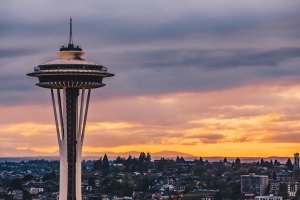
michael-discenza-331452-unsplashYears ago I bought a novel written by a well-known author because it took place in Seattle, a city where I’d lived, went to school, and worked for many years. A few chapters in, I was dismayed that the descriptions of setting were so generic that the story could have taken place anywhere. It was almost as if that the author had never set foot in the city.
Setting matters. The place of your novel includes the broader vistas into which you set the story, such as the culture and customs of the people who live there, history, land, floral and fauna, and even the shape of the clouds. It’s also where each scene takes place, be it the backseat of a Mini Cooper, an English garden, a Federal prison cell, or a home kitchen.

We were given five senses for a reason. Detail specificity enriches your writing. Don’t just say the kitchen was messy; describe the smell of spaghetti sauce oozing down the wall, the feel of that sticky green substance puddled on the floor next to the baby highchair, and the tick tock of the antique grandfather clock in an otherwise silent room. Descriptions should not just be an inventory of the space. Each one must illuminate an element of plot, theme, or character and, in the case of this kitchen, raise a myriad of dramatic questions about what happened there and to whom.

Description as fine sauce. Descriptions need not be long and rambling, but a writer must persuade the reader that the story is real. Even people who’ve never been to a location should feel as though they’re experiencing it firsthand. This also applies to imaginary settings. To prevent long passages of boring prose, take Elmore Leonard’s advice, ”Don’t write the parts people skip.” Instead, distill the essence of a place into a fine sauce. Below is an example of reporter Jeffrey Fleishman’s brilliant and evocative description of Port Said, Egypt, from the Los Angeles Times:

“This shipping city of factory men, with its whispers of colonial-era architecture, was once a crossroads for intellectuals, spies and wanderers who conspired in cafes while the Suez Canal was dug and Egypt’s storied cotton was exported around the globe. Rising on a slender cusp in the Mediterranean Sea, the town exuded cosmopolitan allure amid the slap of fishing nets and the creak of trawlers.”

Don’t trust your memory—verify. Get the specifics right. Nothing takes a reader out of the story faster than getting hung up on inaccurate details. If you can’t visit the location, read travel blogs, talk to friends with knowledge of the area, consult Google Maps, online photos, and YouTube videos.

People like to “travel” when they read. Effective use of description creates atmosphere and mood, and stimulates emotions. Anyone who is familiar with the cold, bleak settings in Scandinavian crime novels or films knows how integral “place” is to every part of those stories. So, give your readers a compelling setting and then wish them a bon voyage.

_______________

patty-smiley-250-shadow

Patricia Smiley is the author of four novels featuring amateur sleuth Tucker Sinclair. Her new Pacific Homicide series profiles LAPD homicide detective Davie Richards and is based on her fifteen years as a volunteer and a Specialist Reserve Officer for the Los Angeles Police Department.

The third in that series, The Second Goodbye, is set for release on December 8, 2018.

Patty’s short fiction has appeared in Ellery Queen Mystery Magazine and Two of the Deadliest, an anthology edited by Elizabeth George. She has taught writing at various conferences in the U.S. and Canada and also served as vice president for the Southern California chapter of Mystery Writers of America and as president of Sisters in Crime/Los Angeles.

PatriciaSmiley.com

3books
______________
Photo by Michael Discenza on Unsplash
*This blog article is posted for Patricia Smiley by The Writers In Residence member, Jackie Houchin