
 by Rosemary Lord
As writers, we quickly learn that the most important part of writing is the beginning and the ending.
Get ’em hooked – hit the ground running; that, we are told, is how good writing should start. If you can’t reel your reader in with that first page, they probably won’t bother to read further. Especially in today’s short attention-span world.
 There is a series of things we are told never to begin a story with: The weather, the phrase “It was a dark and stormy night…,” description of the scenery – and so on. Of course some masterpieces have started with these very things. So we have to know exactly what will work for us and when we can break the rules. That’s something learned along the way.
 Then, there’s the ending. Always leave ’em wanting more! Of course, you have to tie up the loose ends, especially with mystery novels. Readers feel really cheated if ‘red-herrings’ are scattered throughout, yet never explained. Worst still is to have the culprit introduced at the last minute: ‘Surprise!’ That’s a big no-no, as the readers will not have been allowed to follow along with us, tracing the trail of literary breadcrumbs we leave as we attempt to create another writing masterpiece. This is another creative challenge, as the wheels of our brain spin from pillar to post sorting through the mystery we are producing. But we need to leave readers wanting more, if we want them to come back for the next book in our series; either unanswered questions about the protagonist, or interest peaked in the settings of the story.
I loved the film of the book, “The Most Excellent Marigold Hotel,” which starred Judy Dench and Maggie Smith as British seniors moving to India to start a better life at the Marigold Hotel. By the end of the first book and the film, all sorts of intriguing things were happening. It was a happy ending as they began this great adventure. We were left wanting to know what happened – how did it work out? Unfortunately, the sequel, “The Second Best Most Excellent Marigold Hotel,” didn’t fare so well because it tied up all the ends too neatly. It told us exactly what happened: all done and dusted. Nothing left for us to ask or wonder about. No ‘what ifs?’ Nothing to look forward to in the next episode.
Life, like books, has beginnings and endings. There seem to have been a lot of these recently. The simplest closing of one door often opens a new door to surprising results.
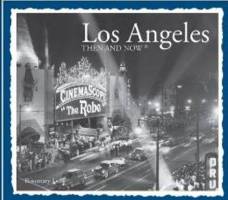 When I shattered both ankles some years ago I was earning my living as an actress, while writing on the side. That acting door closed because I was in a wheelchair for several months, before I learned to walk again. So my writing career was reborn, starting with my Los Angeles Then and Now book success.
Big doors and little doors.
A while back, on holiday with my family in Greece, our favorite restaurant was closed for remodeling. We were really upset, as we had looked forward to evenings of great food and ambiance there. So, we had to look further afield and instead discovered a charming small harbor just up the coast with rustic tavernas and a community of delightful, friendly people. A new place to vacation. That was a little door opened for us.
When my husband Rick died so unexpectedly, a very big door was slammed in my face, as all the things we had planned together stopped. As time went by, healing didn’t stop the hurt. It just felt different. New doors opened. I have done so many things I never would have done if Rick were still here. Although I still feel him very much with me, watching over me, cheering me on as I begin new adventures. I travel a lot more – spending time with my siblings and family in Europe. Something Rick and I never had the time to do. Now, I make the time. My priorities have changed.
I undertook to save the historic Woman’s Club of Hollywood from being turned into a luxury condo resort. Working long hours every day filled the void and helped me through the grief. I did not have time to think about my own situation. I found strength in the work I was doing there: managing maintenance, restoration, bookkeeping, putting on events, handling film location rentals – and growing the membership, so we have a bigger army of people to protect the historic club going forward. I was in a world to which I had never aspired. I learned a lot. I was elected President, which increased my responsibilities. But I also learned to delegate – instead of my life-long “I can do it…” practice of attempting to do everything myself. And now, that door is closing.
As I approach the end of my term as President, I relish the time that will be freed up. I will still remain on the Board of Directors, overseeing many of my current responsibilities – proud of what we have accomplished so far. But I am surrounded by a new group of strong women also intent on saving the club. So I can step back, a little, knowing the club is in safe hands. I will now be able to return to serious writing time.
The door that was partially closed after Rick passed away was my extended writing hours. I did not have the heart, or the time, to dedicate my life to writing anymore. I was needed elsewhere. Now I look forward to a fresh start with my writing. I have a lot of ideas bottled up, waiting to be written.
 Who knows how this new chapter will end or when this door will close and a new door – or window – open. But I know that whatever I write I will start with a great ‘hook’ and at the end endeavor to leave my readers wanting more!
………………………………..
Rosemary Lord. August 2018


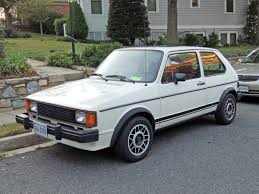 Assigned identically set-up cars, we stood dutifully at the starting line. Taped to the passenger side window of each Rabbit was a glass vial containing the precious gas. A narrow plastic tube ran from the vial, across the hood, and into the engine much like an I.V. line dripping life-saving fluids into a heart patient.
 No matter. I was on my way around the track for the first lap. The only problem was we were supposed to drive as slowly as possible to preserve the fuel and thus achieve high mileage, a great promo for VW. Here we were on one of America’s most famous race tracks and to win we were to dawdle all the way. Well, women never like to follow the crowd, just ask any husband, so I must admit I gave in to temptation and led the rest of the field at first, all 21 of the men behind me as I pressed the pedal to the metal.

 novels. Her current literary focus is Route 66 as it traverses California’s Mojave Desert in her “Rhodes” series. Madeline is a lifetime lover of mysteries, and besides reading and writing, is also an occasional potter. She lives with her husband and assorted canines in the High Desert. Visit her

 I TASTED the cool creamy sweetness of real Italian Gelato, bit into crusty (salt-free) Tuscan bread piled high with fresh-made tomato Bruschetta and drizzled with first-press virgin olive oil from an orchard that covered the nearby rolling hills. I sipped a frosty pale green menta (mint) icy that tingled my taste buds and sent shivers of coolness through my mouth and throat…on a baking-hot humid day.
 I sampled a vast array of Italian cheeses (said to outshine France’s), from wedges of soft, creamy whites, protected by powdery rinds, to the mellow, medium-soft, large-holed varieties (not Swiss), that were delicious in a salty-sweet way with a dollop of apricot jam on top, to the hard, net-wrapped aged cheeses that take a good strong knife to slice, and a hunk of soft Italian bread to eat it with to even out the sharpness.
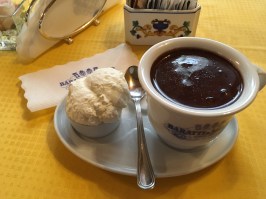 What about a decadent hot chocolate so thick and rich that it looks like Hershey’s Chocolate Topping, but more delicious, served with a scoop of freshly whipped cream so thick you could eat it with a fork.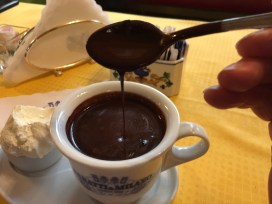
 Move through wet heat that causes limp hair, sticky skin, and clothes that cling. And then come upon an arched metal fountain in a park or piazza in the shape of a bull’s head (honoring “Torino”) that flows with cool sweet entirely drinkable water from its mouth. Hold out an empty water bottle, or cup your hands to catch the coolness, or even bend your head and drink freely.
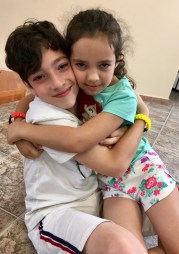 Kids walk down the streets holding hands and they hug their siblings freely, unembarrassed.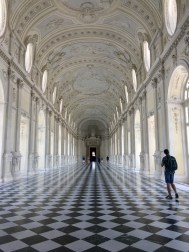


 Why do I use a time machine when I write? For Sandy Fairfax, I had no choice. I wanted to write about a ‘70s teen idol because of the culture of that time when teen idols were promoted through TV shows. I like the melodic songs from the era, the cheesy clothes, and the drama that often took place behind the idols’ innocent façades. \
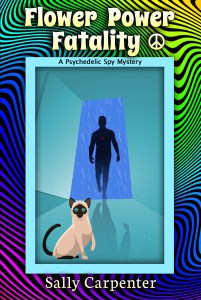 In “Flower Power Fatality,” Noelle McNabb is an actress at a Christmas-theme park in Yuletide, Indiana. Her drab routine is interrupted when a stranger shows up on her porch with a bullet in his chest. Then, a super-secret spy agency recruits Noelle to find missing microdots along with veteran agent Destiny King. As Noelle goes undercover, she finds herself dancing in sleazy nightclubs and chasing bad guys at night while wondering who is going to feed her pet cat.


 Sally Carpenter was born and raised in southwest Indiana but now lives in Moorpark California, leaving the land of rain and snow for wildfires and earthquakes. She has a master’s degree in theater from Indian State University. She also has a master’s degree in theology and a black belt in tae kwon do. She’s also “mom” to two black cats.


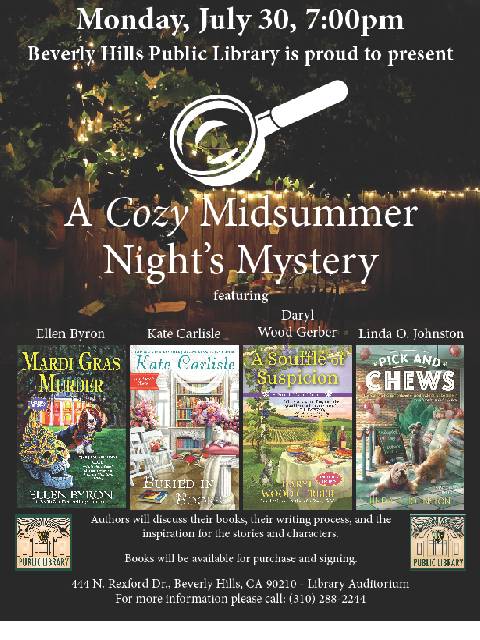


 When I came up with
  The first story I wrote had Johnny mention that he once worked for the Mob. I was channeling his voice and the words just came. Then I realized I needed to know a little bit about the Mafia. An ex-cop acquaintance with a rather interesting connection to the Mafia told me what books to read and he also shared some insights that you might never find in a book, but if you did, you would think it was fiction.
 As I was on this road of discovery, I realized I had given Johnny the title:
  My newest character in a series is Chance McCoy. I bill him as a third rate P.I. in a secondhand suit who blows half the cases he takes on. Not a great track record. Then Chance is shot… and killed. But Chance gets the opportunity of a lifetime. He gets to come back, alive. Now he can fix some of those old cases and take on some that challenge even the brightest detectives. What does he use? As the guy who sent him back tells him: You use what’s inside. Chance’s discovery process is a trip in book one:
  Aren’t memorable characters what writers want to create? And isn’t that what readers want to read. You betcha.


You must be logged in to post a comment.