
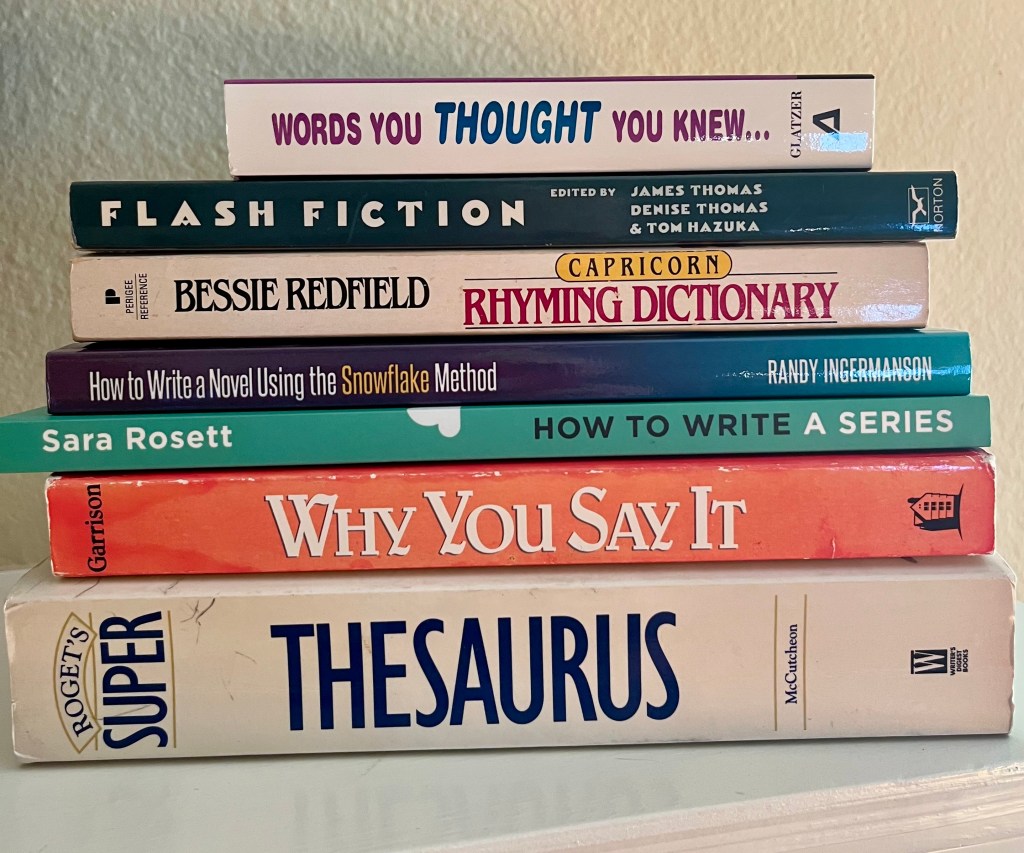
September Group Question: What book taught YOU the most about writing craft? What book would you RECOMMEND to other writers?
…
G. B. Pool: The book that taught me the most about writing was Aristotle’s The Poetics. I took a Philosophy course in college, and that was one of the books we read. Good ol’ Aristotle said there were Five Basic Elements in writing: Plot, Character, Dialogue, Setting, and the Meaning of the Story. I have covered each of these areas in numerous posts on Writers-in-Residence. I have also written a book on the very subject myself called The Anatomy of a Short Story, which covers those points. The points are good for short stories and novels. Without using each point in your work, you will be leaving a large hole in the story. So I thank Aristotle for his insight.
.
Jackie Houchin: My favorite book for learning the craft of writing novels (stories of any kind) is Save the Cat! Writes a Novel: The Last Book On Novel Writing You’ll Ever Need, by Jessica Brody. She has a series of “Save the Cat” books that might cover the genre you would like to write. The cover photo shows a cat hanging at the end of a rope. (I love it!)
The book reveals the 15 “beats” (plot points) that make up a successful story — from the opening image to the finale. It lays out Ten Story Genres alongside quirky, original insights (Save the Cat; Shard of Glass) to help novelists craft a plot that will captivate and sell. If you want to know how to START a novel or short story (and not a screenplay), this is a good book to buy. Yes, it may repeat things you’ve read in other books on writing, but it’s done in such a clever, easy-to-read way that you will learn easily.
And, NO, I didn’t buy the book because I like cats (although I do), but because of the easy-to-understand details on crafting a story.
…
Miko Johnston: Tough question, as I’ve found many books helpful in certain aspects of writing. Two that stand out are Sol Stein’s How To Grow A Novel, which taught me, among other things, the importance of a great beginning, and Noah Lukeman’s The First Five Pages, which laid the groundwork for creating a great opening. However, I strongly recommend reading well-written books, regardless of genre, and studying the author’s techniques. That always inspires me to write, and to write better.
…
Bonnie Schroeder: Stephen King’s On Writing taught me quite a bit. He certainly knows whereof he speaks.
…
Patty Smiley: No book on writing has clarified the process as clearly as Jack M. Bickham’s Scene & Structure: How to construct fiction with scene-by-scene flow, logic, and readability. Bickham argues that readers are threatened by change, which you must introduce at the book’s beginning. Readers also want a story question to worry about. For example, in the opening scene of my latest Justice Bay mystery, A Cold November Murder, Emma McCoy discovers a murder victim in a remote rural field. She recognizes him from a chance encounter the day before but doesn’t know his name. The problem is, no one else does either. Discovering a dead body changes her life and raises a story question: Will Emma identify the victim and help find who murdered him? By the end of the book, the story question must be answered.
Each scene also raises a question. Bickham defines a scene as an action sequence that mirrors a play performed on stage. In each scene, the writer should include: 1) Scene goal. 2) Conflict: who opposes your character in this scene and why. 3) Plot twists that turn the story in another direction or deepen the conflict. 4) Resolution, i.e., an answer to the scene question, which should not be yes. Possibilities are no, yes, but… (I’ll help you, but I want a favor in return), No, and furthermore (Never come here again or I’ll call the police). A sequel follows each scene. The sequel includes the following, though it doesn’t have to be long: Emotion: how the character feels after the scene. Thought: review, analysis, planning. Decision: a newly selected goal. Action: leads to a new scene
.
Linda Johnston: I know that this month we’re each supposed to tell the world about the books on writing that inspired us when we started out. Me? I really have nothing to suggest. I started reading, and writing, long ago to start my career. No book I read then particularly stands out.
My advice to aspiring writers? Check out the books my fellow writers here suggest. And what I did then, and suggest now? Join writing organizations in the genre(s) in which you want to write and learn all you can from the other writers there.
###
Thank you, ladies (members and guests) these suggestions are very helpful. I hope readers will learn from them and start writing quality books and stories for themselves.
.
Here are a few more:
1. Bird by Bird by Anne Lamott;
2. The Elements of Style by William Strunk Jr. and E. B. White;
3. Into the Woods by John Yorke;
4. The Mindful Writer by Dinty W. Moore.
NOTE: We hosted a guest poster who wrote about helpful books. Here’s the link, in case we missed any good ones this time that you may be interested in. “Do Writing Books Help?” by Jacqueline Vick https://thewritersinresidence.com/2010/01/29/do-writing-books-help/
ONE MORE came in this morning:
Rosemary Lord: For me, Lynn Truss’s book immediately comes to mind: EATS SHOOTS AND LEAVES! It’s a wonderful, humorous book about sloppy and careless grammar.
It reminds me of the actor Michael Caine when, as a young actor in a play, he and another actor found themselves laughing hysterically at his reading of a line written: “What’s that in the road ahead.” He (intentionally) read it aloud as “What’s that in the road? A head?”
,
,
,
,
Share this:


There are a lot of books on writing out there. Pick one or find one of your own. But most of all – write something. Reread it. Rewrite what doesn’t sound right to you. After all, you’re the one who has to be satisfied with the finish product. The more you write and read a few classic books and some modern books will let you see the possibilities out there, but first you have to get those words on paper. Write On!
LikeLiked by 1 person
That is practical advice, Gayle. You can read all you want about bettering your writing, but unless you ARE writing, it’s wasted time and money. Read, write, look to other experienced authors for help, write again … and hopefully publish!
LikeLiked by 1 person
Well, I missed the deadline for this post, but appreciate the suggestions my fellow bloggers have offered. I’ve read many of the non-fiction books on writing, but there are two authors whose fiction has taught me a lot about writing: Gillian Roberts’s Amanda Pepper series and Joan Smith’s Loretta Lawson series. Both series have compelling plots and characters. Gillian also wrote the non-fiction YOU CAN WRITE A MYSTERY.
LikeLiked by 1 person
Oh, Maggie, I forgot about Gillian Robert’s books!! I think I read all her mysteries, and I read and owned her instruction book as well – very good, simple and clear, IMO. Thanks for the reminder!
LikeLiked by 1 person
Maybe I’d better take a look at the books my fellow writers here have suggested–although I’m not sure, at this stage of my writing, that I’ll change much.
LikeLiked by 1 person
You may be surprised, Linda! haha.
LikeLiked by 1 person
All wonderful ideas. And I forgot about Carolyn See’s book ‘A Writer’s Life” … with all sort of helpful ideas, plus an important thought about making sure you meet and mingle with other writers: attend their book signings and lecture, seek them out, and especially at conferences….
LikeLike